

2026年最新の100%無料CRT-450日常練習試験には240問があります
CRT-450試験資料Salesforce学習ガイド
質問 # 102
Which three data types can a SOQL query return?
Choose 3 answers
- A. sObject
- B. O Long
- C. List
- D. Double
- E. dg Integer
正解:A、C、D
解説:
sObject:SOQL queries can return single or multiple records assObjectinstances.
List:SOQL queries often return results as aListofsObject.
Double:SOQL aggregate queries can return numeric data types likeDouble(e.g., COUNT, SUM).
Reference:SOQL Query Return Types
Incorrect Options:
B (Long):SOQL does not directly returnLongvalues.
D (Integer):Aggregate results useDouble, notInteger
質問 # 103
Managers at Universal Containers want to ensure that only decommissioned containers are able to be deleted in the system. To meet the business requirement a Salesforce developer adds "Decommissioned" as a picklist value for the Status _c custom field within the Container _c object.
Which two approaches could a developer use to enforce only Container records with a status of
"Decommissioned" can be deleted?
Choose 2 answers
- A. After record-triggered flow
- B. Validation rule
- C. Before record-triggered flaw
- D. Apex trigger
正解:B、D
解説:
Apex Trigger (Option B):
An Apex trigger can be written on theContainer__cobject to prevent deletion unless theStatus__cfield value is
"Decommissioned".
This allows custom logic to be executed during the deletion process.
Apex Triggers Documentation
Validation Rule (Option D):
A validation rule is typically used to enforce conditions during record creation or update. However, it cannot directly restrict deletions.
To ensure deletion restriction, an Apex trigger is more effective.
Not Suitable:
Option A(Before record-triggered flow): Flows triggered "before delete" are not available.
Option C(After record-triggered flow): These occur after a record is deleted, so they cannot prevent the deletion process.
質問 # 104
What are three considerations when using the @InvocableMethod annotation in Apex?
Choose 3 answers
- A. A method using the @InvocableMethod annotation can be declared as Public or Global. (Missed)
- B. A method using the @InvocableMethod annotation can have multiple input parameters.
- C. A method using the @InvocableMethod annotation must be declared as static (Missed)
- D. A method using the @InvocableMethod annotation must define a return value.
- E. Only one method using the @InvocableMethod annotqation can be defined per Apex class. (Missed)
正解:A、C、E
質問 # 105
Universal Containers stores the availability date on each Line Item of an Order and Orders are only shipped when all of the Line Items are available.
Which method should be used to calculate the estimated ship date for an Order?
- A. Use a CEILING formula on each of the latest availability date fields.
- B. Use a DAYS formula on each of the availability date fields and a COUNT Roll-Up Summary field on the Order.
- C. Use a LATEST formula on each of the latest availability date fields.
- D. Use a MAX Roll-Up Summary field on the latest availability date fields.
正解:D
質問 # 106
A developer creates a custom controller and a custom Visualforce page by using the code block below:
public class MyController {
public String myString {
get {
if (myString == null) { myString = 'a';
}
return myString;
} private set; } public string getMyString (){
return 'getMyString';
} public string getStringMethod () {
if (myString == null) {
myString = 'b';
} return myString;
}
} <apex:page controller = "MyController"> {!StringMethod}, {!myString}, {!myString} </apex:page> What can the user expect to see when accessing the custom page?
- A. A, a, a
- B. B, b, b
- C. B, a, getMyString
- D. A, b, getMyString
正解:A
質問 # 107
A developer wants to display all of the picklist entries for the Opportunity StageName field and all of the available record types for the Opportunity object on a Visualforce page. Which two actions should the developer perform to get the available picklist values and record types in the controller? Choose 2 answers.
- A. Use Schema.RecordTypeInfo returned by
Opportunity.SObjectType.getDescribe().getRecordTypeInfos(). - B. Use Schema.PicklistEntry returned by Opportunity.SObjectType.getDescribe().getPicklistValues().
- C. Use Schema.RecordTypeInfo returned by
RecordType.SObjectType.getDescribe().getRecordTypeInfos(). - D. Use Schema.PicklistEntry returned by Opportunity.StageName.getDescribe().getPicklistValues().
正解:A、B
質問 # 108
A business has a proprietary Order Management System (OMS) that creates orders from their website and fulfills the orders. When the order is created in the OMS, an integration also creates an order record in Salesforce and relates it to the contact as identified by the email on the order. As the order goes through different stages in the OMS, the integration also updates It in Salesforce. It is noticed that each update from the OMS creates a new order record in Salesforce.
Which two actions will prevent the duplicate order records from being created in Salesforce?
Choose 2 answers
- A. Write a before trigger on the order object to delete any duplicates.
- B. Ensure that the order number in the OMS is unique.
- C. Use the email on the contact record as an external ID.
- D. Use the order number from the OMS as an external ID.
正解:B、D
解説:
The problem of duplicate order records is caused by the integration not being able to identify the existing order record in Salesforce and creating a new one instead. To prevent this, the integration needs to use a unique identifier that can match the order record in both systems. The order number in the OMS can serve as such an identifier, if it is guaranteed to be unique and not reused. Therefore, the following actions can prevent the duplicate order records from being created in Salesforce:
* Option A: Ensure that the order number in the OMS is unique. This will ensure that there is no ambiguity or confusion when matching the order records in both systems.
* Option B: Use the order number from the OMS as an external ID. An external ID is a custom field that can be used to store a unique identifier from an external system. By using the order number from the OMS as an external ID, the integration can use the upsert operation to either insert a new order record or update an existing one based on the external ID value.
References:
* Trailhead: Data Modeling (1)
* Trailhead: Data Integration (2)
* Apex Developer Guide: Upserting Records (3)
質問 # 109
A developer in a Salesforce org with 100 Accounts executes the following code using the Developer console:Account myAccount = new Account(Name = 'MyAccount');Insert myAccount;For (Integer x = 0; x
< 150; x++)
{Account newAccount = new Account (Name='MyAccount' + x);try {Insert newAccount;} catch (Exception ex) {System.debug (ex) ;}}insert new Account (Name='myAccount');How many accounts are in the org after this code is run?
- A. 0
- B. 1
- C. 2
- D. 3
正解:C
質問 # 110
What are three characteristics of change set deployments?
Choose 3 answers Sending a change set between two orgs requires a deployment connection.
- A. Sending a change set between two orgs requires a deployment connection.
- B. Change sets can deploy custom settings data.
- C. Change sets can only be used between related organizations.
- D. Change sets can be used to transfer records.
- E. Deployment is done in a one-way, single transaction.
正解:A、C、E
解説:
Change sets can only be used between related organizations:
Change sets require a relationship between the source and target Salesforce orgs, such as a production org and its sandboxes. You cannot use change sets between unrelated Salesforce orgs.
Reference:Salesforce Change Set Overview
Deployment is done in a one-way, single transaction:
When a change set is deployed, it is applied to the target org as a single transaction. If there are any errors in the deployment, the entire transaction is rolled back.
Reference:Apex Development Guide
Sending a change set between two orgs requires a deployment connection:
Before sending or deploying a change set, a deployment connection must be established between the source and target orgs. This connection is configured in the setup menu under "Deployment Connections." Reference:Trailhead: Deployment Connections Incorrect Options:
A: Change sets can deploy custom settings data:
Change sets cannot deploy data, including custom settings data. They only move metadata.
E: Change sets can be used to transfer records:
Records (data) are not supported by change sets; they only facilitate metadata migration.
質問 # 111
When using SalesforceDX, what does a developer need to enable to create and manage scratch orgs?
- A. Production
- B. Environment Hub
- C. Dev Hub
- D. Sandbox
正解:C
解説:
When using SalesforceDX, a developer needs to enable Dev Hub in order to create and manage scratch orgs. A Dev Hub is a special type of org used by developers to store source code and other development-related artifacts. It is also used to create and manage scratch orgs, which are temporary orgs used for development and testing.
Reference: https://developer.salesforce.com/docs/atlas.en-
us.sfdx_dev.meta/sfdx_dev/sfdx_dev_intro.htm
質問 # 112
A developer created a trigger on a custom object. This custom object also has some dependent pick lists.
According to the order of execution rules, which step happens first?
- A. System validation is run for maximum field lengths.
- B. JavaScript validation is run In the browser.
- C. Old values are overwritten with the new record values,
- D. The original record is loaded from the database.
正解:B
解説:
According to the order of execution rules, the first step that happens when a record is saved is the JavaScript validation on the browser, if the record contains any dependent picklist fields. This validation limits each dependent picklist field to its available values. No other validation occurs on the client side. The other steps happen later on the server side, after the record is submitted to the server. References:
* Triggers and Order of Execution, Apex Developer Guide, Section: Triggers and Order of Execution
* Learn Salesforce Order of Execution, Salesforce Ben, Section: Order of Execution from Developer Docs API v54
質問 # 113
When importing and exporting data into Salesforce, which two statements are true?
Choose 2 answers
- A. Bulk API can be used to bypass the storage limits when importing large data volumes in development environments.
- B. Bulk API can be used to import large data volumes in development environments without bypassing the storage limits.
- C. Developer and Developer Pro sandboxes have different storage limits.
- D. Data import wizard is a client application provided by Salesforce.
正解:C、D
質問 # 114
Which statement generates a list of Leads and Contacts that have a field with the phrase 'ACME'?
- A. List<List <sObject>> searchList = [FIND '*ACME*" IN ALL FIELDS RETURNING Contact, Lead];
- B. List <sObject> searchList = [FIND '*ACME*' IN ALL FIELDS RETURNING Contact, Lead];
- C. List<List <sObject>> searchList = [SELECT Name, ID FROM Contact, Lead WHERE Name like
"tACME3"]; - D. Map <sObject> searchList = [FIND '*ACME*' IN ALL FIELDS RETURNING Contact, Lead];
正解:B
解説:
The correct statement is D, because it uses the SOSL syntax to search for the phrase 'ACME' in all fields of the Contact and Lead objects, and returns a list of sObjects that match the criteria. The other statements are incorrect because:
* A uses the SOQL syntax, which can only query one object at a time, and the LIKE operator requires a wildcard character (%) before and after the search term.
* B uses the SOSL syntax, but returns a list of lists of sObjects, which is not the expected output.
* C uses the SOSL syntax, but returns a map of sObjects, which is not the expected output. References:
* SOSL Syntax - Salesforce
* SOSL Statements - Salesforce
* SOQL and SOSL Reference - Salesforce
質問 # 115
Universal Containers decides to use purely declarative development to build out a new Salesforce application.
Which three options can be used to build out the business logic layer for this application?
Choose 3 answers
- A. Flow Builder
- B. Process builder
- C. Validation Rules
正解:A、B、C
質問 # 116
Which three resources in an Aura component can contain JavaScript functions? Choose 3 answers
- A. Controller
- B. Style
- C. Helper
- D. Design
- E. Renclerer
正解:A、C、D
解説:
A helper is a JavaScript resource that contains functions that can be reused by the component's controller or other helpers. A controller is a JavaScript resource that contains functions that handle user interactions and events in the component. A renderer is a JavaScript resource that overrides the default rendering behavior of the component. A style is a CSS resource that defines the appearance of the component. A design is an XML resource that specifies the design-time attributes for the component. References: Using JavaScript, Using External JavaScript Libraries In Aura Component, Expression Functions Reference
質問 # 117
A change set deployment from a sandbox to production fails due to a failure in a managed package unit test.
The developer spoke with the manager package owner and they determined it is a false positive and can be ignored. What should the developer do to successfully deploy?
- A. Select 'Run local tests' to run all tests in the org that are not in the managed package.
- B. Select 'Fast Deploy' to run only the tests that are in the change set.
- C. Select 'Run local tests' to run only the tests that are in the change set.
- D. Edit the managed package's unit test.
正解:A
質問 # 118
Which statement generates a list of Leads and Contacts that have a field with the phrase
'ACME'?
- A. List <sObject> searchList = [FIND '*ACME*' IN ALL FIELDS RETURNING Contact, Lead];
- B. List<List <sObject>> searchList = [FIND '*ACME*" IN ALL FIELDS RETURNING Contact, Lead];
- C. List<List <sObject>> searchList = [SELECT Name, ID FROM Contact, Lead WHERE Name like
"tACME3"]; - D. Map <sObject> searchList = [FIND '*ACME*' IN ALL FIELDS RETURNING Contact, Lead];
正解:B
質問 # 119
A software company is using Salesforce to track the companies they sell their software to in the Account object. They also use Salesforce to track bugs in their software with a custom object, Bug__c.
As part of a process improvement initiative, they want to be able to report on which companies have reported which bugs. Each company should be able to report multiple bugs and bugs can also be reported by multiple companies.
What is needed to allow this reporting?
- A. Roll-up summary field of Bug_c on Account
- B. Lookup field on Bug_c to Account
- C. Function object between Bug__c and Account
- D. Master-detail field on Bug_c to Account
正解:C
解説:
Many-to-Many Relationship:
To track which companies (Accounts) report which bugs and allow multiple associations for both, ajunction objectis needed.
This junction object will have two master-detail relationships: one toBug__cand one toAccount.
Why Not Other Options?
A: Roll-up summary field: Not suitable for many-to-many relationships.
B: Master-detail field on Bug__c to Account: Creates a one-to-many relationship, not many-to-many.
C: Lookup field on Bug__c to Account: Still creates a one-to-many relationship, not many-to-many.
References:Many-to-Many Relationships:https://developer.salesforce.com/docs/atlas.en-us.object_reference.
meta/object_reference/relationships_manytomany.htm
質問 # 120
A developer identifies the following triggers on the Expense _c object: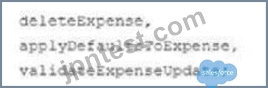
The triggers process before delete, before insert, and before update events respectively.
Which two techniques should the developer implement to ensure trigger best practices are followed?
Choose 2 answers
- A. Unify the before insert and before update triggers and use Flow for the delete action.
- B. Create helper classes to execute the appropriate logic when a record is saved.
- C. Unity all three triggers In a single trigger on the Expense__c object that Includes all events.
- D. Maintain all three triggers on the Expense __c object, but move the Apex logic out of the trigger definition.
正解:B、C
解説:
A: Unify all three triggers in a single trigger on the Expense__c object that includes all events:
Salesforce best practices recommend having only one trigger per object to avoid redundancy and conflicts.
By combining all the events (before delete, before insert, and before update) into a single trigger, the developer can manage the logic in an organized and maintainable manner.
This also simplifies debugging and ensures that the trigger logic executes in a predictable order.
C: Create helper classes to execute the appropriate logic when a record is saved:
Using helper classes allows for a clean separation of concerns. The trigger becomes a dispatcher that delegates logic to dedicated classes.
For example, you can create methods like applyDefaultsToExpense(), validateExpenseUpdate(), and deleteExpense() in a helper class and invoke them from the trigger.
This improves reusability, readability, and testability of the code.
Why not the other options?
B: Unify the before insert and before update triggers and use Flow for the delete action:
While Flow is a powerful tool, it is not ideal for deleting records or replacing Apex trigger functionality, especially when triggers already exist for other events.
D: Maintain all three triggers on the Expense__c object but move the Apex logic out of the trigger definition:
Maintaining multiple triggers on the same object can lead to conflicts and execution order issues, even if the logic is moved to helper classes.
References:
Trigger Best Practices
Trigger Design Patterns
質問 # 121
......
有効な問題最新版を試そうCRT-450テスト解釈CRT-450有効な試験ガイド:https://www.jpntest.com/shiken/CRT-450-mondaishu
CRT-450実際の問題解答PDFは100%カバー率でリアル試験問題:https://drive.google.com/open?id=1VjqQHdiq6n_CxJwmqi8pffSmNCqQ7rMM