

あなたを合格させるXSIAM-Engineer試験問題集で使おう(更新された436問があります)
XSIAM-Engineer試験問題集でPalo Alto Networks練習テスト問題
質問 # 32
An XSIAM deployment utilizes a custom data source for legacy security appliances that export logs in a unique, multi-line JSON format. A newly introduced log type from these appliances is failing ingestion, resulting in fragmented or truncated events in XSIAM. The custom XSIAM parsing rule is defined to handle multi-line events. Given the following snippet of a problematic log:
Which of the following is the most likely cause for the ingestion failure, and how should an XSIAM Engineer approach the fix?
- A. The JSON data contains invalid Unicode characters that XSIAM cannot parse. Convert the source logs to UTF-8 before sending them to the Collector.
- B. The XSIAM Collector's buffer is too small to handle large multi-line JSON events. Increase the collector's ingestion buffer size via configuration files.
- C. The multi-line log processing logic in XSIAM is not correctly identifying the end of an event. The presence of escaped newline characters ('In') within the 'message' field is confusing the parser, causing it to prematurely terminate the event. The XSIAM parsing rule needs a more robust 'multiline_regex' that explicitly identifies the start of a new JSON object ('A(S) or end of an event CAY).
- D. The custom data source mapping in XSIAM is attempting to parse the 'details.message' field as a single-line string, causing truncation. Modify the schema to handle multi-line strings or CLOB data types if available.
- E. The source appliance is sending events faster than the XSIAM Collector can process them, leading to dropped or truncated events. Implement flow control or reduce the sending rate on the source.
正解:C
解説:
This scenario highlights a common pitfall with multi-line parsing: internal newlines. If a multi-line parser relies on simple newline detection, an escaped newline C\n') within a field can trick it into prematurely cutting off an event. Option B correctly identifies this specific issue and proposes a robust 'multiline_regex' (e.g., matching the start of a new JSON object) to correctly delineate events. Option A is a general performance issue. Option C would lead to different parsing errors. Option D would cause complete drops, not fragmentation/truncation of specific events. Option E is about schema definition after parsing, not the initial ingestion and event boundary detection.
質問 # 33
A customer is planning to onboard a large volume of network device logs (e.g., firewalls, routers) into XSIAM, which generate syslog events. They aim to centralize log collection via on-premises Data Collectors. To optimize for high throughput, prevent data loss during network outages, and ensure secure communication end-to-end, what specific configurations and communication strategies should be implemented from the network devices to the Data Collectors, and from Data Collectors to the XSIAM Data Lake? (Select TWO correct answers)
- A. From network devices to Data Collectors: Use SNMP traps for event notification, as these are lightweight. From Data Collectors to Data Lake: Establish a dedicated VPN tunnel over which all data is transmitted unencrypted, relying solely on the VPN for security.
- B. From network devices to Data Collectors: Configure NetFlow/lPFlX collection on Data Collectors, as this protocol is more efficient than Syslog. From Data Collectors to Data Lake: Transfer data via SFTP batch jobs every hour.
- C. From network devices to Data Collectors: Deploy a local log forwarder (e.g., rsyslog, syslog-ng) configured to buffer logs to disk and forward them to the Data Collector via secure TCP, ensuring guaranteed delivery. From Data Collectors to Data Lake: Employ HTTPS (TCP port 443) with API Key authentication and enable Data Collector's local caching/queueing for burst handling and resiliency during intermittent connectivity issues.
- D. From network devices to Data Collectors: Use UDP Syslog (port 514) for maximum throughput, relying on network infrastructure to guarantee delivery. From Data Collectors to Data Lake: Configure standard HTTP POST with basic authentication.
- E. From network devices to Data Collectors: Implement Encrypted Syslog (Syslog-over-TLS, TCP port 6514), configuring certificates on both ends. From Data Collectors to Data Lake: Utilize HTTPS (TCP port 443) with mutual TLS authentication and Data Collector's internal queuing mechanism for resilience.
正解:C、E
解説:
Both B and D represent robust, secure, and resilient strategies for high-volume log ingestion. Option B Encrypted Syslog (Syslog-over-TLS) is the best practice for securing log transmission from sources to the Data Collector, providing both encryption and guaranteed delivery (TCP). For Data Collectors to Data Lake, HTTPS with mutual TLS provides strong authentication and encryption. Data Collector's internal queuing is crucial for handling bursts and temporary connectivity issues, preventing data loss. Option D Using a local log forwarder with disk buffering (e.g., rsyslog, syslog-ng) on the network devices side is an excellent way to ensure data persistence and reliable delivery to the Data Collector, especially for high volumes or during network interruptions. This acts as a robust first-hop. From Data Collectors to Data Lake, HTTPS with API Key (common for XSIAM) and enabling Data Collector's local caching/queueing are essential for resilience and high-volume ingestion. Why others are incorrect: A: UDP Syslog is unreliable and can lead to data loss. Basic HTTP POST is insecure. C: NetFlow/IPFIX is for flow data, not typically detailed syslog events. SFTP batch jobs introduce significant latency. E: SNMP traps are for alerts, not full logs. Transmitting unencrypted data over a VPN is poor practice, and relies solely on the VPN for security, which isn't always sufficient or granular.
質問 # 34
A security team needs to deploy Cortex XSIAM agents on highly sensitive Windows domain controllers. Due to the critical nature of these servers, minimal resource consumption and absolute stability are paramount. Which of the following installation and post- installation configurations represents the best practice to achieve this balance while maintaining essential security visibility?
- A. Install the agent with default settings and then, upon observing performance issues, manually create exclusions for every single process on the DC that shows high resource usage, leading to a reactive approach.
- B. Only install the XSIAM agent on member servers and not on domain controllers, as any EDR solution poses an unacceptable risk to AD stability. Rely on network-based security for DCs.
- C. Install the agent in 'monitoring-only' mode. Disable all network protection, malware prevention, and file analysis modules. Ensure kernel-level monitoring is off. This minimizes impact but severely limits security capabilities.
- D. Utilize XSIAM's 'Data Collection Profile' feature to customize what data is collected. For DCs, prioritize only authentication logs, process execution, and network connections to/from the DC, while reducing telemetry from other less critical activities.
- E. Deploy the agent with a dedicated 'Domain Controller' policy. This policy should include process and file exclusions for Active Directory databases (e.g., 'NTDS.DIT) and related binaries, disable suspicious network activity blocking, but retain full logging and behavioral analysis capabilities for critical system processes and authentication events.
正解:D、E
解説:
Both B and E are excellent strategies. Option B focuses on a dedicated policy with carefully planned exclusions. For domain controllers, excluding AD-related files and processes from real-time scanning is crucial to prevent corruption or performance issues. Retaining behavioral analysis and logging for critical system processes and authentication events ensures essential security visibility without aggressive prevention that could destabilize the DC. Option E further refines this by suggesting the use of Data Collection Profiles. This XSIAM feature allows for granular control over the type and volume of telemetry sent from agents. For critical servers like DCs, optimizing data collection to focus on high-value security events (authentication, process execution, network connections) reduces resource consumption and network bandwidth while still providing necessary insights. Option A is too extreme and compromises security. Option C is a security gap. Option D is reactive and inefficient.
質問 # 35
A Security Operations Center (SOC) using Palo Alto Networks XSIAM has implemented a new set of detection rules. After initial deployment, they observe a high volume of low-fidelity alerts for legitimate administrative activities, leading to alert fatigue. Which of the following content optimization strategies involving scoring rules would be most effective in mitigating this issue without completely suppressing valuable security alerts?
- A. Create a new scoring rule that assigns a lower reputation score to alerts originating from known, whitelisted administrative IPs or specific service accounts when associated with 'successful login' events, effectively reducing their overall criticality.
- B. Increase the severity score of all newly generated alerts across the board to ensure critical events are prioritized.
- C. Configure all alerts to automatically be suppressed for 24 hours after their initial generation.
- D. Disable all detection rules that are generating excessive alerts, regardless of their potential security value.
- E. Modify the global alert threshold in XSIAM to only show alerts with a score above 90, ignoring all others.
正解:A
解説:
Option B is the most effective content optimization strategy. By using scoring rules to assign lower reputation scores to known benign activities (e.g., successful logins from whitelisted administrative IPs), the overall criticality of these alerts is reduced. This helps in de-prioritizing noise without completely suppressing the underlying detection rules, allowing the SOC to focus on higher-fidelity threats. Option A would exacerbate alert fatigue. Option C would lead to significant blind spots. Option D is a temporary band-aid and could hide legitimate threats. Option E is too blunt and would likely miss important alerts below the arbitrary threshold.
質問 # 36 
- A.

- B.

- C.
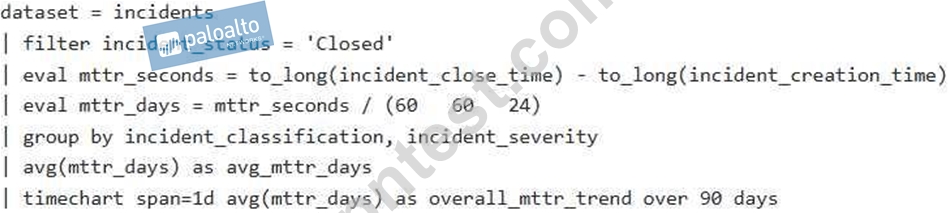
- D. Pre-built 'Incident Analytics' reports are sufficient; custom MTTR calculations are not necessary.
- E.

正解:C
解説:
質問 # 37
An organization is deploying a new web application and wants to ensure robust detection of common web-based attacks using XSIAM.
They have observed several attempts of SQL Injection and Cross-Site Scripting (XSS) during pre-production testing. To optimize their detection content, which of the following XSIAM content management strategies would be most effective for creating high-fidelity detection rules for these attack types, leveraging both IOCs and BIOCs?
- A. Rely solely on out-of-the-box XSIAM rules for web attacks, as they are generally comprehensive.
- B. Implement a simple keyword-based search in XSIAM for common SQLi keywords like 'SELECT FROM' and XSS keywords like '<script>'.
- C. Develop BIOC rules that analyze web server logs for unusual HTTP request parameters, abnormal response codes, and sequences of requests indicative of SQLi or XSS payloads, while also incorporating IOCs for known attack patterns.
- D. Create custom IOC rules based on known malicious IP addresses and URLs found in threat intelligence feeds related to web attacks.
- E. Configure network-based firewalls to block all traffic containing 'SQL' or 'XSS' in the payload.
正解:C
解説:
Option C is the most effective. While out-of-the-box rules (A) are a good starting point, custom rules are often needed for specific applications. IOCs (B) are good for known threats but won't catch novel or polymorphic attacks. Simple keyword searches (D) are prone to high false positives and evasion. Blocking all 'SQL' or 'XSS' (E) will undoubtedly break legitimate application functionality. Option C combines the strength of behavioral analysis (BIOCs) by looking at patterns and sequences that indicate an attack, which is crucial for SQLi and XSS, with the precision of IOCs for known attack signatures. This hybrid approach provides robust and adaptable detection.
質問 # 38
A global enterprise uses XSIAM for centralized security monitoring. They've discovered that highly critical but extremely noisy network device logs (e.g., connection resets, high-volume legitimate traffic) are consuming excessive Data Lake storage and impacting query performance, even after initial parsing. These logs contain useful metadata (source/dest IP, port, protocol) but most of the raw message content is irrelevant for long-term retention or immediate security analysis, yet is still stored. To optimize storage, reduce ingestion costs, and improve query efficiency without losing critical metadata, which Data Flow content optimization strategy is best?
- A. Use XSIAM's 'Summarization' feature to aggregate these logs into summary events, losing individual log details but retaining counts and basic statistics.
- B. Transform the raw log message content into a more compact, compressed format (e.g., Base64 encoded) before storing it in the Data Lake, and decompress it during XQL queries.
- C. Implement a project() operation early in the Data Flow to remove the large, irrelevant raw message field (e.g., event.message) after extracting all necessary metadata, ensuring only optimized fields are stored in the Data Lake.
- D. Configure a retention policy on the Data Lake specific to these log types, setting a very short retention period (e.g., 7 days) to limit storage consumption.
- E. Filter out these noisy logs entirely at the Data Collector level using a drop rule based on event type or source, losing all metadata.
正解:C
解説:
Option B is the most effective content optimization strategy for this scenario. By using a operation (or an implicit projection project ( ) by only keeping the fields you want), you explicitly select which fields are retained in the Data Lake. If the raw field is large and event . message largely irrelevant after parsing, removing it after extracting all necessary metadata (like source/dest IP, port, protocol) directly reduces storage consumption and improves query performance because XSIAM has less data to index and retrieve. This is content optimization at its core, as you're optimizing the content that is actually stored. Option A leads to data loss. Option C manages retention post-ingestion but doesn't optimize the ingested data itself. Option D might be useful for certain analytics but loses granular details required for specific threat hunting. Option E adds complexity and query overhead for decompression.
質問 # 39
An XSIAM deployment utilizes a robust custom role definition for its 'Threat Hunter' team. This role grants access to specific XQL queries, Alert Management, and Incident Management. However, a new compliance mandate requires that 'Threat Hunters' must NOT be able to export any raw log data from XSIAM, even if they can view it within the console. How would you enforce this granular restriction within XSIAM's RBAC model?
- A. Modify the underlying XSIAM database schema to disable export functionalities for specific user groups.
- B. Remove the 'Export Data' permission from the 'Threat Hunter' custom role definition. This permission is typically a distinct capability that can be toggled.
- C. Configure XSIAM's data retention policies to automatically purge raw logs for 'Threat Hunter' users after a short period.
- D. Implement a Data Loss Prevention (DLP) policy on the network perimeter to block XSIAM data exports for 'Threat Hunter' users.
- E. Create a new XSIAM tenant specifically for 'Threat Hunters' with no export capabilities, and restrict their access to the main tenant.
正解:B
解説:
XSIAM's role-based access control (RBAC) is designed with granular permissions. The ability to export data is typically a specific permission within the XSIAM platform that can be granted or denied as part of a custom role definition. To prevent 'Threat Hunters' from exporting raw log data, you would simply ensure that the 'Export Data' (or similar 'Download Data' / 'Export Raw Logs') permission is NOT included in their custom role. Option B is an external control, not an XSIAM RBAC solution. Option C addresses data retention, not export control. Option D is an over-engineered solution for this specific requirement, intended for full environment separation. Option E involves direct database modification, which is unsupported and highly risky.
質問 # 40
An XSIAM engineer is attempting to optimize existing detection content. They notice that a rule detecting 'Rare DNS Query to External IP' generates a lot of noise from legitimate cloud services. To fine-tune this, they plan to use a custom XQL query as part of a scoring rule to reduce the score for queries to known legitimate domains. Which of the following XQL query patterns, when used in a scoring rule's condition, would effectively identify and de-prioritize such alerts based on a predefined list of domains?
- A.

- B.

- C.

- D.

- E.

正解:D
解説:
Option D is the most appropriate XQL pattern for a scoring rule. Scoring rules operate on the alert object itself. The 'alert' dataset (implicitly, or explicitly in some contexts for enriched alerts) contains fields like and Using 'endsWith" or 'contains' with domain patterns allows for flexible matching against subdomains, which is common for cloud services. Option A queries raw XDR data, not the alert object. Option B is syntactically plausible but containS is less precise for domain matching than 'endsWith'. Option C attempts a join which is not typically needed or directly supported for simple alert field checks within a scoring rule condition. Option E is a configuration change, not an XQL query for a scoring rule.
質問 # 41
A Security Orchestration, Automation, and Response (SOAR) playbook in XSOAR (now part of Cortex XSOAR) is failing consistently at a specific task. The playbook attempts to fetch threat intelligence data from a custom API endpoint, process it, and then update a security incident in XSIAM. The error message in the XSOAR logs is 'Error: Failed to parse API response. Expected JSON, received HTML.' Which of the following debugging strategies would be most effective in quickly identifying the root cause?
- A. Utilize the XSOAR 'Debugger' feature to step through the playbook execution, specifically inspecting the output of the API call task for the exact raw response received.
- B. Review the custom API server's access logs to check if the request from XSOAR reached it and what response it sent.
- C. Inspect the XSOAR integration's configuration for the custom API endpoint to ensure the 'Content-Type' header is set to 'application/json'
- D. Temporarily add a 'print' or command immediately after the API call in the playbook to output the raw response body, then re-run the playbook.
- E. Check the XSIAM incident for any partial updates or error messages related to the playbook's execution.
正解:A、D
解説:
The error message 'Expected JSON, received HTML' strongly suggests the API call itself is returning an unexpected format. While checking the 'Content-Type' (A) and server logs (C) are valid debugging steps, the most effective and immediate way to see what was actually received by XSOAR is to inspect the raw response within the playbook's execution context. The XSOAR Debugger (B) allows for interactive inspection of task outputs, and adding a 'print' or 'log' command (D) achieves a similar goal by outputting the raw data. Both B and D directly address the core issue of understanding the malformed response. Option E is less direct for identifying the root cause of the API parsing error.
質問 # 42
You are debugging an XSIAM setup where a critical 'DLP Exfiltration' alert (base score 85) is occasionally being scored much lower, sometimes as low as 30. You suspect an issue with a 'data sensitivity' field, which can be 'Public', 'Confidential', or 'Secret', affecting scoring. You examine the following simplified XQL snippet from a problematic scoring rule:
Assuming this XQL logic is being applied within a scoring rule's action. What are the potential issues with this approach or the expected outcome if an alert with 'data_sensitivity = 'Public'' and base score 85 processes through this rule?
- A. The 'final_score' alias is only for internal calculation within the XQL query. It will not actually update the 'alert.score' field, leading to no visible change in the alert's score.
- B. The logic is sound, but the 'score 1.0' for 'Secret' data implies no score change, which might be a misconfiguration if 'Secret' data should actually boost the score.
- C. The XQL 'if function is designed for filtering, not for dynamic score modification within a scoring rule's 'Action' field. This rule would likely fail to apply any score change.
- D. If 'data_sensitivity' is 'Public', the score will correctly become 42.5. The issue is likely another rule overriding this. The XQL itself is valid for score adjustment.
- E. The provided XQL fragment is too simplistic for a 'Set Total Score' action, and typical XSIAM scoring rules use discrete 'Additive' or 'Multiplicative' actions per condition, not complex inline XQL 'if statements for direct score manipulation.
正解:A、C、E
解説:
This question highlights several common pitfalls or misconceptions about how XSIAM scoring rules are configured, especially at a 'Very tough' level, assuming direct UI configuration and not backend API manipulation. Option A (Correct): The ' if function within an XQL query is primarily for conditional logic within the query's processing stream (e.g., for creating new fields or filtering). Directly placing this kind of XQL 'if statement for score modification in the 'Action' field of a scoring rule (which typically expects 'Additive', 'Multiplicative', or 'Set Total Score' with a fixed value or simple reference) is generally not how XSIAM's scoring rule configuration works. It would likely result in an error or the rule failing to apply any score change as intended. Option C (Correct): Even if the XQL itself was valid for execution, creating an alias like 'as final_score' within a subquery or a transformation does not automatically update the 'alert.score' attribute that the XSIAM platform uses for display and prioritization. To modify 'alert.score' , you need to use the specific 'Actions' provided by the scoring rule engine C Additive Score Change', "Multiplicative Score Change' , 'Set Total Score'). Option E (Correct): This sums up the primary issue. XSIAM's scoring rules, when configured through the UI, generally expect discrete conditions and then specific, predefined actions for score modification (Additive, Multiplicative, Set Total Score with a single value). They do not support embedding complex, multi-conditional XQL directly to calculate and apply a score. For such dynamic, conditional scoring, you would typically use multiple separate scoring rules, each with its own condition and a simple 'Additive' or 'Multiplicative' action, or potentially a 'set Total Score' in combination with an XQL lookup to fetch the desired final score from a table. The provided XQL is more suited for a detection rule's query or a standalone enrichment query, not a scoring rule's action. Option B: Incorrect. While 42.5 is the correct mathematical result of 85 0.5, the XQL itself is not applied in the way needed to achieve this as a scoring rule action. Option D: Incorrect. While a 'score 1 for 'Secret' data might seem like a misconfiguration, it's a separate issue from the fundamental problem of the XQL logic not being applicable in a scoring rule's action. The primary issue is the mechanism of score application, not the specific values.
質問 # 43
A security operations center (SOC) is migrating from a traditional SIEM to Palo Alto Networks XSIAM. They currently process 5 TB of security events daily, with an average of 100,000 security incidents per month requiring detailed investigation. The SOC analysts frequently perform ad-hoc queries spanning several months of data to identify sophisticated attack patterns. Considering the XSIAM architecture, what is the most critical hardware requirement to ensure optimal query performance for these analytical workloads?
- A. Ensuring the underlying storage infrastructure provides extremely low latency and high IOPS for random read operations across large datasets.
- B. Utilizing specialized network interface cards (NICs) with offloading capabilities for log parsing.
- C. Deploying the XSIAM cluster on bare-metal servers with direct-attached storage (DAS) for minimal latency.
- D. Provisioning a dedicated hardware security module (HSM) for encryption key management.
- E. Maximizing RAM capacity on all XSIAM cluster nodes to cache historical query results.
正解:A
解説:
Ad-hoc queries spanning months of data require rapid access to potentially massive datasets. This directly translates to the need for storage with extremely low latency and high IOPS for random read operations (C). While RAM (A) is important, it's primarily for active working sets, not caching historical results over months. Bare-metal (B) can offer performance benefits, but it's not the single most critical factor for query performance compared to storage characteristics. HSMs (D) are for security, not direct query performance. NIC offloading (E) is for ingestion efficiency, not query performance.
質問 # 44
An XSIAM engineer is troubleshooting a scenario where endpoint-based threat detections are occurring, but the correlated network flow data in XSIAM for those specific endpoints is incomplete or missing, hindering comprehensive investigation. The organization uses Palo Alto Networks NGFWs and Cortex XDR agents. Which of the following potential root causes and corresponding troubleshooting steps should the engineer investigate, and why?
- A. Root Cause: XSIAM's data retention policy for network flow data is shorter than for endpoint data, causing older flow data to be purged. Troubleshooting: Review and adjust the data retention settings for network flow data in XSIAM to match investigation requirements.
- B. Root Cause: The endpoints in question are bypassing the NGFW (e.g., direct internet access, VPN exclusion). Troubleshooting: Review network architecture and firewall policies to ensure all relevant endpoint traffic is inspected by the NGFW and logs are generated.
- C. Root Cause: The Cortex XDR agents are configured in 'Forensics Only' mode, which doesn't send real-time network connection data. Troubleshooting: Change the XDR agent profile to 'Full Protection' or 'Standard' mode to ensure continuous network telemetry is collected.
- D. Root Cause: The NGFW is not configured to send traffic logs to the correct XSIAM ingestion profile. Troubleshooting: Verify NGFW log forwarding profiles and ensure the appropriate log types (e.g., Traffic, Threat) are being sent to the XSIAM collector/data lake.
- E. Root Cause: The XSIAM Broker VM responsible for NGFW log ingestion is offline or experiencing resource exhaustion. Troubleshooting: Check the Broker VM's status and resource utilization in the XSIAM console, and restart or scale up if necessary.
正解:A、B、C、D、E
解説:
This is a complex troubleshooting scenario involving multiple potential points of failure, which requires a systematic approach.
All listed options are plausible root causes and valid troubleshooting steps: A. Root Cause: NGFW Log Forwarding (Correct): This is a primary suspect. If the NGFW isn't configured to send its traffic logs (which contain network flow data) to XSIAM, then XSIAM won't have the data. Troubleshooting involves verifying the NGFW's log forwarding profiles. B. Root Cause: Cortex XDR Agent Configuration (Incorrect): While the XDR agent does collect network connection data, the question specifically refers to 'network flow data' (implying NGFW/network device logs) correlated with endpoint detections. If XDR detections are occurring, the agent is sending some telemetry. The agent mode affects endpoint-level network visibility, but wouldn't explain missing NGFW network flow data . C. Root Cause: Broker VM Issues (Correct): If NGFW logs are forwarded via a Broker VM (common for on-premise deployments), then an issue with the Broker VM (offline, resource exhaustion) would directly impact log ingestion. Checking its status and resources is crucial. D. Root Cause: Network Bypass (Correct): If endpoint traffic doesn't pass through the NGFW, the NGFW won't generate logs for that traffic, resulting in missing network flow data in XSIAM. This points to a network architecture or policy misconfiguration. E. Root Cause: Data Retention Policy (Correct): XSIAM has configurable data retention. If network flow data has a shorter retention period than endpoint data, older investigations will find correlated network data missing because it has been purged. Adjusting retention is the solution.
質問 # 45
Your XSIAM deployment is integrated with an external vulnerability management system. A recent scan has identified several legitimate, but unpatched, internal web servers that are generating 'Web Application Vulnerability Detected' alerts from an XSIAM Correlation Rule. Due to business constraints, these servers cannot be patched immediately. You need to create an exclusion that dynamically adapts to new web server deployments within a specific subnet (172.16.10.0/24) while still alerting on any other web application vulnerabilities outside this specific, known-vulnerable context. Which XSIAM exclusion configuration snippet, applied to the 'Web Application Vulnerability Detected' rule, would achieve this? Assume and are relevant fields.
- A.
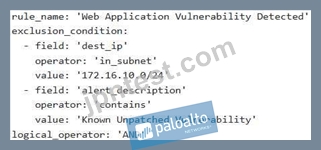
- B.

- C.
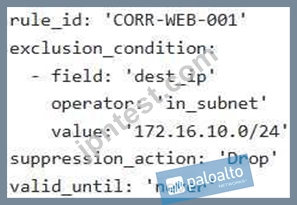
- D.
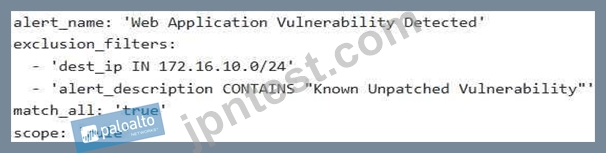
- E.

正解:E
解説:
Option D accurately reflects the likely structure and fields for creating an exclusion in XSIAM that targets a specific detection rule and applies conditions to the events themselves Cevent_filter'). The use of for subnet matching and 'CONTAINS' for text matching within the 'event_filter' is crucial for dynamically excluding all servers in that subnet with a specific vulnerability description, without requiring manual updates for new servers. This ensures the rule is still active for other vulnerabilities or IPs. Options A and C use non-standard or generic exclusion syntax. Option B lacks the specific alert description condition, making it too broad. Option E is more akin to a general suppression rule rather than a direct rule exclusion and modifies severity, which is not the primary goal.
質問 # 46
Consider the following XSIAM playbook action snippet intended to update an incident artifact. An engineer reports that while the playbook runs without errors, the incident artifact is not being updated as expected.
Which of the following is the most likely reason for the incident artifact not being updated with the new 'threat_score' and 'last_seen' fields?
- A. Option A
- B. Option E
- C. Option B
- D. Option D
- E. Option C
正解:E
解説:
While 'D' (empty enrichment_result) would prevent data from being added, and 'A' (incorrect operation) could cause issues, the most fundamental reason for custom fields not being updated or appearing is that they haven't been properly defined in the XSIAM data model. For custom fields like 'threat_score' or 'last_seen' to be associated with an artifact type (like 'IP Address'), they must be explicitly defined in a Content Pack as part of the artifact's schema. Without this definition, XSIAM doesn't know how to store or display these new fields, even if the playbook attempts to set them. The 'append' operation for artifacts typically adds a new artifact if not found or updates its labels if found; for existing artifact's fields_, the fields themselves need to exist in the schema.
質問 # 47
You are tuning an XSIAM indicator rule to detect suspicious use of 'PsExecs for lateral movement. The current rule filters for:
However, the Red Team has shown that attackers are now renaming 'PsExec.exe' to arbitrary names (e.g., 'tools.exe', 'serv.exe'). To counter this obfuscation, what modifications are required for a high-fidelity indicator rule? (Select all that apply)
- A. Develop a behavioral rule instead that looks for the characteristic network traffic patterns or service creation behaviors associated with 'PsExec' (e.g., SMB/IPC$ connections, service 'PSEXECSVC').
- B. Modify the rule to filter on = 'PsExec.exe'' instead of 'process_name' , as this field often persists the original name despite renaming.
- C. Include contains 'PsExec.exe" as an additional filter, assuming the command line might still reference the original name even if the executable is renamed.
- D. Add a filter for 'sha256_hash' matching known malicious 'PsExec' hashes from threat intelligence feeds.
- E. Use a 'regex' on to detect patterns indicative of 'PsExec' usage, such as \ADMIN\. or ' followed by a command, even if the executable name is changed.
正解:A、B、D、E
解説:
To effectively detect renamed PsExec, a multi-faceted approach is required: A: This is a highly effective field because it often stores the original filename embedded in the executable's metadata, regardless of renaming. This is a primary and very strong indicator. B: Leveraging known hashes from threat intelligence is critical for catching specific malicious variants, including renamed ones. This provides a direct match to known bad. D: Behavioral Rule: While the question focuses on 'indicator rules', for advanced threats like PsExec, behavioral detection is superior. PsExec has distinct behavioral patterns (SMB/IPC$ connections, specific service creation). A behavioral rule can detect these underlying actions irrespective of the executable name. E: 'regex' on PsExec's command-line arguments often follow predictable patterns (e.g., targeting administrative shares 'ADMINS or 'CS). Using regex to match these patterns can detect PsExec activity even when the executable itself is renamed. Option C is less reliable; attackers often ensure the command line doesn't expose the original name. While sometimes useful, it's not as robust as the other options for renamed executables.
質問 # 48
During the planning phase for a Palo Alto Networks XSIAM deployment, an organization discovers that their existing data center infrastructure utilizes an older Fibre Channel SAN that caps out at 8 Gbps and has an average latency of 5ms. The proposed XSIAM deployment requires a sustained ingress rate of 2 TB/hour and supports complex queries on historical data up to 6 months old. What is the most significant hardware-related challenge presented by the existing infrastructure, and how should it be addressed?
- A. The SAN's limitations will primarily affect cold data archiving. Implement a separate, faster storage solution for archival purposes.
- B. The Fibre Channel SAN is incompatible with XSIAM's Linux-based operating system. Migrate all data to a new NFS or SMB share.
- C. The 8 Gbps Fibre Channel SAN is insufficient for the ingress rate. Upgrade the SAN to 16 Gbps or 32 Gbps Fibre Channel, or transition to a high-speed iSCSI/NVMe-oF network.
- D. The 5ms latency of the SAN is acceptable for data ingestion but will severely impact historical data query performance. Implement local NVMe SSDs on XSIAM nodes for hot data and leverage the SAN for warm data.
- E. The current SAN cannot support the parallel processing capabilities of XSIAM. Re-architect the entire data center network to a leaf-spine topology with 100 GbE connections.
正解:C
解説:
An 8 Gbps Fibre Channel SAN provides approximately 800 MB/s throughput. A sustained ingress rate of 2 TB/hour is roughly 555 MB/s, which might seem feasible, but this doesn't account for peaks, overhead, or concurrent query demands. Furthermore, XSIAM's performance relies heavily on fast I/O. The 5ms latency is also a concern, especially for queries. However, the most significant challenge stated directly related to hardware is the insufficiency of the SAN for the required throughput for both ingestion and query. Upgrading the SAN (A) or migrating to modern high-speed storage networking protocols (NVMe-oF) is the direct solution to address the throughput and latency limitations for a performant XSIAM deployment. While latency (B) is a concern, the 8Gbps throughput is a more fundamental bottleneck for the given ingestion rate and query patterns.
質問 # 49
An XSIAM administrator is reviewing the audit logs for user activity and notices suspicious API calls originating from a compromised service account. The API key associated with this service account has 'Security Operations Center - Admin' permissions. The immediate action is to revoke the compromised API key. Which of the following XSIAM commands or API operations would be used to revoke a specific API key, assuming you have the necessary administrative privileges?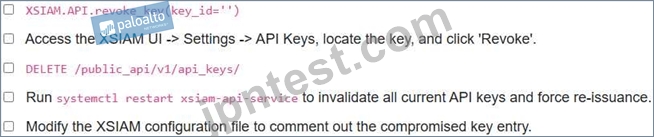
- A. Option A
- B. Option E
- C. Option D
- D. Option C
- E. Option B
正解:D、E
解説:
Both the XSIAM UI and the XSIAM API provide mechanisms to revoke API keys. Option B describes the direct IJI approach, which is straightforward for administrators. Option C describes the typical REST API approach for deleting a resource, where DELETE requests are used to revoke or remove API keys. Option A is a pseudocode function call that might be part of an SDK, but not a direct API endpoint. Option D is an extreme measure that would disrupt all API integrations and is not the targeted way to revoke a single key. Option E is an unsupported and dangerous method of configuration management.
質問 # 50
......
Palo Alto Networks XSIAM-Engineer 認定試験の出題範囲:
| トピック | 出題範囲 |
|---|---|
| トピック 1 |
|
| トピック 2 |
|
| トピック 3 |
|
| トピック 4 |
|
最新でリアルなXSIAM-Engineer試験問題集解答:https://drive.google.com/open?id=1P45Uxdos57IGgbQOv7xO7vGHF2Vz1C9_
あなたをお手軽に合格させるXSIAM-Engineer試験正確なPDF問題:https://www.jpntest.com/shiken/XSIAM-Engineer-mondaishu