

リリースHP HPE7-A07更新された問題PDF
HPE7-A07問題集と練習テスト(70試験問題)
HP HPE7-A07 認定試験の出題範囲:
| トピック | 出題範囲 |
|---|---|
| トピック 1 |
|
| トピック 2 |
|
| トピック 3 |
|
| トピック 4 |
|
| トピック 5 |
|
| トピック 6 |
|
| トピック 7 |
|
質問 # 19
A customer's infrastructure is set up to use Doth primary and secondary gateway clusters on the SSID profile What is a valid reason for the AP to failover to the secondary gateway cluster?
- A. The secondary gateway cluster is homogeneous.
- B. The primary gateway cluster is up. out the AP is unable to reach the primary gateway cluster.
- C. The secondary gateway cluster is heterogeneous.
- D. The secondary gateway cluster is up. hut the AP is unable to reach the secondary gateway cluster
正解:B
解説:
In Aruba's infrastructure, the Access Points (APs) are configured with primary and secondary gateway clusters to ensure connectivity and resiliency. The APs will failover to the secondary gateway cluster if they are unable to reach the primary gateway cluster, even if the primary cluster is operational. This mechanism ensures that the APs maintain connectivity to the network infrastructure for continuous service delivery.
質問 # 20
You deployed UBT tosecurely tunnel traffic from user desktop PCs connected behind VOIP phones Ail other non-UBT dents are connected to a different network. After the deployment users reported interruptions lo their phone service
- A. The UBT client broadcast/multicast packets returned to the same switch port and corrupted the phones IMC table
- B. Broadcast/multicast packets are copied to both the tunnel and locally, causing duplicate packets and network instability
- C. The VLAN on which UBT clients are placed is not configured on the switch uplink and traffic from the VoIP phones is being dropped
- D. You tailed to correctly configure a user-defined VRF to support the UBT clients behind the VoIP phones, causing traffic to drop.
正解:C
解説:
If users report interruptions to their phone service after the deployment of User-Based Tunneling (UBT), it can be due to the VLAN designated for UBT clients not being configured on the switch uplink. As a result, traffic from VoIP phones, which may be trying to use the same VLAN, could be dropped, leading to service interruptions. Ensuring that the VLAN is properly configured on the switch uplink is crucial for the seamless operation of UBT clients and VoIP services.
質問 # 21
Exhibit.
Which statement is true?
- A. The SSID is supports 6 GHz clients.
- B. The SSID supports 802 11ac clients.
- C. The SSID supports HR-DSSS data rates
- D. The SSID supports 802 11ax clients.
正解:D
解説:
The exhibit shows that the SSID supports 802.11ax clients, which is indicated by the presence of HT (High Throughput) information, VHT (Very High Throughput) capabilities, and HE (High-Efficiency) operation, which are all features associated with 802.11ax, also known as Wi-Fi 6.
質問 # 22
A customer has deployed anAOS 10 mobilitygateway cluster consisting of three controllers at a single site The WLAN is configured to tunnel wireless device traffic to the AOS 10 mobilitycluster.The clients areauthorized to use WPA2-Personal.An end-userhas opened a ticket with the helpdesk stating they cannot connect their client device to the network.There are other devices currently associated with the SSID with no issues.
Reviewing the output, what Is the issue?
- A. The client device has an invalid pre-shared key.
- B. The client device has an invalid certificate
- C. transition mode is not enabled
- D. The RADIUS response from the authentication server is
正解:A
解説:
The issue indicated by the output is an invalid pre-shared key (PSK). The logs show multiple failures during the WPA2 key exchange process, which points to a mismatch between the PSK configured on the client device and the PSK expected by the AOS 10 mobility gateway.
質問 # 23
An administrator is creating a fabric withNetConductor in HPE Aruba Networking Central Considering an EVPN VXLAN fabric, click on the most appropriate layer to be configured as a Rome-Reflector Persona.
正解:
解説:
Explanation:
In the context of an EVPN VXLAN fabric, the Route-Reflector Persona is most appropriately configured at theServices Aggregationlayer. This layer is responsible for interconnecting different network services and typically includes more robust, higher-capacity devices capable of handling the route-reflection functions for EVPN VXLAN.
In an Aruba Networks fabric, route reflectors are used to optimize the distribution of BGP routes. The Services Aggregation layer, which is centrally located in the network topology, is best suited for this role due to its high availability and ability to efficiently manage routes between the core and access layers.
Therefore, if you were to click on the image provided, you would select the Services Aggregation layer to configure the Route-Reflector Persona.
質問 # 24
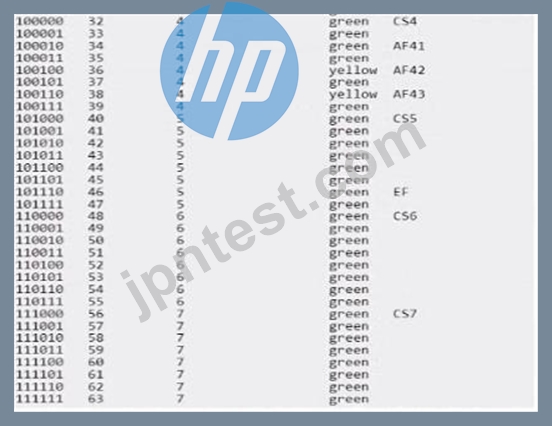
The ACME company has an AOS-CX 6200 VSF switch slack with an uplink over subscription ratio of 9.6:1.
They have indicated that their low-priority TCP traffic has been flagged with a DSCP marking coloring them yellow.
Refer to the exhibit.

They are considering adding two more nodes to thestack without adding any additional uplinks due to existing wiring constraints.One of their architects has suggested adding the following configuration:
What would be the impact of applying the acmethreshold profile as shown? (Select two.)
- A. All TCP traffic egressing LAG1 wail be subject to drop probability
- B. VoIP packets egressing any queue on LAG1 will more likely be protected from uplink over-utilization
- C. Only VoIP packets egressing queue 5 on LAG1 will likely be protected from uplink over-utilization.
- D. All upper-layer protocol traffic egressing LAG1 will be subject to drop probability.
- E. Yellow-flagged TCP traffic egressing LAG1 will be subject to drop probability
正解:D、E
解説:
Applying the 'acmethreshold' profile as shown in the exhibit would set a minimum and maximum threshold for queue 0, which affects the drop probability for traffic that exceeds these thresholds. The yellow marking indicates a medium drop precedence, so yellow-flagged traffic would be more likely to be dropped when congestion occurs, and the uplink is over-utilized. This action is intended to protect higher-priority traffic, such as VoIP, by giving it a lower probability of being dropped.
質問 # 25
A customer wan a gateway connected to a device on gigabitethernet0/0/3 configures an Asset ID TLVon the device for inventory management.
Exhibit.
The customer mentions me Asset ID is not shown What is causing the issue?
- A. Unknown TLVs cannot be displayed.
- B. MTU size is too small.
- C. LLDP TX is not enabled.
- D. LLPD-MED needs to be enabled.
正解:A
解説:
The issue is that unknown TLVs (Type Length Values) cannot be displayed. LLDP (Link Layer Discovery Protocol) is used to share device information with network neighbors, but if a TLV is not recognized by the LLDP implementation on the gateway, it won't be displayed or processed. Hence, the Asset ID TLV set on the device for inventory management is not showing up because it is unrecognized or unsupported by the gateway's LLDP.
質問 # 26
A customer's infrastructure is set up to use both primary and secondary gateway clusters on the SSID profile cased on best practices. Why do they have an equal split of their 120 APs across the primary and secondary gateway clusters?
- A. The primary and secondary gateway clusters are up. and the cluster preemption is enabled
- B. The primary gateway cluster is a heterogeneous cluster with six nodes.
- C. The secondary gateway cluster is a homogeneous cluster with six nodes.
- D. The primary and secondary gateway clusters are up. but the cluster preemption Is not enabled
正解:D
解説:
When cluster preemption is not enabled, access points (APs) will not automatically fail back to the primary gateway cluster once it is up again after having failed over to the secondary. This would result in an equal split of APs across primary and secondary clusters if both clusters are operational. Without preemption, there's no automatic rebalancing of APs back to the primary cluster, leading to the current distribution.
質問 # 27
A customer is planning to add loT devices that connect wirelessly to the existing 802.1X SSlD. The customer will use ClearPass to authenticate the IoT devices by MAC address but other devices will still need to authenticate by only 802 1X Exhibit.
The customer provided the current configuration and reported their non-loT 802. IX devices are no longer able to connect. Which configuration change can be made to fix the issue?
- A. Remove mac-authentication from the WLAN configuration
- B. Add i2-autn-fairtnrougn to the WLAN configuration
- C. Modify max-authentication failures to 0.
- D. Modify opmode wpa3-aes-gcm-256 to opmode wpa2-aes
正解:A
解説:
The existing configuration for the WLAN ssid-profile has enabled MAC authentication which, while suitable for IoT devices that may not support 802.1X, can interfere with the normal 802.1X authentication process for other devices. By removing themac-authenticationdirective from the WLAN configuration, the non-IoT
802.1X devices should be able to connect without issues as the authentication process will not be disrupted by MAC authentication checks. This adjustment ensures that the WLAN ssid-profile is correctly aligned with the authentication requirements for both IoT and non-IoT devices within the network environment, conforming to the best practices for mixed-device WLAN configurations.
質問 # 28
A customer is evaluating device profiles on a CX 6300 switch. The test device has the following attributes:
* MAC address = 81:cd:93:13:ab:31
* LLDP sys-desc = iotcontroller
The test device is being assigned to the ''lot-dev'' role However, the customer requires the "lot-prod'' role be applied.
Given the configuration, what is causing the "iot-dev" role to be applied to the device'?
- A. The LLDP system description matches the IIdp-group configuration.
- B. An external RADIUS server is unreachable.
- C. The device-profile precedence order is not configured.
- D. The test device does not support CDP.
正解:A
解説:
In device profile configuration, the device role is often determined by matching attributes such as MAC address, LLDP system description, and CDP information against defined conditions. The test device is being assigned the "iot-dev" role because its LLDP system description matches the 'iot-lldp' group configuration that is associated with the 'iot-dev' role.
質問 # 29
Exhibit.
A network administrator attempts to improve multicast traffic flow and performs some packet captures for validation What can the network administrator conclude from the results?
- A. The type flew remains consistent because Dynamic Multicast Optimization (DMO) was configured.
- B. The data rate increased from 6 Mops to 300 Mops because Broadcast Multicast optimization (BCMCO) was configured.
- C. The capture taken after optimization does not show a packet length because Multicast Transmission Optimization was configured.
- D. The data rate increased from 6 Mbps to 300 Mops because Dynamic Multicast Optimization (DMO) was configured.
正解:D
解説:
Dynamic Multicast Optimization (DMO) is a feature that enhances the delivery of multicast traffic by optimizing the data rate. The before and after optimization images show a significant increase in the data rate, which is a typical result of DMO being configured, as it allows multicast traffic to be transmitted at higher data rates by converting multicast streams into unicast streams for the clients that need them.
質問 # 30
in a WLAN network with a tunneled SSID. you see the following events in HPE Aruba Networking Central:
The customer asks you to investigate log messages What should you tell them?
- A. There is a roaming issue Enable Fast Roaming 802.11r and OKC to resolve the issue.
- B. This indicates a client WLAN driver issue for the client with a MAC address ending with 37:18
:Od. You should upgrade the client WLAN driver. - C. This indicates a security issue. The client with a MAC address ending with 37 18;0d Is performing a Denial-of-Service attack on your network. You should track down the client and remove it from the network.
- D. This is normal, expected behavior. No further actions are needed.
正解:D
解説:
The event log showing PMK (Pairwise Master Key) and OKC (Opportunistic Key Caching) key add/update and delete operations is indicative of normal client behavior in a WLAN environment. These events are part of the standard process for maintaining client session security and do not necessarily indicate any issue.
質問 # 31
An OSPF router has learned a pain 10 an external network by Doth an E1 and an E2 advertisement Both routes have the same path cost Which path will the router prefer?
- A. The router will prefer the E2 path.
- B. The router will prefer the E1 path.
- C. The router will use Doth paths equally utilizing ECMP.
- D. Both routes will be suppressed until the path conflict has been resolved.
正解:B
解説:
In OSPF, when a router learns about an external network through both E1 and E2 advertisements, and if both have the same path cost, the router will prefer the E1 path. This is because E1 routes consider both the external cost to reach the external network and the internal cost to reach the ASBR, providing a more comprehensive metric. E2 routes only consider the external cost and ignore the internal cost to the ASBR, which could potentially lead to suboptimal routing. Therefore, the router will choose the E1 path due to its more accurate representation of the total path cost.
質問 # 32
You recently added ClearPass as an authentication server to an HPE Aruba Networking Central group.
RADIUS authentication with Local User Roles (LUR) works fine Out the same access points cannot use Downloadable User Roles (DUR).
What should he corrected in this configuration to fa the issue with DUR?
- A. Add the correct values for "CPPM username" and "CPPM Password" m the authentication server configuration on HPEAruba Networking Central
- B. Add a new Enforcement Policy of type ''WEBAUTH''on ClearPass and associate it with the matching service on ClearPass
- C. Add the correct IP addresses or IP subnets of the Network Access Devices(NADs) under the "Devices" tabon ClearPass
- D. Replace the AP's expiree digital certificate using the "crypto pki-import pem serverCert" command.
正解:C
解説:
For Downloadable User Roles (DUR) to function correctly with ClearPass, the Network Access Devices (NADs) need to be correctly defined in ClearPass under the "Devices" tab. This ensures that ClearPass can identify and communicate with the NADs to deliver the appropriate user roles. If the NADs are not correctly defined, ClearPass will not be able to provide the DURs to the access points for enforcement. This is a common configuration step that is required to integrate ClearPass with network devices for advanced role-based access control.
質問 # 33
Which option shows the correct Banawidth Control for 1024 kbpsdown and 2048 Kops up for the SSID?
- A.

- B.

- C.

- D.

正解:D
解説:
The correct Bandwidth Control settings for 1024 Kbps down and 2048 Kbps up for the SSID are shown in Option D. In Option D, the downstream is set at 1024 Kbps and the upstream at 2048 Kbps, both configured per user, which matches the requested configuration. This setup ensures that each user has a guaranteed bandwidth allocation of the specified rates when connected to the SSID, providing a controlled and predictable user experience.
質問 # 34
You are deploying a new AOS 10 mobility gateway cluster. Due to customer requirements, the gateways must be configured with static IP addresses and are restricted from communicating using port 443 to any URLs except tor "central arubanetworks.com How would you onboard these gateways successfully into HPE Aruba Networking Central?
- A.

- B.

- C.

- D.

正解:D
解説:
Option A includes all necessary steps for a full setup of an AOS 10 mobility gateway cluster, including setting the system name, switch role, ACP FQDN address, uplink port information, IP address and default gateway, DNS IP address, controller country code, timezone and clock, andadmin password. Since the gateways must have static IP addresses and can only communicate on port 443 for a specific URL, this configuration would need to allow for static IP configuration and restrict communication to the required URL.
質問 # 35
Exhibit.
Which statement is true?
- A. The SSID supports sending neighbor reports.
- B. The SSID supports implicit beamforming.
- C. The SSID supports RC4 encryption.
- D. The SSID supports 802.11nac clients.
正解:D
解説:
The SSID supports 802.11ac clients, which is indicated by the "High Throughput" and "Very High Throughput" options being enabled. These are terms associated with the 802.11ac wireless standard, indicating that the SSID can serve clients that support this technology.
質問 # 36
The ACME company has an AOS-CX 6200 switch stack with an uplink oversubscription ratio of 9.6:1. They are considering adding two more nodes to the stack without adding any additional uplinks due to cabling constraints One oftheir architects has expressed concerns that their critical UDP traffic from both wired and bridged AP clients will encounter packet drops.They have already applied the following configuration:

Which strategy will complement this solution to achieve their objective?
- A. edge mark critical UDP Traffic with CSS
- B. edge mark lower priority TCP traffic with AF12
- C. edge mark critical UDP traffic with AF42
- D. edge mark lower priority TCP traffic with AF11
正解:C
解説:
Given that the ACME company's concern is about UDP traffic potentially encountering packet drops due to uplink oversubscription, they need a strategy that prioritizes critical UDP traffic to minimize loss.
Option D,edge mark critical UDP traffic with AF42, is the correct answer. Assured Forwarding (AF) classes provide a way to assign different levels of delivery assurance for IP packets. AF42 is typically used for traffic that requires low latency and low loss, such as voice and video, which often use UDP. Marking critical UDP traffic with AF42 will help ensure that this traffic is treated with higher priority over the network.
Option A (edge mark lower priority TCP traffic with AF12) and Option C (edge mark lower priority TCP traffic with AF11) suggest marking lower priority TCP traffic, which does not directly address the concern for critical UDP traffic.
Option B (edge mark critical UDP Traffic with CS5) suggests using Class Selector 5 for critical UDP traffic, which is also a valid approach but does not match the existing configuration that is focused on Assured Forwarding (AF) classes.
質問 # 37
......
HPE7-A07試験問題集合格させるのは更新されたのは2025年年最新の認証済み試験問題:https://www.jpntest.com/shiken/HPE7-A07-mondaishu
ガイド(2025年最新)実際のHP HPE7-A07試験問題:https://drive.google.com/open?id=10cZ_c7UxsoPbpRk95-ByuGirs_OsBQlw