

合格させるSAP C-ABAPD-2507試験には練習テスト問題集豪華お試しセット
2025年最新の有効なC-ABAPD-2507テスト解答とSAP試験PDF問題を試そう
SAP C-ABAPD-2507 認定試験の出題範囲:
| トピック | 出題範囲 |
|---|---|
| トピック 1 |
|
| トピック 2 |
|
| トピック 3 |
|
質問 # 28
What is the sequence priority when evaluating a logical expression?
A) NOT 1
B) OR 3
C) AND 2
- A. B A C
- B. CAB
- C. A C B
- D. A B C
正解:C
解説:
The sequence priority when evaluating a logical expression is C. A C B, which means NOT, AND, OR. This is the order of precedence of the Boolean operators in ABAP, which determines how the system implicitly parenthesizes all logical expressions that are not closed by explicit parentheses. The operator with the highest priority is evaluated first, and the operator with the lowest priority is evaluated last. The order of precedence of the Boolean operators in ABAP is as follows12:
NOT: The NOT operator is a unary operator that negates the logical expression that follows it. It has the highest priority and is evaluated before any other operator. For example, in the expression NOT a AND b, the NOT operator is applied to a first, and then the AND operator is applied to the result and b.
AND: The AND operator is a binary operator that returns true if both logical expressions on its left and right are true, and false otherwise. It has the second highest priority and is evaluated before the OR and EQUIV operators. For example, in the expression a AND b OR c, the AND operator is applied to a and b first, and then the OR operator is applied to the result and c.
OR: The OR operator is a binary operator that returns true if either or both logical expressions on its left and right are true, and false otherwise. It has the third highest priority and is evaluated after the NOT and AND operators, but before the EQUIV operator. For example, in the expression a OR b EQUIV c, the OR operator is applied to a and b first, and then the EQUIV operator is applied to the result and c.
EQUIV: The EQUIV operator is a binary operator that returns true if both logical expressions on its left and right have the same truth value, and false otherwise. It has the lowest priority and is evaluated after all other operators. For example, in the expression a AND b EQUIV c OR d, the EQUIV operator is applied to a AND b and c last, after the AND and OR operators are applied.
質問 # 29
What can you do in SAP S/4HANA Cloud, public edition? (2 correct)
- A. Use Web Dynpros
- B. Use ABAP Development Tools in Eclipse (ADT)
- C. Modify SAP objects
- D. Use SAP-released extension points
正解:B、D
解説:
Comprehensive and Detailed Explanation From Exact Extract:
* Use ABAP Development Tools (ADT) in Eclipse: For ABAP Cloud development, ADT must be used
, and modern object types such as CDS View Entities and Behavior Definitions can only be edited in ADT. This confirms option B.
* Use SAP-released/predefined extension points: RAP extensibility is opt-in; every possible extension point must be defined explicitly in the original BO artifacts. Extensions are performed only at these predefined points to ensure lifecycle stability-this is exactly the "use SAP-released extension points" rule. This confirms option A.
* In contrast, directly modifying SAP objects is not part of the clean-core, upgrade-stable model for public cloud; extensions must adhere to released APIs and predefined points (therefore C is not correct).
The classic Web Dynpro UI technology is not the target for ABAP Cloud development in S/4HANA Cloud public edition (therefore D is not correct). (Context anchored by the extensibility/clean-core guidance above.) Study-Guide anchors: ABAP Cloud development with ADT only; RAP opt-in extensibility and predefined extension points for cloud-ready, upgrade-safe extensions.
質問 # 30
You want to define the following CDS view entity with an input parameter:
Define view entity Z_CONVERT With parameters currency : ???
Which of the following can you use to replace "???? Note: There are 2 correct answers to this question.
- A. A component of an ABAP Dictionary structure
- B. A data element
- C. A built-in ABAP Dictionary type
- D. built-in ABAP type
正解:B、D
解説:
The possible replacements for "???" in the CDS view entity definition with an input parameter are A. built-in ABAP type and C. A data element. These are the valid types that can be used to specify the data type of an input parameter in a CDS view entity. A built-in ABAP type is a predefined elementary type in the ABAP language, such as abap.char, abap.numc, abap.dec, etc. A data element is a reusable semantic element in the ABAP Dictionary that defines the technical attributes and the meaning of a field12. For example:
The following code snippet defines a CDS view entity with an input parameter currency of type abap.cuky, which is a built-in ABAP type for currency key:
Define view entity Z_CONVERT With parameters currency : abap.cuky as select from ... { ... } The following code snippet defines a CDS view entity with an input parameter currency of type waers, which is a data element for currency key:
Define view entity Z_CONVERT With parameters currency : waers as select from ... { ... } You cannot do any of the following:
B . A built-in ABAP Dictionary type: This is not a valid type for an input parameter in a CDS view entity. A built-in ABAP Dictionary type is a predefined elementary type in the ABAP Dictionary, such as CHAR, NUMC, DEC, etc. However, these types cannot be used directly in a CDS view entity definition. Instead, they have to be prefixed with abap. to form a built-in ABAP type, as explained above12.
D . A component of an ABAP Dictionary structure: This is not a valid type for an input parameter in a CDS view entity. A component of an ABAP Dictionary structure is a field that belongs to a structure type, which is a complex type that consists of multiple fields. However, an input parameter in a CDS view entity can only be typed with an elementary type, which is a simple type that has no internal structure12.
質問 # 31
What are some properties of database tables? Note: There are 2 correct answers to this question.
- A. They may have key fields.
- B. They can have any number of key fields.
- C. They can have relationships to other tables.
- D. They store information in two dimensions.
正解:C、D
解説:
Database tables are data structures that store information in two dimensions, using rows and columns. Each row represents a record or an entity, and each column represents an attribute or a field. Database tables may have key fields, which are columns that uniquely identify each row or a subset of rows. Key fields can be used to enforce data integrity, perform efficient searches, and establish relationships to other tables. Database tables can have relationships to other tables, which are associations or links between the key fields of two or more tables. Relationships can be used to model the logical connections between different entities, join data from multiple tables, and enforce referential integrity12.
質問 # 32
In an Access Control Object, which clauses are used? Note: There are 3 correct answers to this question.
- A. Define role (to specify the role name)
- B. Crant (to identify the data source)
- C. Where (to specify the access conditions)
- D. Return code (to assign the return code of the authority check)
- E. Revoke (to remove access to the data source)
正解:A、C、E
解説:
An Access Control Object (ACO) is a CDS annotation that defines the access control rules for a CDS view entity. An ACO consists of one or more clauses that specify the role name, the data source, the access conditions, and the return code of the authority check12. Some of the clauses that are used in an ACO are:
Where (to specify the access conditions): This clause is used to define the logical expression that determines whether a user has access to the data source or not. The expression can use the fields of the data source, the parameters of the CDS view entity, or the predefined variables $user and $session. The expression can also use the functions check_authorization and check_role to perform additional authority checks12.
Define role (to specify the role name): This clause is used to assign a name to the role that is defined by the ACO. The role name must be unique within the namespace of the CDS view entity and must not contain any special characters. The role name can be used to reference the ACO in other annotations, such as @AccessControl.authorizationCheck or @AccessControl.grant12.
Revoke (to remove access to the data source): This clause is used to explicitly deny access to the data source for a user who meets the conditions of the where clause. The revoke clause overrides any grant clause that might grant access to the same user. The revoke clause can be used to implement the principle of least privilege or to enforce data segregation12.
You cannot do any of the following:
Grant (to identify the data source): This is not a valid clause in an ACO. The grant clause is a separate annotation that is used to grant access to a CDS view entity or a data source for a user who has a specific role. The grant clause can reference an ACO by its role name to apply the access conditions defined by the ACO12.
Return code (to assign the return code of the authority check): This is not a valid clause in an ACO. The return code of the authority check is a predefined variable that is set by the system after performing the access control check. The return code can be used in the where clause of the ACO to specify different access conditions based on the outcome of the check12.
質問 # 33
To give authorization to users, in which order are the artifacts used?
- A. 1) The IAM app uses the Business Catalog. 2) The Business Catalog uses the Business Role. 3) The Business Role uses the Business User. 4) The Business User uses the Authorization Object.
- B. 1) The IAM app uses the Business Role. 2) The Business Role uses the Authorization Object. 3) The Authorization Object uses the Business Catalog. 4) The Business User uses the Authorization Object.
- C. 1) The IAM app uses the Business User. 2) The Business User uses the Business Catalog. 3) The Business Catalog uses the Business Role. 4) The Business Role uses the Authorization Object.
- D. 1) The IAM app uses the Authorization Object. 2) The Business Catalog uses the IAM app. 3) The Business Role uses the Business Catalog. 4) The Business User uses the Business Role.
正解:D
解説:
Comprehensive and Detailed Explanation From Exact Extract:
* In RAP/ABAP Cloud, authorization objects define authorizations for roles and are invoked from CDS (read) and behavior (modify). This ties app operations to authorization objects and roles administered in IAM.
* RAP services are exposed for Fiori apps via service bindings; the resulting Fiori app uses the service and its enforcement (which includes the authorization objects configured for roles). Putting it together for S/4HANA Cloud IAM: Apps carry/trigger checks based on authorization objects; Business Catalogs collect apps; Business Roles collect catalogs; Business Users are assigned roles. This aligns with the ABAP Cloud guidance that authorizations are grouped into roles and checked against authorization objects during access.
質問 # 34
Which of the following is a technique for defining access controls?
- A. Singleton
- B. Redefinition
- C. Casting
- D. Inheritance
正解:D
解説:
Comprehensive and Detailed Explanation from Exact Extract:
In ABAP CDS access controls, the technique used is inheritance, which allows one access control object to reuse rules defined in another.
This makes authorization definitions consistent, reusable, and maintainable, which is essential in RAP applications where business objects require layered and reusable authorization concepts.
Options such as Redefinition, Singleton, or Casting belong to OO concepts, not to access control in CDS.
Verified Study Guide Reference: ABAP Cloud Documentation - Defining Access Controls in CDS and RAP BOs.
質問 # 35
How can you control data access of a business user?
(Select 3 correct answers)
- A. To control the "Read access" implicitly via an Access Control object (define role).
- B. To control the "Create, Update, and Delete access" via explicit check using AUTHORITY-CHECK.
- C. To control the "Read access" via explicit check using AUTHORITY-CHECK.
- D. To control the "Create, Update, and Delete access" implicitly via an Access Control object (define role).
- E. To control the general access implicitly via an Access Control object (define role).
正解:A、B、D
解説:
Comprehensive and Detailed Explanation from Exact Extract:
In ABAP Cloud / RAP, authorization control follows a structured approach:
* Read access # can be controlled implicitly via an Access Control object (D).
* Create, Update, Delete access # can be controlled both:
* Explicitly with AUTHORITY-CHECK (B),
* Or implicitly through Access Control object definitions (C).
* General implicit control via Access Control (A) or explicit checks for Read (E) are not correct because the system differentiates access levels precisely.
This ensures that business users can only access the data they are authorized for, following RAP's security- by-default principle.
Verified Study Guide Reference: RAP Security & Access Control Documentation - Authorization in RAP BOs.
質問 # 36
Given the following code:
DATA gv_text1 TYPE string. "#EC_NEEDED
DATA gv_text2 TYPE string ##NEEDED.
What are valid statements? (Select 2 correct answers)
- A. The pseudo-comment is checked by the syntax checker.
- B. ##NEEDED is checked by the syntax checker.
- C. The pragma is not checked by the syntax checker.
- D. #EC_NEEDED is not checked by the syntax checker.
正解:B、D
解説:
Comprehensive and Detailed Explanation from Exact Extract:
* Pragmas (##) are evaluated by the syntax check and runtime check tools (e.g., ATC, Code Inspector). ##NEEDED is recognized and processed (C).
* Pseudo-comments (#EC) are not checked; they are legacy directives to suppress specific findings, hence (D) is correct.
* Therefore, A and B are invalid.
Study Guide Reference: ABAP Cloud Guidelines - Pseudo-comments vs Pragmas.
質問 # 37
Which of the following are rules that extensions in SAP S/4HANA Cloud, public edition must adhere to? Note: There are 3 correct answers to this question.
- A. Modify SAP objects in exceptional cases only.
- B. Extend SAP objects through predefined extension points.
- C. Use tier 2 wrappers to enable access to non-released SAP APIs.
- D. Use released remote or local SAP APIs.
- E. Use cloud-enabled and released technologies.
正解:B、D、E
質問 # 38
You want to document a global class with ABAP Doc.
What do you need to consider? Note: There are 3 correct answers to this question.
- A. The documentation can contain links to other repository object's documentation.
- B. The documentation may contain tags like <strong></strong>.
- C. The documentation can be translated.
- D. The documentation starts with "!
- E. The documentation has to be positioned directly after the declarative statement.
正解:A、C、E
質問 # 39
Which of the following are parts of answers to this question.
- A. Partitioning attributes
- B. Semantic table attributes
- C. Extension
- D. Field list
正解:C、D
解説:
A CDS view is a data definition that defines a data structure and a data selection from one or more data sources. A CDS view consists of several parts, but two of them are:
Extension: An extension is an optional clause that allows a CDS view to extend another CDS view by adding new elements, annotations, or associations. The extension clause has the syntax EXTEND VIEW view_name WITH view_name. The first view_name is the name of the CDS view that is being extended, and the second view_name is the name of the CDS view that is doing the extension1.
Field list: A field list is a mandatory clause that specifies the elements of the CDS view. The field list has the syntax SELECT FROM data_source { element_list }. The data_source is the name of the data source that the CDS view selects data from, and the element_list is a comma-separated list of elements that the CDS view exposes. The elements can be fields of the data source, expressions, associations, or annotations2.
The following example shows a CDS view that extends another CDS view and defines a field list:
@AbapCatalog.sqlViewName: 'ZCDS_EXT' define view Z_CDS_Extension extend view Z_CDS_Base with Z_CDS_Extension as select from ztable { // field list key ztable.id as ID, ztable.name as Name, ztable.age as Age, // extension @Semantics.currencyCode: true ztable.currency as Currency } The other options are not parts of a CDS view, but rather related concepts:
Partitioning attributes: Partitioning attributes are attributes that are used to partition a table into smaller subsets of data. Partitioning attributes are defined in the ABAP Dictionary for transparent tables and can improve the performance and scalability of data access. Partitioning attributes are not part of the CDS view definition, but rather the underlying table definition3.
Semantic table attributes: Semantic table attributes are attributes that provide additional information about the meaning and usage of a table. Semantic table attributes are defined in the ABAP Dictionary for transparent tables and can be used to enhance the data modeling and consumption of the table. Semantic table attributes are not part of the CDS view definition, but rather the underlying table definition4.
質問 # 40
Given this code,
INTERFACE if1.
METHODS m1.
ENDINTERFACE.
CLASS cl1 DEFINITION.
PUBLIC SECTION.
INTERFACES if1.
METHODS m2.
ENDCLASS.
" in a method of another class
DATA go_if1 TYPE REF TO if1.
DATA go_cl1 TYPE REF TO cl1.
go_cl1 = NEW #( ... ).
go_if1 = go_cl1.
What are valid statements? (Select 3 correct answers)
- A. go_if1 may call method m1 with go_if1->m1( ... ).
- B. go_cl1 may call method m1 with go_cl1->if1~m1( ... ).
- C. Instead of go_cl1 = NEW #( ... ) you could use go_if1 = NEW #( ... ).
- D. Instead of go_cl1 = NEW #( ... ) you could use go_if1 = NEW cl1( ... ).
- E. go_if1 may call method m2 with go_if1->m2( ... ).
正解:A、B、D
解説:
Comprehensive and Detailed Explanation From Exact Extract:
* An interface reference (go_if1) can point to any object of a class that implements that interface.
Therefore, creating an instance with NEW cl1( ... ) and directly assigning it to the interface-typed variable is valid (A).
* Type inference with NEW #( ... ) cannot infer a class from an interface-typed target (no unique implementing class), so (B) is invalid.
* An interface reference exposes only the interface's methods; it cannot call class-specific methods (so (C) is invalid).
* Calling interface method m1 via the interface reference is valid (D).
* From the class reference, the interface method can be called (implicitly or explicitly qualified) as go_cl1->if1~m1( ... ) (E).
This reflects ABAP OO rules in ABAP Cloud (method visibility via static type, interface implementation, and explicit interface method calls).
Study Guide Reference: ABAP Objects-Interfaces & Class Constructors; ABAP Cloud Back-End Developer-OO fundamentals.
質問 # 41
Which statements apply to the TRY-ENDTRY construct?
Note: There are 3 correct answers to this question.
- A. All matching CATCH clauses are always executed.
- B. CATCH clauses should be organized ascending from most specific to most general.
- C. A CATCH clause can be use d as a handler for several exception classes.
- D. A CLEANUP clause catches remaining exceptions.
- E. A superclass in a CATCH clause catches exceptions of itself and of its subclasses.
正解:B、C、E
質問 # 42
You have a superclass superl and a subclass subl of superl. Each class has an instance constructor and a static constructor. The first statement of your program creates an instance of subl. In which sequence will the constructors be executed?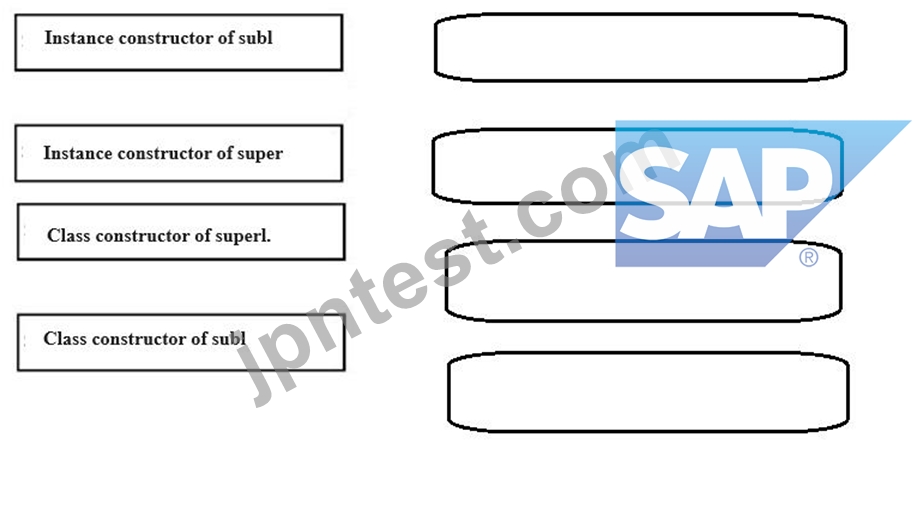
正解:
解説: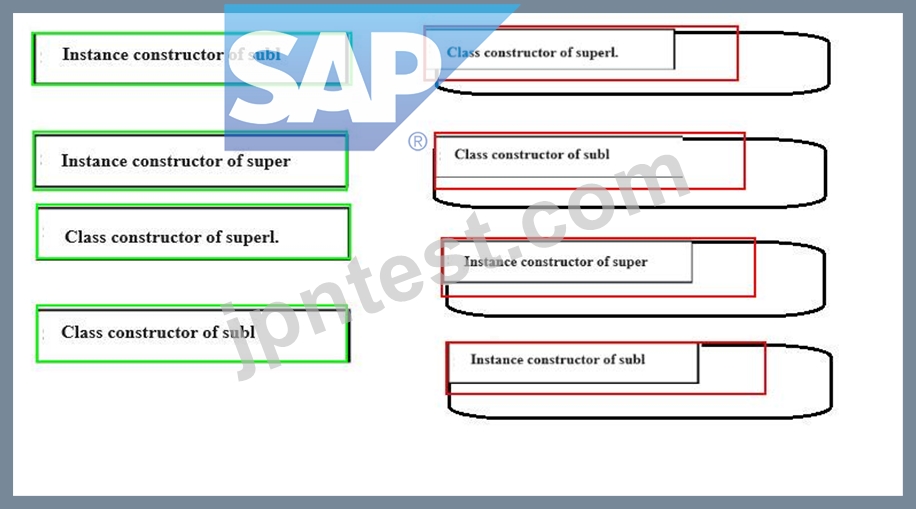
質問 # 43
Refer to the exhibit.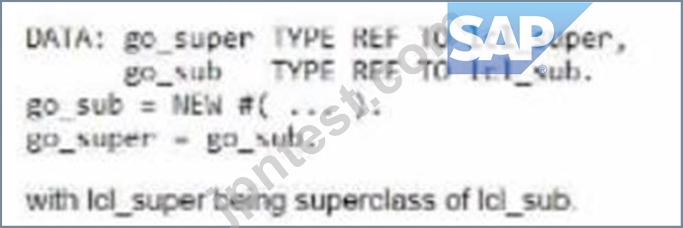
When accessing the subclass instance through go_super, what can you do? Note: There are 2 correct answers to this question.
- A. Access the inherited private components.
- B. Call inherited public redefined methods.
- C. Access the inherited public components.
- D. Call a subclass specific public method
正解:A、C
解説:
When accessing the subclass instance through go_super, you can do both of the following:
Access the inherited private components: A subclass inherits all the private attributes and methods of its superclass, unless they are explicitly overridden by the subclass. Therefore, you can access the inherited private components of the superclass through go_super, as long as they are not hidden by other attributes or methods in the subclass12.
Access the inherited public components: A subclass inherits all the public attributes and methods of its superclass, unless they are explicitly overridden by the subclass. Therefore, you can access the inherited public components of the superclass through go_super, as long as they are not hidden by other attributes or methods in the subclass12.
You cannot do any of the following:
Call a subclass specific public method: A subclass does not have any public methods that are not inherited from its superclass. Therefore, you cannot call a subclass specific public method through go_super12.
Call inherited public redefined methods: A subclass does not have any public methods that are redefined from its superclass. Therefore, you cannot call inherited public redefined methods through go_super12.
質問 # 44
Given the following code excerpt that defines an SAP HANA database table: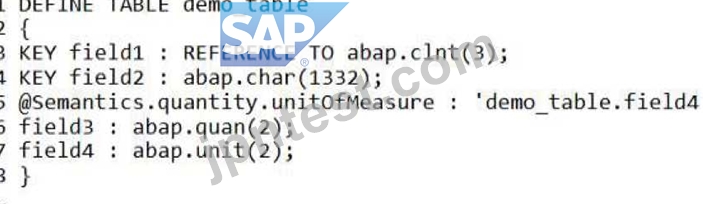
Which field is defined incorrectly?
- A. field1
- B. field4
- C. field3
- D. field2
正解:A
質問 # 45
When you join two database tables, which of the following rules applies to the database fields you use in the join?
- A. They must be the same position in their table, for example left_table-col1 = rigght_table-col1.
- B. They must have the same name, e.g. col1 = col1.
- C. They must always have an alias name.
- D. They must be compared with an ON condition.
正解:D
質問 # 46
What are some features of ABAP SQQL? Note: There are 2 correct answers to this question.
- A. It is directly executed on the HANA database.
- B. It is only valid on the HANA database.
- C. It is first processed by the Database Interface.
- D. It is integrated in the ABAP programming language.
正解:C、D
質問 # 47
What describes multi-column internal tables?
- A. They must contain nested components.
- B. They are based on a structured row type.
- C. They use one complete data type.
- D. They use one incomplete data type.
正解:B
質問 # 48
Exhibit
Which of the following ABAP SQL snippets are syntactically correct ways to provide a value for the parameter on line #4? Note: There are 2 correct answers to this question
- A. ...SELECT * FROM deno_cds_param_view_entity (p_date - '20230101')... )
- B. ...SELECT * FROM demo_cds_param_view entity (p_date: $session.system_date)...
- C. ...SELECT * FROM demo_cds_param_view_entity (p_date: 20238181')... )
- D. ...SELECT * FROM deno_cds_param_view_entity (p_date = @ (cl_abap_context_info->get_system_date ())...
正解:A、D
質問 # 49
Which patterns raise an exception? Note: There are 3 correct answers to this question.
- A. DATA: gv_target TYPE c LENGTH 5. V □ CONSTANTS: ECO string TYPE string VALUE 0123456789ABCDEF". gv_target - EXACT (gco_string + 5 (6) ).
- B. DATA: gv_target TYPE d. s/ □ CONSTANTS: gco_date TYPE d VALUE '20331233*. gv_target EXACT ( geo_date).
- C. DATA: gv_target TYPE p DECIMALS 2. CONSTANTS: go intl TYPE i VALUE 3. gv_target -U EXACT (2 gcojntl).
- D. DATA: Ev target TYPE p DECIMALS 3. CONSTANTS: gcojntl TYPE i VALUE 2. Ev_target -U EXACT #2 / gcojntl ).
- E. DATA: gv_target TYPE string. □ CONSTANTS: gco_string TYPE LENGTH 16 VALUE 0123456789ABCDEF*. gv_target = EXACT # gco_string+5 (5) ).
正解:A、B、C
解説:
The patterns that raise an exception are those that use the constructor operator EXACT to perform a lossless assignment or calculation, but the result cannot be converted to the target data type without data loss. The following are the explanations for each pattern:
A: This pattern raises the exception CX_SY_CONVERSION_LOST because the result of the calculation 2 * 3 is 6, which cannot be assigned to a packed number with two decimal places without losing the integer part. The operator -U is used to perform a lossless calculation with the calculation type decfloat34.
B: This pattern does not raise an exception because the result of the substring expression gco_string+5(5) is '6789A', which can be assigned to a string without data loss. The operator EXACT # is used to perform a lossless assignment with the data type of the argument.
C: This pattern raises the exception CX_SY_CONVERSION_LOST because the result of the substring expression gco_string+5(6) is '6789AB', which cannot be assigned to a character field with length 5 without losing the last character. The operator EXACT is used to perform a lossless assignment with the data type of the target field.
D: This pattern does not raise an exception because the result of the calculation 2 / 2 is 1, which can be assigned to a packed number with three decimal places without data loss. The operator -U is used to perform a lossless calculation with the calculation type decfloat34.
E: This pattern raises the exception CX_SY_CONVERSION_ERROR because the constant gco_date contains an invalid value '20331233' for a date data type, which cannot be converted to a valid date. The operator EXACT is used to perform a lossless assignment with the data type of the target field.
質問 # 50
Which of the following are features of Core Data Services? Note: There are 3 correct answers to this question.
- A. Delegation
- B. Inheritance
- C. Associations
- D. Annotations
- E. Structured Query Language (SQL)
正解:C、D、E
解説:
Core Data Services (CDS) is a framework for defining and consuming semantically rich data models in SAP HANA. CDS supports various features that enhance the capabilities of SQL and enable developers to create data models that are optimized for performance, readability, and extensibility12. Some of the features of CDS are:
Associations: Associations are a way of defining relationships between CDS entities, such as tables or views. Associations enable navigation and path expressions in CDS queries, which allow accessing data from related entities without explicit joins. Associations also support cardinality, referential constraints, and cascading options34.
Annotations: Annotations are a way of adding metadata to CDS entities or their elements, such as fields or parameters. Annotations provide additional information or instructions for the CDS compiler, the database, or the consumers of the CDS views. Annotations can be used for various purposes, such as defining access control, UI rendering, OData exposure, or search capabilities5 .
Structured Query Language (SQL): SQL is the standard language for querying and manipulating data in relational databases. CDS is based on SQL and extends it with additional features and syntax. CDS supports SQL features such as joins, aggregations, filters, expressions, functions, and subqueries. CDS also supports SQL Script, which is a scripting language for stored procedures and functions in SAP HANA .
You cannot do any of the following:
Inheritance: Inheritance is not a feature of CDS. Inheritance is a concept in object-oriented programming that allows a class to inherit the properties and methods of another class. CDS does not support object-oriented programming or classes.
Delegation: Delegation is not a feature of CDS. Delegation is a concept in object-oriented programming that allows an object to delegate some of its responsibilities to another object. CDS does not support object-oriented programming or objects.
質問 # 51
......
トップクラスSAP C-ABAPD-2507オンライン問題集:https://www.jpntest.com/shiken/C-ABAPD-2507-mondaishu
無料SAP C-ABAPD-2507試験問題と解答トレーニングを提供しています:https://drive.google.com/open?id=1E4IgdFz3eLcFdufdqi23DK8i29vehNR2