

更新された検証済みのMCD-Level-2問題集と解答には100%一発合格保証問題集はここ
合格MuleSoft Certified Developer MCD-Level-2試験問題には62問があります
質問 # 16
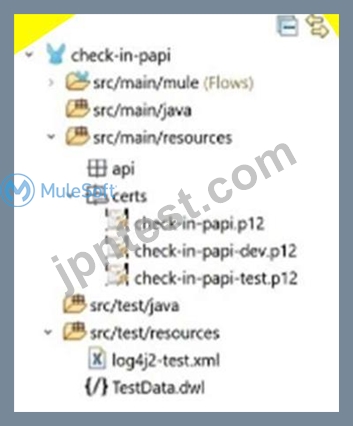
Refer to the exhibit.
What action must be performed to log all the errors raised by the VM Connector?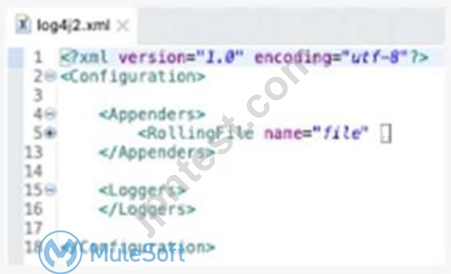
- A. Configure <Logger level-'ERROR'/> inside the VM Connector configuration
- B. Add <AsyncLOgger name='orgroute.extensions vm' level=ERROR'I> inside the Logger tag
- C. Add <AsyncLOgger name='orgroute.extensions vm' level=ERROR'/> inside the Appenders tag
- D. Nothing, as error-level events are automatically logged
正解:C
解説:
Explanation
To log all the errors raised by the VM Connector, the developer needs to add an async logger with the name
'org.mule.extension.vm' and the level 'ERROR' inside the appenders tag of the log4j2.xml file. This will enable logging all error-level events generated by the VM Connector to the console appender. References:
https://docs.mulesoft.com/mule-runtime/4.3/logging-in-mule#configuring-custom-logging-settings
質問 # 17
In a Mule project, Flow-1 contains a flow-ref to Flow-2 depends on data from Flow-1 to execute successfully.
Which action ensures the test suites and test cases written for Flow-1 and Flow-2 will execute successfully?
- A. Use 'After Test Case' to produce the data needed from Flow-1 test cases to pass to Flow-2 test cases
- B. Chain together the test suites and test cases for Flow-1 and Flow-2
- C. Use ''Set Event to pass the input that is needed, and keep the test cases for Flow-1 and Flow-2 independent
- D. Use ''Before Test Case'' To collect data from Flow-1 test cases before running Flow-2 test cases
正解:C
解説:
Explanation
To ensure the test suites and test cases written for Flow-1 and Flow-2 will execute successfully, the developer should use a Set Event processor to pass the input that is needed by Flow-2, and keep the test cases for Flow-1 and Flow-2 independent. This way, the developer can isolate the testing of each flow and avoid coupling them together. References: https://docs.mulesoft.com/munit/2.3/munit-test-flow
質問 # 18
A developer deploys an API to CloudHub and applies an OAuth policy on API Manager. During testing, the API response is slow, so the developer reconfigures the API so that the out-of-the-box HTTP Caching policy is applied first, and the OAuth API policy is applied second.
What will happen when an HTTP request is received?
- A. In case of a cache hit, both the OAuth and HTTP Caching policies are evaluated; then the cached response is returned to the caller
- B. In case of a cache miss, both the OAuth and HTTP Caching policies are evaluated; then the API retrieves the data from the API implementation, and the policy does not store the data in Object Store
- C. In case of a cache it, only the HTTP Caching policy is evaluating; then the cached response is returned to the caller
- D. In case of a cache miss, only the HTTP Caching policy is evaluated; then the API retrieves the data from the API implementation, and the policy stores the data to be cached in Object Store
正解:C
解説:
Explanation
When an HTTP request is received and the HTTP Caching policy is applied first, it checks if there is a cached response for that request in Object Store. If there is a cache hit, meaning that a valid cached response exists, then only the HTTP Caching policy is evaluated and the cached response is returned to the caller without invoking the OAuth policy or the API implementation. If there is a cache miss, meaning that no valid cached response exists, then both the HTTP Caching policy and the OAuth policy are evaluated before invoking the API implementation. References:
https://docs.mulesoft.com/api-manager/2.x/http-caching-policy#policy-ordering
質問 # 19
When registering a client application with an existing API instance or API Group instance, what is required to manually approve or reject request access?
- A. To configure the SLA tier for the application and have the role of Organization Administrator, API Manager Environment Administrator, or the Manage Contacts permission
- B. To configure the SLA tier for the application
- C. To configure the SLA tier for the application and have the Exchange Administrator permission
- D. To only have Exchange Administrator permission
正解:A
解説:
Explanation
To manually approve or reject request access when registering a client application with an existing API instance or API Group instance, it is required to configure the SLA tier for the application and have one of the following roles or permissions: Organization Administrator, API Manager Environment Administrator, or Manage Contracts permission. These roles or permissions allow managing client applications and contracts in API Manager. References:
https://docs.mulesoft.com/api-manager/2.x/client-applications#managing-client-applications-and-contracts
質問 # 20
A Mule application includes a subflow containing a Scatter.Gather scope. Within each log of the Scatter.Gatter. an HTTP connector calls a PUT endpoint to modify records in different upstream system. The subflow is called inside an Unit successful scope to retry if a transitory exception is raised.
A technical spike is being performed to increase reliability of the Mule application.
Which steps should be performed within the Mule flow above the ensure idempontent behavior?
- A. Change the PUT requests inside the Scatter-Gather to POST requests
- B. Remove the Put requests from the Scatter-Getter and perform them sequentially
- C. Ensure an error-handling flow performs corrective actions to roll back all changes if any leg of the Scatter-Gather fails
- D. None, the flow already exhibits idempotent behavior
正解:C
解説:
Explanation
To ensure idempotent behavior within a Mule flow that contains a subflow with a Scatter-Gather scope, the developer should ensure an error-handling flow performs corrective actions to roll back all changes if any leg of the Scatter-Gather fails. Idempotency means that multiple identical requests have the same effect as a single request. Therefore, if one of the HTTP requests inside the Scatter-Gather fails, the error-handling flow should undo any changes made by other successful requests to ensure consistency and avoid partial updates.
References: https://docs.mulesoft.com/mule-runtime/4.3/scatter-gather-concept
https://docs.mulesoft.com/mule-runtime/4.3/error-handling
質問 # 21
The flow is invoicing a target API. The API's protocol is HTTPS. The TLS configuration in the HTTP Request Configuration global element is set to None. A web client submits a request to
http:localhost:8081/vehicles.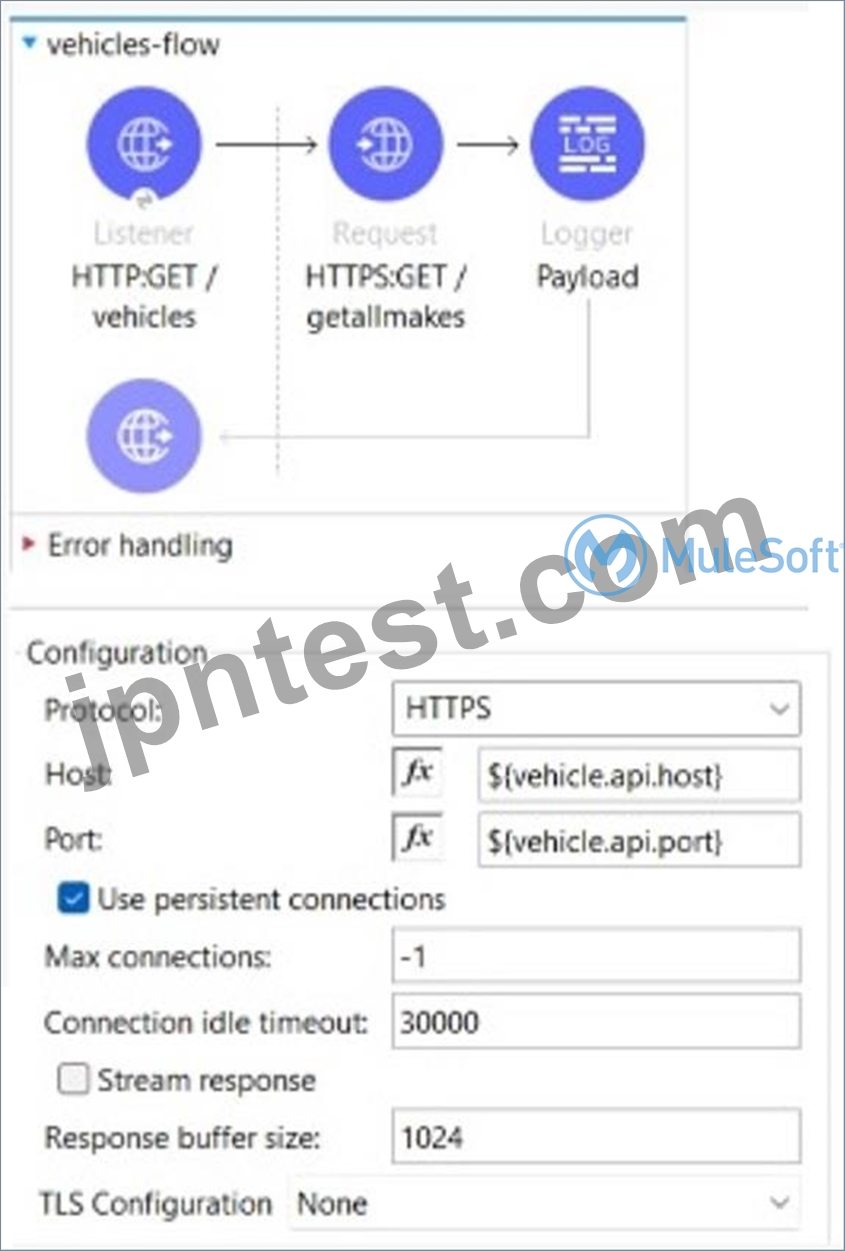
If the certificate of the target API is signed by a certificate authority (CA), what is true about the HTTP Request operation when the flow executes?
- A. The HTTP Request operation will succeed if the CA's certificate is present in the JRE's default truststore.
- B. The HTTP Request operation will always succeed regardless of the CA
- C. The HTTP Request operation will always fail regardless of the CA
- D. The HTTP Request operation will succeed if the CA'S certificate is present in the JRE's default keystore
正解:A
解説:
Explanation
The HTTP Request operation will use the default truststore of the JRE to validate the certificate of the target API. If the CA's certificate is present in the truststore, the operation will succeed. Otherwise, it will fail with a handshake exception. References: https://docs.mulesoft.com/mule-runtime/4.3/tls-configuration#tls-default
質問 # 22
Refer to the exhibit.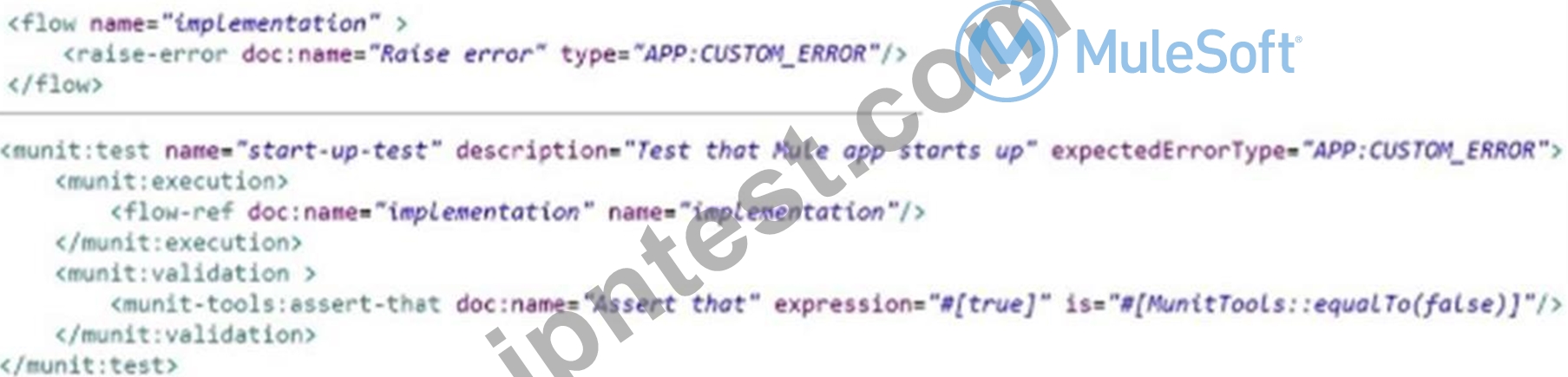
The flow name is ''implementation'' with code for the MUnit test case.
When the MUnit test case is executed, what is the expected result?
- A. The test case fails with an assertion error
- B. The test throws an error and does not start
- C. The test case passes
- D. The test case fails with an unexpected error type
正解:A
解説:
Explanation
Based on the code snippet and MUnit test case below, when the MUnit test case is executed, the expected result is that the test case fails with an assertion error. This is because the assert-equals processor compares two values for equality, and fails if they are not equal. In this case, the expected value is 'Hello World', but the actual value returned by the implementation flow is 'Hello Mule'. Therefore, the assertion fails and an error is thrown. References: https://docs.mulesoft.com/munit/2.3/assert-equals-processor
質問 # 23
A Mule API receives a JSON payload and updates the target system with the payload. The developer uses JSON schemas to ensure the data is valid.
How can the data be validation before posting to the target system?
- A. Using the DataWeave if Else condition test the values of the payload against the examples included in the schema
- B. Use a DataWeave 2.09 transform operation, and at the log of the DataWeave script, add:
%dw 2.0
Import.json-moduls - C. Add the JSON module dependency and add the validate-schema operation in the flow, configured to reference the schema
- D. Apply the JSON Schema policy in API Manager and reference the correct schema in the policy configuration
正解:C
解説:
Explanation
To validate the data before posting to the target system, the developer should add the JSON module dependency and add the validate-schema operation in the flow, configured to reference the schema. The JSON module provides a validate-schema operation that validates a JSON payload against a JSON schema and throws an error if the payload is invalid. References:
https://docs.mulesoft.com/json-module/1.1/json-validate-schema
質問 # 24
Refer to the exhibit.
What required changes can be made to give a partial successful response in case the United Airlines API returns with a timeout?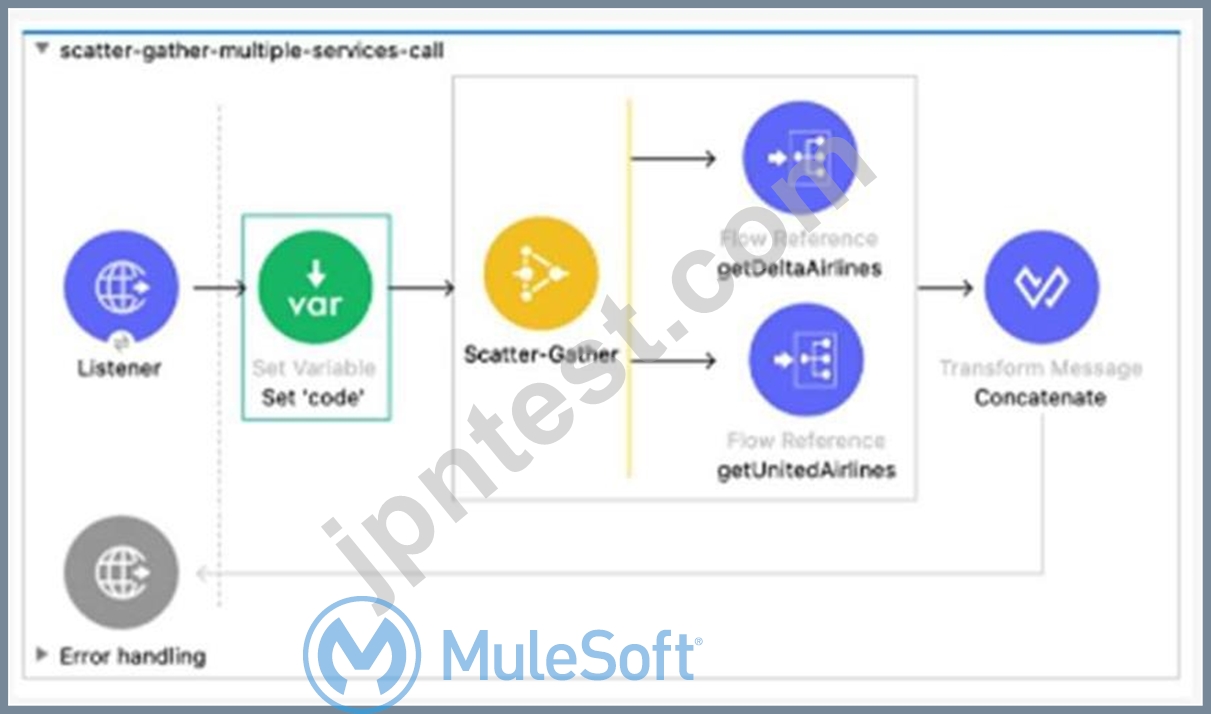
- A. Add a Scatter-Gather component inside a Try scope.
Set the payload to a default value 'Error'' inside the error handler using the On Error Continue scope. - B. Add a Scatter-gather component inside a Try scope.
Set the payload to a default value 'Error' inside the error handler using the On Error Propagate scope. - C. Add Flow Reference components inside a Try scope
Set the payload to a default value '' inside the error handler using the On Error Propagate scope - D. Add Flow Reference components inside a Try scope.
Set the payload to a default value'' insider the error handler using the ON Error Continue scope
正解:A
解説:
Explanation
To give a partial successful response in case the United Airlines API returns with a timeout, the developer should add a Scatter-Gather component inside a Try scope, and set the payload to a default value 'Error' inside the error handler using the On Error Continue scope. A Scatter-Gather component allows sending multiple requests concurrently and aggregating the responses into an array. A Try scope allows handling errors that occur within it using an error handler. An On Error Continue scope allows continuing the flow execution after handling an error. Therefore, by using these components, the developer can send requests to both APIs in parallel, handle any timeout errors from United Airlines API, and return a partial response with a default value for that API. References: https://docs.mulesoft.com/mule-runtime/4.3/scatter-gather-concept
https://docs.mulesoft.com/mule-runtime/4.3/try-scope-concept
https://docs.mulesoft.com/mule-runtime/4.3/on-error-continue-concept
質問 # 25
The Center for Enablement team published a common application as a reusable module to the central Nexus repository.
How can the common application be included in all API implementations?
- A. Add a Maven dependency in the POM file with jar as <classifier>
- B. Download the common application from Naxus and copy it to the src/main/resources folder in the API
- C. Add a Maven dependency in the PCM file with multiple-plugin as <classifier>
- D. Copy the common application's source XML file and out it in a new flow file in the src/main/mule folder
正解:A
解説:
Explanation
To include a common application as a reusable module in all API implementations, the developer should add a Maven dependency in the POM file with jar as <classifier>. This way, the developer can reuse Mule code from another application by packaging it as a JAR file and adding it as a dependency in the POM file of the API implementation. The classifier element specifies that it is a JAR file. References:
https://docs.mulesoft.com/mule-runtime/4.3/mmp-concept#add-a-maven-dependency-to-the-pom-file
質問 # 26
The HTTP Request operation raises an HTTP CONNECTIVITY error.
Which HTTP status code and body are returned to the web client?
- A. HTTP Status Code:500.
Body 'Error in processing your request - B. HTTP Status Code:500.
Body 'Error in processing your request - C. HTTP Status Code:200.
Body 'Error in processing your request - D. HTTP Status Code:500.
Body 'The HTTP CONNECTIVITY Error description
正解:B
解説:
Explanation
When the HTTP Request operation raises an HTTP CONNECTIVITY error, it triggers an on-error-continue handler that sets a payload with 'Error in processing your request'. Since no status code is explicitly set in this handler, it defaults to 500 (INTERNAL SERVER ERROR). Therefore, the web client receives an HTTP response with status code 500 and body 'Error in processing your request'. References:
https://docs.mulesoft.com/mule-runtime/4.3/error-handling#on-error-continue
質問 # 27
Which statement is true about using mutual TLS to secure an application?
- A. Mutual TLS increases the encryption strength versus server-side TLS alone
- B. Mutual TLS requires a hardware security module to be used
- C. Mutual TLS ensures only authorized end users are allowed to access an endpoint
- D. Mutual TLS authenticates the identity of the server before the identity of the client
正解:D
解説:
Explanation
Mutual TLS (mTLS) is an extension of TLS that requires both parties (client and server) to present their certificates to each other during the handshake process. This way, both parties can verify each other's identity and establish a secure connection. The authentication of the server happens before the authentication of the client, as the server sends its certificate first and then requests the client's certificate. References:
https://docs.mulesoft.com/mule-runtime/4.3/tls-configuration#mutual-authentication
質問 # 28
A developer has created the first version of an API designed for business partners to work commodity prices.
What should developer do to allow more than one major version of the same API to be exposed by the implementation?
- A. In Anypoint Studio, generate scaffolding from the RAML, and then modify the flow names generated by APIKit to include a variable with the major version number
- B. In Design Center, open the RAML and modify each operation to include the major version number
- C. In Anypoint Studio, generate scaffolding from the RAML, and the modify the <http:listerner> in the generated flows to include a parameter to replace the version number
- D. In Design Center, open the RAML and modify baseUn to include a variable that indicates the version number
正解:D
解説:
Explanation
To allow more than one major version of the same API to be exposed by the implementation, the developer should modify the baseUri property in the RAML file to include a variable that indicates the version number.
The baseUri property defines the base URL of the API and can include variables that are replaced with actual values when mocking or deploying the API. By using a variable for the version number, the developer can expose different versions of the API using different base URLs and avoid conflicts or confusion. References:
https://docs.mulesoft.com/api-designer/design-modify-raml-specs#baseuri
https://docs.mulesoft.com/api-manager/2.x/api-versioning
質問 # 29
Which configurations are required for HTTP Listener to enable mTLS authentication?
- A. Set an appropriate keystore and truststore configuration for the listener
- B. Set an appropriate reconnection strategy and use persistent connections for the listener
- C. Set an appropriate keystore configuration and use persistent connections for the listener
- D. Set an appropriate truststore configuration and reconnection strategy for the listener
正解:A
解説:
Explanation
To enable mTLS authentication for HTTP Listener, the developer needs to set an appropriate keystore and truststore configuration for the listener. The keystore contains the certificate and private key of the Mule application that are used to prove its identity to clients. The truststore contains the certificates of trusted clients that are allowed to access the Mule application. References:
https://docs.mulesoft.com/mule-runtime/4.3/tls-configuration#mutual-authentication
質問 # 30
A new Mule project has been created in Anypoint Studio with the default settings.
Which file inside the Mule project must be modified before using Maven to successfully deploy the application?
- A. Mule.artificact.json
- B. Config.yaml
- C. Settings.xml
- D. Pom.xml
正解:D
解説:
Explanation
To use Maven to successfully deploy the application, the developer needs to modify the pom.xml file inside the Mule project. The pom.xml file contains the configuration and dependencies of the Mule application, as well as the deployment information such as the CloudHub region, environment, and worker size. The developer needs to specify these properties in the pom.xml file before using Maven to deploy the application.
References: https://docs.mulesoft.com/mule-runtime/4.3/mmp-concept#application-deployment-descriptor
質問 # 31
Refer to the exhibit.
What is the result of the Mule Maven Plugin configuration of the value of property its,keystorePassoword in CloudHub 2.0?
- A. CloudHub encrypts the value
- B. The Mule server encrypts the value
- C. Runtime Manager masks the value
- D. Anypoint Studio secures the value
正解:C
解説:
Explanation
The result of the Mule Maven Plugin configuration of the value of property its,keystorePassword in CloudHub
2.0 is that Runtime Manager masks the value. This means that Runtime Manager hides or obscures the value from anyone who views it in Runtime Manager or Anypoint Platform. References:
https://docs.mulesoft.com/runtime-manager/runtime-manager-agent-for-mule4#properties-tab
質問 # 32
A company deploys 10 public APIs to CloudHub. Each API has its individual health endpoint defined. The platform operation team wants to configure API Functional Monitoring to monitor the health of the APIs periodically while minimizing operational overhead and cost.
How should API Functional Monitoring be configured?
- A. From one private location with all 10 APIs in a single schedule
- B. From one public location with all 10 APIs in a single schedule
- C. From 10 public locations with each API in its own schedule
- D. From one public location with each API in its own schedule
正解:B
解説:
Explanation
To configure API Functional Monitoring to monitor the health of 10 public APIs periodically while minimizing operational overhead and cost, the developer should use one public location with all 10 APIs in a single schedule. A public location is a worker that runs in a CloudHub shared environment, which is cheaper and easier to maintain than a private location. A single schedule allows running all 10 APIs tests at the same time and frequency, which reduces complexity and resource consumption. References:
https://docs.mulesoft.com/functional-monitoring/fm-create-monitor#create-a-monitor
質問 # 33
Refer to the exhibit.
A Mule application pom.xml configures the Maven Resources plugin to exclude parsing binary files in the project's src/main/resources/certs directory.
Which configuration of this plugin achieves a successful build?
- A.

- B.

- C.

- D.
正解:B
解説:
Explanation
To configure the Maven Resources plugin to exclude parsing binary files in the project's src/main/resources/certs directory, option C should be used. This option specifies that any files with .cer or .jks extensions under the certs directory should be excluded from filtering. Filtering is a process of replacing placeholders with actual values in resource files during the build process. Binary files should not be filtered because they may become corrupted or unusable. References:
https://maven.apache.org/plugins/maven-resources-plugin/examples/filter.html
https://maven.apache.org/plugins/maven-resources-plugin/examples/include-exclude.html
質問 # 34
A Mule application contain two policies Policy A and Policy A has order1, and Policy B has order 2. Policy A Policy B, and a flow are defined by he configuration below.
When a HTTP request arrives at the Mule application's endpoint, what will be the execution order?
- A. F1, A1, B1, B2, A2
- B. B1, A1, F1, A2, B2
- C. A1, B1, F1, B2, A2
- D. F1, B1, A1, A2, B2
正解:C
解説:
Explanation
Based on the configuration below, when a HTTP request arrives at the Mule application's endpoint, the execution order will be A1, B1, F1, B2, A2. This is because policies are executed before and after the API implementation flow according to their order attribute. Policy A has order 1, which means it is executed first before Policy B, which has order 2. The flow is executed after both policies are executed before the flow.
Then, Policy B is executed after the flow before Policy A is executed after the flow. References:
https://docs.mulesoft.com/api-manager/2.x/policies-policy-order
質問 # 35
......
合格させるMCD-Level-2テストエンジンPDFで完全版無料問題集がここに:https://www.jpntest.com/shiken/MCD-Level-2-mondaishu