

試験合格保証付きのDatabricks Certification Databricks-Certified-Data-Engineer-Associate試験問題集
Databricks Databricks-Certified-Data-Engineer-Associate日常練習試験は2025年最新のに更新された102問あります
Databricks認定データエンジニアアソシエイト認定資格は、データエンジニアリング、データウェアハウジング、およびデータモデリングの役割を担うプロフェッショナルに適しています。この認定は、候補者がDatabricksの知識を持ち、Databricksを使用したデータエンジニアリングソリューションを設計および実装できる能力を示すものです。また、データ変換、ETLプロセス、データウェアハウジング、およびデータモデリングの概念に関する理解を検証します。この認定は、候補者のキャリア機会を向上させ、収益力を高めることができます。
質問 # 22
Which of the following data lakehouse features results in improved data quality over a traditional data lake?
- A. A data lakehouse allows the use of SQL queries to examine data.
- B. A data lakehouse supports ACID-compliant transactions.
- C. A data lakehouse provides storage solutions for structured and unstructured data.
- D. A data lakehouse stores data in open formats.
- E. A data lakehouse enables machine learning and artificial Intelligence workloads.
正解:A
質問 # 23
Which of the following describes a scenario in which a data team will want to utilize cluster pools?
- A. An automated report needs to be made reproducible.
- B. An automated report needs to be refreshed as quickly as possible.
- C. An automated report needs to be tested to identify errors.
- D. An automated report needs to be version-controlled across multiple collaborators.
- E. An automated report needs to be runnable by all stakeholders.
正解:B
解説:
Databricks cluster pools are a set of idle, ready-to-use instances that can reduce cluster start and auto-scaling times. This is useful for scenarios where a data team needs to run an automated report as quickly as possible, without waiting for the cluster to launch or scale up. Cluster pools can also help save costs by reusing idle instances across different clusters and avoiding DBU charges for idle instances in the pool. References: Best practices: pools | Databricks on AWS, Best practices: pools - Azure Databricks | Microsoft Learn, Best practices: pools | Databricks on Google Cloud
質問 # 24
A data engineer has been using a Databricks SQL dashboard to monitor the cleanliness of the input data to an ELT job. The ELT job has its Databricks SQL query that returns the number of input records containing unexpected NULL values. The data engineer wants their entire team to be notified via a messaging webhook whenever this value reaches 100.
Which of the following approaches can the data engineer use to notify their entire team via a messaging webhook whenever the number of NULL values reaches 100?
- A. They can set up an Alert with one-time notifications.
- B. They can set up an Alert with a new webhook alert destination.
- C. They can set up an Alert without notifications.
- D. They can set up an Alert with a custom template.
- E. They can set up an Alert with a new email alert destination.
正解:B
解説:
Explanation
To achieve this, the data engineer can set up an Alert in the Databricks workspace that triggers when the query results exceed the threshold of 100 NULL values. They can create a new webhook alert destination in the Alert's configuration settings and provide the necessary messaging webhook URL to receive notifications.
When the Alert is triggered, it will send a message to the configured webhook URL, which will then notify the entire team of the issue.
質問 # 25
A data engineer is maintaining a data pipeline. Upon data ingestion, the data engineer notices that the source data is starting to have a lower level of quality. The data engineer would like to automate the process of monitoring the quality level.
Which of the following tools can the data engineer use to solve this problem?
- A. Auto Loader
- B. Unity Catalog
- C. Data Explorer
- D. Delta Lake
- E. Delta Live Tables
正解:E
解説:
Delta Live Tables is a tool that enables data engineers to build and manage reliable data pipelines with minimal code. One of the features of Delta Live Tables is data quality monitoring, which allows data engineers to define quality expectations for their data and automatically check them at every step of the pipeline. Data quality monitoring can help detect and resolve data quality issues, such as missing values, duplicates, outliers, or schema changes. Data quality monitoring can also generate alerts and reports on the quality level of the data, and enable data engineers to troubleshoot and fix problems quickly. Reference: Delta Live Tables Overview, Data Quality Monitoring
質問 # 26
A data engineer that is new to using Python needs to create a Python function to add two integers together and return the sum?
Which of the following code blocks can the data engineer use to complete this task?
- A.

- B.

- C.

- D.

- E.

正解:C
解説:
https://www.w3schools.com/python/python_functions.asp
https://www.geeksforgeeks.org/python-functions/
質問 # 27
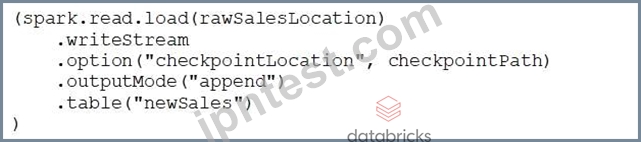
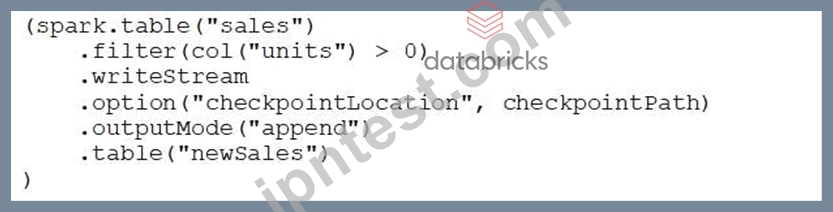
Which of the following Structured Streaming queries is performing a hop from a Silver table to a Gold table?
- A.

- B.
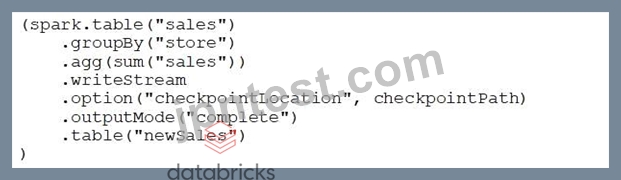
- C.
- D.
- E.

正解:B
解説:
The best practice is to use "Complete" as output mode instead of "append" when working with aggregated tables. Since gold layer is work final aggregated tables, the only option with output mode as complete is option
質問 # 28
A data engineer needs access to a table new_table, but they do not have the correct permissions. They can ask the table owner for permission, but they do not know who the table owner is.
Which of the following approaches can be used to identify the owner of new_table?
- A. All of these options can be used to identify the owner of the table
- B. There is no way to identify the owner of the table
- C. Review the Permissions tab in the table's page in Data Explorer
- D. Review the Owner field in the table's page in Data Explorer
- E. Review the Owner field in the table's page in the cloud storage solution
正解:D
解説:
he approach that can be used to identify the owner of new_table is to review the Owner field in the table's page in Data Explorer. Data Explorer is a web-based interface that allows users to browse, create, and manage data objects such as tables, views, and functions in Databricks1. The table's page in Data Explorer provides various information about the table, such as its schema, partitions, statistics, history, and permissions2. The Owner field shows the name and email address of the user who created or owns the table3. The data engineer can use this information to contact the table owner and request for permission to access the table.
The other options are not correct or reliable for identifying the owner of new_table. Reviewing the Permissions tab in the table's page in Data Explorer can show the users and groups who have access to the table, but not necessarily the owner4. Reviewing the Owner field in the table's page in the cloud storage solution can be misleading, as the owner of the data files may not be the same as the owner of the table5. There is a way to identify the owner of the table, as explained above, so option E is false.
Reference:
1: Data Explorer | Databricks on AWS
2: Table details | Databricks on AWS
3: Set owner when creating a view in databricks sql - Databricks - 9978
4: Table access control | Databricks on AWS
5: External tables | Databricks on AWS
質問 # 29
A new data engineering team has been assigned to work on a project. The team will need access to database customers in order to see what tables already exist. The team has its own group team.
Which of the following commands can be used to grant the necessary permission on the entire database to the new team?
- A. GRANT VIEW ON CATALOG customers TO team;
- B. GRANT USAGE ON DATABASE customers TO team;
- C. GRANT USAGE ON CATALOG team TO customers;
- D. GRANT CREATE ON DATABASE customers TO team;
- E. GRANT CREATE ON DATABASE team TO customers;
正解:B
解説:
The correct command to grant the necessary permission on the entire database to the new team is to use the GRANT USAGE command. The GRANT USAGE command grants the principal the ability to access the securable object, such as a database, schema, or table. In this case, the securable object is the database customers, and the principal is the group team. By granting usage on the database, the team will be able to see what tables already exist in the database. Option E is the only option that uses the correct syntax and the correct privilege type for this scenario. Option A uses the wrong privilege type (VIEW) and the wrong securable object (CATALOG). Option B uses the wrong privilege type (CREATE), which would allow the team to create new tables in the database, but not necessarily see the existing ones. Option C uses the wrong securable object (CATALOG) and the wrong principal (customers). Option D uses the wrong securable object (team) and the wrong principal (customers). References: GRANT, Privilege types, Securable objects, Principals
質問 # 30
A data engineer needs to apply custom logic to identify employees with more than 5 years of experience in array column employees in table stores. The custom logic should create a new column exp_employees that is an array of all of the employees with more than 5 years of experience for each row. In order to apply this custom logic at scale, the data engineer wants to use the FILTER higher-order function.
Which of the following code blocks successfully completes this task?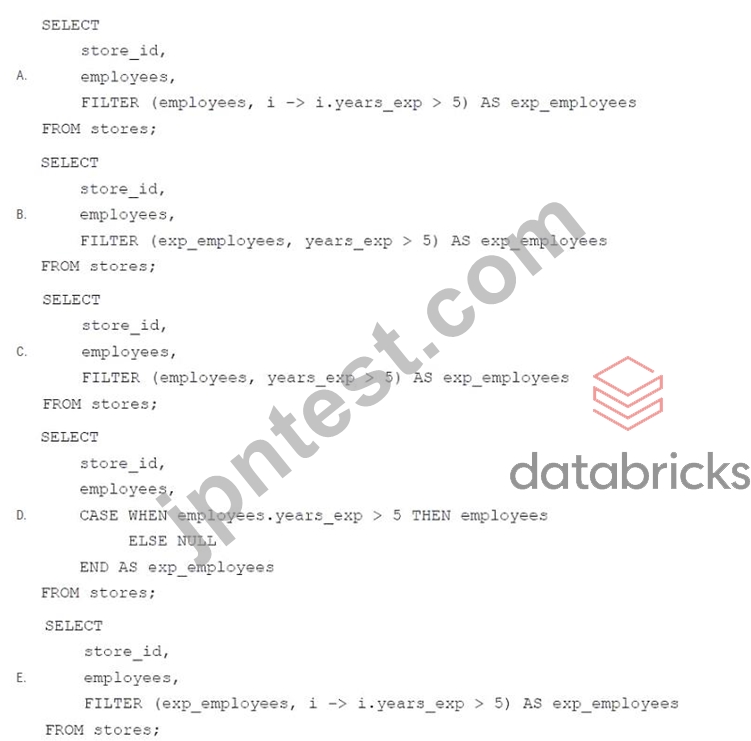
- A. Option C
- B. Option D
- C. Option B
- D. Option E
- E. Option A
正解:E
解説:
Option A is the correct answer because it uses the FILTER higher-order function correctly to filter out employees with more than 5 years of experience from the array column "employees". It applies a lambda function i -> i.years_exp > 5 that checks if the years of experience of each employee in the array is greater than 5. If this condition is met, the employee is included in the new array column "exp_employees".
質問 # 31
A data engineer needs to apply custom logic to string column city in table stores for a specific use case. In order to apply this custom logic at scale, the data engineer wants to create a SQL user-defined function (UDF).
Which of the following code blocks creates this SQL UDF?
- A.

- B.

- C.

- D.

- E.

正解:D
解説:
Explanation
https://www.databricks.com/blog/2021/10/20/introducing-sql-user-defined-functions.html
質問 # 32
A data engineer has a Python variable table_name that they would like to use in a SQL query. They want to construct a Python code block that will run the query using table_name.
They have the following incomplete code block:
____(f"SELECT customer_id, spend FROM {table_name}")
Which of the following can be used to fill in the blank to successfully complete the task?
- A. spark.delta.table
- B. spark.sql
- C. dbutils.sql
- D. spark.table
- E. spark.delta.sql
正解:B
質問 # 33
Which of the following is a benefit of the Databricks Lakehouse Platform embracing open source technologies?
- A. Avoiding vendor lock-in
- B. Simplified governance
- C. Ability to scale storage
- D. Ability to scale workloads
- E. Cloud-specific integrations
正解:A
解説:
One of the benefits of the Databricks Lakehouse Platform embracing open source technologies is that it avoids vendor lock-in. This means that customers can use the same open source tools and frameworks across different cloud providers, and migrate their data and workloads without being tied to a specific vendor. The Databricks Lakehouse Platform is built on open source projects such as Apache Spark, Delta Lake, MLflow, and Redash, which are widely used and trusted by millions of developers. By supporting these open source technologies, the Databricks Lakehouse Platform enables customers to leverage the innovation and community of the open source ecosystem, and avoid the risk of being locked into proprietary or closed solutions. The other options are either not related to open source technologies (A, B, C, D), or not benefits of the Databricks Lakehouse Platform (A, B). References: Databricks Documentation - Built on open source, Databricks Documentation - What is the Lakehouse Platform?, Databricks Blog - Introducing the Databricks Lakehouse Platform.
質問 # 34
Which of the following describes the relationship between Bronze tables and raw data?
- A. Bronze tables contain less data than raw data files.
- B. Bronze tables contain more truthful data than raw data.
- C. Bronze tables contain aggregates while raw data is unaggregated.
- D. Bronze tables contain raw data with a schema applied.
- E. Bronze tables contain a less refined view of data than raw data.
正解:D
解説:
Bronze tables are the first layer of a medallion architecture, which is a data design pattern used to organize data in a lakehouse. Bronze tables contain raw data ingested from various sources, such as RDBMS data, JSON files, IoT data, etc. The table structures in this layer correspond to the source system table structures "as-is", along with any additional metadata columns that capture the load date/time, process ID, etc. The only transformation applied to the raw data in this layer is to apply a schema, which defines the column names and data types of the table. The schema can be inferred from the data source or specified explicitly. Applying a schema to the raw data enables the use of SQL and other structured query languages to access and analyze the data. Therefore, option E is the correct answer. Reference: What is a Medallion Architecture?, Raw Data Ingestion into Delta Lake Bronze tables using Azure Synapse Mapping Data Flow, Apache Spark + Delta Lake concepts, Delta Lake Architecture & Azure Databricks Workspace.
質問 # 35
A data engineer needs to create a table in Databricks using data from a CSV file at location /path/to/csv.
They run the following command: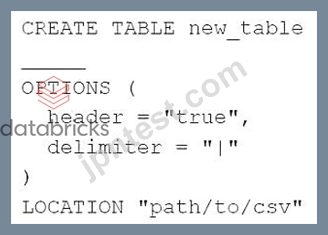
Which of the following lines of code fills in the above blank to successfully complete the task?
- A. FROM CSV
- B. None of these lines of code are needed to successfully complete the task
- C. USING CSV
- D. FROM "path/to/csv"
- E. USING DELTA
正解:D
解説:
A data lakehouse is a new paradigm that can be used to simplify and unify siloed data architectures that are specialized for specific use cases. A data lakehouse combines the best of both data lakes and data warehouses, providing a single platform that supports diverse data types, open standards, low-cost storage, high-performance queries, ACID transactions, schema enforcement, and governance. A data lakehouse enables data engineers to build reliable and scalable data pipelines that can serve various downstream applications and users, such as data science, machine learning, analytics, and reporting. A data lakehouse leverages the power of Delta Lake, a storage layer that brings reliability and performance to data lakes. References: What is a data lakehouse?, Delta Lake, Lakehouse: A New Generation of Open Platforms that Unify Data Warehousing and Advanced Analytics
質問 # 36
Which of the following is a benefit of the Databricks Lakehouse Platform embracing open source technologies?
- A. Avoiding vendor lock-in
- B. Simplified governance
- C. Ability to scale storage
- D. Ability to scale workloads
- E. Cloud-specific integrations
正解:A
解説:
One of the benefits of the Databricks Lakehouse Platform embracing open source technologies is that it avoids vendor lock-in. This means that customers can use the same open source tools and frameworks across different cloud providers, and migrate their data and workloads without being tied to a specific vendor. The Databricks Lakehouse Platform is built on open source projects such as Apache Spark, Delta Lake, MLflow, and Redash, which are widely used and trusted by millions of developers. By supporting these open source technologies, the Databricks Lakehouse Platform enables customers to leverage the innovation and community of the open source ecosystem, and avoid the risk of being locked into proprietary or closed solutions. The other options are either not related to open source technologies (A, B, C, D), or not benefits of the Databricks Lakehouse Platform (A, B). Reference: Databricks Documentation - Built on open source, Databricks Documentation - What is the Lakehouse Platform?, Databricks Blog - Introducing the Databricks Lakehouse Platform.
質問 # 37
A data engineer needs to apply custom logic to string column city in table stores for a specific use case. In order to apply this custom logic at scale, the data engineer wants to create a SQL user-defined function (UDF).
Which of the following code blocks creates this SQL UDF?
- A.
- B.
- C.
- D.
- E.
正解:C
質問 # 38
A data engineer needs to create a table in Databricks using data from their organization's existing SQLite database.
They run the following command: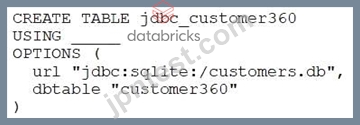
Which of the following lines of code fills in the above blank to successfully complete the task?
- A. DELTA
- B. autoloader
- C. org.apache.spark.sql.jdbc
- D. org.apache.spark.sql.sqlite
- E. sqlite
正解:E
解説:
In the given command, a data engineer is trying to create a table in Databricks using data from an SQLite database. The correct option to fill in the blank is "sqlite" because it specifies the type of database being connected to in a JDBC connection string. The USING clause should be followed by the format of the data, and since we are connecting to an SQLite database, "sqlite" would be appropriate here. References:
* Create a table using JDBC
* JDBC connection string
* SQLite JDBC driver
質問 # 39
Which of the following commands can be used to write data into a Delta table while avoiding the writing of duplicate records?
- A. APPEND
- B. MERGE
- C. INSERT
- D. DROP
- E. IGNORE
正解:B
解説:
The MERGE command can be used to upsert data from a source table, view, or DataFrame into a target Delta table. It allows you to specify conditions for matching and updating existing records, and inserting new records when no match is found. This way, you can avoid writing duplicate records into a Delta table1. The other commands (DROP, IGNORE, APPEND, INSERT) do not have this functionality and may result in duplicate records or data loss234. References: 1: Upsert into a Delta Lake table using merge | Databricks on AWS 2: SQL DELETE | Databricks on AWS 3: SQL INSERT INTO | Databricks on AWS 4: SQL UPDATE | Databricks on AWS
質問 # 40
A data engineer is attempting to drop a Spark SQL table my_table. The data engineer wants to delete all table metadata and data.
They run the following command:
DROP TABLE IF EXISTS my_table
While the object no longer appears when they run SHOW TABLES, the data files still exist.
Which of the following describes why the data files still exist and the metadata files were deleted?
- A. The table's data was larger than 10 GB
- B. The table did not have a location
- C. The table was managed
- D. The table's data was smaller than 10 GB
- E. The table was external
正解:E
解説:
An external table is a table that is defined in the metastore and points to an existing location in the storage system. When you drop an external table, only the metadata is deleted from the metastore, but the data files are not deleted from the storage system. This is because external tables are meant to be shared by multiple applications and users, and dropping them should not affect the data availability. On the other hand, a managed table is a table that is defined in the metastore and also managed by the metastore. When you drop a managed table, both the metadata and the data files are deleted from the metastore and the storage system, respectively. This is because managed tables are meant to be exclusive to the application or user that created them, and dropping them should free up the storage space. Therefore, the correct answer is C, because the table was external and only the metadata was deleted when the table was dropped. Reference: Databricks Documentation - Managed and External Tables, Databricks Documentation - Drop Table
質問 # 41
Which of the following is hosted completely in the control plane of the classic Databricks architecture?
- A. Worker node
- B. Databricks web application
- C. Driver node
- D. Databricks Filesystem
- E. JDBC data source
正解:C
質問 # 42
A data engineer has joined an existing project and they see the following query in the project repository:
CREATE STREAMING LIVE TABLE loyal_customers AS
SELECT customer_id -
FROM STREAM(LIVE.customers)
WHERE loyalty_level = 'high';
Which of the following describes why the STREAM function is included in the query?
- A. The customers table is a reference to a Structured Streaming query on a PySpark DataFrame.
- B. The table being created is a live table.
- C. The customers table is a streaming live table.
- D. The data in the customers table has been updated since its last run.
- E. The STREAM function is not needed and will cause an error.
正解:C
解説:
The STREAM function is used to process data from a streaming live table or view, which is a table or view that contains data that has been added only since the last pipeline update. Streaming live tables and views are stateful, meaning that they retain the state of the previous pipeline run and only process new data based on the current query. This is useful for incremental processing of streaming or batch data sources. The customers table in the query is a streaming live table, which means that it contains the latest data from the source. The STREAM function enables the query to read the data from the customers table incrementally and create another streaming live table named loyal_customers, which contains the customer IDs of the customers with high loyalty level. References: Difference between LIVE TABLE and STREAMING LIVE TABLE, CREATE STREAMING TABLE, Load data using streaming tables in Databricks SQL.
質問 # 43
Which of the following is stored in the Databricks customer's cloud account?
- A. Cluster management metadata
- B. Databricks web application
- C. Repos
- D. Notebooks
- E. Data
正解:E
質問 # 44
......
GAQM Databricks-Certified-Data-Engineer-Associate(DataBricks Certified Data Engineer Associate)認定試験は、データアブリックプラットフォームとデータエンジニアリングにおけるその役割についての候補者の理解を検証する包括的かつ厳密な試験です。この認定は、DataBricksを使用してデータパイプラインの設計、構築、維持に必要な実用的なスキルと知識の評価に焦点を当てています。
テストエンジン練習Databricks-Certified-Data-Engineer-Associateテスト問題:https://www.jpntest.com/shiken/Databricks-Certified-Data-Engineer-Associate-mondaishu
有効問題を試そう!Databricks-Certified-Data-Engineer-Associate実際の試験問題解答:https://drive.google.com/open?id=1HUQzplvWW9YoBtr1Tm7C143AW4mzq7Ha