

1z0-1072-23無料認定試験材料はこちらの57問題
リアル1z0-1072-23は100%カバー率リアル試験問題を試そう!
Oracle 1z0-1072-23 認定試験の出題範囲:
| トピック | 出題範囲 |
|---|---|
| トピック 1 |
|
| トピック 2 |
|
| トピック 3 |
|
| トピック 4 |
|
| トピック 5 |
|
質問 # 27
You are a security administrator for your company's Oracle Cloud Infrastructure (OCI) tenancy. Your storage administrator informs you that she cannot associate an encryption key from an existing Vault to a new Object Storage bucket.
What could be a possible reason for this behavior?
- A. There is no Identity and Access Management (IAM) policy that allows the Object Storage service to use the key.
- B. The secret for the key was not created beforehand
- C. The Object Storage bucket policy lacks the necessary Access Control List (ACL).
- D. The storage administrator forgot to select "Encrypt using Oracle managed keys" while creating the bucket.
正解:A
解説:
There is no Identity and Access Management (IAM) policy that allows the Object Storage service to use the key. The explanation is that when you create an Object Storage bucket with encryption using a customer-managed key from Vault, you need to have an IAM policy that allows the Object Storage service to use the key on your behalf. The policy should look like this:
allow service objectstorage-<region> to use key in compartment <compartment-name> where <region> is the region where your bucket resides and <compartment-name> is the compartment where your key resides.
質問 # 28
Which of the following statements is true about cloning a volume in the Oracle Cloud Infrastructure (OCI) Block Volume service?
- A. You can clone a volume to another region.
- B. You can change the block volume size when cloning a volume.
- C. You need to detach a volume before cloning it.
- D. Creating a clone takes longer than creating a backup of a volume.
正解:B
解説:
You can change the block volume size when cloning a volume. The explanation is that cloning a volume is a way of creating an exact copy of an existing volume without creating a backup first. Cloning a volume is faster and cheaper than creating a backup and restoring it to a new volume. When you clone a volume, you can change the block volume size, performance, encryption settings, and tags of the new volume. You do not need to detach a volume before cloning it, as cloning does not affect the source volume or its attachments. You cannot clone a volume to another region, as cloning only works within the same region and availability domain. Creating a clone usually takes less time than creating a backup of a volume, as cloning does not involve transferring data to Object Storage.
質問 # 29
You are using the Oracle Cloud Infrastructure (OCI) Vault service to create and manage Secrets. For your databasepassword, you have created a secret and rotated the secret one time. The secret versions are as follows:
Version Number | Status
-----------------------------------------
2 (latest) | Current
1 | Previous
You later realize that you have made a mistake in updating the secret content for version 2 and want to rollback to version 1.
What should you do to rollback to version 1?
- A. Deprecate version 2 (latest). Create new Secret version 3. Create soft link from version 3 to version 1.
- B. Create a new secret version 3 and set to Pending. Copy the content of version 1 into version 3.
- C. From the version 1 menu on the OCI console, select "Promote to Current".
- D. From the version 2 (latest) menu, select "Rollback" and select version 1 when given the option.
正解:C
解説:
Explanation
From the version 1 menu on the OCI console, select "Promote to Current". The explanation is that when you promote a secret version to current, it becomes the latest version of the secret and is used by default when you access the secret. This way, you can rollback to a previous version of the secret without creating a new version.
質問 # 30
Which is NOT a valid Oracle Cloud Infrastructure (OCI) Virtual Cloud Network (VCN) approach?
- A. Use OCI tags to tag VCN resources so that all resources follow organizational tagging/naming conventions.
- B. Ensure VCN CIDR prefix overlaps with other VCNs in your tenancy or with your organizations private IP network ranges.
- C. Private subnets should ideally have individual route tables to control the flow of traffic within and outside of VCN.
- D. Ensure not all IP addresses are allocated at once within a VCN or subnet; instead reserve some IP addresses for future use.
正解:B
解説:
Ensure VCN CIDR prefix overlaps with other VCNs in your tenancy or with your organizations private IP network ranges. The explanation is that a VCN CIDR prefix is the range of IPv4 addresses that can be used within the VCN and its subnets. The VCN CIDR prefix should not overlap with other VCNs in your tenancy or with your organization's private IP network ranges, as this can cause routing conflicts and connectivity issues. You should choose a VCN CIDR prefix that is large enough to accommodate your current and future needs, but not too large to waste IP addresses. You can use any of the private IPv4 address ranges specified in RFC 1918 for your VCN CIDR prefix.
質問 # 31
Which is NOT a valid action within the Oracle Cloud Infrastructure (OCI) Block Volume service?
- A. Expanding an existing volume in place with offline resizing.
- B. Attaching a block volume to an instance in a different availability domain.
- C. Restoring from a volume backup to a larger volume.
- D. Cloning an existing volume to a new, larger volume.
正解:B
解説:
Attaching a block volume to an instance in a different availability domain is not a valid action within the OCI Block Volume service. A block volume can only be attached to an instance in the same availability domain. The other options are valid actions that can be performed with the Block Volume service. Reference: [Block Volume Actions]
質問 # 32
Which TWO statements are TRUE about Private IP addresses in Oracle Cloud Infrastructure (OCI)?
- A. By default, the primary VNIC of an instance in a subnet has one primary private IP address.
- B. Each VNIC can only have one private IP address.
- C. A private IP can have an optional public IP assigned to it if it resides in a public subnet.
- D. By default, the primary VNIC of an instance in a subnet has one primary private IP address and one secondary private IP address.
正解:A、C
解説:
By default, the primary VNIC of an instance in a subnet has one primary private IP address. A private IP can have an optional public IP assigned to it if it resides in a public subnet. The explanation is that a private IP address is an IPv4 address that is assigned to a VNIC and belongs to the CIDR block of the VCN or subnet. By default, the primary VNIC of an instance in a subnet has one primary private IP address, which is automatically assigned by OCI and cannot be changed. However, you can also assign secondary private IP addresses to a VNIC, either manually or automatically, up to a maximum of 31 per VNIC. A private IP address can have an optional public IP address assigned to it, which allows the instance to communicate with the internet. A public IP address can be either ephemeral or reserved, depending on whether you want to keep it after stopping or terminating the instance. A private IP address can only have a public IP address assigned to it if it resides in a public subnet, which means that the subnet's route table has a route rule that directs traffic to the internet gateway.
質問 # 33
You are in the process of migrating several legacy applications from on-premises to Oracle Cloud Infrastructure (OCI). The current servers are already virtualized. However, you notice that the version of CentOS currentlyrunning does not align with any of the Oracle-provided compute images.How would you migrate your existing virtual server images to OCI?
- A. Export your current image in the VMDK format and copy to an Object Storage bucket. Import it as a custom image. Select native mode to ensure the best possible performance.
- B. Export your current image in the QED format and copy to an Object Storagebucket. Import it as a customimage. Select emulated modeto ensure compatibility with legacy drivers.
- C. Export your current image in the QCOW2 format and copy to an Object Storage bucket. Import it as a custom image. Select emulated mode to ensure compatibility with legacy drivers
- D. Export your current image in the VDI format and copy to an Object Storagebucket. Import it as a customimage. Select native modeto ensure the best possible performance.
正解:C
解説:
Explanation
Export your current image in the QCOW2 format and copy to an Object Storage bucket. Import it as a custom image. Select emulated mode to ensure compatibility with legacy drivers. The explanation is that QCOW2 is one of the supported formats for importing custom images to OCI. Custom images are images that you can create from your own on-premises or cloud servers and use them to launch instances in OCI. To import a custom image, you need to export your current image in a supported format, copy it to an Object Storage bucket, and then import it as a custom image using the OCI console or API. When you import a custom image, you can choose between native mode or emulated mode. Native mode offers better performance but requires compatible drivers and firmware. Emulated mode offers better compatibility but lower performance.
質問 # 34
You need to set up instance principals so that an application running on an instance can call Oracle Cloud Infrastructure (OCI) public services, without the need to configure user credentials.
A developer in your team has already configured the application built using an OCI SDK to authenticate using the instance principals provider.
Which is NOTa necessary step to complete this set up?
- A. Create a policy granting permissions to the dynamic group to access services in your compartment or tenancy.
- B. Deploy the application and the SDK to all the instances that belong to the dynamic group.
- C. Generate Auth Tokens to enable instances in the dynamic group to authenticate with APIs.
- D. Create a dynamic group with matching rules to specify which instances can make API calls against services.
正解:C
解説:
Generating Auth Tokens to enable instances in the dynamic group to authenticate with APIs is not a necessary step to complete this set up. This is because Auth Tokens are used to authenticate users, not instances, when making API calls to OCI services. Instance principals are a feature that allows instances to authenticate themselves using certificates, without requiring user credentials or Auth Tokens. The other options are necessary steps to complete this set up, as they enable instances in the dynamic group to make API calls against services using instance principals and IAM policies. Reference: [Instance Principals], [Auth Tokens]
質問 # 35
You plan to launch a VM instance with the VM.Standard2.24 shape and Oracle Linux 8 platform image. You wantto protect your VM instance from low-level threats, such as rootkits and bootkits that can infect the firmwareand operating system and are difficult to detect.
What should you do?
- A. Use Vulnerability Scanning Service.
- B. Create a shielded instance.
- C. Create a burstable instance.
- D. Use in-transit encryption.
正解:B
解説:
Explanation
The explanation is that shielded instances are VM instances that have additional security features to protect them from low-level threats, such as rootkits and bootkits that can infect the firmware and operating system and are difficult to detect. Shielded instances use verified boot, which ensures that only trusted software components are executed during the boot process. Shielded instances also use virtual trusted platform module (vTPM), which provides a secure storage for encryption keys and certificates. Shielded instances are available for Oracle Linux 8 platform images with VM.Standard2.* shapes.
質問 # 36
In which TWO ways does Cloud Guard help improve the overall security posture for your tenancy?
- A. Allows you to centrally manage encryption keys.
- B. Prevents you from creating misconfigurations on your resources in Oracle Cloud Infrastructure (OCI).
- C. Masks sensitive data and monitors security controls on your Oracle databases.
- D. Monitors unauthorized or suspicious user activity.
- E. Helps detect misconfigured resources, such as publicly accessible Object Storage buckets, instances, and restricted ports on security lists.
正解:D、E
解説:
Monitors unauthorized or suspicious user activity, prevents you from creating misconfigurations on your resources in OCI, and helps detect misconfigured resources, such as publicly accessible Object Storage buckets, instances, and restricted ports on security lists. The explanation is that Cloud Guard is a service that helps you improve the security posture of your tenancy by providing visibility into your cloud resources, identifying security misconfigurations and threats, and taking corrective actions to remediate them. Cloud Guard monitors user activity and resource configurations using data collectors and detectors, evaluates them against predefined or custom rules, generates problems and recommendations based on severity levels, and executes responders to fix the issues automatically or manually.
質問 # 37
You have objects stored in an OCI Object Storage bucket that you want to share with a partner company. You decide to use pre-authenticated requests to grant access to the objects. Which statement is true about preauthenticated requests?
- A. You cannot edit a pre-authenticated request.
- B. Deleting a pre-authenticated request does not revoke user access to the associated bucket or object.
- C. You need to provide your OCI credentials to the partner company.
- D. Pre-authenticated requests can be used to delete buckets or objects.
正解:A
解説:
You cannot edit a pre-authenticated request is a true statement about pre-authenticated requests. Pre-authenticated requests are URLs that allow users to access objects or buckets in OCI Object Storage without requiring additional authentication or authorization. Pre-authenticated requests can be created with an expiration date and time, and can be used for read or write operations. However, once created, pre-authenticated requests cannot be edited, but can only be deleted or extended. The other statements are false about pre-authenticated requests. Reference: [Pre-Authenticated Requests]
質問 # 38
You create a file system and then add a 2 GB file. You then take a snapshot of the file system.
What would be the total meteredBytes shown by the File Storage service after the hourly update cycle is complete?
- A. 2.5 GB
- B. 3 GB
- C. 4 GB
- D. 2 GB
正解:D
解説:
Explanation
The total meteredBytes shown by the File Storage service after the hourly update cycle is complete would be 2 GB. This is because snapshots do not consume any additional storage space unless there are changes made to the file system after taking the snapshot. Since no changes were made in this scenario, the snapshot would not add any extra storage cost. References: [Snapshots and MeteredBytes]
質問 # 39
Which statement is TRUE about delegating an existing domain to the OracleCloud Infrastructure (OCI) DNS service?
- A. All domains can be retrieved to OCI DNS via DYN.
- B. Domains can be delegated to OCI DNS from the OCI Marketplace.
- C. Domains can be delegated to OCI DNS from the Domain Registrar's self-service portal.
- D. Domains can be self-delegated to OCI DNS from its own service portal.
- E. Domains can be delegated to OCI DNS via FastConnect partners.
正解:C
解説:
Explanation
Domains can be delegated to OCI DNS from the Domain Registrar's self-service portal. The explanation is that delegating a domain to OCI DNS means that you are transferring the authority to resolve DNS queries for your domain from your current DNS provider to OCI DNS. To delegate a domain to OCI DNS, you need to create a zone in OCI DNS that matches your domain name and add any records that you want to serve from OCI DNS. Then, you need to update the name servers for your domain at your Domain Registrar's self-service portal with the name servers provided by OCI DNS. This will point your domain to OCI DNS and allow it to resolve DNS queries for your domain.
質問 # 40
You have three compartments: ProjectA, ProjectB, and ProjectC. For each compartment, there is an admin groupset up: A-Admins, B-Admins, and C-Admins.
Each admin group has full access over their respective compartments as shown in the graphic below.
Your organization has set up a tag namespace, EmployeeGroup.Role and all your admin groups are tagged with a value of 'Admin'.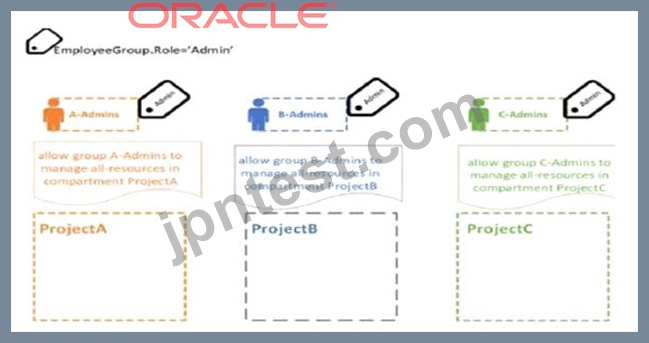
You want to set up a Test compartment for members of the three projects to share. You also need to provideadmin access to all three of your existing admin groups.
Which policy would you write to accomplish this task?
- A. Allow any-user to manage all-resources in compartment Test where request.principal.group.tag.EmployeeGroup.Role='Admin'
- B. Allow dynamic-group to manage all-resources in compartment Test where request.principal.group.tag.EmployeeGroup.Role='Admin'
- C. Allow group any-group to manage all-resources in compartment Test where request.principal.group.tag.EmployeeGroup.Role='Admin'
- D. Allow all-group to manage all-resources in compartment Test where
request.principal.group.tag.EmployeeGroup.Role='Admin'
正解:D
解説:
Explanation
Allow all-group to manage all-resources in compartment Test where
request.principal.group.tag.EmployeeGroup.Role='Admin' is the policy that would accomplish this task. This policy grants admin access to all groups that have the tag EmployeeGroup.Role='Admin' in the compartment Test. The other options are not correct, as they use incorrect terms such as dynamic-group, any-group, or any-user. References: [Tag-Based Authorization]
質問 # 41
You are part of a team that manages a set of workload instances running in an on-premises environment. The Architect team is tasked with designing and configuring Oracle Cloud Infrastructure (OCI) Logging service to collect logs from these instances. There is a requirement to archive Info-level logging data of these instances into the OCI Object Storage.
Which TWO features of OCI can help you achieve this?
- A. Cloud Agent Plugin
- B. Agent Configuration
- C. Grouping Function
- D. ObjectCollectionRule
- E. Service Connectors
正解:A、E
解説:
Cloud Agent Plugin and Service Connectors are two features of OCI that can help collect logs from on-premises instances and archive them into OCI Object Storage. Cloud Agent Plugin is a component of the OCI Logging service that can be installed on any Linux or Windows instance to collect logs and send them to OCI. Service Connectors are components of the OCI Service Connector Hub that can transfer data between different OCI services, such as Logging and Object Storage. The other options are not relevant for this requirement. Reference: [Cloud Agent Plugin], [Service Connectors]
質問 # 42
Which is NOT a valid option for an Oracle Cloud Infrastructure (OCI) compute shape?
- A. Bare Metal
- B. Virtual Machine
- C. Dedicated Virtual Machine Host
- D. Exadata Virtual Machine
正解:D
解説:
Explanation
Exadata Virtual Machine is not a valid option for an OCI compute shape. Exadata Virtual Machine is a deployment option for Exadata Cloud Service or Exadata Cloud@Customer, which are services that provide dedicated Exadata infrastructure for running Oracle databases in OCI. Exadata Virtual Machine allows you to create multiple virtual machines on each Exadata compute node and isolate them from each other using Oracle VM technology. The valid options for OCI compute shapes are:
Bare Metal: A bare metal instance is a physical server that gives you direct access to the underlying hardware and full isolation from other tenants.
Dedicated Virtual Machine Host: A dedicated virtual machine host is a physical server that hosts only your virtual machine instances and no other tenant's instances.
Virtual Machine: A virtual machine instance is a virtual server that runs on a shared physical server with other tenants' instances.
Burstable: A burstable instance is a virtual machine instance that has a baseline utilization of either 12% or 50% of each CPU core and can burst above the baseline when needed.
質問 # 43
......
1z0-1072-23試験問題集簡単なまとめ:https://www.jpntest.com/shiken/1z0-1072-23-mondaishu
1z0-1072-23最新Oracle Cloudトレーニングと認定をゲット:https://drive.google.com/open?id=1HSjjM5jd7qk1ifR6nv5qW0TuIkmdW6hV