

[2022年11月] 検証済みGoogle試験問題集でProfessional-Machine-Learning-Engineer試験学習ガイド
ベスト品質のGoogle Professional-Machine-Learning-Engineer試験解答リアル練習試験問題集で[2022]
質問 60
Your company manages a video sharing website where users can watch and upload videos. You need to create an ML model to predict which newly uploaded videos will be the most popular so that those videos can be prioritized on your company's website.
Which result should you use to determine whether the model is successful?
- A. The Pearson correlation coefficient between the log-transformed number of views after 7 days and 30 days after publication is equal to 0.
- B. The model predicts 95% of the most popular videos measured by watch time within 30 days of being uploaded.
- C. The model predicts 97.5% of the most popular clickbait videos measured by number of clicks.
- D. The model predicts videos as popular if the user who uploads them has over 10,000 likes.
正解: B
質問 61
You are going to train a DNN regression model with Keras APIs using this code: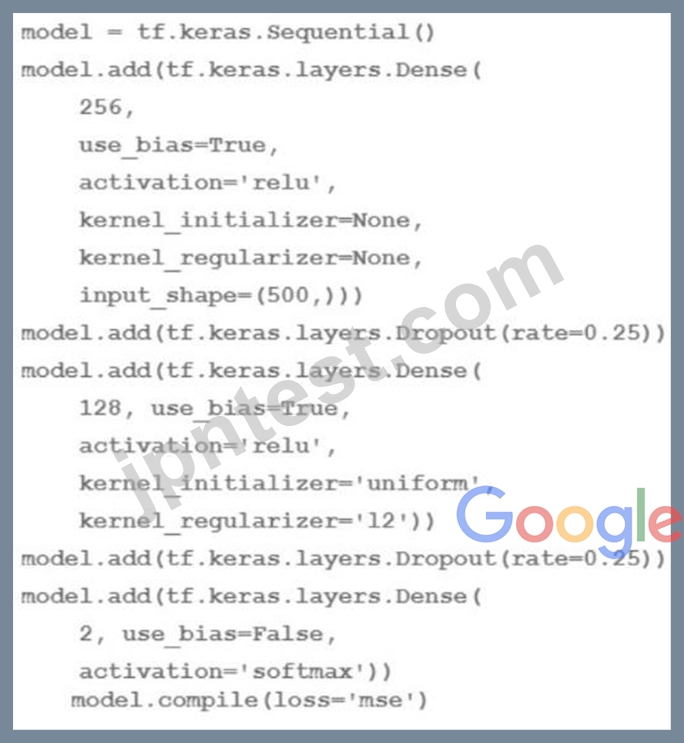
How many trainable weights does your model have? (The arithmetic below is correct.)
- A. 500*256+256*128+128*2 = 161024
- B. 500*256*0 25+256*128*0 25+128*2 = 40448
- C. 501*256+257*128+2 = 161154
- D. 501*256+257*128+128*2=161408
正解: B
質問 62
A Data Scientist wants to gain real-time insights into a data stream of GZIP files.
Which solution would allow the use of SQL to query the stream with the LEAST latency?
- A. Amazon Kinesis Data Analytics with an AWS Lambda function to transform the data.
- B. An Amazon Kinesis Client Library to transform the data and save it to an Amazon ES cluster.
- C. Amazon Kinesis Data Firehose to transform the data and put it into an Amazon S3 bucket.
- D. AWS Glue with a custom ETL script to transform the data.
正解: A
解説:
Explanation/Reference: https://aws.amazon.com/big-data/real-time-analytics-featured-partners/
質問 63
You work for a large technology company that wants to modernize their contact center. You have been asked to develop a solution to classify incoming calls by product so that requests can be more quickly routed to the correct support team. You have already transcribed the calls using the Speech-to-Text API. You want to minimize data preprocessing and development time. How should you build the model?
- A. Use the Cloud Natural Language API to extract custom entities for classification
- B. Use AutoML Natural Language to extract custom entities for classification
- C. Build a custom model to identify the product keywords from the transcribed calls, and then run the keywords through a classification algorithm
- D. Use the Al Platform Training built-in algorithms to create a custom model
正解: D
質問 64
An employee found a video clip with audio on a company's social media feed. The language used in the video is Spanish. English is the employee's first language, and they do not understand Spanish. The employee wants to do a sentiment analysis.
What combination of services is the MOST efficient to accomplish the task?
- A. Amazon Transcribe, Amazon Comprehend, and Amazon SageMaker seq2seq
- B. Amazon Transcribe, Amazon Translate, and Amazon Comprehend
- C. Amazon Transcribe, Amazon Translate and Amazon SageMaker BlazingText
- D. Amazon Transcribe, Amazon Translate, and Amazon SageMaker Neural Topic Model (NTM)
正解: D
質問 65
You work for an online retail company that is creating a visual search engine. You have set up an end-to-end ML pipeline on Google Cloud to classify whether an image contains your company's product. Expecting the release of new products in the near future, you configured a retraining functionality in the pipeline so that new data can be fed into your ML models. You also want to use Al Platform's continuous evaluation service to ensure that the models have high accuracy on your test data set. What should you do?
- A. Extend your test dataset with images of the newer products when they are introduced to retraining
- B. Keep the original test dataset unchanged even if newer products are incorporated into retraining
- C. Update your test dataset with images of the newer products when your evaluation metrics drop below a pre-decided threshold.
- D. Replace your test dataset with images of the newer products when they are introduced to retraining.
正解: A
質問 66
You work for a bank and are building a random forest model for fraud detection. You have a dataset that includes transactions, of which 1% are identified as fraudulent.
Which data transformation strategy would likely improve the performance of your classifier?
- A. Use one-hot encoding on all categorical features.
- B. Oversample the fraudulent transaction 10 times.
- C. Write your data in TFRecords.
- D. Z-normalize all the numeric features.
正解: B
質問 67
You built a custom ML model using scikit-learn. Training time is taking longer than expected. You decide to migrate your model to Vertex AI Training, and you want to improve the model's training time. What should you try out first?
- A. Train your model in a distributed mode using multiple Compute Engine VMs.
- B. Migrate your model to TensorFlow, and train it using Vertex AI Training.
- C. Train your model using Vertex AI Training with GPUs.
- D. Train your model with DLVM images on Vertex AI, and ensure that your code utilizes NumPy and SciPy internal methods whenever possible.
正解: D
質問 68
You have been asked to productionize a proof-of-concept ML model built using Keras. The model was trained in a Jupyter notebook on a data scientist's local machine. The notebook contains a cell that performs data validation and a cell that performs model analysis. You need to orchestrate the steps contained in the notebook and automate the execution of these steps for weekly retraining. You expect much more training data in the future. You want your solution to take advantage of managed services while minimizing cost. What should you do?
- A. Write the code as a TensorFlow Extended (TFX) pipeline orchestrated with Vertex AI Pipelines. Use standard TFX components for data validation and model analysis, and use Vertex AI Pipelines for model retraining.
- B. Move the Jupyter notebook to a Notebooks instance on the largest N2 machine type, and schedule the execution of the steps in the Notebooks instance using Cloud Scheduler.
- C. Rewrite the steps in the Jupyter notebook as an Apache Spark job, and schedule the execution of the job on ephemeral Dataproc clusters using Cloud Scheduler.
- D. Extract the steps contained in the Jupyter notebook as Python scripts, wrap each script in an Apache Airflow BashOperator, and run the resulting directed acyclic graph (DAG) in Cloud Composer.
正解: A
質問 69
You work for a global footwear retailer and need to predict when an item will be out of stock based on historical inventory dat a. Customer behavior is highly dynamic since footwear demand is influenced by many different factors. You want to serve models that are trained on all available data, but track your performance on specific subsets of data before pushing to production. What is the most streamlined and reliable way to perform this validation?
- A. Use k-fold cross-validation as a validation strategy to ensure that your model is ready for production.
- B. Use the entire dataset and treat the area under the receiver operating characteristics curve (AUC ROC) as the main metric.
- C. Use the last relevant week of data as a validation set to ensure that your model is performing accurately on current data
- D. Use the TFX ModelValidator tools to specify performance metrics for production readiness
正解: D
解説:
https://www.tensorflow.org/tfx/guide/evaluator
質問 70
A Machine Learning Specialist is required to build a supervised image-recognition model to identify a cat. The ML Specialist performs some tests and records the following results for a neural network-based image classifier:
Total number of images available = 1,000
Test set images = 100 (constant test set)
The ML Specialist notices that, in over 75% of the misclassified images, the cats were held upside down by their owners.
Which techniques can be used by the ML Specialist to improve this specific test error?
- A. Increase the number of epochs for model training
- B. Increase the training data by adding variation in rotation for training images.
- C. Increase the dropout rate for the second-to-last layer.
- D. Increase the number of layers for the neural network.
正解: A
質問 71
Your team is building a convolutional neural network (CNN)-based architecture from scratch. The preliminary experiments running on your on-premises CPU-only infrastructure were encouraging, but have slow convergence. You have been asked to speed up model training to reduce time-to-market. You want to experiment with virtual machines (VMs) on Google Cloud to leverage more powerful hardware. Your code does not include any manual device placement and has not been wrapped in Estimator model-level abstraction. Which environment should you train your model on?
- A. A Deep Learning VM with an n1-standard-2 machine and 1 GPU with all libraries pre-installed.
- B. AVM on Compute Engine and 1 TPU with all dependencies installed manually.
- C. A Deep Learning VM with more powerful CPU e2-highcpu-16 machines with all libraries pre-installed.
- D. AVM on Compute Engine and 8 GPUs with all dependencies installed manually.
正解: A
解説:
https://cloud.google.com/deep-learning-vm/docs/cli#creating_an_instance_with_one_or_more_gpus
https://cloud.google.com/deep-learning-vm/docs/introduction#pre-installed_packages
"speed up model training" will make us biased towards GPU,TPU options by options eliminations we may need to stay away of any manual installations , so using preconfigered deep learning will speed up time to market
質問 72
You are the Director of Data Science at a large company, and your Data Science team has recently begun using the Kubeflow Pipelines SDK to orchestrate their training pipelines. Your team is struggling to integrate their custom Python code into the Kubeflow Pipelines SDK. How should you instruct them to proceed in order to quickly integrate their code with the Kubeflow Pipelines SDK?
- A. Use the predefined components available in the Kubeflow Pipelines SDK to access Dataproc, and run the custom code there.
- B. Use the func_to_container_op function to create custom components from the Python code.
- C. Deploy the custom Python code to Cloud Functions, and use Kubeflow Pipelines to trigger the Cloud Function.
- D. Package the custom Python code into Docker containers, and use the load_component_from_file function to import the containers into the pipeline.
正解: C
質問 73
You are an ML engineer in the contact center of a large enterprise. You need to build a sentiment analysis tool that predicts customer sentiment from recorded phone conversations. You need to identify the best approach to building a model while ensuring that the gender, age, and cultural differences of the customers who called the contact center do not impact any stage of the model development pipeline and results. What should you do?
- A. Convert the speech to text and build a model based on the words
- B. Convert the speech to text and extract sentiments based on the sentences
- C. Extract sentiment directly from the voice recordings
- D. Convert the speech to text and extract sentiment using syntactical analysis
正解: B
質問 74
You are building a model to predict daily temperatures. You split the data randomly and then transformed the training and test datasets. Temperature data for model training is uploaded hourly. During testing, your model performed with 97% accuracy; however, after deploying to production, the model's accuracy dropped to 66%. How can you make your production model more accurate?
- A. Add more data to your test set to ensure that you have a fair distribution and sample for testing
- B. Split the training and test data based on time rather than a random split to avoid leakage
- C. Normalize the data for the training, and test datasets as two separate steps.
- D. Apply data transformations before splitting, and cross-validate to make sure that the transformations are applied to both the training and test sets.
正解: A
質問 75
......
正真正銘のベスト材料Professional-Machine-Learning-Engineer:https://www.jpntest.com/shiken/Professional-Machine-Learning-Engineer-mondaishu
Professional-Machine-Learning-Engineerテストエンジン練習試験:https://drive.google.com/open?id=1mO1WBFGExs5Xs1i3kuYp1LqJQ66O-kd6