

[2024年05月09日] 信頼され続けるAD0-E134試験のコツがあるPDF試験材料
2024年最新のAD0-E134テスト解説(更新されたのは52問があります)
Adobe AD0-E134 認定試験の出題範囲:
| トピック | 出題範囲 |
|---|---|
| トピック 1 |
|
| トピック 2 |
|
| トピック 3 |
|
| トピック 4 |
|
| トピック 5 |
|
| トピック 6 |
|
| トピック 7 |
|
質問 # 30
An AEM application wants to set up multi-tenancy using Adobe-recommended best practices and bind multiple configurations to it. Which of the following options is recommended?
- A. import org.apache.felix.scr.annotations.Component; @Component(label = "My configuration", metatype = true, factory= true)
- B. @Component(service = ConfigurationFactory.class)
@Designate(ocd = ConfigurationFactorylmpl.Config.class, factory=true) - C. import org.osgi.service.component.annotations.Component; @Component(service = ConfigurationFactory.class)
- D. import org.osgi.service.metatype.annotations.AttributeDefinition;
import org.osgi.service.metatype.annotations.ObjectClassDefinition;
@ObjectClassDefinition(name = "My configuration")
正解:B
解説:
Explanation
The @Component(service = ConfigurationFactory.class) @Designate(ocd =
ConfigurationFactorylmpl.Config.class,factory=true) option is recommended for creating a multi-tenancy configuration and binding multiple configurations to it. This option uses the OSGi R6 annotations to define a component that provides a service of type ConfigurationFactory and designates a class that contains the configuration properties. The factory=true attribute indicates that multiple configurations can be created for this component.
References:https://experienceleague.adobe.com/docs/experience-manager-65/deploying/configuring/osgi-configu
質問 # 31
A customer adds third-party client libraries to add some features in an existing AEM application, which will significantly reduce performance.
How should the developer optimize the site?
- A. Rebuild Client libraries.
- B. Embed client libraries to consolidate them into fewer files.
- C. Debug third-party client lib and fix the code.
正解:B
解説:
Explanation
Embedding client libraries is a technique that allows combining code from multiple client libraries into a single file. This reduces the number of network requests and improves performance. Embedding client libraries can be done by using the embed property of the cq:ClientLibraryFolder node and specifying the categories of the client libraries to be embedded. References:
https://experienceleague.adobe.com/docs/experience-manager-cloud-service/content/implementing/developing/fu
質問 # 32
An AEM as a Cloud Service implementation customer wants content to be replicated as soon as the On Time and Off Times are reached.
What must the developer configure?
- A. Enable Auto Replicate via On Off Trigger Configuration
- B. Configure the Publish content tree via Workflow Models
- C. Enable On Time or Off Time via Page Properties
正解:A
解説:
Explanation
The Auto Replicate via On Off Trigger Configuration is a feature that allows content to be replicated as soon as the On Time and Off Times are reached. This feature can be enabled by creating an OSGi configuration for the com.day.cq.wcm.core.impl.servlets.OnOffTimeServlet service. This service listens for changes in the On Time and Off Time properties of pages andtriggers replication accordingly. References:
https://experienceleague.adobe.com/docs/experience-manager-65/deploying/configuring/replication.html?lang=e
質問 # 33
A development team is starting a new AEM project that is going to integrate with the Adobe Commerce platform. The developer needs to create a new AEM project using the Maven command line interface.
How can the 'mvn -B archetype:generate' command help the developer with the integration between AEM and Adobe Commerce?
- A. Using the property 'commerceModule=AdobeCommerce' can provide a path to an external jar that integrates between the platforms.
- B. Using the property ,aemVersion=cloudl automatically provides a report with integration guidelines.
- C. Using the property 'includeCommerce=y'1 the command will generate specific Commerce Core Components.
正解:C
解説:
Explanation
The includeCommerce property is a boolean flag that indicates whether to include Commerce Core Components in the project or not. If set to y, the command will generate a commerce module that contains specific Commerce Core Components and their dependencies. These components can be used to integrate AEM with Adobe Commerce platform or other commerce solutions. References:
https://experienceleague.adobe.com/docs/experience-manager-core-components/using/developing/archetype/usin
質問 # 34
Which tool should a developer use to look up Adobe Identity Management System (IMS) users by email and return their IMS IDs?
- A. IMS Lookup Tool
- B. User Mapping Tool
- C. Cloud Acceleration
- D. Developer Console
正解:A
解説:
Explanation
The IMS Lookup Tool is a tool that allows looking up Adobe Identity Management System (IMS) users by email and returning their IMS IDs. The IMS Lookup Tool is available in the Cloud Manager UI under the Tools menu. The IMS Lookup Tool can be used to find the IMS IDs of users who need to be added to Cloud Manager programs or environments. References:
https://experienceleague.adobe.com/docs/experience-manager-cloud-service/implementing/using-cloud-manager
質問 # 35
Which configuration/section should be used to resolve the domain name by dispatcher?
- A. Configuration in filters.any
- B. Configuration in DNS
- C. Configuration in vhosts file
- D. Configuration in httpd.conf
正解:B
解説:
Explanation
The configuration in DNS (Domain Name System) should be used to resolve the domain name by dispatcher.
The DNS resolves the domain names to the IP address of the web server that hosts the dispatcher. The dispatcher then matches the incoming request URL with the cached files or the AEM publish instances.
References:https://experienceleague.adobe.com/docs/experience-manager-dispatcher/using/configuring/dispatche
質問 # 36
Which AEM as a Cloud Service role can configure or run pipelines?
- A. DevOps
- B. Deployment Manager
- C. Program Manager
- D. Developer
正解:B
解説:
Explanation
The Deployment Manager is a role that can configure or run pipelines in Cloud Manager. The Deployment Manager can create and edit programs and environments, configure pipelines, start and cancel pipeline executions, and approve or reject deployments to production. The Deployment Manager role requires an IMS ID that is associated with the Adobe Experience Cloud product profile. References:
https://experienceleague.adobe.com/docs/experience-manager-cloud-service/implementing/using-cloud-manager
質問 # 37
An AEM Developer receives requirements for Sling Models in a human-readable yaml format. A custom application needs to be built. The dependency is as shown:
- A. 1. Create OSGI models to export as yaml
2. Configure mime type in Apache Sling MIME Type Service - B. 1. Create Sling models to export as yaml
2. Configure mime type in Apache Sling MIME Type Service - C. 1. Create Sling models to export as yaml
2. Configure mime type in Apache Sling Referrer Filter - D. 1. Create OSGI models to export as yaml
2. Configure mime type in Apache Sling Servlet/Script Resolver and Error Handler
正解:B
解説:
Explanation
To create Sling Models that can export data in a human-readable yaml format, the following steps are required:
* Create Sling models to export as yaml. Sling models are Java classes that can be used to represent resources in AEM. Sling models can use annotations to define how they can be adapted from a resource and how they can export data in different formats. To export data in yaml format, the Sling model class needs to use the @Model annotation with the resourceType parameter set to the resource type of the resource that the model represents. The Sling model class also needs to implement the org.apache.sling.models.annotations.Exporter annotation with the name parameter set to "jackson" and the extensions parameter set to "yaml". The Sling model class also needs to use the @JsonProperty annotation on the fields or methods that need to be exported in yaml format.
* Configure mime type in Apache Sling MIME Type Service. The Apache Sling MIME Type Service is an OSGi service that maps file extensions to MIME types and vice versa. To enable the yaml format for Sling models, the MIME Type Service needs to be configured with a new entry for the yaml extension and its corresponding MIME type, which is "application/x-yaml". This can be done by creating an OSGi configuration for the org.apache.sling.commons.mime.internal.MimeTypeServiceImpl service and adding the entry "yaml=application/x-yaml" to the mime.types property. References:
https://sling.apache.org/documentation/bundles/models.html
https://sling.apache.org/documentation/bundles/mime-type-support-commons-mime.html
質問 # 38
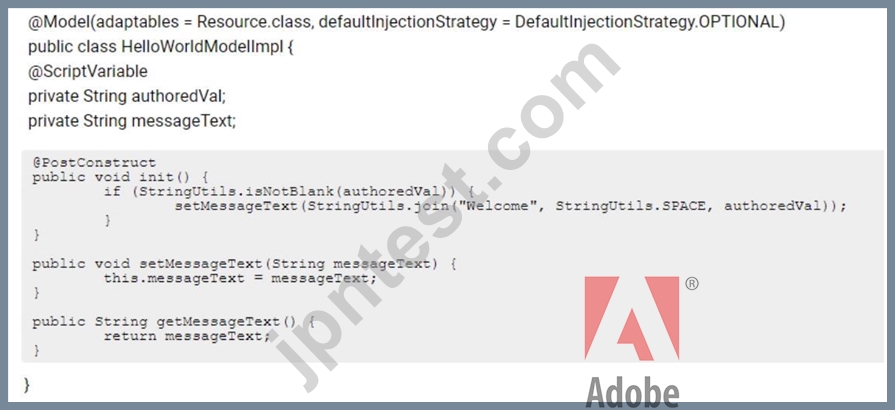
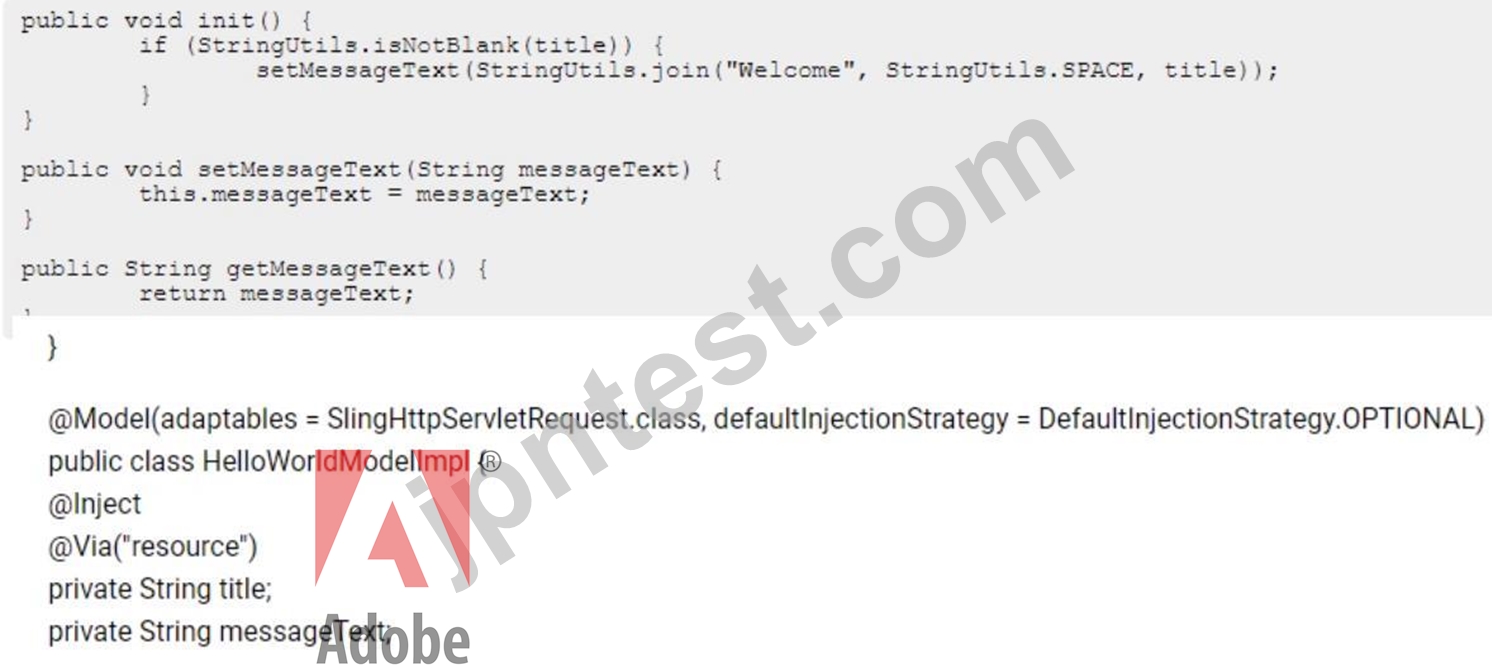
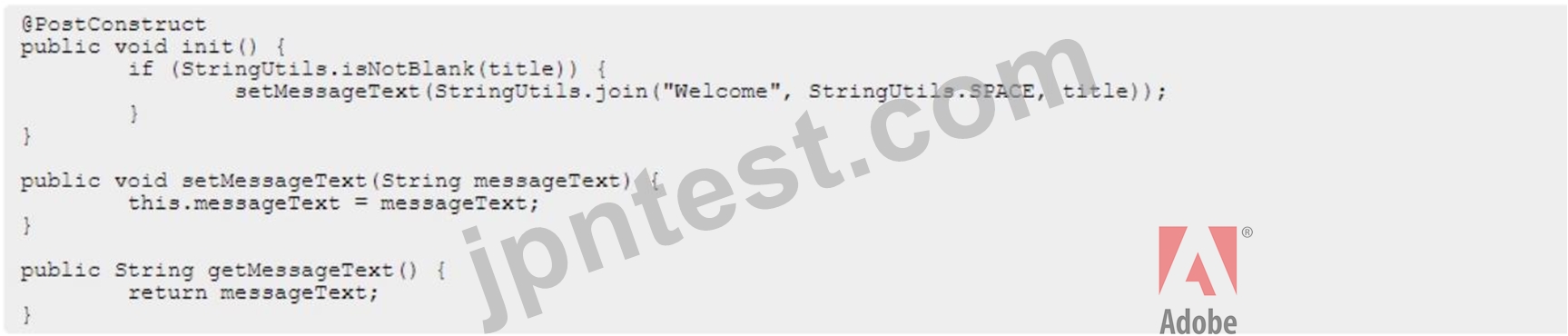
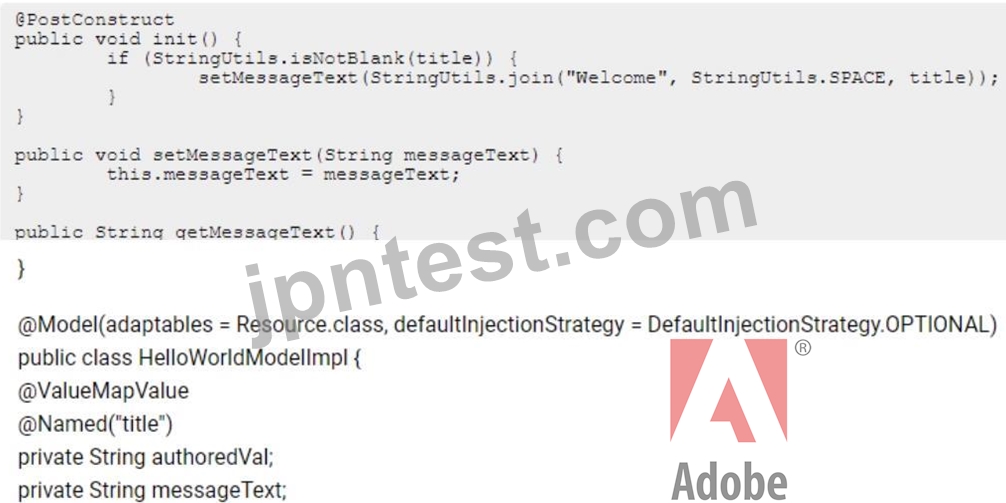
A custom component has one dialog field:
The developer needs to implement a Sling Model to perform a business logic on the authored value. The developer writes the following HTL snippet.
Which two implementations will support this HTL snippet? (Choose two.)
- A.
- B.
- C.
- D.
正解:B、C
解説:
Explanation
Option B and Option D are two implementations that will support the HTL snippet. Option B uses the
@Model annotation with the adaptables parameter set to Resource.class. This allows the Sling Model to adapt from a resource object and access its properties using the ValueMap interface. Option B also uses the @Inject annotation with the name parameter set to "./text" to inject the value of the text property into the text field.
Option D uses the @Model annotation with the defaultInjectionStrategy parameter set to OPTIONAL. This allows the Sling Model to use optional injection for all fields and avoid null pointer exceptions if a property is missing. Option D also uses the @Inject annotation without any parameters to inject the value of the text property into the text field, using the field name as the default property name. References:
https://sling.apache.org/documentation/bundles/models.htmlhttps://experienceleague.adobe.com/docs/experience
質問 # 39
Which configuration must be applied to enable re-fetching of cached items based on Cache Headers sent by AEM?
- A. /enableTTL "1"
- B. /enableTTLtrue
- C. /autolnvalidate true
- D. /autolnvalidate "1"
正解:A
解説:
Explanation
The /enableTTL "1" configuration must be applied to enable re-fetching of cached items based on Cache Headers sent by AEM. This configuration enables the Time To Live (TTL) feature of dispatcher, which allows dispatcher to check the Cache-Control and Expires headers of the cached files and re-fetch them from AEM if they are expired.
References:https://experienceleague.adobe.com/docs/experience-manager-dispatcher/using/configuring/page-inv
質問 # 40
Which environment-specific configuration is used in AEM as a Cloud Service to store private API keys?
- A. $[secret:SECRET_VAR_NAME]
- B. $[env:ENV_VAR_NAME]
- C. $[secret:ENV_VAR_NAME]
- D. $[env:SECRET_VAR_NAME]
正解:A
解説:
Explanation
This syntax allows the developer to reference a secret variable that is stored in the Cloud Manager UI under Environment Details > Variables. The secret variable name must start with a lowercase letter and can contain alphanumeric characters and underscores. References:
https://experienceleague.adobe.com/docs/experience-manager-cloud-service/implementing/deploying/configurin
質問 # 41
Which Maven plugin checks if all the requirements declarations made in OSGi bundles are satisfied by the capabilities declarations of other bundles included in the Maven project?
- A. maven-enforcer-plugin
- B. aemanalyser-maven-plugin
- C. content-package-maven-plugin
- D. femaven-assembly-plugin
正解:B
解説:
Explanation
The aemanalyser-maven-plugin is a Maven plugin that checks if all the requirements declarations made in OSGi bundles are satisfied by the capabilities declarations of other bundles included in the Maven project.
This plugin ensures that the OSGi bundles are consistent and can be resolved at runtime. The plugin also checks for other issues such as API compatibility, package versioning, and bundle start order. References:
https://experienceleague.adobe.com/docs/experience-manager-cloud-service/implementing/developing/aem-proje
質問 # 42
If multiple configurations for the same PID are applicable, which configuration is applied?
- A. The configuration with the highest number of matching run modes is applied.
- B. The one that occurs first in the repository is applied.
- C. The last modified configuration is applied.
- D. A configuration factory is created and all configurations are applied.
正解:A
解説:
Explanation
When multiple configurations for the same PID are applicable, the configuration with the highest number of matching runmodes is applied. This is because the runmodes act as a filter to select the most specific configuration for a given environment. If there is a tie between two or more configurations with the same number of matching runmodes, the one that occurs first in the repository is applied.
References:https://experienceleague.adobe.com/docs/experience-manager-65/deploying/configuring/configure-ru
質問 # 43
AEM SPA integration provides various design models. In an application the developer chooses to use AEM as a headless CMS without using the SPA Editor SDK framework.
What would be an advantage for this design model?
- A. The content author can edit the app using AEM's content authoring experience.
- B. The developer has full control over the app.
- C. The developer keeps control over the app by only enabling authoring in restricted areas of the app
- D. The SPA is compatible with the template editor
正解:B
解説:
Explanation
AEM SPA integration provides various design models for different levels of authoring capabilities and developer control. In the design model where AEM is used as a headless CMS without using the SPA Editor SDK framework, the developer has full control over the app and can use any SPA framework or library.
However, this also means that the content author cannot edit the app using AEM's content authoring experience, the SPA is not compatible with the template editor, and the developer cannot enable authoring in restricted areas of the app.
References:https://experienceleague.adobe.com/docs/experience-manager-learn/spa-editor-overview/spa-overvie
質問 # 44
SPA components are connected to AEM components via the MapTo() method.
Which code should be used to correctly connect an SPA component called ItemList to its AEM equivalent?
- A. MapToCproject/cornponents/content/itemList^ltemListJtemListEditConfig);
- B. ItemList.MapToCproject/components/content/itemList1);
- C. MapTo(ltemList)('project/components/content/itemList,,ltemListEditConfig);
- D. ('project/components/content/itemList,).MapTo(ltemList,ltemListEditConfig);
正解:B
解説:
Explanation
The MapTo() method is used to map a SPA component to an AEM component by specifying the sling:resourceType of the AEM component as an argument. The MapTo() method should be called on the SPA component and not on a string. The second argument of the MapTo() method is optional and can be used to provide an edit configuration for the SPA component.
質問 # 45
Which attribute must be present in all filter rules in AEM dispatcher configuration?
- A. /glob
- B. /selectors
- C. /type
- D. /url
正解:A
解説:
Explanation
The /glob attribute is mandatory for all filter rules in the dispatcher configuration. It specifies a pattern that is matched against the incoming request URL. If the pattern matches, the rule is applied. The /glob attribute can use wildcards (*) and placeholders ($1, $2, etc.) to match parts of the URL.
References:https://experienceleague.adobe.com/docs/experience-manager-dispatcher/using/configuring/dispatche
質問 # 46
What two types of testing are available OOB in AEM Cloud Manager Pipeline? (Select Two.)
- A. Integration testing
- B. Penetration testing
- C. Code Quality testing
- D. Performance testing
- E. Ul testing
正解:C、E
解説:
Explanation
Code Quality testing and UI testing are two types of testing that are available OOB in AEM Cloud Manager Pipeline. Code Quality testing checks the code quality of the project using SonarQubeand reports any issues or vulnerabilities. UI testing checks the functionality and usability of the project using Selenium WebDriver and reports any errors or failures. References:
https://experienceleague.adobe.com/docs/experience-manager-cloud-service/implementing/testing/testing-overvi
https://experienceleague.adobe.com/docs/experience-manager-cloud-service/implementing/testing/code-quality-t
質問 # 47
Which property under /cache on dispatcher.any file identifies the directory where cached files are stored?
- A. /cacheroot
- B. /statfile
- C. /docroot
- D. /invalidate
正解:A
解説:
Explanation
The /cacheroot property under /cache in the dispatcher.any file identifies the directory where cached files are stored. It is a relative or absolute path to the cache root directory. The dispatcher creates a subdirectory for each virtual host under this directory and stores thecached files there.
References:https://experienceleague.adobe.com/docs/experience-manager-dispatcher/using/configuring/dispatche
質問 # 48
An AEM development team is working on a new multi-country application using AEM as a Cloud Service. A developer has been assigned the task for building the integration with a third-party web service. A secret key is needed to connect with this web service. The website creators will provide this key. The key is different for each type of environment (dev, stage and production) What is the recommended way to make the secret key available in the AEM application?
- A. Read the key value from OSGi configuration stored in run nNdes
- B. Use a context aware configuration
- C. Read the key value from a property file stored in the code base
- D. Use an environment variable which is then consumed by an OSGi configuration
正解:D
解説:
Explanation
The recommended way to make the secret key available in the AEM application is to use an environment variable which is then consumed by an OSGi configuration. This way, the secret key is not stored in the code base or in the repository, but rather in a secure and encrypted way in the Cloud Manager environment variables. The OSGi configuration can use a placeholder to reference the environment variable and inject its value at runtime. References:
https://experienceleague.adobe.com/docs/experience-manager-cloud-service/implementing/deploying/configurin
質問 # 49
An AEM application requires LDAP Service integration to synchronize users/groups. Which two OSGi configuration are required for LDAP integration in AEM? (Select Two.)
- A. Apache Jackrabbit Oak Default Sync Handler
- B. Apache Jackrabbit Oak Solr server provider
- C. Apache Jackrabbit Oak AuthorizableActionProvider
- D. Apache Jackrabbit Oak CUG Configuration
- E. Apache Jackrabbit Oak External Login Module
正解:A、E
解説:
Explanation
The Apache Jackrabbit Oak External Login Module and Apache Jackrabbit Oak Default Sync Handler are the two OSGi configurations that are required for LDAP integration in AEM. The External Login Module defines how AEM connects to the LDAP server and authenticates users against it. The Default Sync Handler defines how AEM synchronizes users and groups from the LDAP server to the repository.
References:https://experienceleague.adobe.com/docs/experience-manager-65/administering/security/ldap-config.
質問 # 50
......
AD0-E134認定ガイドPDFは100%カバー率でリアル試験問題:https://www.jpntest.com/shiken/AD0-E134-mondaishu
AD0-E134試験問題集を提供していますAdobe問題:https://drive.google.com/open?id=1ur-ZVz61LipTN6_QRNa4uZ6rHlPmwlZI