

[2024年12月]更新のOGEA-101試験資料The Open Group学習ガイド
有効な問題最新版を試そうOGEA-101テスト解釈OGEA-101有効な試験ガイド
質問 # 56
Refer to the Exhibit.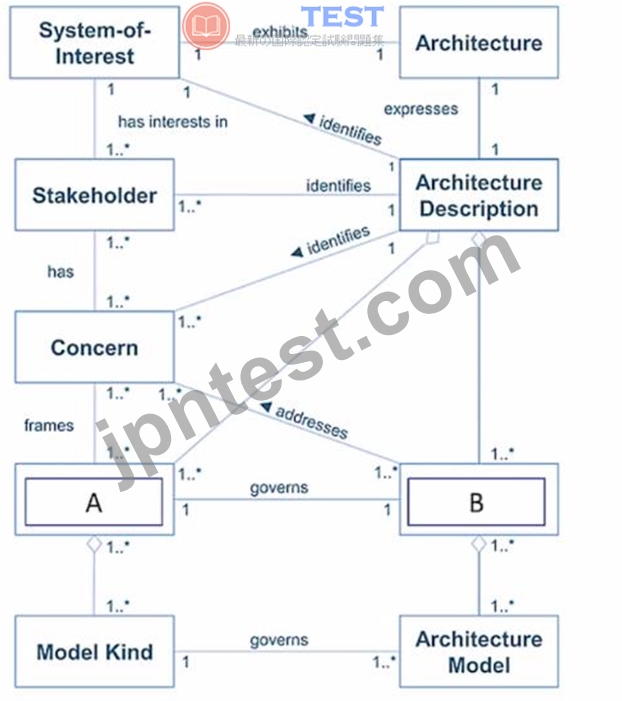
Consider the image showing basic architectural concepts.
What are items A and B?
- A. A-Candidate Architecture, B-Trade-off
- B. A-Architecture Viewpoint, B-Architecture View
- C. A-Architecture Board, B-Architecture Capability
- D. A-Requirement. B-Candidate Architecture
正解:B
解説:
The image shows a diagram that illustrates the basic concepts of architecture description as defined by the ISO/IEC/IEEE 42010:2011 standard1, which is also adopted by the TOGAF standard2.
According to the ISO/IEC/IEEE 42010:2011 standard, an architecture description is a work product used to express an architecture, and it consists of one or more architecture views1.
An architecture view is a representation of a system from the perspective of a related set of concerns, and it conforms to an architecture viewpoint1.
An architecture viewpoint is a specification of the conventions for constructing and using an architecture view to address specific stakeholder concerns1.
Therefore, the correct answer is option A, which identifies the items labeled as "A" and "B" in the image as an architecture viewpoint and an architecture view, respectively. Reference:
1: ISO/IEC/IEEE 42010:2011 - Systems and software engineering - Architecture description1
2: TOGAF Standard, Version 9.2 - Part IV: Architecture Content Framework - 31. Architectural Artifacts2
質問 # 57
Consider the following ADM phases objectives.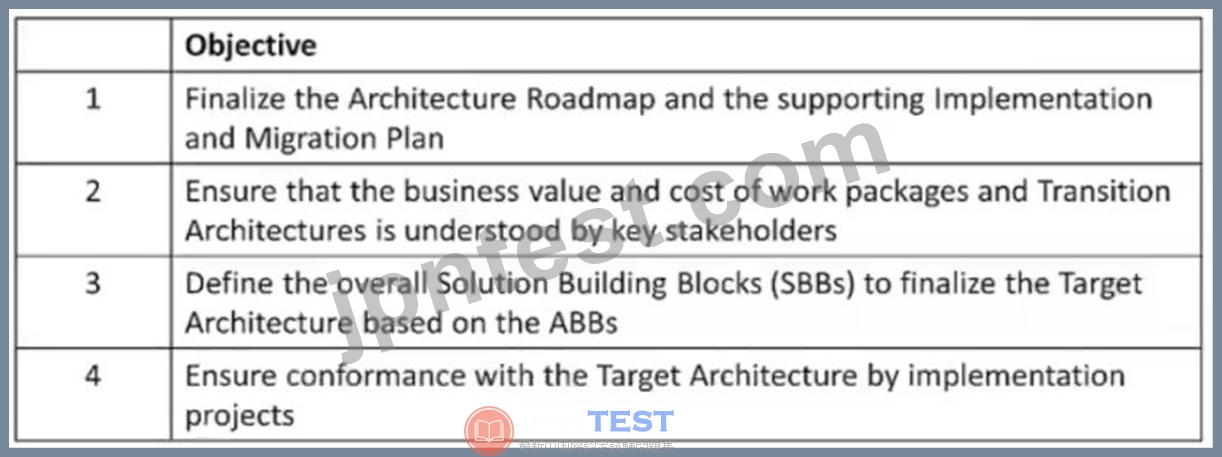
Which phase does each objective match?
- A. 1G-2E-3F-4E
- B. 1F-2G-3F-4F
- C. 1F-2F-3E-4G
- D. 1E-2F-3E-4G
正解:D
解説:
1E: To identify delivery vehicles (projects programs portfolios) that will deliver the Target Architecture 2F: To confirm readiness and ability to undergo change 3E: To determine whether an incremental approach is required and if so identify Transition Architectures that will deliver continuous business value 4G: To perform appropriate governance functions while the solution is being implemented
質問 # 58
Complete the sentence The Enterprise Continuum provides methods for classifying architecture artifacts as they evolve from________________________.
- A. Foundation Architectures to re-usable architecture assets
- B. Solutions Architectures to Solution Building Blocks
- C. generic architectures to Organization-Specific Architectures
- D. generic architectures to reusable Solution Building Blocks
正解:C
解説:
The Enterprise Continuum provides methods for classifying architecture artifacts as they evolve from generic architectures to Organization-Specific Architectures. Generic architectures are architectures that have been developed for use across a wide range of enterprises with similar characteristics. They provide common models, functions, and services that can be reused and adapted for specific purposes. Organization-Specific Architectures are architectures that have been tailored to meet the needs and requirements of a particular enterprise or a major organizational unit within an enterprise. They reflect the unique vision, goals, culture, structure, processes, systems, and technologies of that enterprise or unit. Reference: The TOGAF Standard | The Open Group Website, Section 2.3 Enterprise Continuum.
質問 # 59
What are the following activities part of?
. Risk classification
. Risk identification
. Initial risk assessment
- A. Security Architecture
- B. Phase G
- C. Phase A
- D. Risk Management
正解:D
解説:
Risk management is a generic technique that can be applied across all phases of the Architecture Development Method (ADM), as well as in the Preliminary Phase and the Requirements Management Phase2. Risk management involves the following steps1:
* Risk identification: This step involves identifying the potential risks that may affect the architecture project, such as technical, business, organizational, environmental, or legal risks. The risks can be identified through various sources, such as stakeholder interviews, workshops, surveys, checklists, historical data, or expert judgment.
* Risk classification: This step involves categorizing the risks based on their nature, source, impact, and priority. The risks can be classified according to different criteria, such as time, cost, scope, quality, security, or compliance. The classification helps in prioritizing the risks and allocating resources and efforts to address them effectively.
* Initial risk assessment: This step involves assessing the likelihood and impact of each risk, and determining the initial level of risk. The likelihood is the probability of the risk occurring, and the impact is the severity of the consequences if the risk occurs. The initial level of risk is the product of the likelihood and impact, and it indicates the urgency and importance of the risk. The initial risk assessment helps in identifying the most critical risks that need immediate attention and mitigation.
質問 # 60
Which of the following best describes purpose of the Business Scenarios?
- A. To identify risk when implementing an architecture project
- B. To catch errors in a project architecture early
- C. To identify and understand requirements
- D. To guide decision making throughout the enterprise
正解:C
解説:
Business scenarios are a technique for capturing, clarifying, and communicating the functional and non-functional requirements of a system. Business scenarios describe the business environment, the actors involved, the desired outcomes, and the processes or rules that govern the behavior of the system. Business scenarios are useful for ensuring that the architecture addresses the real needs and concerns of the stakeholders, and for validating and testing the architecture against expected situations. Business scenarios are developed in Phase A: Architecture Vision of the ADM cycle, and refined and updated throughout the other phases3 Reference: 3: The TOGAF Standard, Version 9.2, Part III: ADM Guidelines and Techniques, Chapter 26: Business Scenarios : The TOGAF Standard, Version 9.2, Part II: Architecture Development Method (ADM), Chapter 18: Phase A: Architecture Vision
質問 # 61
Which ADM phase focuses on defining the problem to be solved, identifying the stakeholders, their concerns, and requirements?
- A. Phase
- B. Phase
- C. Phase A
- D. Preliminary Phase
正解:C
解説:
Phase A: Architecture Vision is the first phase of the Architecture Development Method (ADM) cycle, which is the core of the TOGAF standard. The main purpose of this phase is to define the scope and approach of the architecture development, and to create the Architecture Vision, which is a high-level description of the desired outcomes and benefits of the proposed architecture. To achieve this purpose, this phase focuses on defining the problem to be solved, identifying the stakeholders, their concerns, and requirements, and establishing the business goals and drivers that motivate the architecture work. This phase also involves obtaining the approval and commitment of the sponsors and other key stakeholders, and initiating the Architecture Governance process.
質問 # 62
Consider the following descriptions of deliverables consumed and produced across the TOGAF ADM cycle.
1-General rules and guidelines, intended to be enduring and seldom
amended, that inform and support the way in which an organization sets
about fulfilling its mission
1-The joint agreements between development partners and sponsors on the deliverables, quality, and fitness-for-purpose of an architecture.
1-A document that is sent from the sponsoring organization to the
architecture organization to trigger the start of an architecture
development cycle
1-A set of quantitative statements that outline what an implementation
project must do in order to comply with the architecture.
Which deliverables match these descriptions?
- A. 1 Architecture Requirements Specification -2 Architecture Principles - 3 Architecture Vision - 4 Architecture Contracts
- B. 1 Architecture Principles -2 Architecture Contracts - 3 Request for Architecture Work - 4 Architecture Requirements Specification
- C. 1 Architecture Contracts - 2 Architecture Requirements Specification - 3 Architecture Vision - 4 Architecture Principles
- D. 1 Architecture Principles -2 Architecture Contracts - 3 Architecture Requirements Specification-4 Request for Architecture Work
正解:B
解説:
According to the TOGAF standard, the deliverables that match the descriptions are as follows:
* 1 Architecture Principles: These are general rules and guidelines, intended to be enduring and seldom amended, that inform and support the way in which an organization sets about fulfilling its mission1. They reflect a level of consensus among the various elements of the enterprise, and form the basis for making future IT decisions1.
* 2 Architecture Contracts: These are the joint agreements between development partners and sponsors on the deliverables, quality, and fitness-for-purpose of an architecture2. They are used to ensure that the architecture is implemented and governed according to the agreed-upon specifications and standards2.
* 3 Request for Architecture Work: This is a document that is sent from the sponsoring organization to the architecture organization to trigger the start of an architecture development cycle3. It defines the scope, schedule, budget, deliverables, and stakeholders of the architecture project3.
* 4 Architecture Requirements Specification: This is a set of quantitative statements that outline what an implementation project must do in order to comply with the architecture4. It defines the requirements for each architecture domain, as well as the relationships and dependencies among them4.
質問 # 63
Which of the following does the TOGAF standard describe as a package of functionality defined to meet business needs across an organization?
- A. A building block
- B. A solution architecture
- C. An application
- D. A deliverable
正解:A
質問 # 64
Complete the following sentence. In the ADM documents which are under development and have not undergone any formal review and approval process are_______________.
- A. Known as ''Version 0.1''
- B. Called ''draft''
- C. In between phases
- D. Invalid
正解:B
解説:
In the ADM documents which are under development and have not undergone any formal review and approval process are called "draft". This indicates that they are subject to change and refinement as the architecture development progresses. Reference: The TOGAF Standard | The Open Group Website, Section 4.2.5 Architecture Deliverables.
質問 # 65
Exhibit
Consider the illustration showing an architecture development cycle Which description matches the phase of the ADM labeled as item 2?
- A. Conducts implementation planning for the architecture defined in previous phases
- B. Establishes procedures for managing change to the new architecture
- C. Operates the process of managing architecture requirements
- D. Provides architectural oversight for the implementation
正解:D
解説:
Based on the illustration, the phase of the ADM labeled as item 2 is the Implementation Governance phase. This phase provides architectural oversight for the implementation. It ensures that the implementation project conforms to the architecture. It also provides a framework for monitoring and managing the implementation.
The Implementation Governance phase involves the following activities:
* Finalizing the Architecture Roadmap and the supporting Implementation and Migration Plan
* Assigning an Architecture Board to oversee the implementation
* Establishing Architecture Contracts with the implementation partners
* Reviewing and approving the implementation project plans and deliverables
* Performing Architecture Compliance reviews to ensure alignment with the architecture
* Performing Architecture Audit reviews to ensure quality and performance of the architecture
* Resolving any architecture issues or change requests that arise during the implementation
* Maintaining the architecture lifecycle and ensuring its continuity
The Implementation Governance phase is essential for ensuring that the architecture is realized as intended and that it delivers the expected business value and outcomes.
質問 # 66
What is an objective of the ADM Preliminary Phase?
- A. To develop a vision of the business value to be delivered by the proposed enterprise architecture
- B. To select and implement tools to support the Architecture Capability
- C. To create the initial version of the Architecture Roadmap
- D. To obtain approval for the Statement of Architecture Work
正解:B
解説:
The Preliminary Phase is the preparatory phase of the Architecture Development Method (ADM) cycle, which sets the context and direction for the architecture work. One of the objectives of this phase is to select and implement tools to support the Architecture Capability, which is the ability of an organization to perform enterprise architecture effectively and efficiently. Tools can include software applications, methods, techniques, standards, and frameworks that assist the architecture development and governance processes. The selection and implementation of tools should be based on the requirements and constraints of the organization, and the alignment with the Architecture Principles and the Architecture Vision3 Reference: 3: The TOGAF Standard, Version 9.2, Part II: Architecture Development Method (ADM), Chapter 6: Preliminary Phase : The TOGAF Standard, Version 9.2, Part VI: Architecture Capability Framework, Chapter 45: Establishing and Maintaining an Enterprise Architecture Capability : The TOGAF Standard, Version 9.2, Part VI: Architecture Capability Framework, Chapter 46: Tools for Architecture Development
質問 # 67
Exhibit
Consider the illustration showing an architecture development cycle Which description matches the phase of the ADM labeled as item 1?
- A. Operates the process of managing architecture requirements
- B. Conducts implementation planning for the architecture defined in previous phases
- C. Establishes procedures for managing change to the new architecture
- D. Provides architectural oversight for the implementation
正解:A
解説:
The illustration shows an architecture development cycle based on the TOGAF ADM (Architecture Development Method), which is a method for developing and managing an enterprise architecture1.
The ADM consists of nine phases, each with a specific purpose and output. The phases are1:
Preliminary Phase: To prepare and initiate the architecture development cycle, including defining the architecture framework, principles, and governance.
Phase A: Architecture Vision: To define the scope, vision, and stakeholders of the architecture initiative, and to obtain approval to proceed.
Phase B: Business Architecture: To describe the baseline and target business architecture, and to identify the gaps between them.
Phase C: Information Systems Architectures: To describe the baseline and target data and application architectures, and to identify the gaps between them.
Phase D: Technology Architecture: To describe the baseline and target technology architecture, and to identify the gaps between them.
Phase E: Opportunities and Solutions: To identify and evaluate the opportunities and solutions for implementing the target architecture, and to define the work packages and transition architectures.
Phase F: Migration Planning: To finalize the implementation and migration plan, and to ensure alignment with the enterprise portfolio and project management.
Phase G: Implementation Governance: To provide architecture oversight and guidance for the implementation projects, and to manage any architecture change requests.
Phase H: Architecture Change Management: To monitor the changes in the business and technology environment, and to assess the impact and performance of the architecture.
In addition to these phases, there is a central process called Requirements Management, which is labeled as item 1 in the illustration. This process operates throughout the ADM cycle, and its purpose is to manage the architecture requirements throughout the architecture development, ensuring that they are aligned with the business requirements and the stakeholder concerns2.
Therefore, the description that matches the phase of the ADM labeled as item 1 is C. Operates the process of managing architecture requirements.
Reference:
1: The TOGAF Standard, Version 9.2, Chapter 5: Architecture Development Method (ADM)
2: The TOGAF Standard, Version 9.2, Chapter 17: Requirements Management
質問 # 68
Refer to the table below: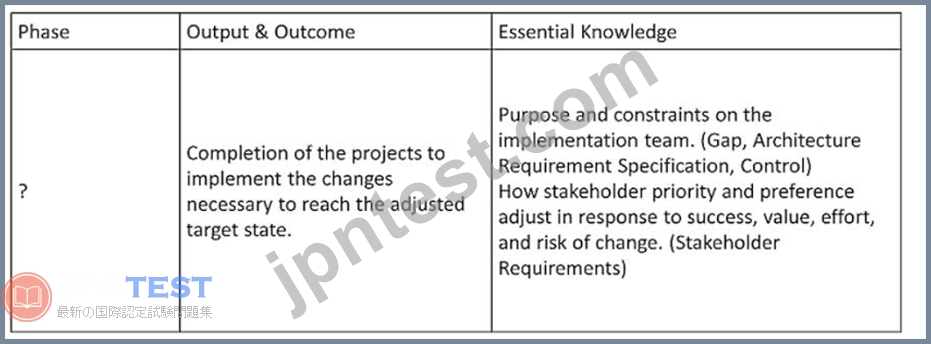
Which ADM Phase does this describe?
- A. Phase F
- B. Phase G
- C. Phase E
- D. Phase A
正解:B
解説:
The table describes the output, outcome, and essential knowledge of an ADM phase that oversees the implementation of changes necessary to reach the adjusted target state. This corresponds to Phase G, also known as Implementation Governance, which ensures that the architecture defined in earlier phases is realized, and it oversees the development and implementation of projects to align with this architecture. The essential knowledge required during this phase includes understanding constraints on the implementation team and adjusting stakeholder priority and preference in response to success, value, effort, and risk of change. Reference: TOGAF Version 9.1 - 1
質問 # 69
Consider the illustration.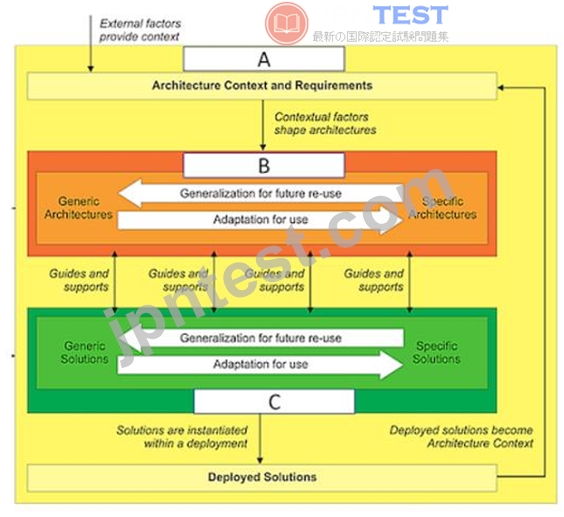
What are the items labelled A, B and C?
- A. A-Enterprise Strategic Architecture, B-Segment Architecture, C-Solutions Architecture
- B. A-Enterprise Architecture, B-Architecture Building Blocks, C-Solutions Building Blocks
- C. A-Enterprise Continuum, B-Architecture Continuum, C-Solutions Continuum
- D. A-Architecture Vision, B-Business Architecture, C-Information Systems Architecture
正解:C
解説:
The illustration shows the relationship between the Enterprise Continuum, the Architecture Continuum, and the Solutions Continuum, which are key concepts in the TOGAF framework. The Enterprise Continuum is a view of the Architecture Repository that shows how generic foundation architectures can be leveraged and specialized to support the requirements of an individual organization. The Architecture Continuum specifies a structured classification for architectural artifacts, such as models, patterns, and descriptions, that can be reused and adapted across different domains and levels of abstraction. The Solutions Continuum identifies implemented solutions that support various stages of business and IT capability evolution, such as common systems, industry solutions, and organization-specific solutions. The illustration also shows how the architecture context and requirements are influenced by external factors, such as business drivers, stakeholders, and standards, and how they shape the generic and specific architectures and solutions. The illustration also shows how the deployed solutions become part of the architecture context for future iterations of the architecture development cycle. Reference:
* TOGAF Standard, 10th Edition, Part II: Architecture Development Method, Chapter 6: Architecture Repository, Section 6.2 Enterprise Continuum.
* TOGAF Standard, 10th Edition, Part IV: Architecture Content Framework, Chapter 35: Enterprise Continuum and Tools, Section 35.1 Introduction.
質問 # 70
Consider the following statement.
Projects may cycle between ADM phases, in planned cycles covering multiple phases.
What does it illustrate?
- A. Requirements management
- B. Iteration
- C. Enterprise Architecture
- D. Implementation governance
正解:B
解説:
The statement "Projects may cycle between ADM phases, in planned cycles covering multiple phases" illustrates the concept of iteration, which is the process of repeating the ADM phases or steps within a phase to refine the architecture outputs and address the changing requirements and stakeholder concerns. Iteration can occur at different levels of granularity and scope, such as within a single phase, across multiple phases, or across the entire ADM cycle. Iteration can also be applied to different architecture domains, such as business, data, application, and technology. Iteration is a key feature of the ADM that enables the development of architectures that are fit for purpose, adaptable, and responsive to change. Reference: : The TOGAF Standard, Version 9.2, Part III: ADM Guidelines and Techniques, Chapter 24: Applying Iteration to the ADM
質問 # 71
Which statement about Requirements Management is most correct?
- A. Requirements Management is a step of all ADM Phases
- B. The purpose of Requirements Management is to process change requests
- C. Stakeholder requirements are captured once in Phase A and managed throughout the ADM cycle
- D. Requirements Management and stakeholder engagement are placed at the center of architecture development
正解:D
解説:
This statement about Requirements Management is most correct because it reflects the central role of Requirements Management and stakeholder engagement in the ADM cycle. Requirements Management is not a step of all ADM Phases, but rather an ongoing process that ensures that all relevant requirements are elicited, analyzed, prioritized, and addressed throughout the architecture development and transition. Stakeholder engagement is also a continuous activity that involves identifying, communicating, and managing stakeholder expectations and concerns. Reference: The TOGAF Standard | The Open Group Website, Section 3.1 Introduction to the ADM.
質問 # 72
According to the TOGAF standard, what term describes an individual with an interest in a system?
- A. sponsor
- B. stakeholder
- C. lead architect
- D. consumer
正解:B
解説:
According to the TOGAF Standard, 10th Edition, a stakeholder is "an individual with an interest in a system" 1. A stakeholder can be anyone who is affected by the system, or who can influence or be influenced by the system. Stakeholders can have different roles, perspectives, and concerns regarding the system, and they can be internal or external to the organization. Stakeholder management is a technique that helps to identify, analyze, and engage the stakeholders of an architecture project, and to address their needs and expectations 2. The other options are not correct, as they are not the term used by the TOGAF Standard to describe an individual with an interest in a system. A consumer is "an individual or group that uses a product or service" 1. A lead architect is "an individual who is responsible for leading the development of an architecture" 1. A sponsor is "an individual who provides funding and support for an architecture project" 1. Reference: 1: TOGAF Standard, 10th Edition, Part I: Introduction, Chapter 3: Definitions. 2: TOGAF Standard, 10th Edition, Part III: ADM Guidelines and Techniques, Chapter 24: Stakeholder Management.
質問 # 73
Which section of the TOGAF template for Architecture Principles should highlight the business benefits of adhering to the principle?
- A. Implications
- B. Name
- C. Rationale
- D. Statement
正解:C
解説:
According to the TOGAF Standard, 10th Edition, the rationale section of the architecture principles template should highlight the business benefits of adhering to the principle, as well as the business risks of not adhering to it 1. The rationale section should explain the reasoning behind the principle, and provide evidence or arguments to support it. The rationale section should also link the principle to the business drivers, goals, and objectives of the enterprise, and show how the principle contributes to the value and success of the enterprise. The other options are not correct, as they have different purposes in the architecture principles template. The name section should provide a short and memorable name for the principle, such as "Information is an Asset" or "Business Continuity" 1. The statement section should provide a concise and formal statement of the principle, such as "The enterprise's information is recognized as a core asset, and is managed accordingly" or "The enterprise's ability to provide critical services and products must be maintained in the event of a disaster" 1. The implications section should identify the impact of the principle on the enterprise, such as the changes, costs, benefits, and risks that may result from applying or violating the principle 1. Reference: 1: TOGAF Standard, 10th Edition, Part III: ADM Guidelines and Techniques, Chapter 23: Architecture Principles, Section 23.3 Developing Architecture Principles.
質問 # 74
Consider the image showing basic architectural concepts.
What are items A and B?
- A. A-Candidate Architecture, B-Trade-off
- B. A-Architecture Viewpoint, B-Architecture View
- C. A-Architecture Board, B-Architecture Capability
- D. A-Requirement. B-Candidate Architecture
正解:B
解説:
* The image shows a diagram that illustrates the basic concepts of architecture description as defined by the ISO/IEC/IEEE 42010:2011 standard1, which is also adopted by the TOGAF standard2.
* According to the ISO/IEC/IEEE 42010:2011 standard, an architecture description is a work product used to express an architecture, and it consists of one or more architecture views1.
* An architecture view is a representation of a system from the perspective of a related set of concerns, and it conforms to an architecture viewpoint1.
* An architecture viewpoint is a specification of the conventions for constructing and using an architecture view to address specific stakeholder concerns1.
* Therefore, the correct answer is option A, which identifies the items labeled as "A" and "B" in the image as an architecture viewpoint and an architecture view, respectively. Reference:
* 1: ISO/IEC/IEEE 42010:2011 - Systems and software engineering - Architecture description1
* 2: TOGAF Standard, Version 9.2 - Part IV: Architecture Content Framework - 31. Architectural Artifacts2
質問 # 75
......
OGEA-101試験問題と解答:https://www.jpntest.com/shiken/OGEA-101-mondaishu
OGEA-101実際の問題解答PDFは100%カバー率でリアル試験問題:https://drive.google.com/open?id=1wa0PwQEd7Q2Yt2cBW5XMoGUBp8OBIRsx