

[2025年更新]CLO-002試験問題集でテストエンジン練習テスト問題
合格できるCLO-002試験[2025年12月04日]最新620問題
質問 # 27
Which of the following application types is suitable for a cloud computing pilot?
- A. Mission-critical applications
- B. Desktop productivity applications
- C. Legacy applications
- D. Marginal applications
正解:B
質問 # 28
Transferring all of a customer's on-premises data and virtual machines to an appliance, and then shipping it to a cloud provider is a technique used in a:
- A. lift and shift migration approach.
- B. phased migration approach.
- C. rip and replace migration approach.
- D. replatforming migration approach.
正解:A
解説:
A lift and shift migration approach, also known as rehosting, is a cloud migration strategy where applications and infrastructure are moved from one environment to another without making substantial changes to the underlying architecture123. This approach can be faster, cheaper, and less risky than other migration strategies, as it does not require extensive redesign or reconfiguration of the applications. However, it may also limit the ability to leverage the native features and benefits of the cloud platform, such as scalability, elasticity, and performance1245.
One of the challenges of a lift and shift migration is transferring large amounts of data and virtual machines over the network, which can be time-consuming, costly, and prone to errors. To overcome this challenge, some cloud providers offer a technique where the customer can transfer all of their on-premises data and virtual machines to an appliance, such as a physical storage device or a server, and then ship it to the cloud provider. The cloud provider then uploads the data and virtual machines to the cloud platform, where they can be accessed by the customer12. This technique can reduce the network bandwidth and latency issues, as well as the security risks, associated with transferring data over the internet. However, it may also introduce additional costs and delays for shipping and handling the appliance, as well as the risk of damage or loss during transit2.
Therefore, transferring all of a customer's on-premises data and virtual machines to an appliance, and then shipping it to a cloud provider is a technique used in a lift and shift migration approach. Reference:
1: Lift and Shift: An Essential Guide | IBM
2: What Is Lift and Shift? | 5 Strategies to Consider | NetApp
3: What Is Lift and Shift Migration? | Pure Storage
4: Lift and Shift: Business Benefits, Planning and Execution - NetApp
5: Lift and Shift Cloud Migration: Benefits, Disadvantages and Use Cases ...
質問 # 29
Which of the following allows an IP address to be referenced via an easily remembered name for a SaaS application?
- A. VPN
- B. WAN
- C. CDN
- D. DNS
正解:D
質問 # 30
Which of the following is a cloud service model that organizations use when their third-party ERP tool is provided as a complete service?
- A. IaaS
- B. Public cloud
- C. SaaS
- D. Hybrid cloud
正解:C
解説:
SaaS, or software as a service, is a cloud service model that provides ready-to-use, cloud-hosted application software to customers. Customers do not need to install, manage, or maintain the software; they simply access it via an internet connection, usually through a web browser. SaaS applications are typically offered on a subscription or pay-per-use basis. Examples of SaaS applications include email, CRM, ERP, office productivity, and collaboration tools12.
SaaS is different from the other cloud service models in terms of the level of abstraction and control. In SaaS, the cloud service provider manages everything from the underlying infrastructure to the application software, while the customer only controls the application settings and data. In contrast, in IaaS (infrastructure as a service), the customer has more control and responsibility over the servers, storage, networking, and operating systems, while the cloud service provider only manages the physical infrastructure. In PaaS (platform as a service), the customer has control and responsibility over the applications and data, while the cloud service provider manages the underlying infrastructure and the development tools and platforms12.
Therefore, when an organization uses a third-party ERP tool as a complete service, it is using the SaaS cloud service model. The organization does not need to worry about the installation, configuration, or maintenance of the ERP software; it only needs to access it via the internet and pay for the usage. The cloud service provider takes care of the rest.
https://www.comptia.org/training/books/cloud-essentials-clo-002-study-guide
https://www.amazon.com/CompTIA-Essentials-Certification-Second-CLO-002/dp/1260461785
質問 # 31
A company decides to move some of its computing resources to a public cloud provider but keep the rest in-house. Which of the following cloud migration approaches does this BEST describe?
- A. Phased
- B. Lift and shift
- C. Rip and replace
- D. Hybrid
正解:D
解説:
A hybrid cloud migration approach best describes the scenario where a company decides to move some of its computing resources to a public cloud provider but keep the rest in-house. A hybrid cloud is a type of cloud deployment that combines public and private cloud resources, allowing data and applications to move between them. A hybrid cloud can offer the benefits of both cloud models, such as scalability, cost-efficiency, security, and control. A hybrid cloud migration approach can help a company to leverage the advantages of the public cloud for some workloads, while maintaining the on-premise infrastructure for others. For example, a company may choose to migrate its web applications to the public cloud to improve performance and availability, while keeping its sensitive data and legacy systems in the private cloud for compliance and compatibility reasons. A hybrid cloud migration approach can also enable a gradual transition to the cloud, by allowing the company to move workloads at its own pace and test the cloud environment before fully committing to it.
質問 # 32
Due to a drastic reduction in IT staffing, which has resulted in multiple outages, a health provider wants to migrate its internal patient's data to a cloud-based solution to ensure it is readily available. The cloud guarantees the data will be encrypted and only available to the health provider. Which of the following is the health provider's main concern when reviewing the contract?
- A. The backend IT infrastructure
- B. The type of database being used
- C. The ability to brand the application
- D. The SLA
正解:B
質問 # 33
Which of the following is a negative business impact of cloud computing?
- A. It slows down the company's ability to deal with server capacity issues.
- B. It is more difficult to ensure policy compliance.
- C. It lowers the company's overall application processing availability.
- D. It is difficult to implement problem management.
正解:B
質問 # 34
Which represents the MOST important business continuity risk?
- A. Incomplete Service Level Agreements (SLAs)
- B. Network connectivity interruption
- C. Providers going out of business
- D. Privacy laws
正解:C
質問 # 35
A cloud usage metering scheme allows for which of the following customer chargeback alternatives?
- A. Shared cost
- B. Direct cost
- C. Cost amortization
- D. Cost allocation
正解:D
質問 # 36
A company requires 24 hours' notice when a database is taken offline for planned maintenance.
Which of the following policies provides the BEST guidance about notifying users?
- A. Access control policy
- B. Information security policy
- C. Communication policy
- D. Risk management policy
正解:C
解説:
A communication policy is a set of guidelines that defines how an organization communicates with its internal and external stakeholders, such as employees, customers, partners, and regulators. A communication policy typically covers topics such as the purpose, scope, methods, frequency, tone, and responsibilities of communication within and outside the organization. A communication policy also establishes the standards and expectations for communication quality, accuracy, timeliness, and security. A communication policy is essential for ensuring effective, consistent, and transparent communication across the organization and with its stakeholders. A communication policy can help to avoid misunderstandings, conflicts, and errors that may arise from poor or unclear communication. A communication policy can also help to enhance the reputation, trust, and credibility of the organization.
質問 # 37
Which of the following allows an IP address to be referenced via an easily remembered name for a SaaS application?
- A. VPN
- B. WAN
- C. CDN
- D. DNS
正解:D
解説:
DNS stands for Domain Name System, which is a service that translates domain names into IP addresses. Domain names are easier to remember than IP addresses, and they can also change without affecting the users. For example, a SaaS application can have a domain name like www.saas.com, which can be resolved to different IP addresses depending on the location, availability, and performance of the servers. DNS allows users to access the SaaS application by typing the domain name in their browser, instead of memorizing the IP address. Reference: https://www.comptia.org/training/books/cloud-essentials-clo-002-study-guide, Chapter 2, page 43.
質問 # 38
Which of the following would be expected from a security consultant who has been hired to investigate a data breach of a private cloud instance?
- A. Risk register
- B. Request for information
- C. Incident report
- D. Application scan results
正解:C
解説:
An incident report is a document that summarizes the details of a security breach, such as the cause, impact, response, and lessons learned. It is expected from a security consultant who has been hired to investigate a data breach of a private cloud instance, as it provides a clear and concise account of what happened and how to prevent or mitigate future incidents. An incident report is also useful for communicating with stakeholders, regulators, customers, and other parties who may be affected by the breach.
Application scan results are the output of a tool that scans an application for vulnerabilities, such as SQL injection, cross-site scripting, or broken authentication. They are not expected from a security consultant who has been hired to investigate a data breach of a private cloud instance, as they are more relevant for the development and testing phases of the application lifecycle. Application scan results may help identify potential weaknesses in the application, but they do not provide a comprehensive analysis of the breach.
A request for information is a document that solicits information from vendors or service providers, such as their capabilities, pricing, or references. It is not expected from a security consultant who has been hired to investigate a data breach of a private cloud instance, as it is more relevant for the procurement and evaluation phases of the cloud service lifecycle. A request for information may help compare different cloud service options, but it does not provide a detailed report of the breach.
A risk register is a document that records the risks associated with a project or an organization, such as their likelihood, impact, mitigation strategies, and status. It is not expected from a security consultant who has been hired to investigate a data breach of a private cloud instance, as it is more relevant for the risk management and governance phases of the cloud service lifecycle. A risk register may help identify and prioritize the risks that need to be addressed, but it does not provide a specific report of the breach. Reference:
CompTIA Cloud Essentials+ CLO-002 Study Guide, Chapter 5: Security in the Cloud, Section 5.3: Incident Response, page 196 CompTIA Cloud Essentials+ CLO-002 Study Guide, Chapter 4: Cloud Service Management, Section 4.1: Cloud Service Lifecycle, page 145 CompTIA Cloud Essentials+ CLO-002 Study Guide, Chapter 2: Cloud Concepts, Section 2.4: Cloud Service Models, page 63
質問 # 39
A software development platform is in the process of being migrated from an in-house framework to a cloud-based PaaS. Which of the following development aspects is likely to be applicable in the PaaS environment?
- A. Familiarization will be required with cloud provider-based APIs, web services, and development frameworks.
- B. Cloud environments only support agile development. The software development team will need to change from their waterfall SDLC methodology before migrating.
- C. PaaS providers do not allow customers with their own software development teams to write new applications on the cloud platform.
- D. No expected change in software development process when migrating from in-house to PaaS.
正解:A
質問 # 40
A business analyst is drafting a risk assessment.
Which of the following components should be included in the draft? (Choose two.)
- A. Asset management
- B. Data classification
- C. Asset inventory
- D. Encryption algorithms
- E. Database type
- F. Certificate name
正解:B、C
解説:
A risk assessment is a process of identifying, analyzing, and controlling hazards and risks within a situation or a place1. According to the CompTIA Cloud Essentials+ Certification Study Guide, Second Edition (Exam CLO-002), a risk assessment should include the following steps2:
Identify the assets that are relevant to the scope of the assessment. Assets can be physical, such as hardware and software, or non-physical, such as data and information.
Identify the threats and vulnerabilities that could affect the assets. Threats are sources of potential harm, such as natural disasters, cyberattacks, or human errors. Vulnerabilities are weaknesses or gaps in the security or protection of the assets, such as outdated software, misconfigured settings, or lack of encryption.
Analyze the likelihood and impact of each threat-vulnerability pair. Likelihood is the probability of a threat exploiting a vulnerability, and impact is the severity of the consequences if that happens. The combination of likelihood and impact determines the level of risk for each pair.
Evaluate the risks and prioritize them based on their level. Risks can be categorized as low, medium, high, or critical, depending on the organization's risk appetite and tolerance. Risk appetite is the amount of risk that the organization is willing to accept, and risk tolerance is the degree of variation from the risk appetite that the organization can endure.
Implement appropriate controls to mitigate or reduce the risks. Controls are measures or actions that can prevent, detect, or correct the occurrence or impact of a risk. Controls can be administrative, technical, or physical, and they can have different functions, such as preventive, detective, corrective, deterrent, or compensating.
Based on these steps, two components that should be included in the draft of a risk assessment are asset inventory and data classification. Asset inventory is the process of identifying and documenting the assets that are within the scope of the assessment1. Data classification is the process of categorizing data based on its sensitivity, value, and criticality to the organization3. These components are essential for determining the potential risks and impacts that could affect the assets and data, and for applying the appropriate controls and protection levels.
https://www.comptia.org/training/books/cloud-essentials-clo-002-study-guide
https://books.google.com/books/about/CompTIA_Cloud_Essentials+_Certification.html?id=S2TNDwAAQBAJ
質問 # 41
A Chief Technology Officer (CTO) wants to be the first to market with a new SaaS application. To meet the stringent timelines, the code push is time critical. Which of the following should be implemented to achieve this goal?
- A. Templates
- B. Resource management
- C. Access control
- D. CI/CD
正解:D
質問 # 42
A systems administrator needs to transfer 300GB of data to the cloud every month. Given the information below:
Which of the following connection methods would be the MOST cost-effective and satisfy the monthly transfer requirements?
- A. Enhanced VPN (200MB)
- B. Direct Connect (500MB)
- C. VPN (100MB)
- D. Enhanced Direct Connect (1GB)
正解:B
解説:
According to the CompTIA Cloud Essentials objectives and documents, the most cost-effective and satisfying monthly transfer requirements connection method would be Direct Connect (500MB). This is because it has a fixed cost of $200 per month and a transfer limit of up to 250GB, which is enough to satisfy the 300GB monthly transfer requirement. Additionally, it has a lower cost per GB after the transfer limit is reached compared to the other options.
The other connection methods are either more expensive or insufficient for the monthly transfer requirement. VPN (100MB) has a fixed cost of $50 per month and a transfer limit of up to 50GB, which is not enough for the 300GB monthly transfer requirement. Enhanced VPN (200MB) has a fixed cost of $100 per month and a transfer limit of up to 100GB, which is also not enough for the 300GB monthly transfer requirement. Enhanced Direct Connect (1GB) has a fixed cost of $400 per month and a transfer limit of up to 500GB, which is more than enough for the 300GB monthly transfer requirement, but also more expensive than Direct Connect (500MB).
質問 # 43
Which of the following concepts will help lower the attack surface after unauthorized user-level access?
- A. Audit
- B. Sanitization
- C. Hardening
- D. Validation
正解:C
解説:
Hardening is the concept that will help lower the attack surface after unauthorized user-level access. Hardening is the process of securing a system by reducing its vulnerability to attacks. Hardening involves applying patches, updates, and configuration changes to eliminate or mitigate known weaknesses. Hardening also involves disabling or removing unnecessary services, features, and accounts that could be exploited by attackers. Hardening can help lower the attack surface by reducing the amount of code running, the number of entry points available, and the potential damage that can be caused by unauthorized access. Reference: CompTIA Cloud Essentials+ CLO-002 Study Guide, Chapter 4: Cloud Security, Section 4.2: Cloud Security Concepts, Page 153.
質問 # 44
In the Service Strategy model when considering a cloud solution, which of the following BEST demonstrates the Analyze phase?
- A. Inventories Business Case
- B. Communication Resource Allocation
- C. Value Proposition Prioritization
- D. Service Portfolio Authorization
正解:A
質問 # 45
A report identified that several of a company's SaaS applications are against corporate policy. Which of the following is the MOST likely reason for this issue?
- A. Shadow IT
- B. Sensitive data
- C. Encryption
- D. Vendor lock-in
正解:B
質問 # 46
Which of the following is used to connect on-premises resources to resources located in a cloud environment?
- A. Software-defined network
- B. Access control list
- C. Secure file transfer protocol
- D. Virtual private network
正解:D
解説:
A virtual private network (VPN) is a technology that creates a secure and encrypted connection over a public network, such as the internet, between two or more endpoints. A VPN can be used to connect on-premises resources to resources located in a cloud environment, such as a virtual private cloud (VPC), which is a private network hosted within a public cloud. A VPN allows the on- premises and cloud resources to communicate with each other as if they were on the same local network, without exposing the traffic to the public internet. A VPN can help to ensure the privacy, security, and reliability of the data and applications that are transferred between the on-premises and cloud environments.
質問 # 47
A company is considering moving all of its VMs to reserved instances, which would save 20% on each instance. The instances the company would move are shown below: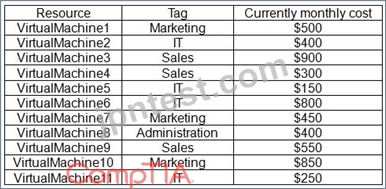
Which of the following is the amount the company would save annually be converting all of these VMs to reserved instances?
- A. $13320
- B. $1600
- C. $53280
- D. $5550
- E. $1110
- F. $3840
正解:A
質問 # 48
Which of the following types of clouds is a company implementing when it provides advertisement supported virtualized services to its customers?
- A. Public
- B. Hybrid
- C. Private
- D. Community
正解:A
質問 # 49
A company is migrating its e-commerce platform to a cloud service provider. The e-commerce site has a significant number of images. Which of the following is the BEST storage type for storing the images?
- A. File
- B. Object
- C. Cold
- D. Block
正解:B
質問 # 50
Which of the following would help a company avoid failure of a cloud project due to a lack of adherence of the company's operations and business processes to a cloud solution?
- A. Company baseline
- B. Proof of value
- C. Cloud managed services
- D. Industry benchmarks
正解:B
解説:
A proof of value (POV) is a method of testing a cloud solution before fully adopting it, to ensure that it meets the company's operations and business processes. A POV can help a company avoid failure of a cloud project by validating the feasibility, functionality, and benefits of the cloud solution, and identifying any gaps or issues that need to be resolved. A POV can also help a company compare different cloud solutions and select the best one for their needs. A POV is different from a proof of concept (POC), which is a more technical demonstration of the cloud solution's capabilities and performance. Reference: CompTIA Cloud Essentials+ Certification Study Guide, Second Edition (Exam CLO-002), Chapter 3: Cloud Planning, Section 3.2: Cloud Adoption, Subsection 3.2.2: Proof of Value1
質問 # 51
A company is considering migrating to a cloud provider. The IT department has produced the following checklist of features that will satisfy the RFP requirements:
Ability to customize internally developed applications Ability to patch internally developed applications.
Which of the following should the company do?
- A. Install a thick client to provide the required functionality, regardless of the cloud model.
- B. Migrate critical applications to a SaaS model, and keep non-critical applications in-house.
- C. Deploy non-critical applications to a PaaS model.
- D. Implement a community IaaS solution.
正解:D
質問 # 52
......
CompTIA CLO-002試験は、クラウドコンピューティング業界で自分のスキルと知識を確立したい人にとって必須の認定資格です。この認定資格は、さまざまな産業において雇用主に高い評価を受けており、この分野でのキャリアアップをサポートすることができます。試験は難しいですが、適切な準備と勉強をすることで、クラウドコンピューティングにおける専門知識を証明することができます。
CompTIA CLO-002リアルな2025年最新の知能問題集模擬試験問題集:https://www.jpntest.com/shiken/CLO-002-mondaishu
CompTIA CLO-002リアルな問題と100%カバーリアルな試験問題:https://drive.google.com/open?id=1IjlQuVDta3m8rBJI3RMBbZ4_SsFXi6-M