

[2025年06月]更新のDP-203問題集には100%厳密検証された問題と解答で合格保証もしくは全額返金
合格させるMicrosoft DP-203試験には練習テスト問題集豪華お試しセット
Microsoft DP-203認定を取得することで、候補者がクラウドベースの環境でデータソリューションを設計、実装、および管理するために必要なスキルと知識を持っていることが証明されます。この認定は、雇用主に高く評価され、データ関連の専門家が新しい仕事の機会や高い給与を得るための手段となります。全体的に、DP-203認定試験は、データ関連の専門家がMicrosoft Azure上のデータエンジニアリングのスキルと知識を検証する優れた方法です。
質問 # 104
You are creating dimensions for a data warehouse in an Azure Synapse Analytics dedicated SQL pool.
You create a table by using the Transact-SQL statement shown in the following exhibit.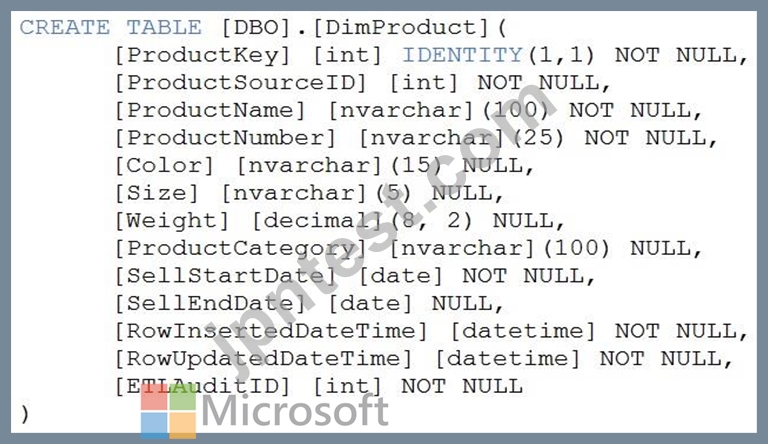
Use the drop-down menus to select the answer choice that completes each statement based on the information presented in the graphic.
NOTE: Each correct selection is worth one point.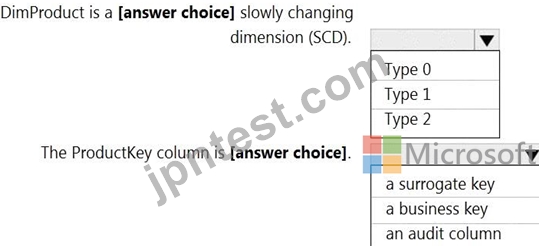
正解:
解説: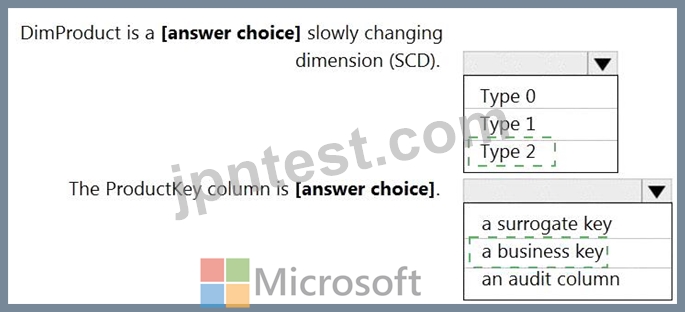
Explanation: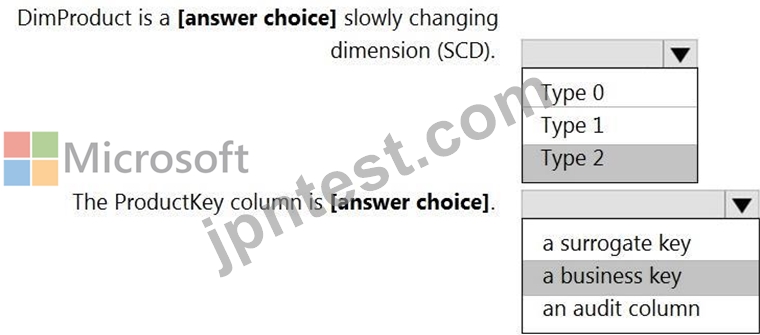
Box 1: Type 2
A Type 2 SCD supports versioning of dimension members. Often the source system doesn't store versions, so the data warehouse load process detects and manages changes in a dimension table. In this case, the dimension table must use a surrogate key to provide a unique reference to a version of the dimension member. It also includes columns that define the date range validity of the version (for example, StartDate and EndDate) and possibly a flag column (for example, IsCurrent) to easily filter by current dimension members.
Reference:
https://docs.microsoft.com/en-us/learn/modules/populate-slowly-changing-dimensions-azure-synapse-analytics-p
質問 # 105
You store files in an Azure Data Lake Storage Gen2 container. The container has the storage policy shown in the following exhibit.
Use the drop-down menus to select the answer choice that completes each statement based on the information presented in the graphic.
NOTE: Each correct selection Is worth one point.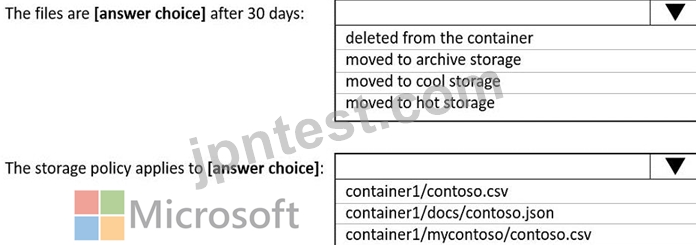
正解:
解説: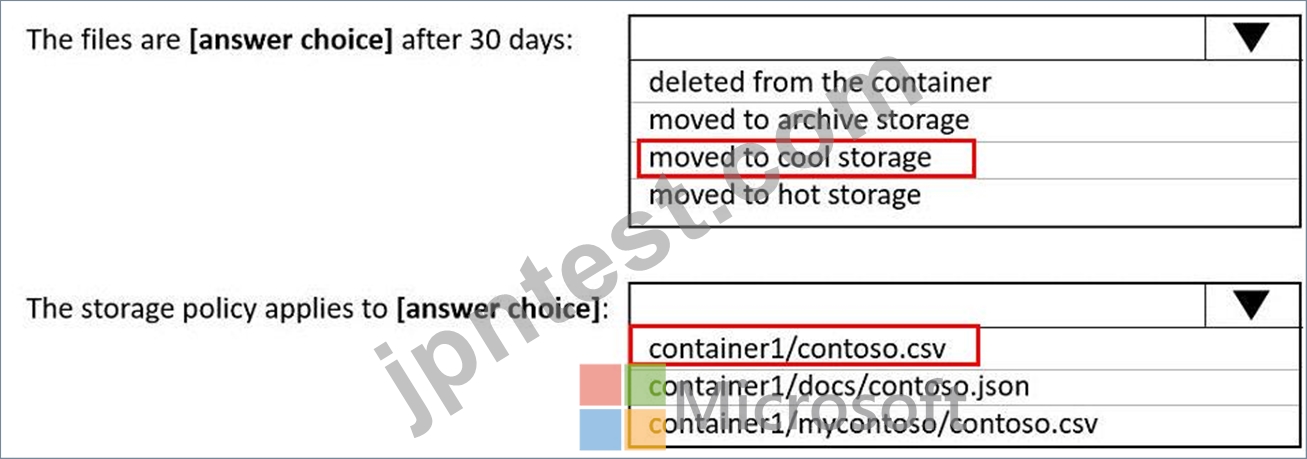
Reference:
https://docs.microsoft.com/en-us/dotnet/api/microsoft.azure.management.storage.fluent.models.managementpolicybaseblob.tiertocool
質問 # 106
What should you do to improve high availability of the real-time data processing solution?
- A. Deploy an Azure Stream Analytics job and use an Azure Automation runbook to check the status of the job and to start the job if it stops.
- B. Deploy a High Concurrency Databricks cluster.
- C. Set Data Lake Storage to use geo-redundant storage (GRS).
- D. Deploy identical Azure Stream Analytics jobs to paired regions in Azure.
正解:D
解説:
Guarantee Stream Analytics job reliability during service updates
Part of being a fully managed service is the capability to introduce new service functionality and improvements at a rapid pace. As a result, Stream Analytics can have a service update deploy on a weekly (or more frequent) basis. No matter how much testing is done there is still a risk that an existing, running job may break due to the introduction of a bug. If you are running mission critical jobs, these risks need to be avoided. You can reduce this risk by following Azure's paired region model.
Scenario: The application development team will create an Azure event hub to receive real-time sales data, including store number, date, time, product ID, customer loyalty number, price, and discount amount, from the point of sale (POS) system and output the data to data storage in Azure Reference:
https://docs.microsoft.com/en-us/azure/stream-analytics/stream-analytics-job-reliability
質問 # 107
You are batch loading a table in an Azure Synapse Analytics dedicated SQL pool.
You need to load data from a staging table to the target table. The solution must ensure that if an error occurs while loading the data to the target table, all the inserts in that batch are undone.
How should you complete the Transact-SQL code? To answer, drag the appropriate values to the correct targets. Each value may be used once, more than once, or not at all. You may need to drag the split bar between panes or scroll to view content.
NOTE Each correct selection is worth one point.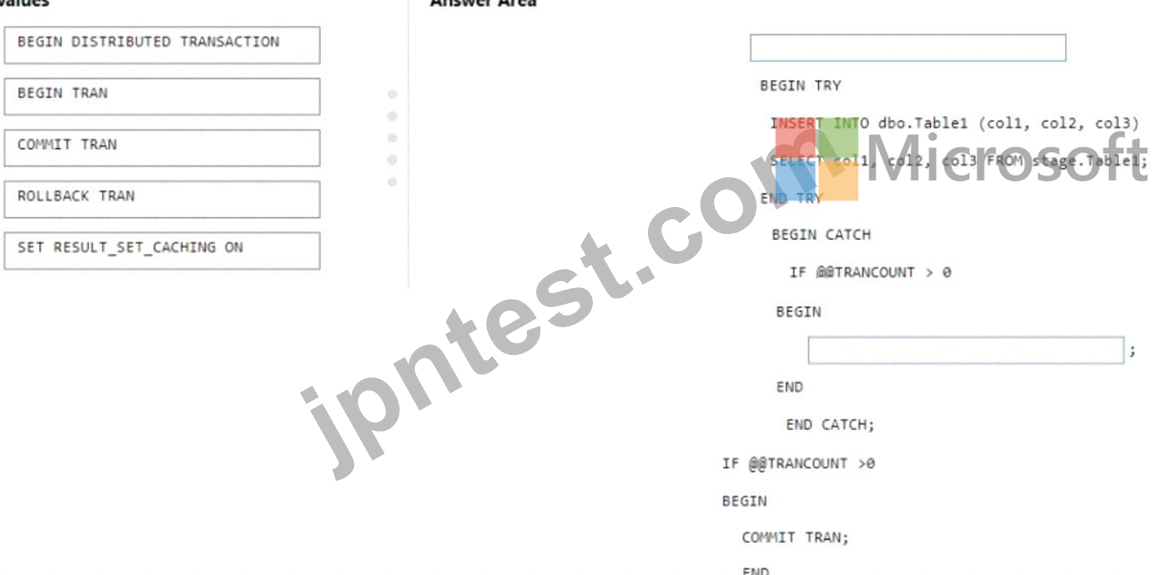
正解:
解説: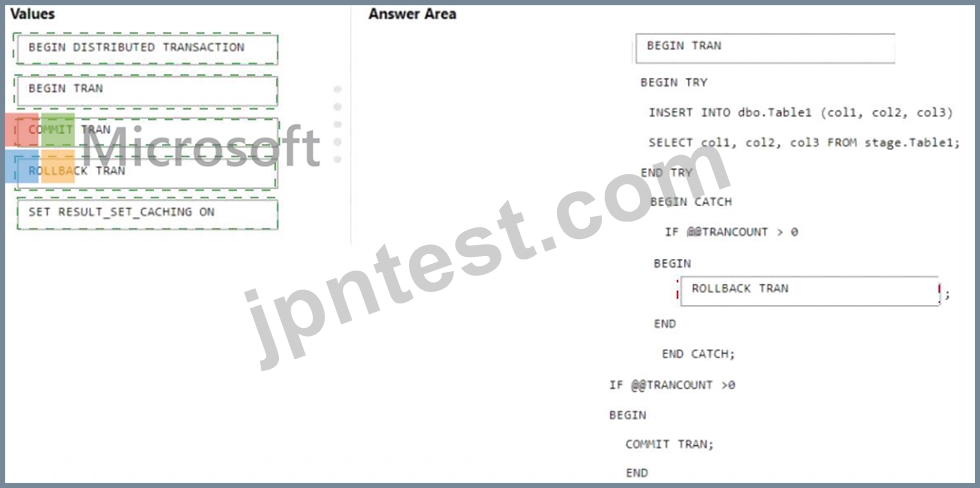
Explanation
D:\mudassar\Untitled.jpg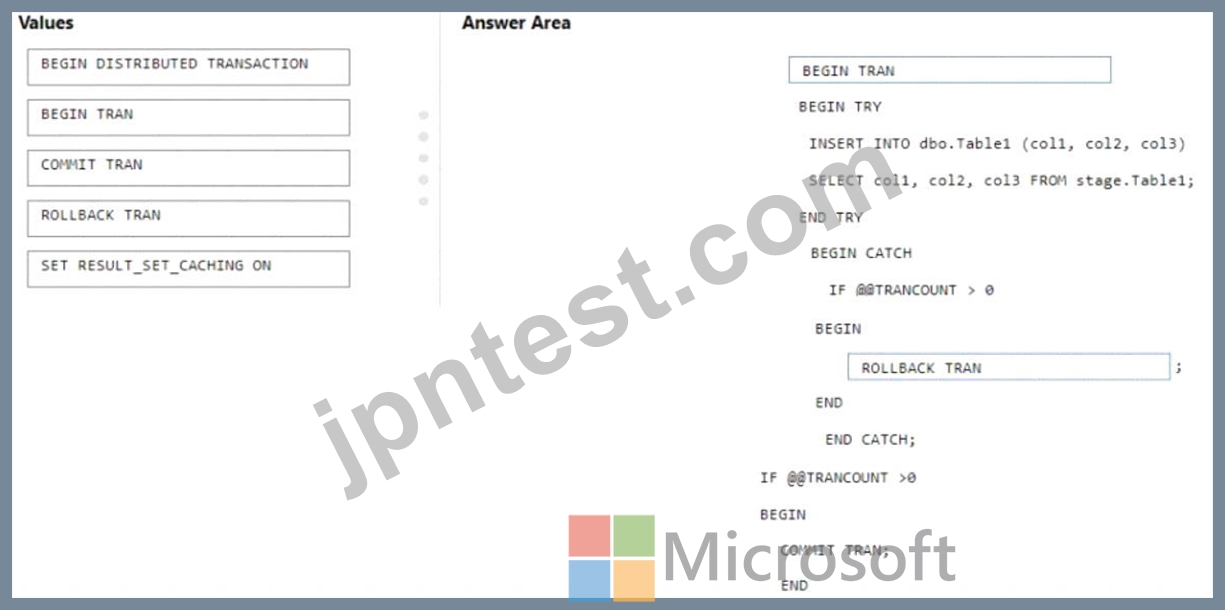
質問 # 108
You plan to implement an Azure Data Lake Gen2 storage account.
You need to ensure that the data lake will remain available if a data center fails in the primary Azure region.
The solution must minimize costs.
Which type of replication should you use for the storage account?
- A. geo-zone-redundant storage (GZRS)
- B. geo-redundant storage (GRS)
- C. locally-redundant storage (LRS)
- D. zone-redundant storage (ZRS)
正解:C
解説:
Locally redundant storage (LRS) copies your data synchronously three times within a single physical location in the primary region. LRS is the least expensive replication option Reference:
https://docs.microsoft.com/en-us/azure/storage/common/storage-redundancy
質問 # 109
You have an Azure subscription that contains an Azure Blob Storage account named storage1 and an Azure Synapse Analytics dedicated SQL pool named Pool1.
You need to store data in storage1. The data will be read by Pool1. The solution must meet the following requirements:
* Enable Pool1 to skip columns and rows that are unnecessary in a query.
* Automatically create column statistics.
* Minimize the size of files.
Which type of file should you use?
- A. JSON
- B. Avro
- C. CSV
- D. Parquet
正解:D
解説:
Explanation
Automatic creation of statistics is turned on for Parquet files. For CSV files, you need to create statistics manually until automatic creation of CSV files statistics is supported.
Reference:
https://docs.microsoft.com/en-us/azure/synapse-analytics/sql/develop-tables-statistics
質問 # 110
You are building a database in an Azure Synapse Analytics serverless SQL pool.
You have data stored in Parquet files in an Azure Data Lake Storage Gen2 container.
Records are structured as shown in the following sample.
{
"id": 123,
"address_housenumber": "19c",
"address_line": "Memory Lane",
"applicant1_name": "Jane",
"applicant2_name": "Dev"
}
The records contain two applicants at most.
You need to build a table that includes only the address fields.
How should you complete the Transact-SQL statement? To answer, select the appropriate options in the answer area.
NOTE: Each correct selection is worth one point.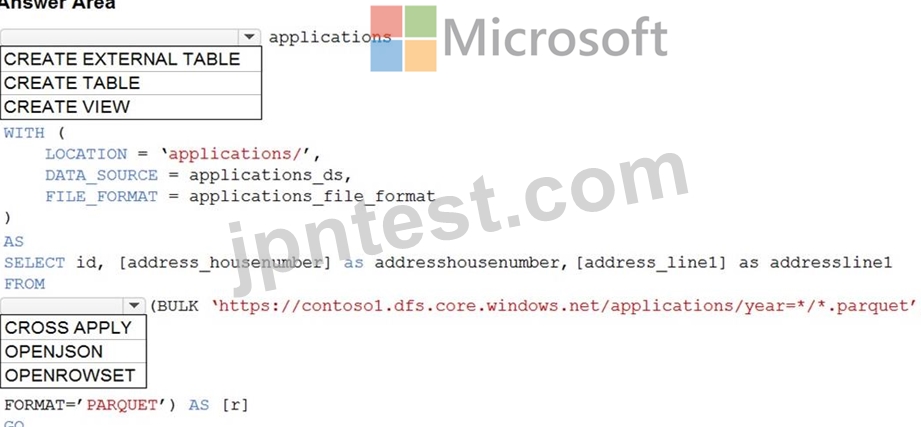
正解:
解説: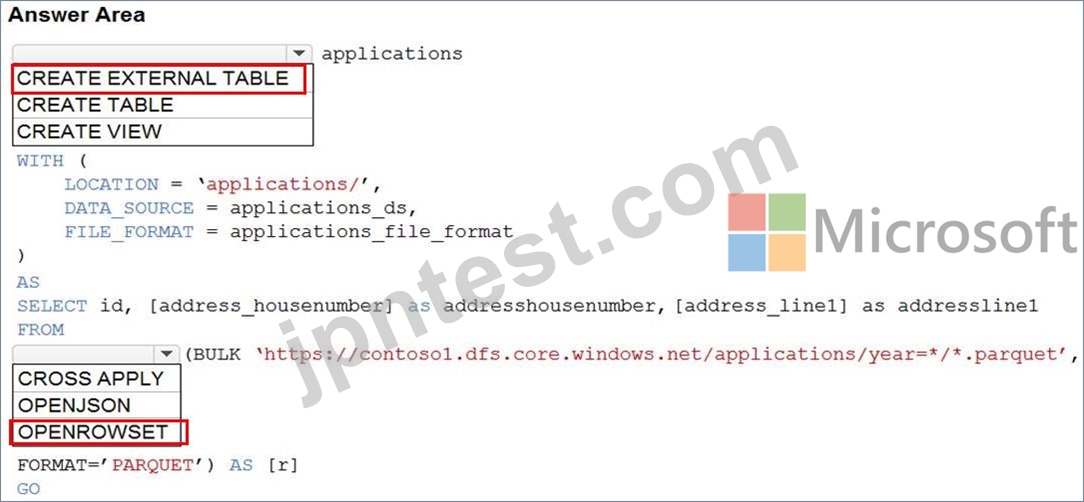
Reference:
https://docs.microsoft.com/en-us/azure/synapse-analytics/sql/develop-tables-external-tables
質問 # 111
You are designing an Azure Stream Analytics job to process incoming events from sensors in retail environments.
You need to process the events to produce a running average of shopper counts during the previous 15 minutes, calculated at five-minute intervals.
Which type of window should you use?
- A. sliding
- B. snapshot
- C. hopping
- D. tumbling
正解:D
解説:
Explanation
Tumbling windows are a series of fixed-sized, non-overlapping and contiguous time intervals. The following diagram illustrates a stream with a series of events and how they are mapped into 10-second tumbling windows.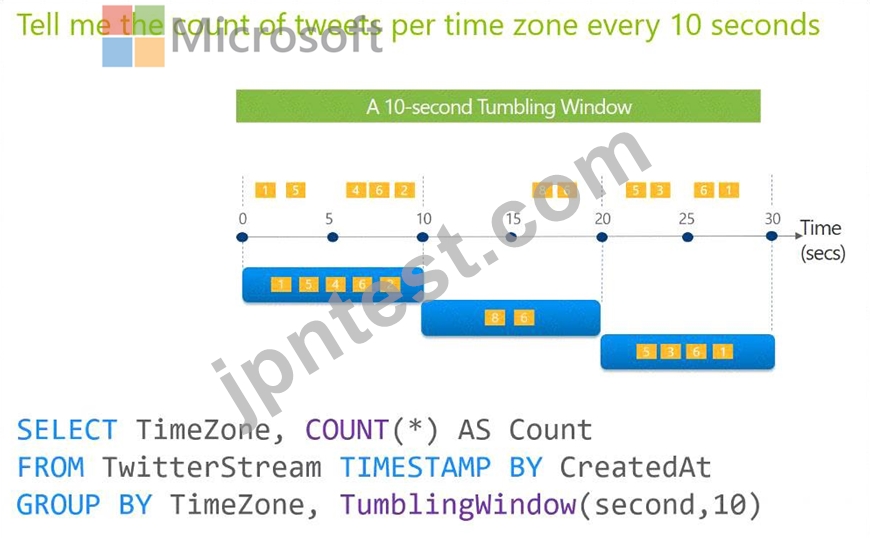
Reference:
https://docs.microsoft.com/en-us/stream-analytics-query/tumbling-window-azure-stream-analytics
質問 # 112
You have an Azure subscription that contains an Azure Databricks workspace named databricks1 and an Azure Synapse Analytics workspace named synapse1. The synapse1 workspace contains an Apache Spark pool named pool1.
You need to share an Apache Hive catalog of pool1 with databricks1.
What should you do? To answer, select the appropriate options in the answer area.
NOTE: Each correct selection is worth one point.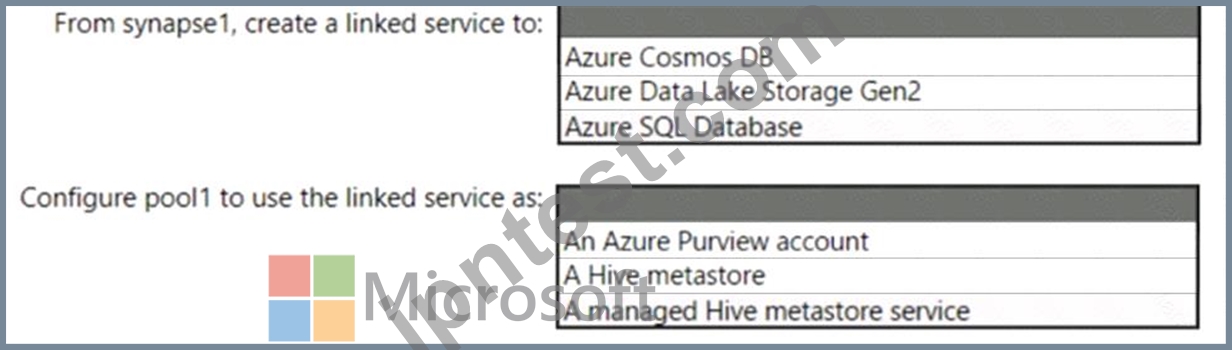
正解:
解説: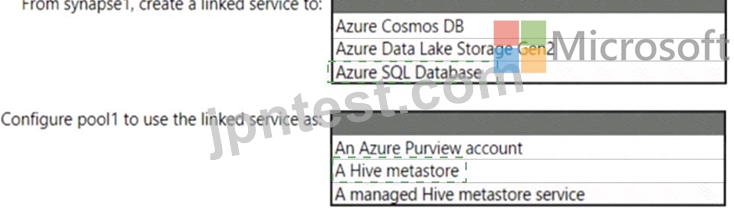
Explanation:
Box 1: Azure SQL Database
Use external Hive Metastore for Synapse Spark Pool
Azure Synapse Analytics allows Apache Spark pools in the same workspace to share a managed HMS (Hive Metastore) compatible metastore as their catalog.
Set up linked service to Hive Metastore
Follow below steps to set up a linked service to the external Hive Metastore in Synapse workspace.
* Open Synapse Studio, go to Manage > Linked services at left, click New to create a new linked service.
* Set up Hive Metastore linked service
* Choose Azure SQL Database or Azure Database for MySQL based on your database type, click Continue.
* Provide Name of the linked service. Record the name of the linked service, this info will be used to configure Spark shortly.
* You can either select Azure SQL Database/Azure Database for MySQL for the external Hive Metastore from Azure subscription list, or enter the info manually.
* Provide User name and Password to set up the connection.
* Test connection to verify the username and password.
* Click Create to create the linked service.
Box 2: A Hive Metastore
Reference: https://docs.microsoft.com/en-us/azure/synapse-analytics/spark/apache-spark-external-metastore
質問 # 113
Note: This question is part of a series of questions that present the same scenario. Each question in the series contains a unique solution that might meet the stated goals. Some question sets might have more than one correct solution, while others might not have a correct solution.
After you answer a question in this section, you will NOT be able to return to it. As a result, these questions will not appear in the review screen.
You are designing an Azure Stream Analytics solution that will analyze Twitter data.
You need to count the tweets in each 10-second window. The solution must ensure that each tweet is counted only once.
Solution: You use a tumbling window, and you set the window size to 10 seconds.
Does this meet the goal?
- A. No
- B. Yes
正解:B
解説:
Explanation
Tumbling windows are a series of fixed-sized, non-overlapping and contiguous time intervals. The following diagram illustrates a stream with a series of events and how they are mapped into 10-second tumbling windows.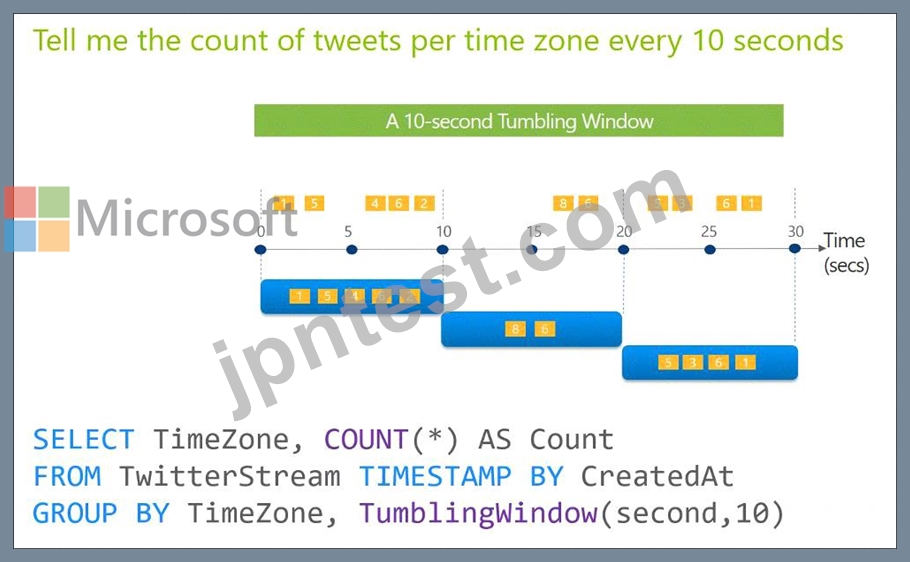
Reference:
https://docs.microsoft.com/en-us/stream-analytics-query/tumbling-window-azure-stream-analytics
質問 # 114
You have an Azure data factory.
You execute a pipeline that contains an activity named Activity1. Activity1 produces the following output.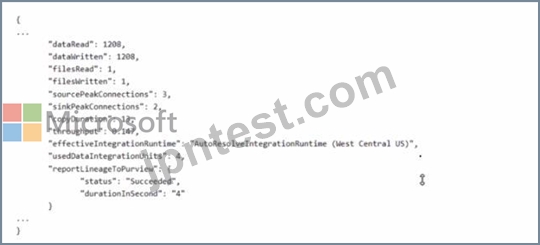
For each of the following statements select Yes if the statement is true. Otherwise, select No.
NOTE: Each correct selection is worth one point.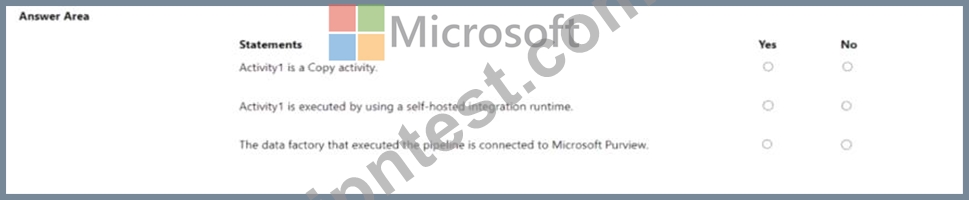
正解:
解説: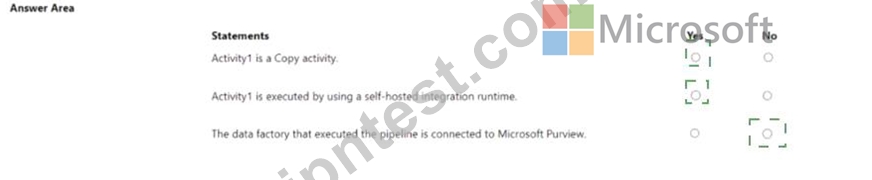
Explanation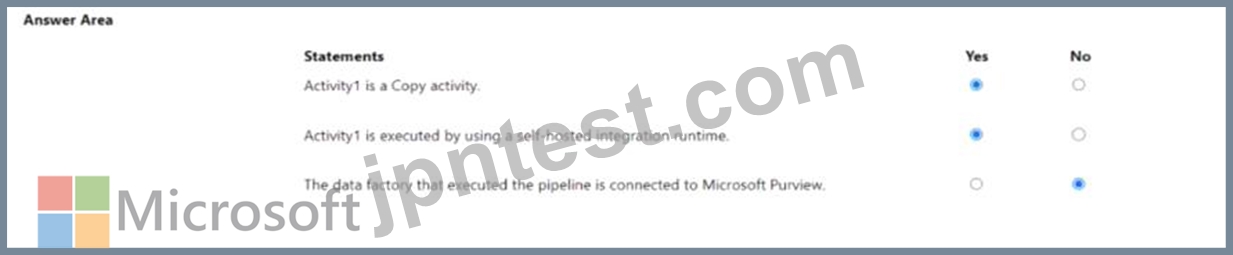
質問 # 115
You have an Azure Synapse Analytics dedicated SQL pool named Pool1 and an Azure Data Lake Storage Gen2 account named Account 1.
You plan to access the files in Accoun1l by using an external table.
You need to create a data source in Pool1 that you can reference when you create the external table.
How should you complete the Transact-SQL statement? To answer, select the appropriate options in the answer area.
NOTE Each coned selection is worth one point.
正解:
解説:
Answer as below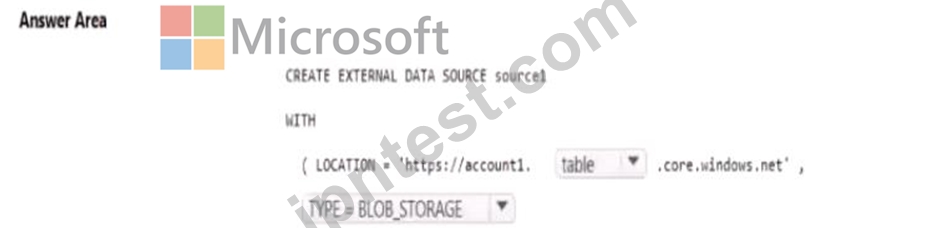
質問 # 116
You have an Azure subscription that contains a logical Microsoft SQL server named Server1. Server1 hosts an Azure Synapse Analytics SQL dedicated pool named Pool1.
You need to recommend a Transparent Data Encryption (TDE) solution for Server1. The solution must meet the following requirements:
Track the usage of encryption keys.
Maintain the access of client apps to Pool1 in the event of an Azure datacenter outage that affects the availability of the encryption keys.
What should you include in the recommendation? To answer, select the appropriate options in the answer area.
NOTE: Each correct selection is worth one point.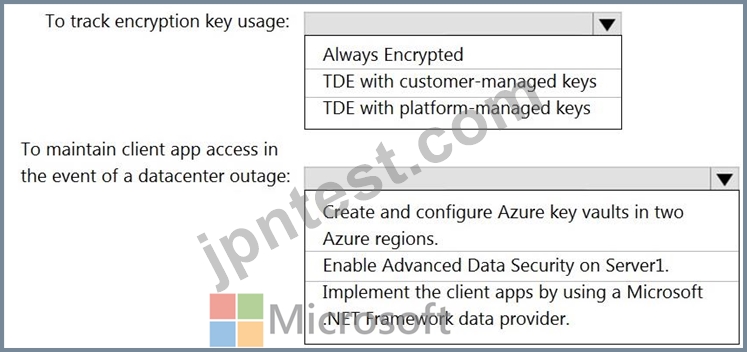
正解:
解説: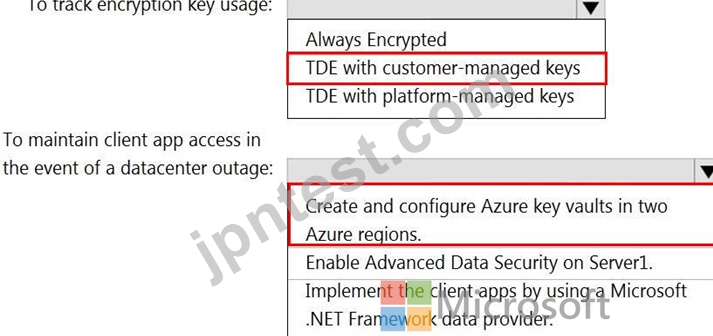
Reference:
https://docs.microsoft.com/en-us/azure/synapse-analytics/security/workspaces-encryption
https://docs.microsoft.com/en-us/azure/key-vault/general/logging
質問 # 117
You are building an Azure Data Factory solution to process data received from Azure Event Hubs, and then ingested into an Azure Data Lake Storage Gen2 container.
The data will be ingested every five minutes from devices into JSON files. The files have the following naming pattern.
/{deviceType}/in/{YYYY}/{MM}/{DD}/{HH}/{deviceID}_{YYYY}{MM}{DD}HH}{mm}.json You need to prepare the data for batch data processing so that there is one dataset per hour per deviceType. The solution must minimize read times.
How should you configure the sink for the copy activity? To answer, select the appropriate options in the answer area.
NOTE: Each correct selection is worth one point.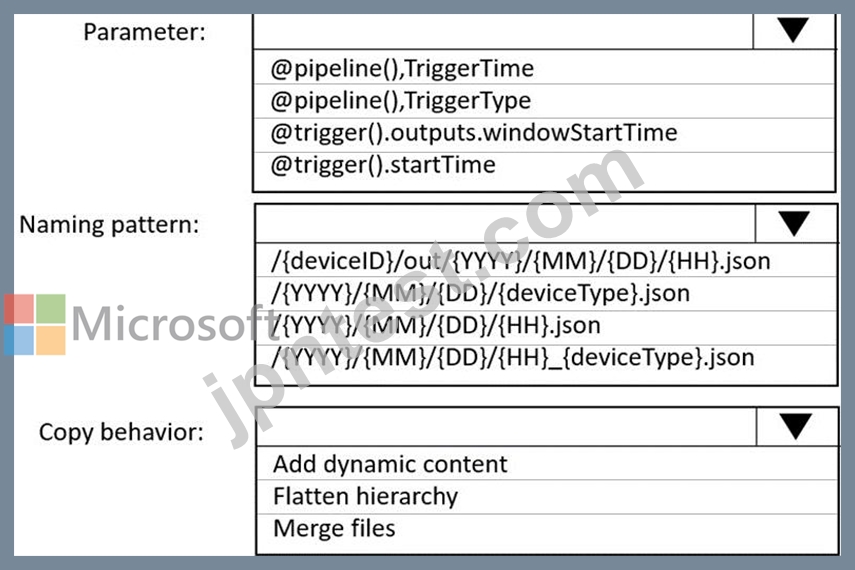
正解:
解説: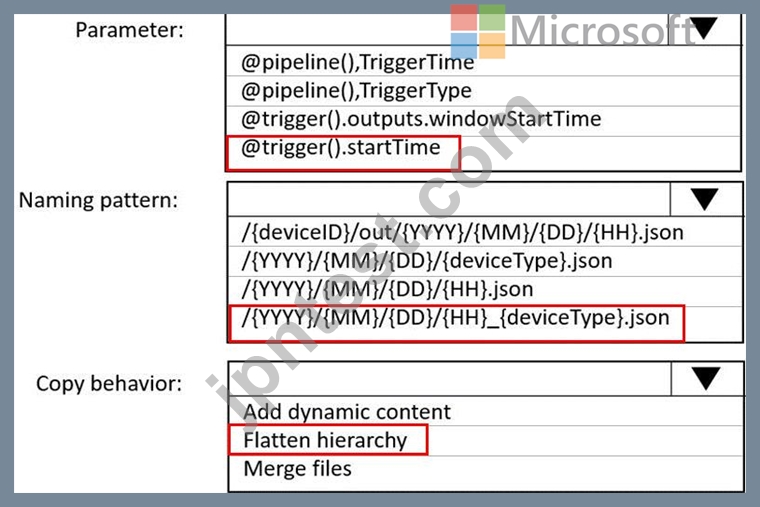
Reference:
https://docs.microsoft.com/en-us/azure/data-factory/concepts-pipeline-execution-triggers
https://docs.microsoft.com/en-us/azure/data-factory/connector-file-system
質問 # 118
Note: This question is part of a series of questions that present the same scenario. Each question in the series contains a unique solution that might meet the stated goals. Some question sets might have more than one correct solution, while others might not have a correct solution.
After you answer a question in this scenario, you will NOT be able to return to it. As a result, these questions will not appear in the review screen.
You have an Azure Storage account that contains 100 GB of files. The files contain text and numerical values. 75% of the rows contain description data that has an average length of 1.1 MB.
You plan to copy the data from the storage account to an Azure SQL data warehouse.
You need to prepare the files to ensure that the data copies quickly.
Solution: You modify the files to ensure that each row is less than 1 MB.
Does this meet the goal?
- A. No
- B. Yes
正解:B
解説:
When exporting data into an ORC File Format, you might get Java out-of-memory errors when there are large text columns. To work around this limitation, export only a subset of the columns.
References:
https://docs.microsoft.com/en-us/azure/sql-data-warehouse/guidance-for-loading-data
質問 # 119
You have an on-premises data warehouse that includes the following fact tables. Both tables have the following columns: DateKey, ProductKey, RegionKey. There are 120 unique product keys and 65 unique region keys.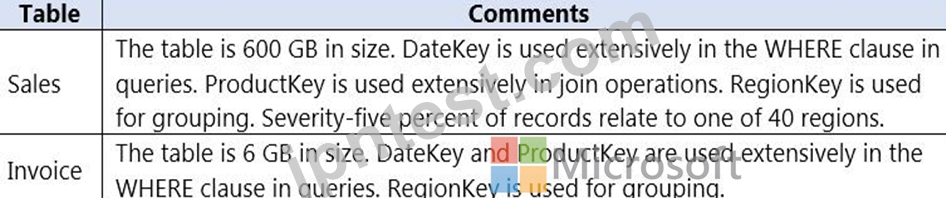
Queries that use the data warehouse take a long time to complete.
You plan to migrate the solution to use Azure Synapse Analytics. You need to ensure that the Azure-based solution optimizes query performance and minimizes processing skew.
What should you recommend? To answer, select the appropriate options in the answer area.
NOTE: Each correct selection is worth one point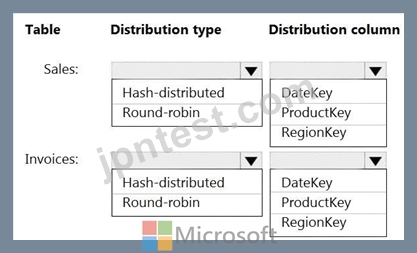
正解:
解説: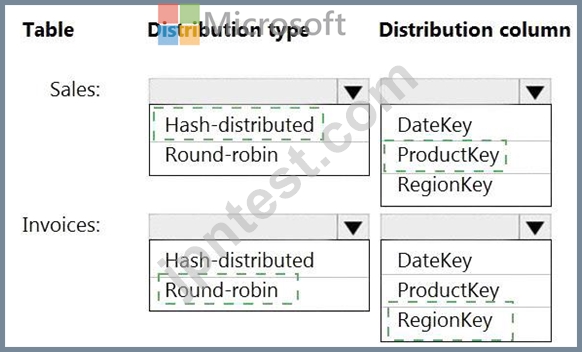
Explanation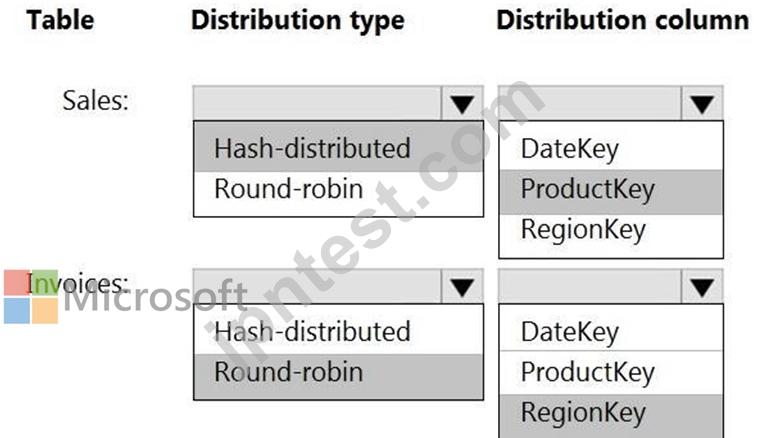
Box 1: Hash-distributed
Box 2: ProductKey
ProductKey is used extensively in joins.
Hash-distributed tables improve query performance on large fact tables.
Box 3: Round-robin
Box 4: RegionKey
Round-robin tables are useful for improving loading speed.
Consider using the round-robin distribution for your table in the following scenarios:
* When getting started as a simple starting point since it is the default
* If there is no obvious joining key
* If there is not good candidate column for hash distributing the table
* If the table does not share a common join key with other tables
* If the join is less significant than other joins in the query
* When the table is a temporary staging table
Note: A distributed table appears as a single table, but the rows are actually stored across 60 distributions. The rows are distributed with a hash or round-robin algorithm.
Reference:
https://docs.microsoft.com/en-us/azure/sql-data-warehouse/sql-data-warehouse-tables-distribute
質問 # 120
......
Microsoft DP-203(Microsoft Azureのデータエンジニアリング)認定試験は、Azureのデータを使用しているデータエンジニアのスキルと知識を検証するために設計された認定プログラムです。認定試験では、データストレージ、処理、分析など、Azureデータサービスの操作経験がある個人を対象としています。試験を通じて、候補者はAzureのデータ処理システムの設計、構築、および維持に関する専門知識を実証できます。
2025年最新の有効なDP-203テスト解答Microsoft試験PDF:https://www.jpntest.com/shiken/DP-203-mondaishu
無料Microsoft DP-203試験問題と解答トレーニングにはJPNTest:https://drive.google.com/open?id=1ez-8Wft94Ram3JIqvWO-keBiCMLnWz63