

2026年最新のTM3プレミアム資料テストPDFの無料問題集お試しセット
試験合格を向けてTM3今すぐ弊社のTest Manager試験パッケージを使おう
質問 # 31
Which status would typically be assigned to a false-positive defect report during defect management?
- A. Resolved
- B. Accepted
- C. Deferred
- D. Rejected
正解:D
解説:
Comprehensive and Detailed Explanation From Exact Extract of ISTQB Certified Tester Advanced Level - Test Manager v3.0 syllabus:
Afalse-positivedefect is one where the reported behavior isnot actually a defect(e.g., intended behavior, misuse, environment/setup issue). In defect management, the appropriate disposition for "not a defect" is torejectthe report rather than accept, resolve, or defer it.
Rejected: used when the item is not a defect (e.g., "as designed," duplicate, or cannot be reproduced).
Accepted/Resolved: used when confirmed and fixed.
Deferred: used when confirmed, but the fix is postponed to a later release.This aligns with the syllabus content ondefect lifecycle states and dispositionswithin defect management governance and reporting (CTAL- TM v3.0, Chapter 5: Test Monitoring, Test Control, and Test Reporting - defect management process, defect states, and reporting).
質問 # 32
In multi-team environments with hybrid software development approaches, there are various challenges in the context of defect management, such as:
i. Alignment of defect attributes to be used
ii. Prioritisation of defects
iii. Alignment of the approach for defect fixes
Solutions to the above-mentioned challenges include:
- A. Synchronisation between the defect management tools
- B. A = i, B = iii, C = ii
- C. A = i, B = ii, C = iii
- D. The product owner should be involved in the defect management meetings
- E. Transparency of plans by sharing them between teams via dashboardsWhich solution is related to which challenge?
- F. A = i, B = ii, C = i
- G. A = ii, B = i, C = iii
正解:E
解説:
Comprehensive and Detailed Explanation From Exact Extract of ISTQB Certified Tester Advanced Level - Test Manager v3.0 syllabus:
ii. Prioritisation of defects # A. Product owner involvement: The PO (or equivalent business authority) ensuresbusiness-value/risk-based prioritizationis consistent across teams.
i. Alignment of defect attributes # B. Tool synchronization: Toalign fields/attributes/statuses, teams synchronize or harmonize defect management tools and schemas.
iii. Alignment of approach for fixes # C. Transparent shared dashboards:Shared plans/dashboardssupport coordination onhow/whenfixes are implemented across teams, improving consistency and visibility.This mapping reflects the syllabus coverage oforganization-level test management, multi-team governance, tool alignment, and cross-team transparency practices in hybrid/Agile environments (CTAL-TM v3.0, Chapter 2:
Test Management in the Organization; Chapter 5: defect management coordination and reporting).
質問 # 33
You are involved in the selection of a test management tool and have decided to calculate the ROI for the two potential tools: TestMaker and ImproveIT.
TestMaker is priced at €15,000 with yearly maintenance costs of €1,500. Its traceability to requirements feature is strong and the defect management process can easily be customised to meet the needs of the organisation. Effort for test management activities is expected to decrease by 20%.
ImproveIT is priced at €20,000 with yearly maintenance costs of €2,500. Its traceability feature is also strong and has a high level of usability. It also has interesting options for adding extensions to its features in the future. Effort for test management activities is expected to decrease by 30%.
Based on the calculated ROI, which tool would you suggest?
- A. None of the tools, since they do not provide a positive ROI
- B. TestMaker
- C. There is too little information to accurately calculate the ROIs
- D. ImproveIT
正解:C
解説:
Comprehensive and Detailed Explanation From Exact Extract of ISTQB Certified Tester Advanced Level - Test Manager v3.0 syllabus:
InTest Tool and Automation, the syllabus states that determining thebusiness case/ROIfor a tool requires identifying and quantifyingall relevant costs(acquisition, maintenance,training,pilot/rollout,integration, customization) andbenefits(e.g.,effort reductionacross activities, quality and cycle-time gains), then comparing them over a defined period within the organization's context. A % effort reduction alone is insufficient without knowing thebaseline effort/cost, number of users, training/transition costs, and implementation scope. Therefore, ROI cannot be accurately computed with the given data.
(Reference: CTAL-TM v3.0 -Test Tool and Automation: tool selection and introduction; establishing a business case/ROI by quantifying costs and benefits; considering acquisition, maintenance, training, pilot, integration, process changes, and productivity gains.)
質問 # 34
You are a test manager developing a master test plan. As part of the master test plan, you are defining exit criteria for the various test levels.
Which of the following exit criteria would be most appropriate and SMART for component testing, and which one would be most appropriate and SMART for system testing?
i. 95% of the tests prepared are executed successfully
ii. All test cases have been run
iii. 80% decision coverage for all tests run
iv. At least 30 defects have been found
v. At least two weeks of test execution
vi. No more open defects
- A. ii for component testing, iv for system testing
- B. v for component testing, vi for system testing
- C. iii for component testing, v for system testing
- D. iii for component testing, i for system testing
正解:D
解説:
Comprehensive and Detailed Explanation From Exact Extract of ISTQB Certified Tester Advanced Level - Test Manager v3.0 syllabus:
The syllabus emphasizesSMART exit criteriatailored to the test level:
Forcomponent testing, structural coverage metrics (e.g.,decision coverage) are appropriate and measurable at code level, makingiii (80% decision coverage)suitable and SMART.
References: ISTQB CTAL-TM v3.0 Syllabus-Chapter 3 (Test Planning: defining level-appropriate and measurable entry/exit criteria; use of structural coverage for lower levels and outcome/behavior criteria for higher levels).
質問 # 35
Which of the following is not something you should do when performing a Belbin assessment with an Agile team?
- A. The team member roles should be balanced with the Belbin team roles model to identify any missing or overrepresented roles and adjust accordingly.
- B. The team should not align the team's roles with the team's goals and expectations. These should be kept independent.
- C. Feedback is provided to the individual team members by another team member using the observer assessment questionnaire.
- D. Team members use a self-assessment questionnaire to identify their own strengths and weaknesses in relation to nine Belbin roles.
正解:B
解説:
Comprehensive and Detailed Explanation From Exact Extract of ISTQB Certified Tester Advanced Level - Test Manager v3.0 syllabus:
The syllabus introducesBelbin team rolesas a tool tobalance rolesin a team and improve collaboration. It notes the use ofself-assessmentandobserver feedbackand stresses aligning team composition and role usage withthe team's goals and context. Therefore, statementDis incorrect: teamsshouldalign roles withteam goals and expectations; keeping them "independent" runs counter to the intended use of Belbin roles in Agile teams.
(ISTQB CTAL-TM v3.0 - Chapter "People Skills - Team Composition": Belbin roles, use of self/observer assessments, and aligning role mix with team goals.)
質問 # 36
You are working as a test manager at a company that develops software applications for the mobile domain.
The organisation has recently been assessed against TMMi. This assessment showed that the company is a TMMi level 1 organisation. The projects use the V-model lifecycle and an independent test team exists. The test team consists of both experienced and novice testers. The team has not yet been formally trained in testing, but an ISTQB Foundation course is scheduled to take place in two months.
In your role as a test manager working in the independent test team, you have recently performed a risk assessment for a mobile software application to be developed. You want the features that have been identified as major risks to be tested more thoroughly.
Which test practice would you propose to mitigate the identified major product risks?
- A. Start a test improvement project to achieve TMMi level 2
- B. Create pairs of developers and testers to test the features with the highest risk levels together
- C. Assign the most experienced testers to test the features with the highest risk levels
- D. Use test design techniques such as equivalence partitioning and decision table testing
正解:C
解説:
Comprehensive and Detailed Explanation From Exact Extract of ISTQB Certified Tester Advanced Level - Test Manager v3.0 syllabus:
The syllabus advises thatrisk mitigationincludes allocatingstronger capability and more efforttohigh-riskareas (e.g., by assigningmore experienced testersand more intensive testing to those features). In alow-maturity (TMMi level 1)context withnovice testers not yet trained, immediately deployingexperienced testersto high- risk items is the most practical and effective step to achievedeeper, more reliable testing.
Option B would be beneficial, but without formal training yet, immediate effectiveness is uncertain.
Option C is a longer-term improvement initiative, not a direct immediate mitigation for the current project risks.
Reference: ISTQB CTAL-TM v3.0 Syllabus, Chapter 4 (Risk-Based Testing) onallocating test effort and expertise according to product risk; Chapter 3 (Test Planning) onresourcing high-risk areasfirst.
質問 # 37
The diagram below shows an incomplete defect management process, where three states (states X, Y and Z) have yet to be named appropriately.
Which of the following labels would correctly complete the process?
- A. X: In Progress, Y: Verified, Z: Terminated.
- B. X: Accepted, Y: Tested, Z: Deferred.
- C. X: Accepted, Y: Reviewed, Z: Duplicate.
- D. X: Approved, Y: Reviewed, Z: Deferred.
正解:B
解説:
According to theISTQB Certified Tester Advanced Level - Test Manager v3.0 syllabus (Chapter 2: Test Management in the Organization), thedefect management processdefines how defects are handled from discovery to closure, ensuring traceability and communication between testing and development.
"The defect management process defines the states a defect may have during its lifetime, including identification, evaluation, correction, re-testing (confirmation testing), and closure." (ISTQB CTAL-TM v3.0 Syllabus, Chapter 2 - Defect Management Process) In the standard ISTQB defect workflow:
Afterevaluation, a defect can either be:
Rejected(e.g., not a defect, duplicate, or out of scope), or
Accepted(X) - meaning it is confirmed as a valid defect and will be corrected.
Once accepted, the defect isplannedfor correction andfixedby development.
After being fixed, it must betested (Y)- also referred to asconfirmation testingorretesting.
Some evaluated defects may bedeferred (Z)- postponed for future releases.
Thus, the correct states are:
X = Accepted(defect confirmed as valid and correction planned)
Y = Tested(confirmation testing after the fix)
Z = Deferred(postponed correction)
This sequence aligns directly with the ISTQB-defineddefect management lifecycle, which includes transitions betweenopen,evaluated,accepted (planned/fixed/tested), andclosed, as well as possiblerejectedordeferredbranches.
References (from ISTQB Certified Tester Advanced Level - Test Manager v3.0 Syllabus):
Chapter 2: Test Management in the Organization
Section:Defect Management Process
Describes thedefect states, includingopen, evaluated, accepted, planned, fixed, tested (retested), closed, and alternate states such asrejectedordeferred.
質問 # 38
Which of the following factors influences the risk impact?
- A. Maturity of the development organisation
- B. Complexity of technology being used
- C. Geographically distributed teams
- D. Frequency of use of the affected feature
正解:D
解説:
Comprehensive and Detailed Explanation From Exact Extract of ISTQB Certified Tester Advanced Level - Test Manager v3.0 syllabus:
In the syllabus,risk impactconcerns thepotential damage or lossif a failure occurs (business, user, financial, legal, or reputational).Frequency of use of the affected featureincreases theexposureand thus theimpactwhen defects occur, making optionBcorrect. By contrast,complexity of technology,organizational maturity, anddistributed teamsprimarily influencelikelihood(the chance of defects entering/escaping), not the impact dimension (CTAL-TM v3.0 Syllabus, Risk-Based Testing section explaining factors oflikelihood vs.
impactand examples of each).
質問 # 39
Your company is considering purchasing a test tool suite from a respectable vendor. Your manager has searched the internet for comparable products, but none of them meet his specific requirements. A tool demonstration has been arranged for next week and your team has been invited to attend. The tool suite consists of a test management tool, test execution tool, and a requirements management tool. There is a possibility of adding a performance testing tool at a later stage.
You have decided to attend the demo but raise some issues beforehand regarding expectations.
Which two issues from the options provided below should at least be raised?
- A. Do we have a set of tool requirements to validate the tool against?
- B. Is customized training available?
- C. How will the implementation be organised?
- D. Which project will be selected to perform the tool pilot?
- E. What are the problems we are trying to address?
正解:A、E
解説:
Comprehensive and Detailed Explanation From Exact Extract of ISTQB Certified Tester Advanced Level - Test Manager v3.0 syllabus:
The syllabus reminds test managers thattool introduction must be problem-drivenandrequirements-based.
Before (or alongside) demos, teams should clarify:
Athebusiness/testing problemsand improvement goals the tool is meant to address (e.g., traceability, automation scale, reporting).
Baclear set of tool requirements/selection criteriato objectivelyassess the toolduring a demo or evaluation.
These two are theminimum critical questionsto ground any evaluation. WhileC,D, andEare important for later stages (rollout planning, piloting, and training), ISTQB stresses thatsuccessful adoption starts with defined needs and evaluation criteria, ensuring the demo and subsequent selection are aligned to real objectives.
Relevant syllabus areas:Test Tool and Automation-Tool selection and introduction(identify problems
/opportunities, define requirements and success criteria, evaluate, then plan pilot/rollout/training).
質問 # 40
You are a tester working in an Agile team in the finance domain. The team consists of 6 members, and you are the only tester. The team is responsible for the development and maintenance of a mobile front-end application. The application is considered to be critical with respect to customer impact and market branding.
You have been asked to identify which test management activity needs to be performed within the team to enhance test maturity and achieve a higher level of product quality.
Which test management activity would you recommend the team should adopt?
- A. Increase coverage by automating more tests
- B. Perform product risk identification and analysis
- C. Provide detailed estimations early for each test level
- D. Define quality criteria for user stories and acceptance criteria
正解:B
解説:
Comprehensive and Detailed Explanation From Exact Extract of ISTQB Certified Tester Advanced Level - Test Manager v3.0 syllabus:
The syllabus positionsproduct risk analysisas a core activity for test managers toprioritize testing and allocate effort. Performingproduct risk identification and analysisdrives the selection of features, levels, and test types to focus on, informs coverage depth, and guides where to automate for maximum value. While defining acceptance criteria (A) is important and often handled during backlog refinement, and automation (D) is valuable, withoutrisk analysisthe team cannot ensure efforts target the most critical quality risks-especially forhigh-impact, customer-facing mobile applications(CTAL-TM v3.0 Syllabus, chapter on Risk-Based Testing: risk identification, analysis, and applying risk to test prioritization and coverage).
質問 # 41
Management is sceptical regarding the budget request (€25,000) for the next testing project. You are asked for a cost-benefit calculation. Based on historical data from several projects, you have the following numbers:
Average prevention cost per defect: €200
Average cost of detection per defect: €400
Average cost of internal failure: €150
Average cost of external failure: €2,500
Expected number of defects to be found in this project during testing: 50 What is the result for the expected cost-benefit calculation for the upcoming project?
- A. €87,500
- B. €72,500
- C. €92,500
- D. €62,500
正解:A
解説:
Comprehensive and Detailed Explanation From Exact Extract of ISTQB Certified Tester Advanced Level - Test Manager v3.0 syllabus:
Using thecost of qualityperspective in the syllabus, compute the savings from moving defects fromexternal failuretointernal discovery(prevention + appraisal + internal failure).
Internal discovery cost per defect:€200 + €400 + €150 = €750.
External failure cost per defect:€2,500.
Net saving per defect moved inside:€2,500 # €750 = €1,750.
For50defects:€1,750 × 50 = €87,500#answer: €87,500.The syllabus directs test managers to articulate testing' s value by quantifyingavoided external failure costsagainstprevention, detection, and internal failure costs, supporting investment decisions and demonstrating ROI for testing initiatives (Chapter: Test Management in the Organization - economics/cost of quality; business case and benefit evaluation).
質問 # 42
To which category of cost of quality does "fixing a defect found during testing" belong?
- A. Appraisal costs
- B. External failure costs
- C. Internal failure costs
- D. Defect prevention costs
正解:C
解説:
Comprehensive and Detailed Explanation From Exact Extract of ISTQB Certified Tester Advanced Level - Test Manager v3.0 syllabus:
The syllabus differentiatescost of qualityinto:
Prevention(to avoid defects),
Appraisal(to evaluate products, e.g., reviews, testing),
Internal failure(defectsfound before release, including the cost to fix during testing), and External failure(defects foundafter release)."Fixing a defect found during testing" is aninternal failure cost, because the failure is detected and corrected prior to delivery (CTAL-TM v3.0, Organizational Test Management - economics of testing and cost of quality categories).
質問 # 43
Assume that you are using traceability to manage test case coverage against test conditions. During test analysis, three test conditions were identified. Test design for system testing has been completed and 10 test cases (TC1 to TC10) have been designed, as described by the following traceability matrix ("C" indicates a critical test case, while "NC" indicates a non-critical test case):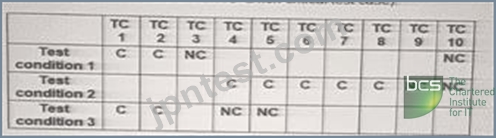
[traceability matrix not visible in the prompt]
The exit criterion for system testing states that each test condition must have all the associated critical test cases successfully executed (passed) AND all associated non-critical test cases at least executed.
The following is the situation after three days of system testing:
TC1, TC2, TC4, TC5, TC7, TC9: passed
TC3, TC10: failed (with an associated open defect report)
TC6, TC8: not run
Management wants to decide whether to release the system. You advise them that the system does not yet meet the defined exit criteria.
Based only on the given information, which test condition does not yet meet the stated exit criterion?
- A. None, all meet the stated exit criteria
- B. Test condition 3
- C. Test condition 2
- D. Test condition 1
正解:C
解説:
The syllabus explicitly states thatexit criteriamust be met before considering completion of a test level:
"Exit criteria are the conditions that must be achieved to declare completion of a given test level... including coverage criteria and status of required tests (e.g., passed)."
- ISTQB CTAL-TM v3.0 Syllabus, Chapter 5Test Monitoring and Test Control And test control must act when exit criteria are not met:
"If the exit criteria are not satisfied, appropriate actions must be taken to address the situation."
- ISTQB CTAL-TM v3.0 Syllabus, Chapter 5
Sincetest condition 2 still has critical tests not yet executed, thedefined exit criteria are not fulfilled, and therefore a release decision should not be approved.
質問 # 44
For which type of testing would a test manager be involved with establishing benchmarks?
- A. Non-Functional Testing
- B. Functional Testing
- C. White-box Testing
- D. Testing Black-box
正解:A
解説:
Comprehensive and Detailed Explanation From Exact Extract of ISTQB Certified Tester Advanced Level - Test Manager v3.0 syllabus:
WithinTest Planning(Chapter:Test Planning, Monitoring, and Control), the syllabus describes that the test manager defines the test approach fornon-functional quality characteristics(e.g., performance, load, scalability, reliability). For these, the test manager oftensets or references benchmarks/baselines and success criteria(e.g., response-time thresholds, throughput targets) to evaluate system behavior under specified conditions. Establishing and usingbenchmarksis a hallmark ofnon-functional testing, particularlyperformance testing.
(Reference: CTAL-TM v3.0 Syllabus - Chapter "Test Planning, Monitoring, and Control", subsections on defining the test approach for non-functional testing and specifying success criteria/benchmarks.)
質問 # 45
Which of the following activities in the test process is considered to deliver a document which can be used as a major input for test process improvement?
- A. Test Execution
- B. Test Planning
- C. Test Completion
- D. Test Monitoring
正解:C
解説:
Comprehensive and Detailed Explanation From Exact Extract of ISTQB Certified Tester Advanced Level - Test Manager v3.0 syllabus:
In the ISTQB CTAL-TM v3.0 syllabus (Chapter:Testing Process, section onTest Completion), the Test Completion activity includes producing thetest summary report, capturinglessons learned, and finalizing
/archiving testware. Thetest summary report and lessons learned are specifically identified as key inputs to test process improvement, enabling organizations to refine their approach, improve efficiency, and address gaps revealed during the test effort. This makesTest Completionthe activity that delivers the document(s) most directly used for ongoingtest process improvement.
(Reference: CTAL-TM v3.0 Syllabus - Chapter "Testing Process", subsection "Test Completion":
responsibilities include creating the test summary report, collecting lessons learned, and providing input to process improvement.)
質問 # 46
......
2026年最新の問題をマスターTest Manager合格目指してTM3リアル試験!:https://www.jpntest.com/shiken/TM3-mondaishu
完全版は2026年最新のTM3試験問題集ガイドはトレーニング専門JPNTest:https://drive.google.com/open?id=1OfQ90p_MbmHSng3lowmYCf13-nbQfZef