

[2026年最新] 完璧NCP-MCI-6.10日本語問題集問題と解答で一年無料最速更新
更新されたのは2026年リアルな無敵NCP-MCI-6.10日本語問題集で100% 無料NCP-MCI-6.10日本語試験問題集
質問 # 34
管理者は VM のパフォーマンスに関する苦情を受け取ります。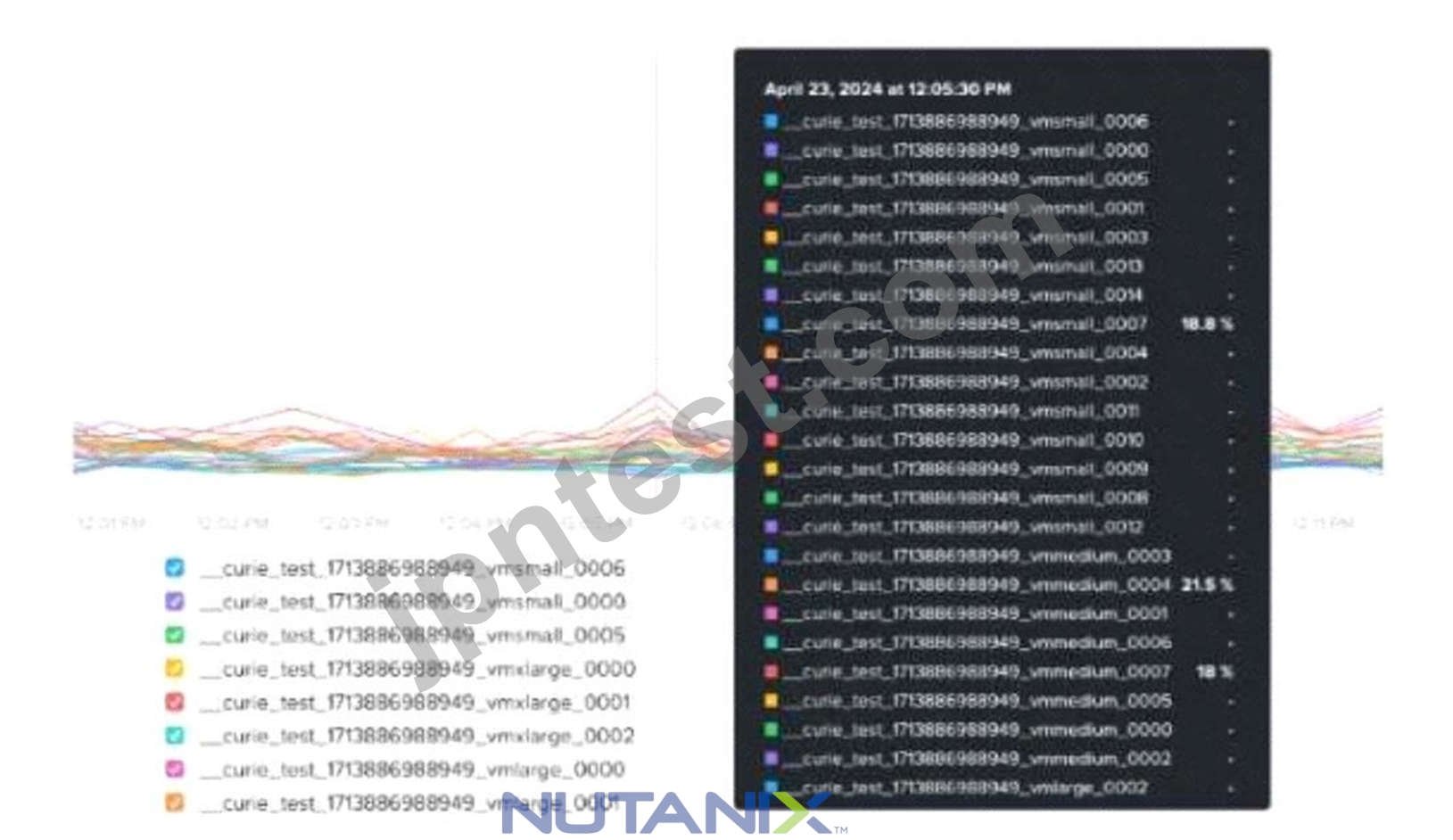
展示に示されている VM の CPU 準備完了時間データを確認した後、管理者は問題をさらに診断するためにどの手順を実行する必要がありますか?
- A. ホストの CPU 使用率を確認します。
- B. VM メモリのオーバーサブスクリプションを有効にします。
- C. 各 CVM に割り当てられている vCPU の数を確認します。
- D. クラスターの SSD 容量を評価します。
正解:A
解説:
Understanding the Issue
The administrator is investigating VM performance complaints and is analyzing CPU Ready Time data.
* CPU Ready Time is a crucial metric in Nutanix and virtualization environments (AHV, ESXi, or Hyper-V).
* It measures the amount of time a VM is waiting for CPU scheduling due to resource contention.
* High CPU Ready Time indicates that VMs are ready to run but are waiting because the host lacks available CPU resources.
Analysis of the Exhibit
* The graph shows CPU Ready Time spikes for multiple VMs.
* Some VMs have CPU Ready Time exceeding 18% to 21.5%, which is very high.
* A healthy CPU Ready Time should be below 5%.
* Values above 10% indicate CPU contention, and anything above 20% is critical and requires immediate troubleshooting.
Evaluating the Answer Choices
#(A) Check the number of vCPUs assigned to each CVM. (Incorrect)
* CVMs (Controller VMs) have fixed CPU allocation, and modifying their vCPU count is not recommended unless advised by Nutanix Support.
* The issue is related to VM CPU contention, not CVM configuration.
#(B) Review host CPU utilization. (Correct Answer)
* High CPU Ready Time suggests CPU overcommitment or host saturation.
* The administrator should check host CPU usage in Prism Central to determine if the cluster is overloaded.
* If host CPU usage is consistently above 85-90%, VMs are competing for CPU resources, leading to high CPU Ready Time.
#(C) Assess cluster SSD capacity. (Incorrect)
* SSD capacity impacts storage performance (latency, read/write speeds) but does not affect CPU Ready Time.
* High CPU Ready Time is a CPU scheduling issue, not a storage bottleneck.
#(D) Enable VM memory oversubscription. (Incorrect)
* Memory oversubscription does not impact CPU scheduling.
* Enabling memory oversubscription affects RAM allocation, but CPU Ready Time is strictly related to CPU contention.
Next Steps to Diagnose & Resolve the Issue
* Review Host CPU Utilization:
* Navigate to Prism Central # Analysis # CPU Usage per Host.
* Identify hosts experiencing high CPU load.
* Check VM vCPU Allocation:
* Ensure that VMs do not have excessive vCPUs assigned, which can lead to scheduling inefficiencies.
* Overprovisioning vCPUs can cause unnecessary contention.
* Balance Workload Across Hosts:
* Use Nutanix AHV DRS (Dynamic Scheduling) or VMware DRS to redistribute VMs across hosts.
* Check if certain hosts are overloaded while others have spare CPU capacity.
* Consider Scaling Out the Cluster:
* If CPU usage is consistently high, adding more nodes may be required to reduce CPU contention.
Multicloud Infrastructure References & Best Practices
* CPU Ready Time Best Practices:
* Keep CPU Ready Time below 5%.
* Avoid overcommitting vCPUs on heavily loaded hosts.
* Monitor Prism Central Runway Metrics to predict future CPU resource needs.
* Nutanix AHV CPU Scheduling Optimization:
* Ensure proper VM sizing (avoid excessive vCPU allocation).
* Balance workloads using Nutanix AHV DRS.
References:
* Nutanix Prism Central: Performance Analysis and CPU Metrics
* Nutanix Bible: VM Performance and Resource Management
* Nutanix KB: Troubleshooting High CPU Ready Time in AHV
質問 # 35
管理者は、アプリケーションを監視するために、Nutanix クラスタ上でアプリケーション検出を有効にしたいと考えています。APrism Central インスタンスはすでに十分な CPU とメモリで構成されています。
アプリケーション検出を有効にする前に満たす必要があるその他の前提条件は何ですか? (2 つ選択してください。)
- A. APIキーとキーID
- B. インターネット接続
- C. ネットワークコントローラが有効になっています
- D. 十分な Prism Central VM リソース
正解:B、D
質問 # 36
5 ノードのクラスターで、管理者は 3 つの VM が単一のホスト上でリソースを過剰に消費していることに気付きました。
Acropolis Dynamic Scheduling (ADS) ではこれらの VM を移行できません。
ADS がこれらの VM を移行できない理由として最も考えられるものは何ですか?
- A. VM は外部ネットワーク接続ストレージを使用します。
- B. VM はボリューム グループを使用します。
- C. VM-VM アンチアフィニティ ポリシーが設定されています。
- D. VM は GPU パススルーを使用します。
正解:D
解説:
VMs using GPU pass-through cannot be live-migrated because they are directly tied to a physical GPU on a specific host.
* Option B (VMs use GPU pass-through) is correct:
* Pass-through devices (such as GPUs) are directly assigned to VMs, makingmigration impossibleunless the VM is powered off first.
* Option A (VMs use a Volume Group) is incorrect:
* Volume Groupssupport live migrationunless they are configured incorrectly.
* Option C (VM-VM anti-affinity) is incorrect:
* Anti-affinity rules prevent two specific VMs from running together, but do not prevent migration.
* Option D (VMs use external NAS) is incorrect:
* Using NAS does not block VM migration, as Nutanixsupports shared storage across hosts.
References:
Nutanix AHV Best Practices#GPU Pass-through and VM Migration Limitations Nutanix KB#Why Can't I Live Migrate a VM with GPU Passthrough?
質問 # 37
クラスターには、多数のVMが収容されたRF3ストレージコンテナがあります。管理者は、クラスターの容量が不足する前に、新しいRF2ストレージコンテナを作成し、vDiskのライブマイグレーションを実行したいと考えています。
vDisk の移行を実行する前に、どのチェックを行う必要がありますか?
- A. 保護ドメインまたは保護ポリシーから VM を削除します。
- B. マルチチャネル サポートが有効になっていることを確認します。
- C. ネットワーク遅延が 5 ミリ秒未満であることを検証します。
- D. ストレージコンテナ間でストレージ最適化オプションが一致していることを確認する
正解:D
質問 # 38
管理者は Prism で次の内容の警告を受信します:
「クラスター <cluster_name> 上のストレージ コンテナー <container_name> のストレージ リソースは、約 1 日で不足します。」ただし、クラスターには使用可能なスペースが十分に残っています。
クラスターにスペースが残っているのに、コンテナのスペースが不足する原因となっている構成設定は何ですか?
- A. アドバタイズされた容量が低すぎます。
- B. 圧縮の設定が低すぎます。
- C. レプリケーション係数の設定が高すぎます。
- D. 予約容量の設定が高すぎます。
正解:D
解説:
Reserved Capacity settings define how much storage is exclusively allocated for a specific container.
* Option B (Reserved Capacity is too high) is correct:
* If too much space is reserved for a container, it can report "out of space" while the cluster still has free capacity.
* Options A, C, and D are incorrect:
* Advertised Capacity, Compression, and RF settings do not directly cause storage exhaustion unless misconfigured with Reserved Capacity.
References:
Nutanix Storage Best Practices#Configuring Reserved and Advertised Capacity Nutanix KB#Troubleshooting Storage Container Out-of-Space Alerts
質問 # 39
LCM で GPU を搭載した AHV ホストをアップグレードするには、どのような追加手順が必要ですか?
- A. LCM をダーク サイト モードで実行し、AHV を個別に更新できるようにします。
- B. NCC を最新バージョンに更新し、インベントリを再実行します。
- C. GPU ドライバーがインストールされている各ホストにエージェント VM を作成します。
- D. 直接アップロードを使用して適切なドライバー バンドルをアップロードします。
正解:D
解説:
Nutanix Life Cycle Manager (LCM) relies on validated firmware and driver bundles for hardware components. For GPU-enabled hosts, LCM documentation states:
"GPU-enabled AHV hosts require GPU driver bundles to be uploaded manually via the Direct Uploads mechanism so that LCM can validate and upgrade the necessary GPU components during workflow execution." GPU drivers are vendor-specific and not always available in the standard catalog, so the administrator must upload them before LCM can orchestrate the upgrade.
Running in dark site mode does not provide missing GPU bundles. Creating agent VMs is unrelated to GPU driver operations. Updating NCC improves validations but does not provide GPU support files.
Therefore, Direct Uploads of GPU driver bundles is required.
質問 # 40
管理者は、AHV ホスト上のユーザー VM がボンド内の単一アダプタを超える帯域幅を活用できるようにしたいと考えています。
これを実現するために管理者はどのアップリンク ボンド タイプを設定する必要がありますか?
- A. アップリンクボンドなし
- B. アクティブ-アクティブ
- C. MAC ピンニングによるアクティブ-アクティブ
- D. アクティブバックアップ
正解:B
解説:
Active-Active bonding allows multiple network interfaces to be used simultaneously, improving bandwidth and redundancy.
* Option B (Active-Active) is correct:
* This mode enablesload balancing across all available adapters, providinghigher throughput and fault tolerance.
* Option A (No Uplink Bond) is incorrect:
* Without a bond, VMscannot benefit from multiple adapters.
* Option C (Active-Active with MAC pinning) is incorrect:
* MAC pinningbinds traffic to a single NIC, limiting bandwidth distribution.
* Option D (Active-Backup) is incorrect:
* This modeonly provides failover, not increased bandwidth.
References:
* Nutanix AHV Networking Guide #Bonding Modes and Load Balancing
* Nutanix KB #Optimizing Network Throughput in AHV
質問 # 41
管理者は、DR スナップショットが通知なしの不注意または悪意による削除から保護されるようにしたいと考えています。
これを実現するための最善の方法は何でしょうか?
- A. イベントをアラートするプレイブックを作成する
- B. ユーザーに DR 管理者ロールを割り当てます。
- C. アラート ポリシーを作成して適用します。
- D. 承認ポリシーを作成して適用します。
正解:D
解説:
The Nutanix ECA course addresses data protection mechanisms, including how to safeguard disaster recovery (DR) snapshots from inadvertent or malicious deletion. Ensuring that DR snapshots are protected while providing notification requires a policy-based approach to control and monitor deletion actions. The ECA course emphasizes the use ofApproval Policiesin Prism Central to enforce oversight on critical operations like snapshot deletion.
Extract from Nutanix Enterprise Cloud Administration (ECA) Course Documents:
* Module: Data Protection, Section: Approval Policies"Approval Policies in Prism Central allow administrators to enforce review and approval for operations such as snapshot deletion. By creating an Approval Policy for DR snapshots, administrators can ensure that deletion requests are reviewed by designated approvers, preventing unauthorized or accidental deletions and providing notifications to relevant stakeholders."
* Module: Prism Central Management, Section: Policy Engine"To protect critical resources like DR snapshots, an Approval Policy can be applied to require approval for deletion actions. This ensures that no snapshot is deleted without explicit authorization, and notifications are sent to approvers to maintain oversight." Explanation of Options:
* A. Create and Apply an Approval PolicyThis is the correct answer. An Approval Policy in Prism Central is the best way to protect DR snapshots from inadvertent or malicious deletion. The policy requires designated approvers to review and authorize snapshot deletion requests, ensuring oversight and preventing unauthorized actions. Notifications are sent to approvers, meeting the requirement for awareness of deletion attempts. The ECA course highlights:"Approval Policies are ideal for protecting critical data assets, such as DR snapshots, by enforcing a mandatory review process before deletion."
* B. Create and Apply an Alert PolicyThis is incorrect. Alert Policies in Nutanix are used to notify administrators of system events or thresholds (e.g., high CPU usage or disk failures) but do not prevent actions like snapshot deletion. While an Alert Policy could notify administrators after a deletion occurs, it does not provide proactive protection or require approval, failing to meet the question's requirements.
The ECA course states:"Alert Policies are reactive and designed to notify administrators of events, not to control or prevent actions like snapshot deletion."
* C. Assign DR Admin Role to usersThis is incorrect. Assigning a DR Admin Role grants users permissions to manage DR operations, including snapshot deletion, but does not add protection or notification mechanisms. In fact, it could increase the risk of deletion by granting more users access.
The ECA course notes:"The DR Admin Role provides administrative privileges for data protection tasks but does not enforce approval workflows or protect against unauthorized deletions."
* D. Create a Playbook to alert on eventThis is incorrect. Playbooks in Nutanix Flow or Prism Central are used to automate responses to events (e.g., scaling resources or sending alerts), but they are not designed to prevent snapshot deletion or enforce approval workflows. A Playbook could alert administrators after a deletion event, but it lacks the proactive control provided by an Approval Policy.
The ECA course clarifies:"Playbooks are suited for automated remediation or notifications but cannot enforce approval for actions like snapshot deletion." Additional Context from ECA:
* Approval Policy Workflow: In Prism Central, an Approval Policy can be created underPolicies > Approval Policies, specifying DR snapshots as the target resource and defining approvers. When a user attempts to delete a protected snapshot, the request is queued for approval, and notifications are sent to approvers via email or Prism Central's interface.
* Use Case: For DR snapshots, which are critical for recovery, Approval Policies ensure that only authorized personnel can approve deletions, reducing the risk of data loss.
Supporting Reference from Web Results:
The Nutanix Bible (https://www.nutanix.com/go/the-nutanix-bible) supports the ECA documentation:" Approval Policies in Prism Central provide granular control over operations like snapshot deletion, ensuring critical DR resources are protected through mandatory approval workflows."
質問 # 42
管理者は2つのNutanixクラスタを導入し、それらの間で同期レプリケーションを確立しようとしています。しかし、レプリケーションはすぐに失敗します。
問題を解決するために管理者が実行できる理由と是正措置を示す 2 つの応答はどれですか。
(2つ選択してください。)
- A. プライマリ クラスターとリカバリ クラスターが同じサブネット上にある場合は、通信用にポートを手動で開きます。
- B. プライマリ クラスターとリカバリ クラスターが異なるサブネットにある場合は、通信用にポートを手動で開きます。
- C. modify_firewallコマンドを使用してeth0インターフェースのポートを開きます。
- D. modify_firewall コマンドを使用して、eth1 インターフェースのポートを開きます。
正解:B、D
解説:
When synchronous replication fails immediately between two clusters, it is often due to blocked communication across the required ports (2009 and 2020). These must be open manually if the clusters are in different subnets or if network policies block traffic.
From theNutanix Enterprise Cloud Administration (ECA)course materials:
"Replication communication relies on specific ports, which must be allowed through the firewall. If the clusters are in different subnets or if there are external firewalls, these ports must be explicitly opened."
"The modify_firewall command is used to open or close ports on cluster nodes. For replication and remote site communication, eth1 is typically used for external replication traffic." Since eth1 is typically used for external connectivity and replication traffic, opening ports on this interface using modify_firewall resolves the communication block.
質問 # 43
別添を参照: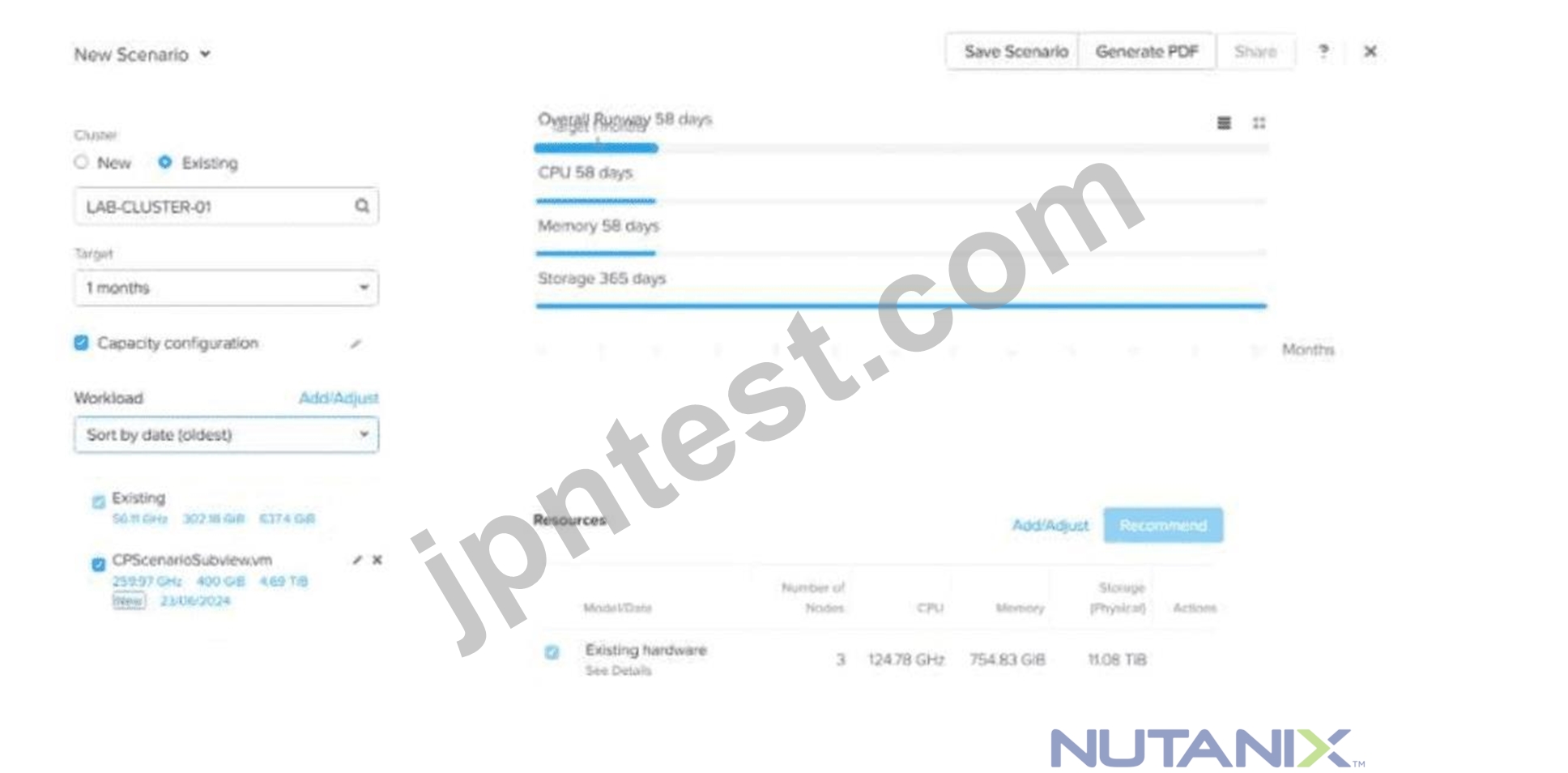
新しいワークロードを追加した後、全体の実行日数が 365 日未満なのに、シナリオではクラスターが良好な状態であると表示されるのはなぜですか?
- A. 目標は1か月だからです。
- B. 推奨リソースがあるからです。
- C. Storage Runway はまだ良いですから。
- D. 新しいワークロードは持続可能であるためです。
正解:D
解説:
InNutanix Capacity Planning,Overall Runwayrepresents how long the cluster can support current and new workloads before resources are exhausted.
* Even if the runway is below 365 days, the system considers the cluster to be in good shape if new workloads are sustainable (Option B).
* Option A is incorrect: Storage runway alone is not the only factor; CPU and memory are equally important.
* Option C is incorrect: The presence of recommended resources does not mean the cluster is in good shape.
* Option D is incorrect: The target of 1 month affects projections but does not explain why the cluster is in good shape.
References:
Nutanix Prism Central # Capacity Runway and Planning
Nutanix Bible # Workload Placement and Cluster Sizing
Nutanix Support KB # Capacity Planning Best Practices
質問 # 44
メンテナンス モードに設定されたノードでは、デフォルトでどの 2 つのアクションが実行されますか? (2 つ選択してください。)
- A. 移行できない VM は電源がオフになり、クラスター内の他のホストで再起動されます。
- B. ホスト上のすべての適格な VM がクラスター内の他のホストに移行されます。
- C. ホスト上のすべての対象仮想マシンの電源がオフになっています。
- D. 移行できない VM の電源がオフになっています。
正解:B、D
解説:
When a node is placed intoMaintenance Mode, Nutanix follows a structured process to ensureservice continuity and data integrity.
* Option B (All eligible VMs on the host are migrated to other hosts) is correct:
* Live Migration automatically moves VMs to other hoststo avoid downtime.
* This ensures workloads remain operational during maintenance.
* Option D (Non-migratable VMs are powered off) is correct:
* Some VMs, such as those usingGPU pass-through or local storage dependencies,cannot be live-migrated.
* These VMsmust be powered offbefore placing the host into Maintenance Mode.
* Option A is incorrect:
* Non-migratable VMs are not automatically restarted on other hosts-they remain powered off until manually restarted.
* Option C is incorrect:
* Eligible VMs are live-migrated, not powered off.
References:
* Nutanix AHV Best Practices#Understanding Maintenance Mode Behavior
* Nutanix KB#VM Migration and Power-Off Scenarios in Maintenance Mode
質問 # 45
開発環境のチーム リーダーは、開発者のアクセスを特定の VM セットに制限したいと考えています。
チーム リーダーがこれらの VM を直接管理できるようにする最も効率的な方法は何ですか?
- A. 各チームリーダーの役割マッピングを作成し、適切に割り当てます。
- B. 各チームリーダーに VPC を作成し、VPC 管理者権限を付与します。
- C. 各チーム リーダーにプロジェクトを作成し、アクセス権を割り当てます。
- D. ユーザーを分離するためのセキュリティ ポリシーを作成します。
正解:C
解説:
Themost efficient wayto allow team leads to manage aspecific set of VMsis bycreating a Project (Option C)in Prism Central and assigning the team leads to that Project.
* Nutanix Projects allow administrators to control VM accessbased on groups and permissions, ensuring that users only manage VMs assigned to their project.
* Option A (Role Mapping)applies more broadly to roles but does not restrict access to specific VM groups.
* Option B (VPC Admin)is related to network segmentation, not VM access control.
* Option D (Security Policies)are used for network and firewall rules, not VM access control.
References:
* Nutanix Prism Central #Projects and Role-Based Access Control (RBAC)
* Nutanix Bible #Multi-Tenancy and Project-Based Access Control
* Nutanix KB #Setting Up Role-Based Access Control (RBAC) for Prism Central
質問 # 46
管理者はリソース計画を担当し、10ノードのRF3クラスタの回復力を計画する必要があります。
クラスターには 100 TB のストレージがあります。
管理者は、将来の障害発生時に容量をどのように計画すればよいでしょうか?
- A. 障害の予備容量を自動検出に設定します。
- B. 予備ストレージ容量 (%) を 20 に設定します。
- C. 予約メモリ容量 (%) を 20 に設定します。
- D. 障害時の予備容量を「なし」に設定します。
正解:A
解説:
RF3 (Replication Factor 3) clusters require sufficient reserved capacity to tolerate failures without data loss.
* Option C (Set Reserve Capacity for Failure to Auto Detect) is correct:
* Auto Detect dynamically calculates the necessary reserved spacebased on cluster size and RF settings.
* It ensures thatenough storage remains available in case of a node failure.
* Option A (Set Reserve Storage Capacity to 20%) is incorrect:
* The required storage reservationdepends on the number of nodes and RF level, not a fixed percentage.
* Option B (Set Reserve Capacity for Failure to None) is incorrect:
* Without reserved capacity,a node failure could lead to data unavailability.
* Option D (Set Reserve Memory Capacity to 20%) is incorrect:
* This setting applies toRAM, notstorage resiliency.
References:
Nutanix Bible #Understanding Replication Factor (RF) and Failure Planning Nutanix Prism Element Guide #Configuring Reserve Capacity for Cluster Resiliency Nutanix KB #How to Plan Capacity for RF3 Clusters
質問 # 47
管理者は、Prism でハイブリッド SSD/HDD クラスターのアラートを確認します。
「ストレージ プールの SSD 使用率が一貫して 75% を超えています。」
この症状の潜在的な影響は何でしょうか?
- A. クラスターは SSD ディスク障害に耐えられません。
- B. クラスター内の平均 I/O レイテンシが増加する可能性があります。
- C. クラスターが読み取り専用状態になる危険性があります。
- D. クラスターのメタデータ用ストレージが不足している可能性があります。
正解:B
解説:
High SSD utilization in a hybrid cluster can lead to increased I/O latency as new writes may spill over to HDDs, reducing overall performance.
* Option D (Average I/O latency in the cluster may increase) is correct:
* If SSD usage isabove 75%,data tiering shifts to slower HDDs,increasing latency.
* Option A is incorrect:
* SSD failures are managed via redundancy policies (RF2/RF3), and high utilizationdoes not impact failure handling.
* Option B is incorrect:
* Metadata is stored separately, and high SSD usage does not mean metadata is at risk.
* Option C is incorrect:
* Clusters do not go into read-only mode due to high SSD utilization-they simply experience performance degradation.
References:
* Nutanix Storage Performance Guide#SSD Tiering and Performance Management
* Nutanix KB#Managing High SSD Utilization in Hybrid Clusters
質問 # 48
コンサルタントは syslog 監視を構成しており、監査モジュールから重要なログを受信したいと考えています。
望ましい出力を得るには、どの重大度レベル設定を構成する必要がありますか?
- A. 0
- B. 1
- C. 2
- D. 3
正解:C
解説:
Syslog severity levels follow a standard numerical system, wherelower numbers indicate higher severity.
* Option B (Severity Level 2) is correct:
* Level 2 = CRITICAL# Used forserious conditions requiring immediate attention.
* Audit logs often generate Critical logsrelated tosecurity, access violations, or major failures.
A screenshot of a computer Description automatically generated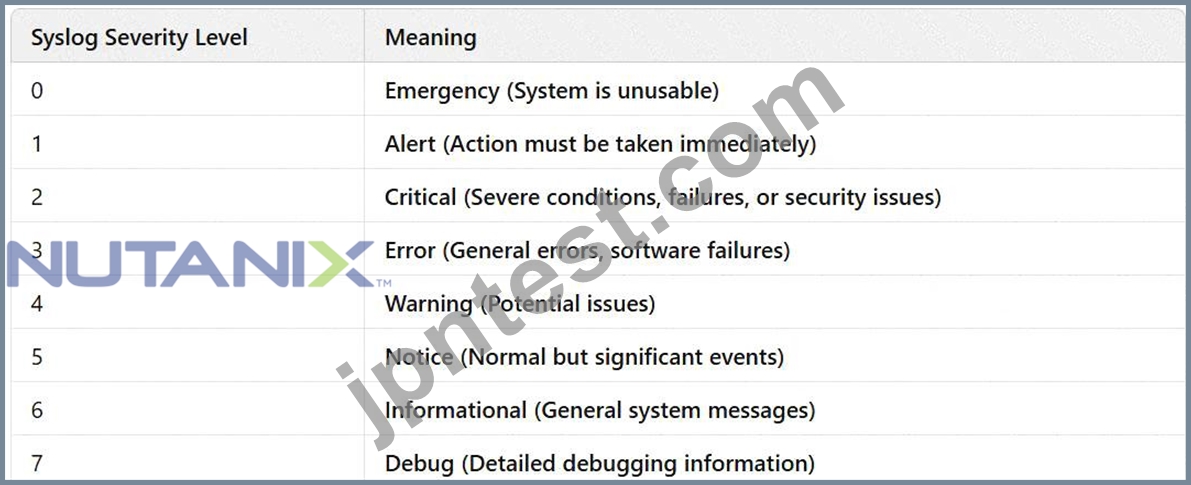
* Options A (0), C (5), and D (7) are incorrect:
* 0 = Emergency (Too severe, only used for full system failures).
* 5 = Notice (Not critical, used for general system events).
* 7 = Debug (Not relevant for critical logs).
References:
* Nutanix Security Guide#Syslog Integration and Severity Levels
* Nutanix KB#Configuring Syslog for Prism Central Audit Logs
質問 # 49
保持されるレポートの最大インスタンス数に達すると、何が起こりますか?
- A. 最も古いレポートが削除されました
- B. レポート失敗が報告されました。
- C. 手動での削除が必要です。
- D. 新しいレポートは遅延されます。
正解:A
解説:
When the maximum instance count of retained reports is reached, Nutanix automatically deletes the oldest report to accommodate the new one.
From theNutanix Enterprise Cloud Administration (ECA)course materials:
"To ensure storage and performance efficiency, Nutanix reporting limits the number of stored reports. If this maximum is reached, the oldest report instance is automatically deleted to make space for new reports."
質問 # 50
管理者は、多数の同時ネットワーク接続をサポートするために AHV VM を変更する必要があります。VM には次の機能があります。
* 4 つの vCPU
* 20 GBのRAM
* OS: Microsoft Windows Server 2022
ネットワーク I/O を集中的に使用するアプリケーションのネットワーク パフォーマンスを向上させるには、どのような変更が必要ですか?
- A. RSS VirtIO-Net マルチキューを有効にします。
- B. AHV Turbo テクノロジーを有効にします。
- C. RAMを追加します。
- D. vCPU を追加します。
正解:A
解説:
Receive Side Scaling (RSS) VirtIO-Net Multi-Queue improves network performance by distributing network processing across multiple CPU cores.
* Option C (Enable RSS VirtIO-Net Multi-Queue) is correct:
* This settingreduces CPU bottlenecksby allowing multiple queues to handle network packets.
* It isessential for high-throughput network applications.
* Option A (Add more vCPUs) is incorrect:
* CPU resources are important, butwithout enabling RSS, additional vCPUs will not optimize network traffic distribution.
* Option B (Enable AHV Turbo Technology) is incorrect:
* AHV Turbo improvesdisk I/O, notnetwork I/O.
* Option D (Add more RAM) is incorrect:
* RAM does not directly impact network performance.
References:
* Nutanix AHV Best Practices Guide #Optimizing Network Performance with RSS Multi-Queue
* Nutanix KB #Enabling Multi-Queue for High-Performance Applications
質問 # 51
......
NCP-MCI-6.10日本語問題集PDFとテストエンジン試験問題:https://www.jpntest.com/shiken/NCP-MCI-6.10-JPN-mondaishu