

FCSS_SASE_AD-23試験問題集を試そう!ベストFCSS_SASE_AD-23試験問題トレーニングを提供しています
実践サンプルと問題集指導には2024年最新のFCSS_SASE_AD-23有効なテスト問題集
質問 # 10
Which secure internet access (SIA) use case minimizes individual workstation or device setup, because you do not needto install FortiClient on endpoints or configure explicit web proxy settings on web browser-based end points?
- A. SIA for SSLVPN remote users
- B. SIA for agentless remote users
- C. SIA for site-based remote users
- D. SIA for inline-CASB users
正解:B
解説:
The Secure Internet Access (SIA) use case that minimizes individual workstation or device setup is SIA for agentless remote users. This use case does not require installing FortiClient on endpoints or configuring explicit web proxy settings on web browser-based endpoints, making it the simplest and most efficient deployment.
* SIA for Agentless Remote Users:
* Agentless deployment allows remote users to connect to the SIA service without needing to install any client software or configure browser settings.
* This approach reduces the setup and maintenance overhead for both users and administrators.
* Minimized Setup:
* Without the need for FortiClient installation or explicit proxy configuration, the deployment is straightforward and quick.
* Users can securely access the internet with minimal disruption and administrative effort.
References:
* FortiOS 7.2 Administration Guide: Details on different SIA deployment use cases and configurations.
* FortiSASE 23.2 Documentation: Explains how SIA for agentless remote users is implemented and the benefits it provides.
質問 # 11
Which FortiSASE feature ensures least-privileged user access to all applications?
- A. SD-WAN
- B. thin branch SASE extension
- C. secure web gateway (SWG)
- D. zero trust network access (ZTNA)
正解:D
質問 # 12
When viewing the daily summary report generated by FortiSASE. the administrator notices that the report contains very little data. What is a possible explanation for this almost empty report?
- A. The web filter security profile is not set to Monitor
- B. Log allowed traffic is set to Security Events for all policies.
- C. Digital experience monitoring is not configured.
- D. There are no security profile group applied to all policies.
正解:B
解説:
If the daily summary report generated by FortiSASE contains very little data, one possible explanation is that the "Log allowed traffic" setting is configured to log only "Security Events" for all policies. This configuration limits the amount of data logged, as it only includes security events and excludes normal allowed traffic.
* Log Allowed Traffic Setting:
* The "Log allowed traffic" setting determines which types of traffic are logged.
* When set to "Security Events," only traffic that triggers a security event (such as a threat detection or policy violation) is logged.
* Impact on Report Data:
* If the log setting excludes regular allowed traffic, the amount of data captured and reported is significantly reduced.
* This results in reports with minimal data, as only security-related events are included.
References:
* FortiOS 7.2 Administration Guide: Provides details on configuring logging settings for traffic policies.
* FortiSASE 23.2 Documentation: Explains the impact of logging configurations on report generation and data visibility.
質問 # 13
An organization needs to resolve internal hostnames using its internal rather than public DNS servers for remotely connected endpoints. Which two components must be configured on FortiSASE to achieve this?
(Choose two.)
- A. Split DNS rules
- B. Split tunnelling destinations
- C. DNS filter
- D. SSL deep inspection
正解:A、B
解説:
To resolve internal hostnames using internal DNS servers for remotely connected endpoints, the following two components must be configured on FortiSASE:
* Split DNS Rules:
* Split DNS allows the configuration of specific DNS queries to be directed to internal DNS servers instead of public DNS servers.
* This ensures that internal hostnames are resolved using the organization's internal DNS infrastructure, maintaining privacy and accuracy for internal network resources.
* Split Tunneling Destinations:
* Split tunneling allows specific traffic (such as DNS queries for internal domains) to be routed through the VPN tunnel while other traffic is sent directly to the internet.
* By configuring split tunneling destinations, you can ensure that DNS queries for internal hostnames are directed through the VPN to the internal DNS servers.
References:
* FortiOS 7.2 Administration Guide: Provides details on configuring split DNS and split tunneling for VPN clients.
* FortiSASE 23.2 Documentation: Explains the implementation and configuration of split DNS and split
* tunneling for securely resolving internal hostnames.
質問 # 14
When you configure FortiSASE Secure Private Access (SPA) with SD-WAN integration, you must establish a routing adjacency between FortiSASE and the FortiGate SD-WAN hub. Which routing protocol must you use?
- A. IS-IS
- B. BGP
- C. OSPF
- D. EIGRP
正解:B
解説:
When configuring FortiSASE Secure Private Access (SPA) with SD-WAN integration, establishing a routing adjacency between FortiSASE and the FortiGate SD-WAN hub requires the use of the Border Gateway Protocol (BGP).
* BGP (Border Gateway Protocol):
* BGP is widely used for establishing routing adjacencies between different networks, particularly in SD-WAN environments.
* It provides scalability and flexibility in managing dynamic routing between FortiSASE and the FortiGate SD-WAN hub.
* Routing Adjacency:
* BGP enables the exchange of routing information between FortiSASE and the FortiGate SD-WAN hub.
* This ensures optimal routing paths and efficient traffic management across the hybrid network.
References:
* FortiOS 7.2 Administration Guide: Provides information on configuring BGP for SD-WAN integration.
* FortiSASE 23.2 Documentation: Details on setting up routing adjacencies using BGP for Secure Private Access with SD-WAN.
質問 # 15
A customer wants to upgrade their legacy on-premises proxy to a could-based proxy for a hybrid network.
Which FortiSASE features would help the customer to achieve this outcome?
- A. SD-WAN and inline-CASB
- B. zero trust network access (ZTNA) and next generation firewall (NGFW)
- C. SD-WAN and NGFW
- D. secure web gateway (SWG) and inline-CASB
正解:D
解説:
For a customer looking to upgrade their legacy on-premises proxy to a cloud-based proxy for a hybrid network, the combination of Secure Web Gateway (SWG) and Inline Cloud Access Security Broker (CASB) features in FortiSASE will provide the necessary capabilities.
* Secure Web Gateway (SWG):
* SWG provides comprehensive web security by inspecting and filtering web traffic to protect against web-based threats.
* It ensures that all web traffic, whether originating from on-premises or remote locations, is inspected and secured by the cloud-based proxy.
* Inline Cloud Access Security Broker (CASB):
* CASB enhances security by providing visibility and control over cloud applications and services.
* Inline CASB integrates with SWG to enforce security policies for cloud application usage, preventing unauthorized access and data leakage.
References:
* FortiOS 7.2 Administration Guide: Details on SWG and CASB features.
* FortiSASE 23.2 Documentation: Explains how SWG and inline-CASB are used in cloud-based proxy solutions.
質問 # 16
Refer to the exhibit.
The daily report for application usage shows an unusually high number of unknown applications by category.
What are two possible explanations for this? (Choose two.)
- A. Zero trust network access (ZTNA) tags are not being used to tag the correct users.
- B. Certificate inspection is not being used to scan application traffic.
- C. Deep inspection is not being used to scan traffic.
- D. The inline-CASB application control profile does not have application categories set to Monitor
正解:B、C
解説:
The unusually high number of unknown applications by category in the daily report for application usage can be attributed to the following reasons:
* Certificate Inspection is not being used to scan application traffic:
* Without certificate inspection, encrypted traffic cannot be adequately analyzed, leading to a higher number of unknown applications.
* Certificate inspection allows the FortiSASE to decrypt and inspect HTTPS traffic, identifying applications correctly.
* Deep Inspection is not being used to scan traffic:
* Deep inspection goes beyond basic traffic analysis, performing thorough examination of packet contents to identify applications accurately.
* If deep inspection is not enabled, many applications may go unrecognized and categorized as unknown.
References:
* FortiOS 7.2 Administration Guide: Details on certificate inspection and deep inspection configurations.
* FortiSASE 23.2 Documentation: Explains the importance of deep inspection and certificate inspection in accurate application identification.
質問 # 17
Refer to the exhibit.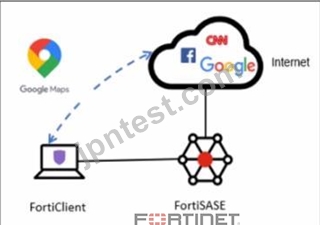
A company has a requirement to inspect all the endpoint internet traffic on FortiSASE, and exclude Google Maps traffic from the FortiSASE VPN tunnel and redirect it to the endpoint physical Interface.
Which configuration must you apply to achieve this requirement?
- A. Configure a static route with the Google Maps FQDN on the endpoint to redirect traffic
- B. Change the default DNS server configuration on FortiSASE to use the endpoint system DNS.
- C. Configure the Google Maps FQDN as a split tunneling destination on the FortiSASE endpoint profile.
- D. Exempt the Google Maps FQDN from the endpoint system proxy settings.
正解:C
解説:
To meet the requirement of inspecting all endpoint internet traffic on FortiSASE while excluding Google Maps traffic from the FortiSASE VPN tunnel and redirecting it to the endpoint's physical interface, you should configure split tunneling. Split tunneling allows specific traffic to bypass the VPN tunnel and be routed directly through the endpoint's local interface.
* Split Tunneling Configuration:
* Split tunneling enables selective traffic to be routed outside the VPN tunnel.
* By configuring the Google Maps Fully Qualified Domain Name (FQDN) as a split tunneling destination, you ensure that traffic to Google Maps bypasses the VPN tunnel and uses the endpoint's local interface instead.
* Implementation Steps:
* Access the FortiSASE endpoint profile configuration.
* Add the Google Maps FQDN to the split tunneling destinations list.
* This configuration directs traffic intended for Google Maps to bypass the VPN tunnel and be routed directly through the endpoint's physical network interface.
References:
* FortiOS 7.2 Administration Guide: Provides details on split tunneling configuration.
* FortiSASE 23.2 Documentation: Explains how to set up and manage split tunneling for specific destinations.
質問 # 18
Which policy type is used to control traffic between the FortiClient endpoint to FortiSASE for secure internet access?
- A. thin edge policy
- B. private access policy
- C. secure web gateway (SWG) policy
- D. VPN policy
正解:C
解説:
The Secure Web Gateway (SWG) policy is used to control traffic between the FortiClient endpoint and FortiSASE for secure internet access. SWG provides comprehensive web security by enforcing policies that manage and monitor user access to the internet.
* Secure Web Gateway (SWG) Policy:
* SWG policies are designed to protect users from web-based threats and enforce acceptable use policies.
* These policies control and monitor user traffic to and from the internet, ensuring that security protocols are followed.
* Traffic Control:
* The SWG policy intercepts all web traffic, inspects it, and applies security rules before allowing or blocking access.
* This policy type is crucial for providing secure internet access to users connecting through FortiSASE.
References:
* FortiOS 7.2 Administration Guide: Details on configuring and managing SWG policies.
* FortiSASE 23.2 Documentation: Explains the role of SWG in securing internet access for endpoints.
質問 # 19
Refer to the exhibits.

When remote users connected to FortiSASE require access to internal resources on Branch-2. how will traffic be routed?
- A. FortiSASE will use the AD VPN protocol and determine that traffic will be directed to Branch-2 directly, using a static route
- B. FortiSASE will use the AD VPN protocol and determine that traffic will be directed to Branch-2 directly, using a dynamic route
- C. FortiSASE will use the SD-WAN capability and determine that traffic will be directed to HUB-1, which will then route traffic to Branch-2.
- D. FortiSASE will use the SD-WAN capability and determine that traffic will be directed to HUB-2. which will then route traffic to Branch-2.
正解:C
解説:
When remote users connected to FortiSASE require access to internal resources on Branch-2, the following process occurs:
* SD-WAN Capability:
* FortiSASE leverages SD-WAN to optimize traffic routing based on performance metrics and priorities.
* In the priority settings, HUB-1 is configured with the highest priority (P1), whereas HUB-2 has a lower priority (P2).
* Traffic Routing Decision:
* FortiSASE evaluates the available hubs (HUB-1 and HUB-2) and selects HUB-1 due to its highest priority setting.
* Once the traffic reaches HUB-1, it is then routed to the appropriate branch based on internal routing policies.
* Branch-2 Access:
* Since HUB-1 has the highest priority, FortiSASE directs the traffic to HUB-1.
* HUB-1 then routes the traffic to Branch-2, providing the remote users access to the internal resources.
References:
* FortiOS 7.2 Administration Guide: Details on SD-WAN configurations and priority settings.
* FortiSASE 23.2 Documentation: Explains how FortiSASE integrates with SD-WAN to route traffic based on defined priorities and performance metrics.
質問 # 20
Which FortiSASE feature ensures least-privileged user access to all applications?
- A. SD-WAN
- B. thin branch SASE extension
- C. secure web gateway (SWG)
- D. zero trust network access (ZTNA)
正解:D
解説:
Zero Trust Network Access (ZTNA) is the FortiSASE feature that ensures least-privileged user access to all applications. ZTNA operates on the principle of "never trust, always verify," providing secure access based on the identity of users and devices, regardless of their location.
* Zero Trust Network Access (ZTNA):
* ZTNA ensures that only authenticated and authorized users and devices can access applications.
* It applies the principle of least privilege by granting access only to the resources required by the user, minimizing the potential for unauthorized access.
* Implementation:
* ZTNA continuously verifies user and device trustworthiness and enforces granular access control policies.
* This approach enhances security by reducing the attack surface and limiting lateral movement within the network.
References:
* FortiOS 7.2 Administration Guide: Provides detailed information on ZTNA and its role in ensuring least-privileged access.
* FortiSASE 23.2 Documentation: Explains the implementation and benefits of ZTNA within the FortiSASE environment.
質問 # 21
Which two advantages does FortiSASE bring to businesses with multiple branch offices? (Choose two.)
- A. It enables seamless integration with third-party firewalls.
- B. It eliminates the need to have an on-premises firewall for eachbranch.
- C. it offers customizable dashboard views for each branch location
- D. It offers centralized management for simplified administration.
正解:B、D
解説:
FortiSASE brings the following advantages to businesses with multiple branch offices:
* Centralized Management for Simplified Administration:
* FortiSASE provides a centralized management platform that allows administrators to manage security policies, configurations, and monitoring from a single interface.
* This simplifies the administration and reduces the complexity of managing multiple branch offices.
* Eliminates the Need for On-Premises Firewalls:
* FortiSASE enables secure access to the internet and cloud applications without requiring dedicated on-premises firewalls at each branch office.
* This reduces hardware costs and simplifies network architecture, as security functions are handled by the cloud-based FortiSASE solution.
References:
* FortiOS 7.2 Administration Guide: Provides information on the benefits of centralized management and cloud-based security solutions.
* FortiSASE 23.2 Documentation: Explains the advantages of using FortiSASE for businesses with multiple branch offices, including reduced need for on-premises firewalls.
質問 # 22
Which two additional components does FortiSASE use for application control to act as an inline-CASB?
(Choose two.)
- A. Web filter with inline-CASB
- B. SSL deep inspection
- C. DNS filter
- D. intrusion prevention system (IPS)
正解:A、B
解説:
FortiSASE uses the following components for application control to act as an inline-CASB (Cloud Access Security Broker):
* SSL Deep Inspection:
* SSL deep inspection is essential for decrypting and inspecting HTTPS traffic to identify and control applications and data transfers within encrypted traffic.
* This allows FortiSASE to enforce security policies on SSL/TLS encrypted traffic, providing visibility and control over cloud applications.
* Web Filter with Inline-CASB:
* The web filter component integrates with inline-CASB to monitor and control access to cloud applications based on predefined security policies.
* This combination provides granular control over cloud application usage, ensuring compliance with security policies and preventing unauthorized data transfers.
References:
* FortiOS 7.2 Administration Guide: Details on SSL deep inspection and web filtering configurations.
* FortiSASE 23.2 Documentation: Explains how FortiSASE acts as an inline-CASB using SSL deep inspection and web filtering.
質問 # 23
......
最新100%合格率保証付きの素晴らしいFCSS_SASE_AD-23試験問題PDF:https://www.jpntest.com/shiken/FCSS_SASE_AD-23-mondaishu
FCSS_SASE_AD-23有効な認定試験問題集解答学習ガイド:https://drive.google.com/open?id=1fZZdA_7bzmw85Iq6i6de56k-h7t79j-D