

MB-820試験問題集を試そう!ベストMB-820試験問題トレーニングを提供しています
実践サンプルと問題集指導には2025年最新のMB-820有効なテスト問題集
質問 # 22
A company plans to set up a local Business Central Development Docker container.
The environment will be used for testing new project ideas.
You need to ensure that the most recent Business Central artifact URL has been selected.
Which command should you use?
- A. Get-BcArtifactUrl -type sandbox -select NextMinor
- B. Get-BcArtifactUrl -type sandbox -select Current
- C. Get-BcArtifactUrl -type sandbox -select Closest
- D. Get-BcArtifactUrl -type sandbox -select NextMajor
正解:B
解説:
To ensure the most recent Business Central artifact URL is selected for setting up a local Business Central Development Docker container, the command to use is Get-BcArtifactUrl -type sandbox - select Current (A). This PowerShell command retrieves the URL for the latest available Business Central artifact for a sandbox environment, ensuring that the Docker container is set up with the most up-to-date version for testing new project ideas. The -select Current parameter is crucial as it specifies that the current, or latest, version of the artifact is to be retrieved, as opposed to selecting a version based on other criteria such as Closest, NextMinor, or NextMajor.
質問 # 23
You develop a test application.
You must meet the following requirements:
* Roll back changes to a test method after run time.
* Run an approve action on a test page named TestPageA.
You need to implement the given requirements on the test codeunit
Which actions should you perform? To answer, select the appropriate options in the answer area NOTE: Each correct selection is worth one point.
正解:
解説:
Explanation:
To roll back changes to a test method after run time, you should:
* Set the TransactionModel attribute to AutoRollback.
To run an approve action on a test page named TestPageA, you should:
* Configure TestPageA.Approve.Invoke().
In Business Central's testing framework, the TransactionModel attribute can be set to AutoRollback. This ensures that any changes made during the test are rolled back after the test is complete, leaving the database in its original state.
For running an action on a test page, you would use the 'Invoke' method on the action you wish to perform. In this case, to run an approve action on TestPageA, you would use TestPageA.Approve.Invoke() within your test codeunit. This simulates the user action of approving something on the page.
These actions ensure that the testing environment is properly set up to test specific functionalities without persisting test data and to invoke actions as part of the test scenarios.
質問 # 24
A company uses a Vendor-List report from the Base Application.
The company has new requirements that cannot be met by extending the Vendor - List report.
You create a new report named My Customized Vendor - List.
You need to replace the Vendor - List report with My Customized Vendor - List.
How should you complete the code segment? To answer, select the appropriate options in the answer area.
NOTE Each correct selection is worth one point.
正解:
解説:
Explanation:
he code in the image shows an event subscription to substitute reports in Business Central.
Code Explanation:
* EventSubscriber subscribes to an event in Business Central that allows you to replace or substitute the report at runtime.
* The event here is associated with Report Distribution Management.
* The local procedure OnSubstituteReport checks if the report being requested is Vendor - List. If it is, it replaces it with My Customized Vendor - List.
Completion:
* EventSubscriber ObjectType: The correct object type in this case is Report Distribution Management.
* Event Name: The appropriate event to substitute a report is OnAfterSubstituteReport.
質問 # 25
You have a per tenant extension that contains the following code.
For each of the following statements, select Yes if the statement is true. Otherwise, select No.
NOTE: Each correct selection is worth one point.
正解:
解説:
質問 # 26
A company plans to set up a local Business Central Development Docker container. The environment will be used for testing new project ideas.
You need to ensure that the most recent Business Central artifact URL has been selected. Which command should you use?
- A. Get-BcArtifactUrl -type sandbox -select NextMinor
- B. Get-BcArtifactUrl -type sandbox -select Current
- C. Get-BcArtifactUrl -type sandbox -select Closest
- D. Get-BcArtifactUrl -type sandbox -select NextMajor
正解:B
解説:
To ensure the most recent Business Central artifact URL is selected for setting up a local Business Central Development Docker container, the command to use is Get-BcArtifactUrl -type sandbox -select Current (A).
This PowerShell command retrieves the URL for the latest available Business Central artifact for a sandbox environment, ensuring that the Docker container is set up with the most up-to-date version for testing new project ideas. The -select Current parameter is crucial as it specifies that the current, or latest, version of the artifact is to be retrieved, as opposed to selecting a version based on other criteria such as Closest, NextMinor
, or NextMajor.
質問 # 27
A company has a Business Central online environment.
You need to create an HTTP GET request that connects to an external REST service.
Which solution should you use?
- A. HttpClient data type variable
- B. HttpContent data type variable
- C. Codeunit 1299 "Web Request Helper"
- D. Codeunit 1297 "Http Web Request Mgt."
- E. Codeunit 5459 "JSON Management"
正解:A
解説:
To create an HTTP GET request that connects to an external REST service in a Business Central online environment, the solution to use is the HttpClient data type variable (E). The HttpClient data type in AL language is designed for sending HTTP requests and receiving HTTP responses from a resource identified by a URI. This makes it the ideal choice for interfacing with external REST services, as it provides the necessary methods and properties to configure and execute HTTP GET requests, handle the responses, and process the data returned by the REST service.
This approach is more direct and flexible compared to using specific codeunits like "Web Request Helper" (B) or "Http Web Request Mgt" (D), which might not provide the same level of control or specificity needed for RESTful interactions.
質問 # 28
You need to define the tables used for the non-conformity entity.
What should you use?
- A. supplemental table to introduce the non-conformity lines
- B. document history table to introduce the non-conformity entities
- C. document table to introduce the non-conformity entities
正解:C
解説:
* Table Structure in Business Central: When creating entities such as "non-conformity" entities in Business Central, you use document tables to represent entities that have a header and line structure. In this case, the non-conformity entity has:
* A header with common information (Non-conformity Number, Date, Vendor No., etc.).
* One or more lines representing the detailed information for each non-conforming item.
* Document Table Usage:
* Document Table: A document table is the correct table type for scenarios where you have a header (with general information like vendor details) and lines (with detailed, item-specific information).
* Document tables are typically used for entities such as Sales Orders, Purchase Orders, or any other transactional data where you have both header and line information.
* Supplemental Table (Option C):
* Supplemental tables are usually used to add supplementary information to existing data in Business Central. In this case, we need to store detailed line information, which is a core part of the entity rather than supplementary data, so a supplemental table would not be appropriate here.
* Document History Table (Option A):
* Document history tables are used to track changes and historical data for entities but are not suitable for the main introduction of the entity and its lines. This option is also not appropriate.
Reference Documentation:
* Introduction to Business Central Tables
* Document Tables in Business Central
質問 # 29
A company plans to deploy Business Central.
The company has the following deployment requirements:
* Use the company hardware architecture to run the deployment.
* Use sandbox environments to develop extensions.
* Allow tenants to connect to Shopify with the standard connector.
* Use Microsoft Power Automate to create a workflow that calls a business event.
You need to identify the deployment type for each requirement.
Which deployment types should you use? To answer, move the appropriate deployment types to the correct requirements. You may use each deployment type once, more than once, or not at all.
正解:
解説:
Explanation:
* Use the company hardware architecture to run the deployment: On-premises
* Use sandbox environments to develop extensions: Online
* Allow tenants to connect to Shopify with the standard connector: Online
* Use Microsoft Power Automate to create a workflow that calls a business event: Online When deploying Microsoft Dynamics 365 Business Central, there are two main deployment types to consider:
On-premises and Online.
* On-premises Deployment:
* The requirement to use the company's hardware architecture implies a need for an on-premises deployment. This is because on-premises deployment allows for the application to be installed and run directly from the company's in-house servers and computing infrastructure, giving full control over the environment and data.
* Online Deployment:
* The use of sandbox environments for developing extensions is a feature provided in the online version of Business Central. Sandbox environments are a part of the service offered in the cloud- based version, which allows developers to test and develop without affecting the live environment.
* Connection to Shopify with the standard connector implies an online deployment. The standard connector is typically a cloud-based service that allows Business Central to connect with other cloud platforms like Shopify, which is more seamlessly integrated with the online version.
* Lastly, the use of Microsoft Power Automate to create a workflow that calls a business event suggests an online deployment. Power Automate is a cloud-based service designed to create automated workflows between applications and services - which aligns with the services provided by the online version of Business Central.
Therefore, each requirement aligns with the deployment types as indicated above.
質問 # 30
A company has extended Business Central.
You plan to submit the extension to AppSource.
You need to ensure that an application meets the technical requirements before submitting it for validation.
Which three actions should you perform? Each correct answer presents a complete solution.
NOTE: Each correct selection is worth one point.
- A. Use data classification on all tables and extension fields.
- B. Ensure the app file is digitally signed
- C. Include extension translation files with the submission.
- D. Code all date fields in the mm-dd-yyyy format
- E. Use the OnBeforeCompanyOpen event for improved sign in time
正解:A、B、C
解説:
B: Include extension translation files with the submission.
* AppSource submissions require that the extension be localized to different languages, and including translation files is part of the requirement.
C: Ensure the app file is digitally signed.
* Digitally signing the app file is a security requirement for AppSource submissions to ensure the integrity and authenticity of the app.
E: Use data classification on all tables and extension fields.
* Microsoft requires that all data, especially personal data, be classified using the data classification feature to comply with GDPR and other data privacy regulations.
質問 # 31
A company has the following custom permission set:
You need to make the permission set visible on the Permission Sets page.
Which three actions should you perform in sequence? To answer, move the appropriate actions from the list of actions to the answer area and arrange them in the correct order.
NOTE: More than one order of answer choices is correct. You will receive credit for any of the correct orders you select.
正解:
解説:
1 - Change the Assignable property value to true.
2 - Add the ObsoleteState = No property.
3 - Publish the app with the permission set to an environment.
Topic 2, Alpine Ski House
Overview
Alpine Ski House is a company that owns and operates hotels, restaurants, and stores. Currently, the company uses the following software and interlace:
* Property management software (PMS) to manage hotel rooms
* On-premises accounting software to generate sales invoices and create purchase orders
* An API that allows restaurants and stores to obtain necessary information Restaurants and stores use standalone software for point of sale (POS) devices. Each day, the POS terminals generate a text file of sales data and save the files in a serval folder. An account assistant must manually import the files to the current software tables to be processed by the system.
The general manager receives several reports monthly from department managers. The reports take too much time to prepare.
The company is moving from a different system to 8usiness Central online to manage the whole company.
The company plans to increase efficiency in every department by using APIs to obtain or share information between the different systems.
Each department involved in purchasing must be able to make purchase requests automatically and easily. The departments do not need access to the full ERP management system.
Alpine Ski House requires the development of several extensions for the planned improvements. Business Central design patterns must be used to develop all extensions.
Alpine Ski House must develop the following pages:
* Pages that provide multiple configurations in a multistep dialog, like a wizard, to provide required information when the extensions are first installed
* Department-specific Role Center pages to show relevant information and pages with additional information The IT department plans to use Power 61 to analyze departmental information. The database must be configured to provide optimal performance.
The housekeeping department requires the following to increase efficiency and help avoid data entry errors:
* A Housekeeping Role Center to minimize navigation to relevant areas In Business Central online and to show relevant information in it
* Pages to embed into a new Room page to show additional information about the Room entity
* A table named Room Incident for the housekeeping team to enter room issue information
* A Housekeeping canvas app that connects to an extension
The department requires the development of an extension with a new API page named RoomsAPI.
* The housekeeping team will use RoomsAPI to publish room details, update when work is complete, or provide repair notifications from the canvas app.
* This custom API page must expose a custom table named Rooms and have an ID 50000. The table must be able to update from the PMS. The PMS team must know the end to connect to the custom API.
* A developer provides the following details for the API page:
APIPublisher = 'alpine';
APIGroup - 'integration';
APIVersion - 'v2.6';
fntityName 'room';
EntitySetName = 'rooms';
* The extension must be published in Business Central online and include a list page named Room List that includes all hotel rooms.
* Installation or updates to this extension must meet the following requirements:
o Some web services must be published automatically.
o The version of the specified application's metadata must be obtained in AL language.
o The code required to perform tasks cannot be accessible from other parts of the application.
The Room Incident table information must include the following fields:
* Incident entry: An incremental number
* Room No.: A room from the Room table
* Incident Date: The work date
o The table definition in the Room Incident table must autofill the Incident Date when the housekeeping team inserts a new record, o The value for Incident Date must be the work date configured in the Business Central online client.
* Status: Includes the following options lo identify the status of the incident:
o Open: When the Room Incident is created
o In Progress: When someone starts repair work
o Closed: When the incident is solved
* Incident Closing Date: Auto-updating field (when the status passes to Closed, the field will update with the work date)
* Incident Description: Text
* Image. Media data type
o The stored picture must be downloadable from a menu action.
o A Room Incident page must be developed to contain the download action.
To increase efficiency, the new system must manage the generated data from the restaurants and stores directly by using the API on the POS terminals.
* The company requires a code unit called from a job queue to read the information from the POS terminal APIs.
* The POS terminal information must be stored in a table named POS Information, have an ID 50100. and be editable on a page.
* The account manager requires an option on the menu of the page to run the process manually.
To analyze the information received from the POS terminals, the company requires:
* A custom API named ticketAPI to export the information to Power BI
* Use of the Read Scale-Out feature to improve database performance
The purchasing department requites a new entity in Business Central online to log non-conformities of goods received from vendors. The entity must be set up as follows:
* The non-conformity entity must have two tables:
o a header with common information
o one or more lines with the detailed received items that are non-conforming
* The entity requires a page named Non-conformity and a subpage named Non-Conformity Lines to store the information.
When a purchase order with incorrect quantity 01 quality issues is received, the entity must create a non-conformity document in the system. The following information must be nick the document:
* Non-conformity Number: must use the No. Series table from Business Central online to manage this field and use these features:
o Alphanumeric values
o Number format that includes "NO and the year as part of the number: for example, NC24-001
* Non-conformity Date: stores only the creation date
* Vendor No.: stores the number of the vendor that sent the items; only vendors from the company must be included
* Owner: code of an employee defined in the company
* Receipt No.: must meet the following conditions:
o Be an existing receipt No.
o Be received from the vendor indicated in the Vendor No. field
* Comments: can include comments with rich text and pictures to illustrate quality problems
* Status: includes nonconformity statuses, such as:
o Open
o Notified
o Closed
* Lines must contain the following details:
o Item No.: item received (for existing inventory items only)
o Description: item description
0 Quantity: non-conforming quantity
0 Non-conformity Type:
* Quality
* Quantity
* Delivery date
The serial numbers of the non-conformities and the period in which they can be created must be in a configuration table and its corresponding page to allow them to be modified for the users.
質問 # 32
You are developing an app.
You plan to publish the app to Microsoft AppSource.
You need to assign an object range for the app.
Which object range should you use?
- A. custom object within the range 50000 to 99999
- B. custom object within the range 50000 to 59999
- C. divided by countries and use specific a country within the range 100000 to 999999
- D. free object within the standard range 1 to 49999
- E. an object range within the range of 7000000 to 74999999 that is requested from Microsoft
正解:E
解説:
When developing an app for Microsoft AppSource, it is essential to use an object range that is specifically designated by Microsoft to avoid conflicts with other apps and the base application.
The correct object range to use is:
An object range within the range of 70000000 to 74999999 that is requested from Microsoft (D):
This range is reserved for AppSource apps. Developers need to request this range from Microsoft to ensure that the objects used in their extension do not conflict with those used by other extensions or by the base application. Using this reserved range helps maintain the integrity and compatibility of extensions published on AppSource.
It's important to note that the other ranges mentioned (A, B, C, and E) are not suitable for apps intended for AppSource. Ranges 50000 to 59999 and 50000 to 99999 are typically reserved for per- tenant customizations or partner solutions, not for distribution on AppSource. The standard range 1 to 49999 is reserved for the base application objects, and using an object range divided by countries (C) is not a standard practice for AppSource apps.
質問 # 33
A company plans to deploy Business Central.
The company has the following deployment requirements:
* Use the company hardware architecture to run the deployment.
* Use sandbox environments to develop extensions.
* Allow tenants to connect to Shopify with the standard connector.
* Use Microsoft Power Automate to create a workflow that calls a business event.
You need to identify the deployment type for each requirement.
Which deployment types should you use? To answer, move the appropriate deployment types to the correct requirements. You may use each deployment type once, more than once, or not at all.
正解:
解説:
Explanation:
* Use the company hardware architecture to run the deployment: On-premises
* Use sandbox environments to develop extensions: Online
* Allow tenants to connect to Shopify with the standard connector: Online
* Use Microsoft Power Automate to create a workflow that calls a business event: Online When deploying Microsoft Dynamics 365 Business Central, there are two main deployment types to consider:
On-premises and Online.
* On-premises Deployment:
* The requirement to use the company's hardware architecture implies a need for an on-premises deployment. This is because on-premises deployment allows for the application to be installed and run directly from the company's in-house servers and computing infrastructure, giving full control over the environment and data.
* Online Deployment:
* The use of sandbox environments for developing extensions is a feature provided in the online version of Business Central. Sandbox environments are a part of the service offered in the cloud- based version, which allows developers to test and develop without affecting the live environment.
* Connection to Shopify with the standard connector implies an online deployment. The standard connector is typically a cloud-based service that allows Business Central to connect with other cloud platforms like Shopify, which is more seamlessly integrated with the online version.
* Lastly, the use of Microsoft Power Automate to create a workflow that calls a business event suggests an online deployment. Power Automate is a cloud-based service designed to create automated workflows between applications and services - which aligns with the services provided by the online version of Business Central.
Therefore, each requirement aligns with the deployment types as indicated above.
質問 # 34
A company plans to customize its per tenant extension reports. The company has the following requirements for the customization:
* Child data items must not be displayed on the request page for some master detail reports.
* Selecting key filter fields takes users too much time. The customization must decrease the amount of time to select the fields.
You need to optimize the report request page.
Which actions should you configure? To answer, select the appropriate options in the answer area.
NOTE: Each correct selection is worth one point.
正解:
解説:
質問 # 35
You create a page with the PageType property set to RoleCenter.
You navigate through the different sections of the page.
You need to add functionalities to the page.
What should you do?
- A. Define actions in the area (reporting) before actions in the area (creation).
- B. Add a source table on the Role Center page.
- C. Define the navigation bar in the area (embedding).
- D. Define the navigation menu in the area(processing).
正解:C
解説:
When creating a page with the PageType property set to RoleCenter in Microsoft Dynamics 365 Business Central, it's essential to organize the functionalities and actions in a manner that enhances user experience and efficiency. The best practice is to define actions in the area (reporting) before actions in the area (creation) (A). This organization allows users to access reporting and analytical features quickly, which are commonly used in Role Centers for overview and insight purposes, before moving on to creation or transactional tasks.
This logical flow aligns with typical user workflows, where analysis and review precede the creation of new records or transactions. The other options, such as defining the navigation menu in the area(processing) (B), defining the navigation bar in the area (embedding) (C), or adding a source table on the Role Center page (D), do not directly address the need to add functionalities to the Role Center page in a user-friendly manner.
質問 # 36
You are treating an app tor Business Central.
You plan to specify the following parameters and properties of the server and app.
* Startup object type and object ID
* Runtime
* Dependencies
You need to configure the JSON file for the specified parameters and properties Which JSON files should you configure? To answer, move the appropriate files to the correct object purposes You may use each file once, more than once, or not at all You may need to move the split bar between panes or scroll to view content NOTE Each correct selection is worth one point.
正解:
解説:
Explanation:
Each JSON file has its own purpose in Business Central extensions:
* app.json
* Purpose: This file holds metadata about the application and contains configuration settings for dependencies and startup object information.
* Startup object type and object ID should be configured here.
* launch.json
* Purpose: This file defines how to run and debug the application during development.
* Runtime settings are configured here.
Final Answer (Drag and Drop):
* Startup object type and object ID # app.json
* Runtime # launch.json
* Dependencies # app.json
質問 # 37
A company has a Business Central online environment.
You are exporting a file from a client by using the DownloadFromStream method.
You need to create an InStream data type to send the data
Which solution should you use?
- A. Use OeatelnStream method from codeunit "Temp Blob".
- B. Use CreatelnStream method for File type variable.
- C. Use OeatelnStream method for BLOB field of "TempBlob" table.
正解:A
解説:
When exporting a file from a client using the DownloadFromStream method in a Business Central online environment, you need to create an InStream data type to send the data. The solution is to use the CreateInStream method from codeunit "Temp Blob" (A). The Temp Blob codeunit provides temporary storage of BLOBs (Binary Large Objects) and is commonly used for handling files and streams in Business Central. By using the CreateInStream method on a Temp Blob, you create an InStream that can then be used with the DownloadFromStream method to send the file data to the client. This approach is efficient for file handling and transfer in Business Central, especially in scenarios involving data export or file manipulation.
質問 # 38
You must simulate the user interaction of selecting a posting option. The options must include:
* Ship
* Invoice
* Ship & Invoice
You need to create a test codeunit to run the test.
What should you use?
- A. Test attribute
- B. Normal attribute
- C. Handler method
正解:C
解説:
* Handler methods are used in tests to simulate user interactions, such as responding to dialogs, confirmation messages, or option selections. Since you need to simulate the user interaction of selecting a posting option (Ship, Invoice, Ship & Invoice), a Handler method would be the appropriate choice for capturing this kind of user input.
* Normal attribute and Test attribute are used for marking methods for test execution, but they do not simulate user interaction, making Handler method the correct answer.
For more details, see the Microsoft Docs on Test Codeunits and Handler Methods.
質問 # 39
A company owns and operates hotels, restaurants, and stores.
When the staff orders materials from the purchasing department, the requests are not directed to the correct approvers.
The staff requires a new field named Approver from which they can select the appropriate approver. The field must include the following options:
* Hotel manager
* Restaurant manager
* Store manager
* Purchasing manager
You need to create the Approver field in the Item table by using an AL extension.
Which three actions should you perform in sequence? To answer, move the appropriate actions from the list of actions to the answer area and arrange them in the correct order.
正解:
解説:
Explanation:
To create the Approver field in the Item table using an AL extension, perform the following actions in sequence:
* Create an enum object named Approver and include all options.
* Create a table extension object for an Item table with an Approver field of enum type named Approver in the fields section.
* Create a page extension object that extends the Item Card object. Add the field to the fields section.
Build and extend tables:To add a new field to an existing table in Business Central using AL extension, you need to define an enumeration (enum) with the possible values for the new field. Then, you create a table extension object where you add the new field and specify its type as the enum you created. This adds the field to the Item table. Finally, you modify the user interface to display the new field by creating a page extension for the Item Card page and adding the new field to it.
質問 # 40
A company uses Business Central.
The company plans to use the AL object model in Business Central to extend the Base Application.
You need to extend the objects.
Which two objects can you extend? Each correct answer presents a complete solution.
NOTE: Each correct selection is worth one point.
- A. API page
- B. Enum
- C. Codeunit
- D. Query
- E. Report
正解:C、E
解説:
* A: Codeunit
* Codeunits can be extended in AL to add or modify functionality in Business Central.
* B: Report
* Reports can also be extended to customize the format or data presented in the reports without modifying the base report.
Incorrect Options:
* C: Query: Queries cannot be extended. You would need to create new queries or modify the existing ones directly.
* D: API page: You cannot extend API pages, but you can create new API pages.
* E: Enum: You cannot extend Enums because they are predefined sets of values.
質問 # 41
You create a query that contains a procedure to display the top customers.
The procedure breaks at runtime.
You need to fix the code.
For each of the following statements, select Yes if the statement is true. Otherwise, select No.
NOTE: Each correct selection is worth one point.
正解:
解説:
Explanation:
* Enclose line 08 into BEGIN .. END = NO
* Add TopCustomerOverview.Open(); before = YES
* TopCustomerOverview.SetFilter(Sales_LCY, '>10000'); in line 06.
* Add TopCustomerOverview.Open(); after TopCustomerOverview.SetFilter(Sales_LCY, '>10000'); in line 06. = YES
* Replace SetFilter in line 06 with SetRange. = NO
The code provided has a runtime error because the query TopCustomerOverview must be opened before it can be read from. Therefore, TopCustomerOverview.Open(); should be added before trying to read from the query, which is not present in the code.
Enclosing line 08 into a BEGIN .. END block is unnecessary because it is a single statement, and AL does not require a BEGIN .. END block for single statements within trigger or procedure bodies.
TopCustomerOverview.SetFilter(Sales_LCY, '>10000'); is a correct method to set a filter for the query, and using SetRange instead is not necessary unless the requirement is specifically to set a range of values, which is not indicated in the procedure's description.
In summary, for the procedure to run correctly, the query must be opened after setting the filter and before attempting to read from it. The SetFilter method is correct for the intended operation, and there's no requirement to use SetRange or to enclose the Message call in a BEGIN .. END block.
Topic 1, Contoso, Ltd. Contoso, Ltd. Is a sales company in the
manufacturing industry. It has subsidiaries in multiple countries
/regions, each with its own localization. The subsidiaries must be
data-independent from each other. Contoso. Ltd. uses an external
business partner to manage the subcontracting of some
manufacturing items. Contoso. Ltd. has different sectors with data
security between sectors required.
Contoso, Ltd. uses Business Central online as the main ERP for financial. sales, purchase, warehouse, and manufacturing processes. It has employees that use the Business Central web application and external applications. The company has a custom external mobile app under development The IT department and its partners installed custom extensions to satisfy the company's requirements where the functionality is not available natively.
Contoso. Ltd. interacts with external services provided by customers and partners. Different applications interact with SOAP and OData endpoints exposed from Business Central.
An external business partner of Contoso, Ltd exposed a REST API for receiving details about new subcontracting orders and for sending the planned release date of each subcontracting order received.
Contoso. Ltd. has not activated the monitoring of the tenant and has no internal telemetry for its apps.
Custom reporting must be created to meet the requirements of the different departments.
Contoso, Ltd. has the following tenant management considerations:
IT department
* The IT department requires the ability to monitor the tenant to prevent performance problems and detect possible anomalies.
* The IT department plans to use Azure Application Insights and Log Analytics to inspect the ingested telemetry signals.
* All tenant upgrades are automatically handled by Microsoft. The IT department does not check for update availability or for tenant-related notifications.
* The IT department has not configured the receipt of tenant-related notifications from the Business Central admin center.
External business partner
* The external business partner must add custom telemetry to an application created for Contoso. Ltd. to monitor a business process.
* Custom telemetry signals for the application must be visible only on the partner's telemetry.
SOAP
* Contoso, Ltd. plans to dismiss using the SOAP protocol for integrations.
* Contoso, Ltd. must be able to detect if external applications are using its Business Central SOAP endpoints.
Issue
The Business Central tenant is upgraded by Microsoft to a new major version during the night.
Users report that one of the Contoso. ltd. extensions disappeared from the tenant The IT department confirms that the extension is still published.
Contoso. Ltd. plans to create a custom mobile application that has the following requirements:
* The app must be used by employees to check item details from the ERP in real time and to report issues that occur during the manufacturing process.
* An AL extension must be created for handling archived issues.
* Business Central development guidelines must be followed when implementing modules.
* A module must be implemented for the reporting and tracking of issues information. You plan to call this module Issue Management The module must expose a method nan Postlude.
* Code modifications will be required over time.
* The Issue Management process must be split into two extensions:
o ISSUE BASE: main extension
o ISSUE EXT: second extension with dependency from ISSUE BASE
* In the version 1.0.0.0 of the ISSUE BASE extension, you plan to create an Issue table that contains a global Decimal variable named Issue Total.
* In the version 1.0.0.0 of the ISSUE BASE extension, you plan to define a table named Issue Category with a Description field defined as follows:
field (2; Description; Text[SG])
{
DataClassificstion * CustoaerContent;
>
* The Issue table defined in ISSUE BASE extension contains a Clone procedure defined as follows:
procedure Corte () begin end;
* In the ISSUE EXT extension, you create a table extension object of the Issue table.
* The table extension object of the Issue table must access the Issue Total: Decimal variable.
After weeks of usage, you discover that you must remove the Description field and the Clone procedure because they are no longer required.
In a new version of the ISSUE BASE extension, you create a new Issue Type table. You must move data row by row from a previously obsolete Issue Category table to the new Issue Type table. Because a large amount of data must be moved, you must write an Upgrade codeunit by using the DataTransfer object.
The IT department creates a custom API for exposing the custom Issue table. The API provides an action for copying an issue to a new table. The action is defined as follows:
(Service Enabled]
procedure Copy (vary action Context: WebServiceActionContext)
begin
end;
Contoso, Ltd. must create an API in Business Central to expose item details to the mobile application.
* The API must have the lowest possible impact on the production environment when used during working hours.
* The API must only support Get operations.
A user of the ISSUE BASE extension in Business Central reports a problem.
To debug the problem, snapshot debugging with the following configuration was activated:
You discover that the debugging is not triggering.
Contoso, Ltd. must connect Business Central to the external API provided by the business partner. This will be used for the partner to send the details of new subcontracting orders to fulfill the sales demand, and for receiving the planned release date of each order sent. The integration requirements are as follows:
* The business partner will provide a REST API secured with basic authentication. Credentials to access the API will be shared with Contoso, ltd.
* The API for sending subcontracting orders must be called by sending an authenticated POST request to the given endpoint.
* The API for retrieving the order no. and planned release date of each subcontracting order responds with the following JSON: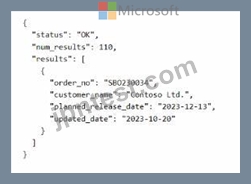
Each order no. must be retrieved.
質問 # 42
You need to handle the removal of the Description field and the Clone procedure without breaking other extensions.
Which three actions should you perform in sequence? To answer, move the appropriate actions from the list of actions to the answer area and arrange them in the correct order.
NOTE: More than one order of answer choices is correct. You will receive credit for any of the correct orders you select.
正解:
解説:
Explanation:
In Business Central, when you need to handle the removal of fields and procedures to ensure that other extensions are not affected by these changes, you typically follow a two-step deprecation process. This allows other developers and users to adapt to the changes before they are fully enforced. Here are the steps to handle the removal:
* Mark as Obsolete: In the first version where the decision to remove the field or procedure is made, you set the ObsoleteState to Pending and provide an ObsoleteReason. This doesn't remove the feature but indicates to users and developers that it will be removed in the future. This step is crucial for backward compatibility.
* Removal: In a subsequent version, after users have had time to adapt to the deprecation warning, you can then remove the field or procedure or set the ObsoleteState to Removed.
Based on these guidelines, here are the three actions you should perform in sequence:
* Set the Description field as ObsoleteState = Pending and ObsoleteReason = 'Not in use' in version
2.0.0.0.
* Set the Clone procedure as ObsoleteState = Pending and ObsoleteReason = 'Not in use' in version
2.0.0.0.
* Remove the Description field from the Issue table in version 2.0.0.1.
These steps will ensure that anyone using the Description field or Clone procedure will receive a warning about the pending deprecation before it is actually removed, thereby minimizing the impact on other extensions and providing a clear path for migration.
When handling the removal of fields and procedures in Microsoft Dynamics 365 Business Central, the process should be carried out in a way that allows other extensions or dependent features to adapt to the changes without causing immediate failures.
* Set Obsolete State and Reason for Description Field (Version 2.0.0.0): The first step involves marking the Description field as obsolete by setting the ObsoleteState to 'Pending'. This is a non-breaking change, signaling to other developers and users that the field is planned for removal in a future version.
An ObsoleteReason should also be provided to explain why the field is being deprecated.
* Set Obsolete State and Reason for Clone Procedure (Version 2.0.0.0): Similarly, the Clone procedure should be marked as obsolete with the ObsoleteState set to 'Pending'. This indicates that the procedure is no longer in use and will be removed in the future. Providing an ObsoleteReason is best practice as it explains the rationale behind the decision.
* Remove the Description Field (Version 2.0.0.1): In the subsequent version, after the developers and users have been given time to adapt to the deprecation notice, the Description field can be safely removed from the Issue table. This is considered a breaking change, hence it is done after the field has been marked as obsolete in a previous version.
The reason for not removing the Description field and Clone procedure immediately in version 2.0.0.0 is to avoid causing runtime errors for any extensions or integrations that may depend on these components. By following this sequence, you provide a clear deprecation path that helps maintain the stability of the overall system while evolving the schema.
質問 # 43
A company is deploying Business Central on-premises.
The company plans to use a single-tenant deployment architecture.
You need to describe how the data is stored and how the Business Central Server is configured.
In which two ways should you describe the single-tenant architecture? Each correct answer presents a complete solution.
NOTE: Each correct selection is worth one point.
- A. The application and business data are stored in separate databases.
- B. Multiple customers share multiple Business Central Server instances.
- C. Multiple customers share a single Business Central Server.
- D. The application and the business data are stored in the same database.
- E. Each customer has their own Business Central Server.
正解:A、D
解説:
In a single-tenant deployment architecture of Business Central on-premises, the following characteristics describe how the data is stored and how the Business Central Server is configured:
The application and the business data are stored in the same database (B): In a single-tenant architecture, each tenant (which typically corresponds to a single customer) has its own dedicated database. This database contains both the application objects (such as pages, reports, codeunits, etc.) and the business data (such as customer, vendor, and transaction records). This setup ensures that each tenant's data is isolated and can be managed independently.
The application and business data are stored in separate databases (D): While (B) is a characteristic of a single-tenant deployment, it's important to clarify that in some configurations, the application objects can be stored in a separate database from the business data. This approach can be used for easier maintenance and upgrades of the application code without affecting the business data. However, each tenant still has its own set of databases, maintaining the single-tenancy model.
質問 # 44
You are developing an app that will be published to Microsoft AppSource.
The app requires code analyzers to enforce some rules. You plan to add the analyzers to the settings.json file.
You need to activate the analyzers for the project.
Which three code analyzers should you activate to develop the app for AppSource? Each correct answer presents part of the solution NOTE: Each correct selection is worth one point.
- A. a custom rule set
- B. CodeCop
- C. UlCop
- D. PerTenantExtensionCop
- E. AppSourceCop
正解:B、D、E
解説:
When developing an app for Microsoft AppSource, it is crucial to adhere to specific guidelines and standards to ensure compatibility and compliance. The three code analyzers you should activate are:
CodeCop (A): This is the default analyzer for AL language extensions. It enforces the AL Coding Guidelines, ensuring that the code follows best practices for readability, maintainability, and performance. It checks for a wide range of issues, from syntax errors to best practice violations, making it essential for any AL development.
PerTenantExtensionCop (D): This analyzer is specifically designed for extensions that are intended to be installed for individual tenants. It includes rules that ensure the extension does not interfere with the per-tenant customizations and adheres to the guidelines for extensions that can be safely installed and uninstalled without affecting the underlying application.
AppSourceCop (E): This analyzer is tailored for extensions that are intended for publication on Microsoft AppSource. It enforces additional rules that are specific to AppSource submissions, such as checking for the use of reserved object ranges and ensuring that all prerequisite dependencies are correctly declared. This is crucial for ensuring that your app meets all the requirements for listing on AppSource.
By activating these three analyzers, developers can ensure their app adheres to the standards required for AppSource, as well as maintain high code quality and compatibility with Business Central.
質問 # 45
......
最新100%合格率保証付きの素晴らしいMB-820試験問題PDF:https://www.jpntest.com/shiken/MB-820-mondaishu
MB-820有効な認定試験問題集解答学習ガイド:https://drive.google.com/open?id=1RjpbDQaD2hhneKqYtQ0tsPPJnssNIHw1