

CIS-DF試験正確な問題集、学習ノートと理論 [2026年09月]
100%高得点合格保証CIS-DF無制限205解答
ServiceNow CIS-DF 認定試験の出題範囲:
| トピック | 出題範囲 |
|---|---|
| トピック 1 |
|
| トピック 2 |
|
| トピック 3 |
|
| トピック 4 |
|
| トピック 5 |
|
質問 # 122
A CMDB CI Class Owner has been asked to change the icon for the UNIX Server class.
Which CI Class Manager tab can the owner use to change the icon for the class?
- A. Basic Info
- B. Attributes
- C. CI List
- D. Suggested Relationships
正解:A
解説:
The correct answer is Basic Info because the class icon is a class-level property, not an attribute, relationship, or CI list configuration. In CI Class Manager, the Basic Info tab is where administrators manage core metadata for a CI class, including class name, label, description, table details, principal class settings, and visual representation such as the class icon. The Suggested Relationships tab is used to define or review recommended relationship patterns between CI classes. The CI List tab is used to view records belonging to the class. The Attributes tab is used to review or manage inherited and class-specific attributes. Since the question specifically asks where the UNIX Server class icon can be changed, the correct location is the Basic Info tab.
=========
質問 # 123
A development team is working on a project where an application will be deployed to many servers. There are several security requirements that must be checked to adhere to lawful regulatory compliance because the application will be holding customer personal data (PII and PCI).
Where in the CSDM should the development team store the information that will be used to satisfy audits?
- A. Customer Service Offerings and Databases
- B. Business Applications and Information Objects
- C. Technology Management Service Offerings (Technical Service Offerings) and Groups
正解:B
解説:
Within the Common Service Data Model (CSDM), regulatory, security, and compliance-related information- especially for PII and PCI-must be modeled at the business and information level, not at the infrastructure or service offering level. The correct location for this data is Business Applications combined with Information Objects.
Business Applications represent the logical applications that support business capabilities and processes.
Since compliance obligations (such as GDPR, PCI-DSS, or HIPAA) are assessed based on how the business uses data-not how many servers host the application-this is the correct anchor point for audit-relevant context.
Information Objects are explicitly designed to capture what data is processed, stored, or transmitted by an application, including data classifications such as PII, PCI, PHI, or confidential business data. They allow organizations to document regulatory scope, retention rules, encryption requirements, and audit controls without overloading CI records or polluting infrastructure classes.
Option A is incorrect because Technical Service Offerings and Groups focus on operational support and service delivery, not regulatory data context. Option C is also incorrect because Customer Service Offerings describe how services are consumed, while databases are technical components; neither is the authoritative place for compliance definitions.
Therefore, Business Applications and Information Objects are the correct CSDM constructs to support audits and regulatory compliance, making Option B the correct answer.
質問 # 124
A CMDB Administrator wants to improve data quality related to the CSDM.
Which action should the Administrator take to meet this goal?
- A. Use the default configured CMDB Health Dashboard
- B. Start the ServiceNow Health Scan
- C. Use the CSDM Data Foundations Dashboard
正解:C
解説:
To specifically improve data quality related to CSDM, the most effective and prescribed action is to use the CSDM Data Foundations Dashboard. In ServiceNow, this dashboard is purpose-built to assess and improve CSDM alignment, not just general CMDB hygiene.
The CSDM Data Foundations Dashboard focuses on service modeling readiness, highlighting gaps such as missing service ownership, incomplete relationships between Business Applications and Application Services, unmanaged services, and misaligned lifecycle states. It provides Get Well Playbooks that guide administrators through structured remediation using Analyze Data, Fix Data, and Govern Data plays--directly tied to CSDM outcomes.
質問 # 125
A CMDB Administrator has configured foundation group data for CIs belonging to the Linux Server class through two different interfaces. CI Class Manager specifies Linux Support as the Managed by Group, while a Technology Management Service Offering specifies Enterprise IT Services as the Managed by Group and Change Management Team as the Change Group for the same CI population.
When Linux Server CIs are discovered and ingested into the CMDB, which group will be assigned as the Managed by Group for these instances?
- A. No group, because the conflicting assignments cause a data-validation error.
- B. Enterprise IT Services
- C. Change Management Team
- D. Linux Support
正解:B
解説:
A Technology Management Service Offering associated with the applicable Dynamic CI Group synchronizes operational group information to its member CIs. The fields designed for this synchronization include Managed by Group and Support Group .
Therefore, Linux Server CIs included in the offering's CI population receive Enterprise IT Services as their Managed by Group. The CI Class Manager value can provide class-level ownership or governance context, but the service-offering alignment actively maintains the operational group value on the related member CIs.
The conflicting values do not cause Discovery or ingestion to fail. ServiceNow applies the configured group- synchronization mechanism rather than leaving the field empty. Change Management Team is assigned to the Change Group field, not the Managed by Group field, so Option D does not answer the question.
Consequently, the Managed by Group assigned to the discovered Linux Server instances is Enterprise IT Services.
質問 # 126
A manufacturing organization has implemented Incident Management in ServiceNow and wants to integrate additional products to enhance its functionality.
Drag each ServiceNow product to the value it brings in supporting Incident Management.
正解:
解説:
Explanation:
Enhancing Incident Management in ServiceNow often involves integrating complementary products that enrich context, prioritization, and decision-making.
Discovery strengthens incident resolution by automatically populating accurate CI data and relationships, allowing responders to quickly understand affected infrastructure and applications.
Hardware Asset Management (HAM) adds visibility into asset lifecycle, ownership, and maintenance actions, which is especially valuable when incidents involve physical devices or failures.
Risk Management (part of IRM) provides insight into business and financial risk exposure, helping teams prioritize incidents based on potential regulatory, safety, or financial impact.
Service Portfolio Management (SPM) connects incidents to the service lifecycle, enabling better understanding of whether an incident affects a live, retiring, or planned service-and improving communication with stakeholders.
Together, these integrations transform Incident Management from a reactive process into a context-rich, business-aligned capability.
質問 # 127
Drag and Drop Question
Some steps need to be taken to transition from using legacy CMDB status attributes to CSDM lifecycle objects.
Drag and drop the objects / attributes to the correct descriptions.
正解:
解説:
Explanation:
When transitioning to CSDM-aligned lifecycle management, ServiceNow introduces a structured lifecycle framework that separates high-level intent from detailed operational state.
Life Cycle Stage represents the macro phase of a CI's existence (for example: Plan, Build, Deploy, Operate, Retire).
Life Cycle Stage Status refines that phase with granular, sub-level states that vary by CI type.
Life Cycle Object determines which lifecycle stages and statuses apply, based on what kind of CI is being managed (hardware, application, document, etc.).
Life Cycle Mapping ensures a safe transition from legacy status fields by translating existing values into standardized CSDM lifecycle values--avoiding data loss or process disruption.
Together, these objects enable consistent lifecycle governance, improve reporting accuracy, and support automation across ITSM, ITOM, and IRM use cases--while remaining backward compatible with legacy CMDB data.
質問 # 128
Drag and drop the application service type to the best description.
正解:
解説:
Explanation:
Service Mapping (Top-down) # Recommended for mission-critical application services that require a precise approach using patterns Tag-Based # Best fit to map cloud-native, container-based, or virtual machine environments Service Mapping (Connection Suggestions) # Ideal for custom-built applications and leverages application fingerprinting to generate service maps in a timely manner Dynamic CI Group # Ideal for small application services that can be easily grouped using filters and CMDB queries In Data Foundations (CMDB + CSDM), an Application Service should be created using an approach that balances accuracy, speed, and maintainability, because the service map becomes the foundation for impact analysis, service visibility, and operational workflows.
Service Mapping (Top-down) is best for mission-critical services because it uses structured entry points and patterns to precisely discover infrastructure, dependencies, and communication paths. This produces high- fidelity maps suitable for strict governance, controlled change, and reliable outage impact analysis.
Tag-Based mapping is best for cloud-native and dynamic environments (containers, elastic virtual machines, and cloud resources) because tags/labels are the most stable identifiers in rapidly changing estates. It aligns well with modern cloud governance where ownership, environment, and service affiliation are expressed through standardized tagging strategies.
Service Mapping (Connection Suggestions) fits custom-built applications because it leverages observed connection data and application fingerprinting to propose likely dependencies. This accelerates service map creation when traditional pattern-first modeling would take longer, helping teams reach usable service visibility faster while still allowing validation and refinement.
Dynamic CI Group is ideal for smaller services where a full discovered map may be unnecessary. It groups CIs using filters and CMDB queries, providing a lightweight way to define "what's in the service" for reporting, ownership, and basic impact without heavy mapping overhead.
質問 # 129
Which ServiceNow solutions automatically create relationships between CI Applications that are part of an Application Service?
(Choose 2 options)
- A. Discovery
- B. Service Mapping
- C. IntegrationHub ETL
- D. Event Management
- E. Data Manager
正解:A、B
解説:
Discovery and Service Mapping are the correct answers because both capabilities can automatically create CMDB relationships that support Application Services. ServiceNow Discovery identifies infrastructure, applications, running processes, and dependencies in the environment. During discovery, it can create technical relationships between discovered CIs, such as servers, applications, databases, and other supporting components. Service Mapping extends this further by building application service topology, identifying how application components interact, and creating the relationship model that connects CIs into an Application Service. These relationships are essential for impact analysis, change risk assessment, incident correlation, and service-aware operations. Event Management does not create application-service CI relationships; it correlates operational events and alerts. Data Manager governs lifecycle, attestation, certification, archival, retirement, and deletion policies, but it does not discover application topology. IntegrationHub ETL can ingest and transform external CMDB data, but it does not automatically discover service relationships in the same way Discovery and Service Mapping do. Therefore, Discovery and Service Mapping are the ServiceNow solutions that automatically create these relationships.
質問 # 130
A CMDB Administrator has installed a Service Graph Connector and customized a script transform.
What will happen on subsequent upgrades if the default definition of the script transform is updated?
- A. The Service Graph Connector upgrade refuses to start
- B. The upgrade stops and reports an error
- C. A skipped change is created and no change is made to the script transform definition
正解:C
解説:
In ServiceNow, Service Graph Connectors deliver data ingestion patterns using protected, upgrade- safe artifacts, including script transforms. When a customer customizes a script transform provided by a Service Graph Connector, ServiceNow follows standard update set and upgrade behavior to protect customer customizations.
During a subsequent upgrade, if the out-of-box (default) script transform definition changes, ServiceNow does not overwrite the customized version. Instead, the platform records a skipped change, indicating that an update was available but intentionally not applied due to a local customization. This ensures customer-specific logic is preserved while still maintaining transparency about what changed in the newer release.
質問 # 131
A Configuration Manager needs to ensure that each device in the CMDB has a unique serial number to reduce the risk of creating duplicate CIs.
Which management tool is used to identify CIs that do not have serial numbers?
- A. CMDB Data Foundations Dashboard
- B. CSDM Data Foundations Dashboard
- C. CMDB Data Manager
- D. CI Class Manager
正解:A
解説:
The CMDB Data Foundations Dashboard identifies foundational CMDB data-quality deficiencies, including hardware CIs that lack important identification attributes such as serial numbers. A missing serial number is particularly serious because serial number is commonly included in Hardware identification rules.
Without it, Discovery and external integrations may fail to match an incoming device to its existing record, resulting in duplicate CIs.
The dashboard exposes the affected population and provides remediation playbooks that help administrators analyse the responsible data sources, correct existing records, and establish controls to ensure that serial numbers continue to be populated.
CI Class Manager is used to configure class structures and identification rules, but it is not the dashboard used to locate the full population of affected CIs. CMDB Data Manager governs lifecycle policies, while the CSDM dashboard focuses on service-model alignment.
=========
質問 # 132
The CMDB Configuration Manager is using the CI Class Manager to define group ownership of CI classes and needs to leverage the ownership value specified in the CI Class Manager.
When creating a CMDB Data Manager policy, which group reference field should be set?
- A. Approval Group
- B. Change Group
- C. Managed By Group
- D. Support Group
正解:C
解説:
In ServiceNow CMDB governance, the CI Class Manager allows administrators to assign ownership and accountability at the class level. This ownership is used by governance tools-- especially CMDB Data Manager--to automatically determine who receives tasks and actions related to data lifecycle management.
The group reference field that aligns with class ownership and is consumed by CMDB Data Manager policies is the Managed By Group. This field represents the team responsible for the technical stewardship and lifecycle management of CIs within that class.
When CMDB Data Manager executes policies such as retention, archival, or cleanup, it uses the Managed By Group to assign tasks to the appropriate data owners. This ensures governance actions are routed to the correct accountable team without manual intervention.
Approval Group, Support Group, and Change Group serve different purposes. Approval Group is used for workflow approvals, Support Group is used for operational ticket routing, and Change Group supports Change Management governance. None of these reflect data ownership at the class level.
質問 # 133
A CMDB Administrator has imported data into the ServiceNow CMDB from a third-party source by using a Service Graph Connector. The Administrator wants to review specific field-to-field mappings for the import.
Which feature shows this information?
- A. CMDB Integrations Dashboard
- B. IntegrationHub ETL
- C. Integration Hub
正解:A
解説:
The CMDB Integrations Dashboard provides visibility into integrations that populate the CMDB, including Service Graph Connector activity and mapping information. It enables administrators to inspect how source data is mapped to ServiceNow target classes and fields, review connector execution information, and investigate ingestion or mapping problems.
Service Graph Connectors are prebuilt, governed integrations that import third-party data into the CMDB through standardized class mappings and IRE processing. They are intended to minimize custom transformations and preserve source and reconciliation information. The guide describes Service Graph Connectors as upgrade-safe integrations that ingest external data while applying Identification and Reconciliation Engine controls.
Integration Hub is the broader integration and automation framework, not the specific dashboard for reviewing Service Graph Connector field mappings. IntegrationHub ETL is a separate tool for building and managing ETL transformations. It does not serve as the inspection dashboard for mappings belonging to an installed Service Graph Connector.
Therefore, B is correct.
質問 # 134
The CMDB Administrator has set up two Dynamic Reconciliation Rules within the ServiceNow Production Instance. The 'Server' class has a Dynamic Reconciliation Rule of largest value for the RAM field. The 'Windows Server' class has a Dynamic Reconciliation Rule of most reported for the RAM field.
Given the above data in Multisource CMDB, which value is added to the CMDB for RAM for a Server CI?
- A. 4,096 MB
- B. 2,048 MB
- C. 8,192 MB
正解:C
解説:
This question hinges on understanding class-specific Dynamic Reconciliation Rules in CMDB 360
/ Multisource CMDB within ServiceNow.
Although two different dynamic rules are configured, the rule applied depends on the CI class being evaluated:
For the Server class, the configured rule is Largest value for the RAM attribute.
For the Windows Server class, the rule Most reported would apply--but only if the CI were evaluated as a Windows Server.
The question explicitly asks for the resulting RAM value for a Server CI, not a Windows Server CI.
Therefore, the Largest value rule governs the outcome.
Looking at the multisource values:
* 2,048 MB (LANDesk)
* 4,096 MB (Tivoli)
* 4,096 MB (ServiceNow)
* 8,192 MB (Altiris)
Under the Largest value dynamic reconciliation rule, the IRE selects the maximum numeric value, regardless of how frequently it is reported or which source provided it.
The Most reported logic (which would result in 4,096 MB) does not apply here because that rule is configured for a different class (Windows Server).
This scenario illustrates an important CMDB 360 principle: Dynamic reconciliation is evaluated per class, and child-class rules do not override parent-class rules unless the CI is actually classified under that child class.
質問 # 135
Which shows the most complete list of policy types that are provided by CMDB Data Manager?
- A. Delete, Attestation, Retire, and Certification
- B. Attestation, Retire, and Certification
- C. Retire, Archive, Attestation, Certification, and Delete
- D. Archive and Delete
正解:C
解説:
CMDB Data Manager supports multiple governance policy types because CMDB lifecycle management is broader than simply deleting or certifying records. The complete set represented here is Retire, Archive, Attestation, Certification, and Delete. Retire policies support lifecycle transition of CIs that should no longer be active. Archive policies remove records from active operational use while preserving them according to retention requirements. Delete policies permanently remove records when they no longer need to be retained. Attestation policies validate that a CI still exists or is still relevant. Certification policies require users to validate and potentially correct specific CI attribute values. Options B, C, and D are incomplete because each omits at least one major CMDB Data Manager policy type. Option A is therefore the best answer because it includes both lifecycle/removal policy types and validation-focused policy types.
質問 # 136
A CMDB Administrator wants to leverage dynamic reconciliation rules.
Which feature must be enabled?
- A. CMDB Workspace
- B. CMDB Data Manager
- C. Reconciliation Rules
- D. CMDB 360 / Multisource CMDB
正解:D
解説:
Dynamic reconciliation rules are tied to CMDB 360 / Multisource CMDB because they depend on visibility into multiple contributing data sources for the same CI. Standard reconciliation rules control which data source is allowed to update specific CI attributes based on source precedence, but dynamic reconciliation adds more advanced logic, such as choosing a value based on source reporting behavior or data comparison rules.
CMDB Workspace and CMDB Data Manager do not enable dynamic reconciliation; they are management and governance interfaces. Reconciliation Rules alone are not the enabling feature because basic IRE reconciliation can exist without the CMDB 360 dynamic reconciliation capability. Therefore, to use dynamic reconciliation rules, CMDB 360 / Multisource CMDB must be enabled.
=========
質問 # 137
A new custom class is needed to reflect a new application being managed in the CMDB.
Which roles are minimally needed to add this custom CI class?
- A. sn_cmdb_admin and personalize_dictionary
- B. itil_admin and personalize_form
- C. sn_cmdb_admin and personalize_dictionary
- D. sn_cmdb_admin and personalize_form
正解:C
解説:
Creating a custom CI class in the CMDB is a dictionary-level configuration activity and must be performed with the correct minimum privileges to ensure governance and upgrade safety in ServiceNow.
The sn_cmdb_admin role is required because it grants administrative access to CMDB structures, including CI class hierarchy management. This role ensures that changes align with CMDB governance controls and Data Foundations practices.
The personalize_dictionary role is also required because adding a new CI class involves creating or extending dictionary entries (tables, attributes, inheritance). Without dictionary-level access, a user cannot define new classes or attributes in the CMDB schema.
Option A is incorrect because sn_cmdb_admin alone is insufficient without dictionary privileges. Option B and D focus on form personalization, which affects UI layout only and does not allow creation of new CI classes. Additionally, itil_admin is not the correct role for schema-level CMDB changes.
Therefore, the minimal and correct role combination is sn_cmdb_admin and personalize_dictionary, making Option C the verified answer.
質問 # 138
(Choose 2 options)
A Change Manager wants to gain value fromCSDM.
How will theChange Managementprocess benefit from CSDM?
- A. Route the change dynamically
- B. Understand the impact of the change on services
- C. Determine the root cause of the change issue
- D. Identify blackout windows
正解:B、D
解説:
CSDM significantly enhancesChange Managementby providingservice-aware context, enabling better planning, risk assessment, and stakeholder communication.
One key benefit is the ability toidentify blackout windows(Option A). Through CSDM-alignedBusiness Services, Service Offerings, and service calendars, Change Managers can clearly see when services are unavailable for change due to business constraints, regulatory requirements, or peak usage periods. This helps prevent changes from being scheduled during high-risk windows.
Another critical benefit is the ability tounderstand the impact of the change on services(Option D). CSDM establishes clear relationships between infrastructure CIs, Application Services, and Business Services. When a change is proposed, these relationships enable accurateimpact analysis, allowing Change Managers to assess risk based on business criticality rather than just technical scope.
Option B (root cause determination) is primarily aProblem Managementfunction. Option C (dynamic routing of changes) is driven by workflow and approval logic, not directly by CSDM.
Therefore, the correct answers areA - Identify blackout windowsandD - Understand the impact of the change on services.
質問 # 139
Configuration Management needs to ensure data quality for all CIs in the CMDB.
What areas of data quality for CIs are included in the CMDB Health Dashboard? (Choose 2 options)
- A. Downgraded CIs
- B. Upgraded CIs
- C. Duplicate CIs
- D. Missing CIs
- E. Stale CIs
正解:C、E
解説:
The CMDB Health Dashboard is a central component of CMDB Data Foundations insight and governance. It measures and tracks data quality using well-defined health indicators that focus on the accuracy, relevance, and usability of CI data.
Two key data quality areas included in the dashboard are Stale CIs and Duplicate CIs.
Stale CIs (Option D) refer to configuration items that have not been updated within a defined time window. These records are risky because they may no longer reflect the current state of the environment, leading to inaccurate impact analysis, poor change decisions, and misrouted incidents. Monitoring staleness helps organizations identify where discovery, integrations, or ownership processes are failing.
Duplicate CIs (Option E) occur when the same real-world asset or service is represented by multiple records. Duplicates undermine trust in the CMDB, distort reporting, and break service mappings. The CMDB Health Dashboard highlights duplicate trends and integrates with de- duplication and remediation workflows to address them.
質問 # 140
A new ServiceNow customer is assembling a Configuration Management team to support their CMDB.
Drag each role to its corresponding job description.
正解:
解説:
Explanation:
CI Analyst # Manages assigned CI tables, keeps records updated, and resolves tasks related to CMDB records Service or Product Owner # Accountable for managing all elements that make up a portfolio throughout their entire lifecycle Configuration Manager / CMDB Admin # Obtains the highest-level role for CMDB privileges CMDB Process Owner # Has read-only access to CMDB data and to basic user interfaces such as CMDB reports and dashboards
質問 # 141
Configuration Management requires an accurate inventory of devices to be reflected in the CMDB.
Which are common use cases for using Agent Client Collector (ACC)? (Choose 2 options)
- A. Network devices in the DMZ
- B. Servers in the data center
- C. Devices that intermittently connect to the network
- D. Devices in secure environments
正解:C、D
解説:
The Agent Client Collector (ACC) in ServiceNow is designed to collect inventory data from endpoints that are not consistently reachable by traditional Discovery methods. ACC is especially valuable where credential-based, network-based discovery is impractical or impossible.
Devices in secure environments (Option C), such as isolated networks, restricted zones, or highly regulated environments, often block inbound discovery traffic. ACC runs locally on the device and securely sends inventory data outward, making it ideal for these scenarios.
Devices that intermittently connect to the network (Option D), such as laptops, remote endpoints, or roaming devices, are another core use case. Traditional Discovery requires the device to be reachable during scheduled scans, which is unreliable for mobile or off-network assets. ACC ensures inventory data is collected whenever the device is online.
質問 # 142
A CMDB Administrator needs to set up CMDB 360/Multisource CMDB Drag and drop the system property to the functionality Some options may not apply.
正解:
解説:
Explanation: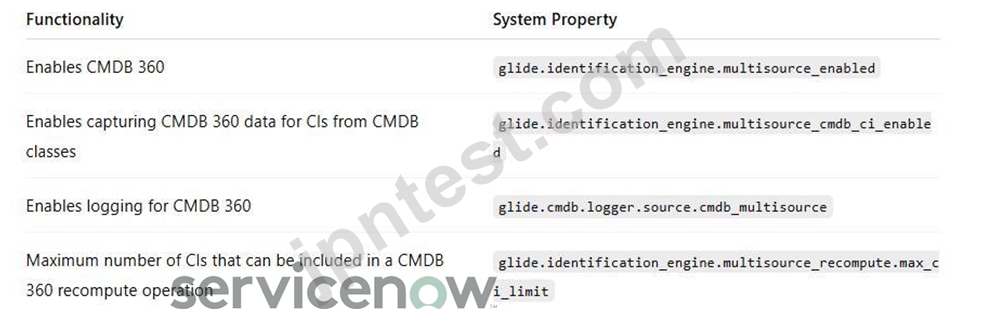
In ServiceNow, CMDB 360 / Multisource CMDB extends the Identification and Reconciliation Engine (IRE) to support multi-source visibility, reconciliation, and confidence scoring. Configuration is controlled through system properties, each enabling a specific capability.
glide.identification_engine.multisource_enabled is the master switch that activates CMDB 360 functionality.
glide.identification_engine.multisource_cmdb_ci_enabled allows CMDB 360 to collect and evaluate data specifically from CMDB CI classes.
glide.cmdb.logger.source.cmdb_multisource enables detailed logging for troubleshooting multisource ingestion and reconciliation.
glide.identification_engine.multisource_recompute.max_ci_limit protects performance by limiting how many CIs can be processed during a recompute operation.
Capturing CMDB 360 data from non-CMDB classes is not supported, which is why no property applies to that option.
This mapping aligns with Data Foundations and CMDB governance best practices, ensuring CMDB 360 is enabled safely, transparently, and at scale.
質問 # 143
......
CIS-DF問題集PDF、CIS-DF最速合格したいなら:https://www.jpntest.com/shiken/CIS-DF-mondaishu
CIS-DF練習試験問題集試験:https://drive.google.com/open?id=1mXEScn8Fo41izHSKf031hqfqYQN47RIM