

100%の合格率を試そう!更新されたのはCDCS試験問題 [2025]
合格させるCDCS試験にはリアル問題解答
質問 # 21
What is a potential disadvantage of using a hypoxic-based fire suppression system as a fire extinguishing system?
- A. It can only be used in computer rooms where you have sufficient positive pressure.
- B. It can only be used in computer rooms which have sufficient air changes per hour.
- C. The gas containers need to be close to the hazard area.
- D. It can only be used in non-continuous occupied areas.
正解:D
解説:
A hypoxic-based fire suppression system works by reducing the oxygen level in a room to below what is necessary to sustain combustion. This makes it effective in fire prevention, but it is not suitable for continuous occupancy by personnel. Low oxygen levels can cause discomfort or even health risks for people spending extended periods in the space. Therefore, these systems are typically deployed in areas where continuous human occupancy is not required, such as storage rooms or data halls with limited personnel access.
Detailed Explanation:
Hypoxic fire suppression systems lower oxygen levels to around 15-16%, which is safe for short periods but not sustainable for continuous occupancy without risk to health. Data center environments where staff need to spend long periods monitoring and maintaining equipment would need alternative systems, like gas-based suppression that allows for safe evacuation rather than oxygen reduction.
EPI Data Center Specialist References:
The EPI Data Center Specialist curriculum emphasizes that fire suppression systems must be chosen based on occupancy requirements. Hypoxic systems are specifically noted as unsuitable for spaces requiring continuous human presence due to the low oxygen environment they create.
質問 # 22
What mainly affects the cooling capacity of a raised floor tile?
- A. Relative humidity in the computer room, temperature of the cold air, pressure under the raised floor, construction material of the tile
- B. Percentage of the surface opening, airflow direction of the ICT equipment, temperature difference between the air intake and air exhaust of the ICT equipment, construction material of the tile
- C. Type of ICT equipment, location of the air conditioner, pressure under the raised floor, allowable temperature in the hot aisle
- D. Percentage of the surface opening, obstruction of the supporting construction, pressure under the raised floor, damper construction
正解:D
解説:
The cooling capacity of a raised floor tile is primarily influenced by the percentage of surface opening, the obstruction caused by the supporting construction, the pressure under the raised floor, and the damper construction. These factors dictate how much airflow can pass through the tile and how effectively cool air is distributed to the equipment in the data center.
Detailed Explanation:
The percentage of surface opening on a floor tile affects how much air can flow through, with larger openings allowing more airflow. Supporting structures beneath the floor can obstruct airflow, reducing cooling efficiency. Pressure under the raised floor impacts the velocity and volume of air that moves through the tile. Additionally, if dampers are installed, they control the airflow rate, which can be adjusted to meet specific cooling needs for the area.
EPI Data Center Specialist References:
EPI guidance on airflow management under raised floors emphasizes these factors as critical for effective cooling, especially in high-density areas. Ensuring unobstructed and adequate airflow helps maintain consistent cooling across equipment.
質問 # 23
Which formula is correct?
- A. Phase-to-Neutral Voltage = Phase-to-Phase voltage * 1.732
- B. Phase-to-Neutral Voltage = Phase-to-Phase voltage /1.732
- C. Phase-to-Neutral Voltage = Phase-to-Neutral voltage * 1.732
- D. Phase-to-Neutral Voltage = (Phase-to-Phase voltage * 1.732) / Phase-to-Neutral Voltage
正解:B
解説:
The correct formula for calculating Phase-to-Neutral Voltage in a three-phase power system is Phase-to-Neutral Voltage = Phase-to-Phase Voltage / 1.732. This formula applies to balanced three-phase systems, where 1.732 (or √3) represents the relationship between line-to-line and line-to-neutral voltages.
Detailed Explanation:
In three-phase systems, Phase-to-Phase Voltage is higher than Phase-to-Neutral Voltage by a factor of √3. Dividing the phase-to-phase voltage by 1.732 gives the phase-to-neutral voltage, which is critical for understanding power distribution in three-phase electrical systems commonly found in data centers.
EPI Data Center Specialist References:
EPI electrical training highlights the importance of knowing these calculations for designing and maintaining balanced power systems, which are essential for stable and efficient data center operations.
質問 # 24
A data center has its own power supply from the public utility and receives chilled water supply from the building owner.
What needs to be taken into consideration when calculating the PUE?
- A. You will need to take the value for COP of the chiller plant into consideration
- B. You will need to take a weight factor of 0.4 for district chilled water into consideration
- C. Nothing, as the chiller plant in the building also uses electrical power
- D. PUE calculations are not possible in shared buildings
正解:B
解説:
When calculating Power Usage Effectiveness (PUE) in a data center that uses chilled water from an external source, like from a building owner, a weight factor for district chilled water must be applied. This is because PUE calculations aim to measure the energy efficiency of the data center's own operations, and external utilities like district chilled water aren't directly powered by the data center. A weight factor of 0.4 is typically used to account for the energy consumed to produce and deliver the chilled water, reflecting the indirect impact on the data center's total energy consumption.
Detailed Explanation:
PUE is calculated as the ratio of the total facility energy to the IT equipment energy. If the cooling is provided by an external chilled water source, it's necessary to adjust the calculations to accurately reflect the energy impact. By incorporating the 0.4 weight factor, data centers can calculate a more accurate PUE, aligning with standard methods and industry best practices.
EPI Data Center Specialist References:
EPI training on PUE highlights the importance of adjusting for external energy sources, such as district cooling, in the calculations. This ensures that PUE values remain accurate and comparable across different data centers, even when external utilities are used.
質問 # 25
You are allowed to use a calculator for this question. A battery bank is rated at a total capacity of 600 Ah. Calculate how much charging current the rectifier should be able to supply as charging current.
- A. 80 Amperes
- B. 60 Amperes
- C. 12 Amperes
- D. 30 Amperes
正解:D
解説:
To determine the charging current for a battery bank, a general rule of thumb is that the charging current should be 5% of the total battery capacity. For a battery rated at 600 Ah, this calculation would be:
600 Ah×0.05=30 Amperes600 \, \text{Ah} \times 0.05 = 30 \, \text{Amperes}600Ah×0.05=30Amperes This ensures the battery is charged efficiently without overloading the rectifier or risking battery damage.
Detailed Explanation:
Battery charging current is typically set as a percentage of the battery's capacity to balance effective charging with longevity and safety. A 5% charging rate is standard for lead-acid batteries, which would be 30 Amperes for a 600 Ah battery bank.
EPI Data Center Specialist References:
EPI standards recommend calculating charging currents based on a percentage of the battery capacity to ensure safety and efficiency, aligning with best practices for battery management in data centers.
質問 # 26
A data center requires an audit to find out whether it conforms with ANSI/TIA-942 Rated-3 (concurrently maintainable).
Will the network architecture be part of this audit?
- A. No, only the type of cabling used will be audited.
- B. No, as concurrently maintainable only applies to electrical and mechanical (power and cooling).
- C. Yes, amongst other aspects, the network architecture should be Rated-3 compliant with the requirements of ANSI/TIA-942.
- D. Yes, but only if the network administration does not comply with ANSI/TIA-606.
正解:C
解説:
For a Rated-3 data center, network architecture is indeed a key component of the audit under ANSI/TIA-942. This rating requires concurrent maintainability across all systems, including telecommunications infrastructure. The network architecture must therefore meet specific redundancy and reliability standards to ensure uninterrupted operations during maintenance or failure of any single component.
Detailed Explanation:
Rated-3 requirements extend beyond electrical and mechanical systems to include network architecture. This ensures that telecommunications systems are also designed for concurrent maintainability, thus contributing to overall uptime and resilience.
EPI Data Center Specialist References:
EPI endorses comprehensive assessments for Rated-3 facilities, emphasizing that network systems must meet standards for redundancy and concurrent maintainability, which align with ANSI/TIA-942's holistic approach to data center reliability.
質問 # 27
The UPS of a data center, with an ANSI/TIA-942 Rating-4, is installed with the rectifier connected to power feed A and the bypass/reserve line input connected to power feed B.
To which feed will the output of the UPS be synchronized?
- A. Depends on the setting of the UPS, as the UPS can normally be set to either feed
- B. Feed A
- C. Feed B
- D. The UPS will not synchronize to any of the feeds but use an internal clock to set the output voltage and frequency
正解:A
解説:
For a UPS system in a Rating-4 data center, the synchronization of output can indeed depend on the specific settings of the UPS. Generally, such systems allow for flexible configuration where the output can be synchronized to either power feed A or B, depending on which feed is preferred for stability or redundancy purposes.
Detailed Explanation:
In dual-feed setups, such as those in high-redundancy data centers, the UPS can be set to synchronize with either feed. This ensures that the UPS maintains continuity in case one feed becomes unstable or fails. The flexibility to choose synchronization to either feed enhances the resiliency and reliability of power supply, which is critical in Tier IV (Rating-4) facilities where uptime is paramount.
EPI Data Center Specialist References:
The EPI Data Center Specialist course underscores the importance of configurable UPS systems in Rating-4 data centers, where redundancy and continuous power are critical. By allowing synchronization to either feed, the UPS can maintain the highest level of reliability, which aligns with the rigorous standards expected in such environments.
質問 # 28
The logical overview of the data center looks as pictured. To what TIA-942 Rating is this design made based on electrical only?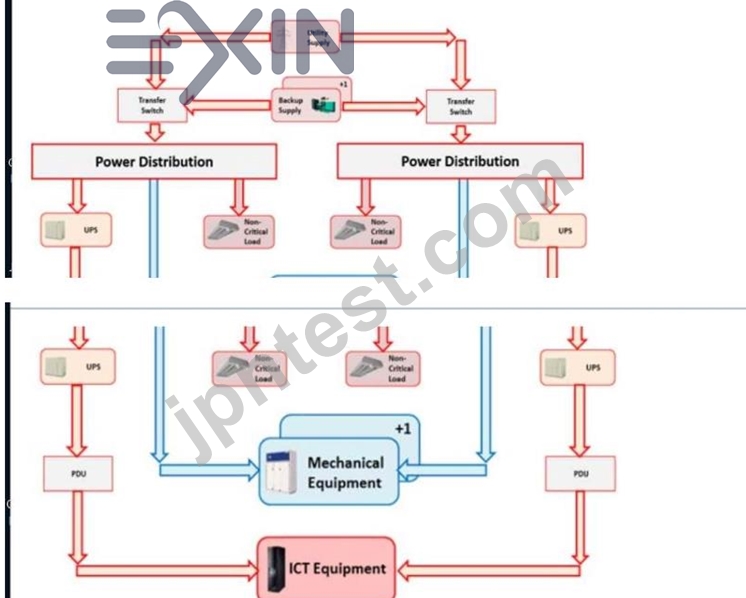
- A. Rating - 3
- B. Rating - 2
- C. Rating - 4
- D. Rating - 1
正解:C
解説:
The electrical design shown in the diagrams represents a TIA-942 Rating-4 configuration. This design includes full redundancy and fault tolerance, as demonstrated by the dual power distribution paths from the utility supply to the critical loads. Each power distribution path is equipped with its own UPS, ensuring that the ICT equipment and mechanical equipment have uninterrupted power in case of any single point of failure.
Detailed Explanation:
A Rating-4 data center requires two independent power paths that are fully redundant and capable of supporting the load independently. In the diagrams:
There are dual feeds from the utility supply, each going through separate transfer switches and power distribution paths.
Both paths have backup sources (+1) and serve critical components through separate UPS systems, providing a completely redundant setup.
The design also includes redundant paths to the mechanical equipment and ICT equipment, which further indicates the fault-tolerant characteristics of a Rating-4 infrastructure.
This setup allows for concurrent maintainability and ensures that no single failure in power distribution or UPS can impact the data center's operation, which is characteristic of the highest Tier/Rated-4 classification.
EPI Data Center Specialist References:
EPI guidelines confirm that TIA-942 Rating-4 requires full redundancy and fault tolerance for electrical infrastructure, ensuring continuous operation even during maintenance or failure events. This design meets all those requirements, thus aligning with Rating-4 standards.
質問 # 29
Three data centers are benchmarked on facilities energy efficiency.
Data center A has achieved a PUE of 2.45.
Data center B has achieved a PUE of 1.20.
Data center C has achieved a PUE of 1.90.
Which of the data centers is operating at the highest facility efficiency?
- A. PUE does not indicate efficiency
- B. Data center C
- C. Data center B
- D. Data center A
正解:D
解説:
A Power Usage Effectiveness (PUE) of 1.20 (achieved by Data Center B) indicates the highest facility efficiency among the three data centers. A lower PUE value signifies better energy efficiency, as it means that a greater proportion of the total energy consumed is used directly for IT equipment rather than for cooling, lighting, or other facility needs.
Detailed Explanation:
PUE is calculated as the ratio of total facility energy to IT equipment energy. A PUE close to 1.0 suggests that almost all the energy is dedicated to computing processes, with minimal overhead. With PUE values of 2.45, 1.20, and 1.90, Data Center B (1.20) operates most efficiently by devoting a higher percentage of its total energy to IT equipment.
EPI Data Center Specialist References:
The EPI curriculum emphasizes PUE as a key metric for data center efficiency, with lower values representing better performance. Achieving a PUE near 1.0 aligns with industry best practices for energy-efficient data center design and operation.
質問 # 30
The temperature in the computer room is being increased from 18°C/64°F to 27°C/81°F.
What is the impact, if any, on the amount of gas required to suppress a fire assuming the gas is a Halocarbon?
- A. The amount of gas required will be lower
- B. The amount of gas required will not change
- C. The change to the amount of gas cannot be determined without knowing the change in humidity as well
- D. The amount of gas required will be higher
正解:A
解説:
With Halocarbon fire suppression systems, as the temperature increases, the amount of gas required for effective suppression decreases. This is because Halocarbon agents are stored as a liquid and discharge as a gas, expanding more at higher temperatures. As a result, less agent is needed at higher room temperatures to achieve the desired concentration for fire suppression.
Detailed Explanation:
Halocarbons rely on specific volumetric concentrations to suppress fires. Higher temperatures cause the agent to expand more rapidly, effectively filling the protected area with less agent needed to reach the required concentration. This is in contrast to some other gases, where temperature changes might not have the same effect on discharge quantities.
EPI Data Center Specialist References:
EPI data center training on fire suppression indicates that understanding the physical properties of agents like Halocarbons is key for correct system sizing. As the temperature rises, the gas expands more readily, thus requiring adjustments in the amount needed for effective coverage.
質問 # 31
It is assumed that EMF shielding material must be installed as the EMF levels coming from the transformer room into the computer room are measured at 100mG. The transformer room is approximately 10 meters away from the computer room and is separated by a corridor. You can assume that no physical issues are present for installing shielding material at any area/location.
Where should you recommend the shielding material to be installed?
- A. As close as possible to the transformer room
- B. As close as possible to the computer room
- C. Shielding is not required to be installed as 100mG is within the acceptable levels for computer rooms
- D. It does not matter, either close to the transformer room or the computer room is okay as there is no impact to cost or shielding material performance
正解:A
解説:
EMF shielding is most effective when installed close to the source of the EMF, which in this case is the transformer room. Shielding at the source contains the magnetic fields before they spread, minimizing exposure throughout the facility, including the computer room.
Detailed Explanation:
Placing shielding close to the EMF source minimizes the area impacted by electromagnetic interference, as it reduces the distance over which the EMF can spread. Shielding materials near the source can absorb or redirect EMF, providing the most effective reduction of EMF levels in adjacent spaces, like the data center.
EPI Data Center Specialist References:
EPI data center training advises positioning shielding close to the EMF source to contain fields more effectively and reduce interference in critical areas. This method is more efficient and cost-effective, as it limits the spread of EMF from the point of origin.
質問 # 32
What should be considered when installing overhead data cabling?
- A. To maintain minimum separation from power and ensure that the fire detection and suppression systems are not hindered.
- B. Optical fiber cabling should always be positioned on top of the copper cabling in the same cable tray to avoid damage to the sensitive optical fiber.
- C. Copper data cabling should not be placed in metal cable trays.
- D. All cabling should make sharp bends directly into the rack to avoid usage of additional space and blocking the airflow on top of the rack.
正解:A
解説:
When installing overhead data cabling, it's crucial to maintain minimum separation from power cables to prevent electromagnetic interference. Additionally, cabling should be arranged so that it does not obstruct fire detection and suppression systems, allowing for proper sensor function and suppression agent dispersion in the event of a fire.
Detailed Explanation:
Separation between power and data cabling minimizes the risk of interference and helps ensure compliance with standards for signal integrity. Proper placement relative to fire suppression systems ensures that any smoke or heat can be effectively detected, and suppression agents can be evenly distributed without obstruction from cabling.
EPI Data Center Specialist References:
EPI guidelines emphasize maintaining adequate separation between power and data cables for safety and performance and ensuring cabling does not interfere with essential safety systems in data centers.
質問 # 33
When installing a raised floor, can we use a spirit level bar to level the floor?
- A. Yes, using a spirit level bar for raised floors higher than 40 cm is preferred.
- B. No, because using a spirit level bar, a measurement error will be transferred from pedestal to pedestal.
- C. Yes, spirit level bars can be used as long as their length is longer than 60 cm/2 ft (the size of a typical raised floor tile).
- D. Yes, but spirit level bars can only be used in the vertical plane.
正解:B
解説:
A spirit level bar should not be used for leveling a raised floor, as measurement errors are likely to propagate from one pedestal to the next. Spirit levels can introduce cumulative errors, leading to uneven floors, particularly in large installations where precise leveling is critical.
Detailed Explanation:
Using a laser level or a precision leveling device is recommended to ensure accuracy across all floor tiles. Spirit levels, while adequate for short spans, can transfer small inaccuracies from one pedestal to another, which can cause alignment issues and floor instability over time.
EPI Data Center Specialist References:
EPI data center guidelines discourage the use of spirit levels for raised floors. Instead, they advocate for precision tools like laser levels that ensure consistency and accuracy in large-scale installations, aligning with best practices for raised floor construction.
質問 # 34
The data center has been in operation for about 1 year and 2 months. The dust levels in the computer room are relatively high.
What is the most likely root cause?
- A. Every computer room has high dust levels due to constant high-speed air movement
- B. Floorboards are most likely not fitted correctly
- C. The cleaning crew is not doing their work properly
- D. Low pressure in the computer room
正解:B
解説:
High dust levels in a computer room are often due to improperly fitted floorboards. When floorboards are not securely installed or do not fit tightly, they allow dust and particles from the subfloor to enter the room. In a data center, this can lead to high levels of dust that affect air quality and equipment performance.
Detailed Explanation:
Raised floors in data centers can accumulate dust and debris, especially if the floorboards are not properly sealed. Loose or improperly fitted floorboards allow contaminants from the subfloor to enter the data center environment, increasing the dust levels over time. Proper installation and maintenance of floor panels are essential to prevent dust infiltration and maintain clean conditions.
EPI Data Center Specialist References:
EPI training emphasizes proper flooring installation and maintenance to control air quality within data centers. Correctly fitted floorboards prevent dust accumulation from the subfloor, which helps protect sensitive equipment and maintains a cleaner environment.
質問 # 35
The noise levels in the data center are approximately 91 dB (A).
Do employers need to take precautions?
- A. As long as the data is compliant to ISO/IEC 27001 it is acceptable.
- B. There are no regulations regarding noise levels inside a building. Regulations only apply to noise pollution outside of the building.
- C. Yes, since it is mandated by regulations.
- D. No, anything less than 100 dB (A) is acceptable.
正解:C
解説:
In a data center with noise levels of 91 dB (A), employers are indeed required to take precautions to protect personnel, as this level exceeds commonly accepted safety thresholds for occupational noise exposure. Regulations, such as those from the Occupational Safety and Health Administration (OSHA) or similar agencies, mandate specific controls and protections for environments with high noise levels.
Detailed Explanation:
Noise levels above 85 dB (A) typically trigger requirements for hearing conservation programs. At 91 dB (A), steps like providing ear protection, conducting regular noise assessments, and possibly implementing engineering controls to reduce noise should be taken. Extended exposure to such levels can lead to hearing loss, so regulatory compliance ensures both immediate and long-term protection for personnel.
EPI Data Center Specialist References:
EPI guidelines for data center safety address noise exposure as part of the environmental safety measures. EPI recommends adhering to local occupational health regulations, as excessive noise can harm personnel and affect operational efficiency due to potential health hazards.
質問 # 36
What is the advantage or disadvantage of using MPO (Multi-fiber Push On)/pre-terminated fiber?
- A. It speeds up installation and provides an easy upgrade to transmission speeds up to 40 Gbit/s -100 Gbit/s.
- B. There is no advantage, as it creates additional heat load in the data center.
- C. It is a very flexible system as it can be used for both copper cables and optical fiber cables.
- D. There is no advantage, as it cannot be used with OM4 optical fiber cables.
正解:A
解説:
MPO (Multi-fiber Push On) pre-terminated fiber offers the advantage of quick installation and supports high-speed upgrades up to 40 Gbit/s and 100 Gbit/s. This technology simplifies connections by allowing multiple fibers to be connected in a single plug-and-play module, reducing installation time and making future expansions or upgrades to higher speeds easier.
Detailed Explanation:
MPO connectors consolidate multiple fiber connections into a single interface, which simplifies cable management and reduces installation complexity. This setup is particularly beneficial in data centers where high-speed networks are essential, and where rapid deployment is necessary. MPO pre-terminated fiber also supports the use of OM4 fiber, making it compatible with existing high-performance cabling infrastructure.
EPI Data Center Specialist References:
EPI training highlights that pre-terminated fiber solutions, like MPO, can greatly enhance efficiency in data centers. By reducing installation time and providing scalability for higher transmission speeds, they align with best practices for maintaining flexible and future-ready network infrastructure.
質問 # 37
When designing a data center network, your company wants to minimize the number of network switches to manage.
What type of physical cabling layout would be the best choice?
- A. EoR (End of Row) design
- B. Star network design using coaxial cables
- C. It does not matter as the number of switches is not influenced by the physical cabling layout
- D. ToR (Top of Rack) design
正解:A
解説:
An End of Row (EoR) design minimizes the number of network switches, as multiple racks can share a single switch at the end of a row, reducing switch counts and simplifying management. This design centralizes network switching to fewer points, which reduces the complexity and number of switches required compared to a Top of Rack (ToR) design, where each rack typically has its own switch.
Detailed Explanation:
In EoR designs, each row has a single network switch that handles the connections for all racks within that row. This reduces the number of individual switches needed and centralizes network management, which is ideal for minimizing equipment and simplifying infrastructure in the data center.
EPI Data Center Specialist References:
EPI promotes the EoR design as a way to reduce switch counts and streamline management in data centers. This configuration allows for easier scaling and maintenance while maintaining efficient network connectivity.
質問 # 38
You are changing the design of the fire suppression system for your computer room from a halocarbon fire suppression system into an inert-based fire suppression system. Could you use the same formula to calculate the gas content for the gas?
- A. No, there is a significant difference in the formula for the different types of fire suppression gases.
- B. Yes, as long as you use the same units of measure, i.e., kg/m³ or lbs/ft³.
- C. Yes, as long as you change the 'S' factor of the formula to reflect the gas type used.
- D. Yes, as long as you take the difference between the net and gross volume into account.
正解:A
解説:
The formula used to calculate the gas content differs significantly between halocarbon and inert-based fire suppression systems. Halocarbon systems function by absorbing heat, while inert systems work by reducing oxygen levels. Due to these differences in fire suppression mechanisms, distinct formulas are applied, factoring in the specific properties of each gas type and the required concentration levels.
Detailed Explanation:
Halocarbon systems like FM200 require a formula that accounts for the concentration needed for cooling, while inert gases like nitrogen or argon need a formula that calculates the volume based on oxygen displacement. As the design concentration and characteristics of these gases differ, it's essential to use the correct formula specific to the gas type.
EPI Data Center Specialist References:
EPI recommends consulting the specific design requirements and formulas provided by each gas manufacturer when switching fire suppression systems to ensure the correct amount of gas is deployed for effective fire suppression.
質問 # 39
The air intake of the mission-critical server at the top of the rack is measuring 25 °C/77 °F.
Is this acceptable?
- A. As long as it does not exceed the average server room temperature of 38 °C/100 °F
- B. No, the temperature needs to be 20 °C/68 °F
- C. Depends on the ANSI/TIA-942 Rating the data center needs to comply with
- D. Yes, this is allowed according to the standards and guidelines
正解:D
解説:
An air intake temperature of 25 °C (77 °F) at the top of the rack is acceptable according to data center standards and guidelines, such as those from ASHRAE. This temperature falls within the recommended range for inlet temperatures, which is typically between 18°C (64°F) and 27°C (81°F).
Detailed Explanation:
ASHRAE standards provide guidelines on acceptable temperature ranges for air intake in data centers to balance cooling efficiency and equipment safety. A temperature of 25°C is within the recommended operational range, allowing data centers to optimize energy efficiency while maintaining safe conditions for IT equipment.
EPI Data Center Specialist References:
EPI guidelines align with ASHRAE recommendations for server intake temperatures, confirming that 25°C is within acceptable limits for most mission-critical equipment. This ensures the data center maintains an efficient and reliable environment.
質問 # 40
......
EXIN CDCS 認定試験の出題範囲:
| トピック | 出題範囲 |
|---|---|
| トピック 1 |
|
| トピック 2 |
|
| トピック 3 |
|
CDCS試験問題を最新版を今すぐ試そうの[2025年最新] 正解回答付き:https://www.jpntest.com/shiken/CDCS-mondaishu
無料EXIN CDCSテスト練習問題試験問題集:https://drive.google.com/open?id=1rgFJvaJSUHgPutBapdT68AwxqJrm5u-0