

合格させるNCP-US-6.5試験一発合格保証100%カバー率でリアル試験問題 [2023年11月]
有効なNCP-US-6.5テスト解答Nutanix NCP-US-6.5試験PDF問題を試そう
質問 # 35
Deploying Files instances require which two minimum resources? (Choose two)
- A. 8 vCPUs per host
- B. 4 vCPUs per host
- C. 8 GiB of memory per host
- D. 12 GiB of memory per host
正解:B、C
解説:
The two minimum resources that are required for deploying Files instances are 8 GiB of memory per host and 4 vCPUs per host. Memory and vCPUs are resources that are allocated to VMs (Virtual Machines) to run applications and processes. Files instances are file server instances (FSIs) that run on FSVMs (File Server VMs) on a Nutanix cluster. FSVMs require at least 8 GiB of memory and 4 vCPUs per host to function properly and provide SMB and NFS access to file shares and exports. The administrator should ensure that there are enough memory and vCPUs available on each host before deploying Files instances. Reference: Nutanix Files Administration Guide, page 27; Nutanix Files Solution Guide, page 6
質問 # 36
Which tool allows a report on file sizes to be automatically generated on a weekly basis?
- A. Files view in Prism Central
- B. Files Console via Prism Element
- C. Data Lens
- D. File Analytics
正解:C
解説:
Data Lens is a feature that provides insights into the data stored in Files, such as file types, sizes, owners, permissions, and access patterns. Data Lens allows administrators to create reports on various aspects of their data and schedule them to run automatically on a weekly basis. Reference: Nutanix Data Lens Administration Guide
質問 # 37
An administrator is required to place all iSCSI traffic on an isolated network.
How can the administrator meet this requirement?
- A. Create a Volumes network in Prism Central.
- B. Configure network segmentation for Volumes.
- C. Create a new network interface on the CVMs via ncli.
- D. Configure the Data Services IP on an isolated network.
正解:B
解説:
The administrator can meet this requirement by configuring network segmentation for Volumes. Network segmentation is a feature that allows administrators to isolate network traffic for different types of services, such as Volumes, Files, or Objects, on a Nutanix cluster. Network segmentation can improve the security, performance, and manageability of network traffic. By configuring network segmentation for Volumes, the administrator can place all iSCSI traffic on an isolated network and prevent it from interfering with other services or applications. Reference: Nutanix Volumes Administration Guide, page 15; Nutanix Volumes Solution Guide, page 7
質問 # 38
An administrator needs to protect a Files cluster unique policies for different shares.
How should the administrator meet this requirement?
- A. Configure data protection polices in File Server view in Prism Element
- B. Configure data protection polices in the Files view in Prism Central.
- C. Create a protection domain in the Data Protection view in Prism Central.
- D. Create a protection domain in the Data Protection view in Prism Element.
正解:B
解説:
The administrator can meet this requirement by configuring data protection policies in the Files view in Prism Central. Data protection policies are policies that define how file data is protected by taking snapshots, replicating them to another site, or tiering them to cloud storage. Data protection policies can be configured for each share or export in a file server in the Files view in Prism Central. The administrator can create different data protection policies for different shares or exports based on their protection needs and requirements. Reference: Nutanix Files Administration Guide, page 79; Nutanix Files Solution Guide, page 9
質問 # 39
An administrator needs to allow individual users to restore files and folders hosted in Files.
How can the administrator meet this requirement?
- A. Configure a Protection Domain on the FSVMs.
- B. Enable Self-Service Restore on shares/exports.
- C. Configure a Protection Domain for the shares/exports.
- D. Enable Self-Service Restore on the FSVMs.
正解:B
解説:
Self-Service Restore (SSR) is a feature that allows individual users to restore files and folders hosted in Files without requiring administrator intervention. SSR can be enabled on a per-share or per-export basis, and users can access the snapshots of their data through a web portal or a Windows client application1. Reference: Nutanix Files Administration Guide1
質問 # 40
An administrator is planning to upgrade all ESXi hypervisors in a cluster hosting Files.
When performing one-click hypervisor upgrades, what prerequisite must be performed?
- A. Enable the anti-affinity rules on all FSVMs.
- B. Manually migrate the FSVMs.
- C. Shutdown the FSVMs.
- D. Disable the anti-affinity rules on all FSVMs.
正解:D
解説:
The prerequisite that must be performed before performing one-click hypervisor upgrades is to disable the anti-affinity rules on all FSVMs. Anti-affinity rules are rules that prevent two or more VMs from running on the same host at the same time. Anti-affinity rules can improve the availability and performance of FSVMs by distributing them across different hosts in a cluster. However, anti-affinity rules can interfere with one-click hypervisor upgrades, which require all VMs on a host to be migrated to another host before upgrading the host. Therefore, the administrator must disable the anti-affinity rules on all FSVMs before performing one-click hypervisor upgrades, and re-enable them after the upgrades are completed. Reference: Nutanix Files Administration Guide, page 22; Nutanix Files Upgrade Guide
質問 # 41
What best describes the data protection illustrated in the exhibit?
- A. NearSync
- B. Metro Availability
- C. Availability Zones
- D. Smart DR
正解:D
解説:
The data protection illustrated in the exhibit is Smart DR. Smart DR is a feature that allows share-level replication between active file server instances for disaster recovery. Smart DR can replicate shares from a primary FSI to one or more recovery FSIs on different clusters or sites. Smart DR can also perform failover and failback operations in case of a disaster or planned maintenance. The exhibit shows a Smart DR configuration with one primary FSI and two recovery FSIs. Reference: Nutanix Files Administration Guide, page 79; Nutanix Files Solution Guide, page 9
質問 # 42
Users are complaining about having to reconnecting to share when there are networking issues.
Which files feature should the administrator enable to ensure the sessions will auto-reconnect in such events?
- A. Workload Optimization
- B. Durable File Handles
- C. Connected Shares
- D. Multi-Protocol Shares
正解:B
解説:
The Files feature that the administrator should enable to ensure the sessions will auto-reconnect in such events is Durable File Handles. Durable File Handles is a feature that allows SMB clients to reconnect to a file server after a temporary network disruption or a client sleep state without losing the handle to the open file. Durable File Handles can improve the user experience and reduce the risk of data loss or corruption. Durable File Handles can be enabled for each share in the Files Console. Reference: Nutanix Files Administration Guide, page 76; Nutanix Files Solution Guide, page 10
質問 # 43
Which scenario is causing the alert and need to be addressed to allow the entities to be protected?
- A. One or more VMs or Volume Groups belonging to the Consistency Group contains state metadata
- B. One or more VMs or Volume Groups belonging to the Consistency Group is part of multiple Recovery Plans configured with a Witness.
- C. The logical timestamp for one or more of the Volume Groups is not consistent between clusters
- D. One or more VMs or Volume Groups belonging to the Consistency Group may have been deleted
正解:D
解説:
The scenario that is causing the alert and needs to be addressed to allow the entities to be protected is that one or more VMs or Volume Groups belonging to the Consistency Group may have been deleted. A Consistency Group is a logical grouping of VMs or Volume Groups that are protected together by a Protection Policy. A Protection Policy is a set of rules that defines how often snapshots are taken, how long they are retained, and where they are replicated for disaster recovery purposes. If one or more VMs or Volume Groups belonging to the Consistency Group are deleted, the Protection Policy will fail to protect them and generate an alert with the code AI303551 - VolumeGroupProtectionFailed. Reference: Nutanix Volumes Administration Guide, page 29; Nutanix Volumes Troubleshooting Guide
質問 # 44
An organization currently has a Files cluster for their office data including all department shares. Most of the data is considered cold Data and they are looking to migrate to free up space for future growth or newer data.
The organization has recently added an additional node with more storage. In addition, the organization is using the Public Cloud for .. storage needs.
What will be the best way to achieve this requirement?
- A. Enable Smart Tiering in Files within the File Console.
- B. Backup the data using a third-party software and replicate to the cloud.
- C. Migrate cold data from the Files to tape storage.
- D. Setup another cluster and replicate the data with Protection Domain.
正解:A
質問 # 45
Within the Prism Central Entity > Services > Objects menu option, what is the correct task order for creating an object storage?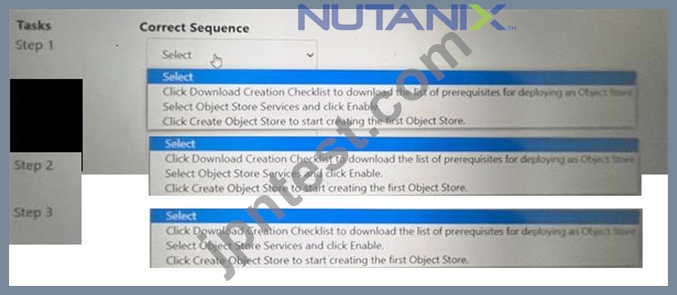
正解:
解説: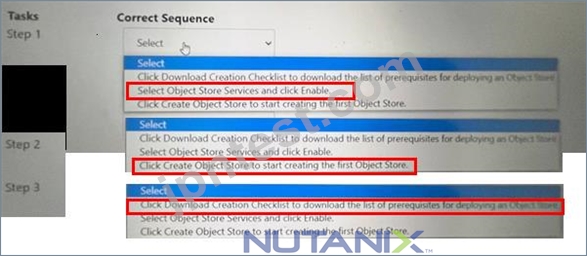
質問 # 46
Life Cycle manager must the compatible versions of which two components before installing or upgrading Files? (Choose two.)
- A. Acropolis Operating System
- B. Active Directory Services
- C. Nutanix Cluster Check
- D. File Server Mobile
正解:C
解説:
Before installing or upgrading Files, Life Cycle Manager (LCM) must check the compatibility versions of Nutanix Cluster Check (NCC) and Acropolis Operating System (AOS). NCC is a framework of scripts that helps diagnose cluster health, and AOS is the core operating system that runs on each node in a Nutanix cluster. LCM will not proceed with the installation or upgrade if NCC or AOS versions are incompatible with Files. Reference: Nutanix Files Administration Guide, Nutanix Cluster Check Guide
質問 # 47
An administrator is upgrading Files from version 3.7 to 4.1 in the highly secured environment the pre-upgrade check fail with below error:
FileServer preupgrade check failed with cause (s) Sub task poll timed out What initial troubleshooting step should the administrator take?
- A. Examine the failed tasks on the FSVMs
- B. Increase upgrades timeout from ecli
- C. Verify connectivity between the FSVMs.
- D. Check the there is enough disk space on FSVMs.
正解:C
解説:
One of the possible causes of a failed pre-upgrade check for Files is network connectivity issues between the FSVMs. The administrator should verify that there are no firewall rules or network policies that block the communication between the FSVMs on ports 22 (SSH), 9440 (HTTPS), and 2009 (RPC). The administrator can use tools such as ping, traceroute, and telnet to test the connectivity between the FSVMs. Reference: Nutanix Support Portal - Troubleshooting Nutanix Files Upgrade Issues
質問 # 48
Which ransomware prevention solution for Files is best when the list of malicious file signatures to block is greater than 300?
- A. Data Lens
- B. Flow Security Central
- C. Third-party solution
- D. File Analytics
正解:C
解説:
Nutanix Files provides a built-in ransomware prevention feature that allows administrators to block malicious file signatures from being written to the file system. However, this feature has a limit of 300 signatures per share or export. If the list of malicious file signatures to block is greater than 300, a third-party solution is recommended2. Reference: Nutanix Files Administration Guide2
質問 # 49
An administrator has been tasked with creating a distributed share on a single-node cluster, but has been unable to successfully complete the task.
Why is this task failing?
- A. Distributed shares require multiple nodes.
- B. File server version should be greater than 3.8.0
- C. Number of distributed shares limit reached.
- D. AOS version should be greater than 6.0.
正解:A
解説:
A distributed share is a type of SMB share or NFS export that distributes the hosting of top-level directories across multiple FSVMs, which improves load balancing and performance. A distributed share cannot be created on a single-node cluster, because there is only one FSVM available. A distributed share requires at least two nodes in the cluster to distribute the directories. Therefore, the task of creating a distributed share on a single-node cluster will fail. Reference: Nutanix Files Administration Guide, page 33; Nutanix Files Solution Guide, page 8
質問 # 50
What are two network requirements for a four-node FSVM deployment? (Choose two.)
- A. Five available IP addresses on the Client network
- B. Four available IP addresses on the Storage network
- C. Five available IP addresses on the Storage network
- D. Four available IP addresses on the Client network
正解:A
解説:
The two network requirements for a four-node FSVM deployment are five available IP addresses on the Client network and five available IP addresses on the Storage network. The Client network is used for communication between the FSVMs and the clients, while the Storage network is used for communication between the FSVMs and the CVMs. For each FSVM, one Client IP and one Storage IP are required. Additionally, one extra Client IP is required for the file server VIP (Virtual IP), which is used as a single point of access for all shares and exports on the file server. Reference: Nutanix Files Administration Guide, page 28; Nutanix Files Solution Guide, page 7
質問 # 51
An administrator is looking for a tool that includes these features:
* Permission Denials
* Top 5 Active Users
* Top 5 Accessed Files
* File Distribution by Type
Nutanix tool should the administrator choose?
- A. File Analytics
- B. File Server Manager
- C. Prism Central
- D. Files Console
正解:A
解説:
The tool that includes these features is File Analytics. File Analytics is a feature that provides insights into the usage and activity of file data stored on Files. File Analytics consists of a File Analytics VM (FAVM) that runs on a Nutanix cluster and communicates with the File Server VMs (FSVMs) that host the file shares. File Analytics can display various reports and dashboards that include these features:
Permission Denials: This report shows the number of permission denied events for file operations, such as read, write, delete, etc., along with the user, file, share, and server details.
Top 5 Active Users: This dashboard shows the top five users who performed the most file operations in a given time period, along with the number and type of operations.
Top 5 Accessed Files: This dashboard shows the top five files that were accessed the most in a given time period, along with the number of accesses and the file details.
File Distribution by Type: This dashboard shows the distribution of files by their type or extension, such as PDF, DOCX, JPG, etc., along with the number and size of files for each type. Reference: Nutanix Files Administration Guide, page 93; Nutanix File Analytics User Guide
質問 # 52
An administrator has been asked to confirm the ability of a physical windows Server 2019 host to boot from storage on a Nutanix AOS cluster.
Which statement is true regarding this confirmation by the administrator?
- A. Physical servers may boot from a volume group from the data services IP and MPIO is not required.
- B. Physical servers may boot from an object bucket from the data services IP address and MPIO is not required.
- C. Physical servers may boot from an object bucket from the data services IP and MPIO is required.
- D. Physical servers may boot from a volume group from the data services IP and MPIO is
正解:D
解説:
Nutanix Volumes allows physical servers to boot from a volume group that is exposed as an iSCSI target from the data services IP. To ensure high availability and load balancing, multipath I/O (MPIO) is required on the physical server. Object buckets cannot be used for booting physical servers1. Reference: Nutanix Volumes Administration Guide1
質問 # 53
Which user is authorized to deploy File Analytics?
- A. AD user mapped to a Cluster admin role
- B. AD user mapped to a Prism admin role
- C. Prism Central administrator
- D. Prism Element administrator
正解:C
解説:
The user that is authorized to deploy File Analytics is Prism Central administrator. Prism Central is a web-based user interface that allows administrators to manage multiple Nutanix clusters and services, including Files and File Analytics. Prism Central administrator is a user role that has full access and control over all Prism Central features and functions. To deploy File Analytics, the user must log in to Prism Central as a Prism Central administrator and follow the steps in the File Analytics Deployment wizard. Reference: Nutanix Files Administration Guide, page 93; Nutanix File Analytics Deployment Guide
質問 # 54
What is the minimum and maximum file size limitations for Smart Tiering?
- A. 64 KiB minimum and 15 TiB maximum
- B. 64 KiB minimum and 5 TiB maximum
- C. 128 IOB minimum and 5 TiB maximum
- D. 128 KiB minimum and 13 TiB maximum
正解:B
解説:
Smart Tiering is a feature that allows Files to tier data across different storage tiers based on the file size and access frequency. Smart Tiering supports files with a minimum size of 64 KiB and a maximum size of 5 TiB2. Reference: Nutanix Files Administration Guide2
質問 # 55
How can an administrator deploy a new instance of Files?
- A. From the Files Console view in Prism Central.
- B. From LCM in Prism Element.
- C. From the Storage view in Prism Element.
- D. From LCM in Prism Central.
正解:A
解説:
The Files Console view in Prism Central is the primary interface for deploying and managing Files clusters. Administrators can use the Files Console to create a new instance of Files by providing the required information, such as cluster name, network configuration, storage capacity, and license key. Reference: Nutanix Files Administration Guide
質問 # 56
An administrator is tasked with performing an upgrade to the latest Objects version.
What should the administrator do prior to upgrade Objects Manager?
- A. Upgrade MSP
- B. Upgrade Lifecycle Manager
- C. Upgrade AOS
- D. Upgrade Objects service
正解:C
解説:
Before upgrading Objects Manager, the administrator must upgrade AOS to the latest version. AOS is the core operating system that runs on each node in a Nutanix cluster and provides the foundation for Objects Manager and Objects service. Upgrading AOS will ensure compatibility and stability for Objects components. Reference: Nutanix Objects Administration Guide, Acropolis Operating System Upgrade Guide
質問 # 57
What tool can be used to report on a specific user's activity within a Files environment?
- A. Files Console Usage
- B. Prism Element Alerts menu
- C. Data Lens Audit Trails
- D. Prism Central Activity menu
正解:C
解説:
The tool that can be used to report on a specific user's activity within a Files environment is Data Lens Audit Trails. Data Lens Audit Trails is a feature that provides detailed logs of all file operations performed by users on Files shares and exports, such as create, read, write, delete, rename, move, copy, etc. Data Lens Audit Trails can help administrators track and audit user actions and identify any unauthorized or malicious activities. The administrator can use Data Lens Audit Trails to filter and search for a specific user's activity based on various criteria, such as file name, file type, file size, file path, file share, file server, operation type, operation time, operation status, and so on. Reference: Nutanix Files Administration Guide, page 98; Nutanix Data Lens User Guide
質問 # 58
......
NCP-US-6.5試験問題にて有効なNCP-US-6.5問題集PDF:https://www.jpntest.com/shiken/NCP-US-6.5-mondaishu
検証済みNCP-US-6.5問題集と解答で合格保証:https://drive.google.com/open?id=1zUMgq64m3eMyeQwh09oxnOchbBxNh_30