

Snowflake GES-C01練習テストPDF試験材料
GES-C01解答GES-C01無料サンプルには全てリアル試験合格させます
質問 # 169
An ML engineer is deploying a custom PyTorch-based image classification model, obtained from Hugging Face, to Snowpark Container Services (SPCS). The deployment requires GPU acceleration on a compute pool named 'my_gpu_pool' and specific Python packages ('torch', 'transformerS, 'opencv-python'). The scenario dictates that 'opencv-python' is only available via PyPI, while 'torch' and 'transformers' can be sourced from either conda-forge or PyPI. The engineer uses the Snowflake Model Registry to log the model. Which of the following 'log model' and 'create_service' configurations correctly specify the necessary Python dependencies and GPU utilization for this inference service, adhering to Snowflake's recommendations?
- A.

- B.

- C.

- D.

- E.

正解:C
解説:
Option A is correct. The 'pip_requirements' argument can be used to specify all necessary Python packages, including 'torch 'transformers', and 'opencv-python', which are commonly available on PyPI. The 'create_service' call correctly specifies and to leverage GPU acceleration, as SPCS supports GPU instances for ML workloads. This approach aligns with the Snowflake recommendation to use either 'conda_dependencies' or 'pip_requirements', but not both, for dependency management. Option B is incorrect because 'opencv-python' is specified as only available via PyPI in the scenario, meaning it cannot be installed via 'conda-forge' . While 'conda-forge' is the default for SPCS dependencies, not all packages are available there. Option C is incorrect because is chosen, which will not provide GPU acceleration required by the PyTorch model for GPU-powered inference. GPU acceleration requires a GPU compute pool. Option D is incorrect because 'opencv-python' is not available through Anaconda channels (as per the scenario that it is PyPI only), and for other conda packages, explicitly specifying the 'conda- forge' channel (e.g., is the recommended practice for SPCS dependencies if they are not in the Snowflake Anaconda channel. Option E is incorrect because, while it correctly separates conda and pip dependencies for specific packages, Snowflake explicitly recommends 'using only 'conda_dependencies' or only 'pip_requirements', not both' for managing dependencies to avoid potential conflicts.
質問 # 170
A new ML Engineer, 'data_scientist_role' , has been assigned to a project involving custom machine learning models in Snowflake. They need to gain the necessary permissions to perform the following actions related to Snowflake Model Registry and Snowpark Container Services: 1. Log a custom model into a specified schem a. 2. Deploy that model to an existing Snowpark Container Service compute pool. 3. Call the deployed model for inference using SQL. Which of the following SQL commands grant the 'minimal' required privileges to the for these actions, assuming the compute pool and image repository already exist and are appropriately configured?
- A.

- B.

- C.

- D.

- E.

正解:C、D
解説:
Option A is correct because the 'CREATE MODEL' privilege on the target schema is required to log a new model (which creates a model object) in the Snowflake Model Registry. Option D is correct because deploying a model to a Snowpark Container Service creates a service object within a schema, which requires the 'CREATE SERVICE privilege on that schema. The role would also implicitly need 'USAGE on the specified compute pool. Option B is incorrect. While 'USAGE ON DATABASE is generally needed for accessing objects within a database, it's a broader prerequisite and not specifically a minimal privilege for the direct model registry actions of logging, deploying, and calling the model. Option C is incorrect because 'CREATE COMPUTE POOL' is for creating the compute pool itself, not for deploying a service 'to' an existing one. The role would need 'USAGE' on the existing compute pool, but not the right to create it from scratch for this scenario. Option E is incorrect because 'READ ON IMAGE REPOSITORY is required for the 'service' to pull the image from the repository, but the question asks for privileges for the to perform the 'actions' of logging, deploying, and calling. While the role might need to manage or verify the image, this isn't a direct privilege for the user's interaction with the deployed model in the same way 'CREATE MODEL' or 'CREATE SERVICE are.
質問 # 171
A data engineering team has developed a Python-based generative AI application and instrumented its key functions using the TruLens SDK. Their next step is to register this application with Snowflake AI Observability to initiate evaluation runs and capture application traces within Snowflake.
- A. Option E
- B. Option B
- C. Option A
- D. Option C
- E. Option D
正解:D
解説:
To register a generative AI application in Snowflake for capturing traces and evaluations, a 'TruApp' object is created. The connector' parameter within 'TruApp' is a 'SnowflakeConnector' instance, specifically a wrapper class that manages the Snowpark session and Snowflake database connection to export traces to Snowflake. - Option A is incorrect because 'test_app' is an instance of the user-defined application, not responsible for managing the connection. - Option B is incorrect; is an arbitrary name for the application but the source does not state it dictates the name of an underlying table for traces. The event table contains logs, but its naming convention is not directly tied to app_name' in this manner. - Option D is incorrect because 'main_method' is optional if another method is instrumented with 'RECORD_ROOT. It doesn't state it's mandatory, and the responsibility for correct trace export lies with the 'connector'. - Option E is incorrect. 'app_version' is for experiment tracking and comparison, not for controlling the pricing model for evaluation runs. LLM judge costs are based on Cortex Complete function calls.
質問 # 172
A global analytics firm is developing a Retrieval Augmented Generation (RAG) system in Snowflake to answer customer queries across a large repository of technical documentation, which includes documents in English, German, and Spanish. They are looking to use a Snowflake Cortex embedding model to convert document chunks into vector embeddings for their Cortex Search Service. Which of the following considerations are critical when selecting an appropriate embedding model to optimize for both query relevance and cost-efficiency for their multilingual RAG application? (Select all that apply)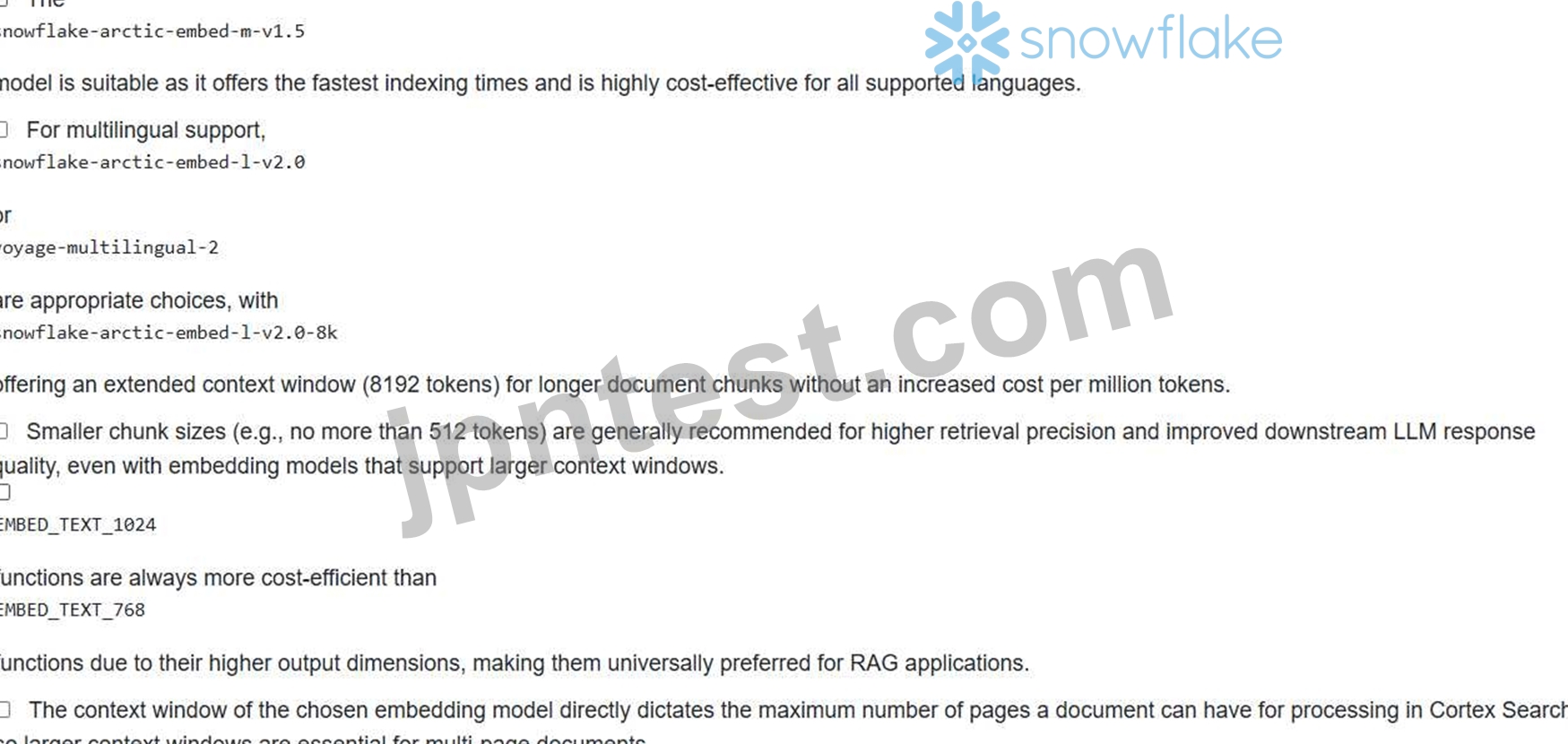
- A. Option E
- B. Option A
- C. Option C
- D. Option B
- E. Option D
正解:C、D
解説:
Option B is correct because both
model provides an increased context window of 8000 tokens while maintaining the same cost per million tokens (0.05 credits) as the 512-token version of
Option C is correct because Snowflake recommends splitting text into chunks of no more than 512 tokens for best search results with Cortex Search, as research shows this typically leads to higher retrieval precision and improved downstream LLM response quality, even when using longer-context embedding models. Option A is incorrect because
is an English-only embedding model, which does not meet the requirement for multilingual documentation. Option D is incorrect; the cost per million tokens for EMBED_TEXT_1024 models (e.g., 0.05-0.07 credits) is not inherently more cost-efficient than EMBED_TEXT_768 models (e.g., 0.03 credits), and cost-efficiency depends on the specific model and use case, not just output dimensions. Option E is incorrect; the context window of an embedding model refers to the maximum length of a text input (chunk) it can process. The maximum pages a document can have (e.g., 300 pages for Document AI) is a separate document requirement, not directly determined by the embedding model's context window.
質問 # 173
An analytics team is preparing documents for a new Document AI model build to extract information from internal policy reviews. They have a variety of documents that they intend to upload to an internal stage for processing. The document list includes: (1) a 70 MB PDF with 100 pages, (2) a 45 MB DOCX with 150 pages, (3) a 30 MB PNG image, (4) a 60 MB TIFF image, and (5) a 20 MB HTML file. All documents are in English. Which of these documents would 'fail' to meet the direct input requirements for Document AI processing?
- A. The 60 MB TIFF image.
- B. The 20 MB HTML file.
- C. The 70 MB PDF with 100 pages.
- D. The 45 MB DOCX with 150 pages.
- E. The 30 MB PNG image.
正解:A、C、D
解説:
質問 # 174
A Gen AI developer is using 'SNOWFLAKE.CORTEX.COMPLETE" to generate concise summaries of legal documents. Initially, the LLM sometimes provides overly creative or slightly off-topic responses, indicating potential 'hallucinations' or a lack of focus. To improve the factual accuracy and conciseness of the summaries, which combination of prompt engineering techniques and 'COMPLETE' function options should be prioritized?
- A. Provide a 'task description' focusing on broad themes and set 'top_p' to 0.5 to balance creativity and relevance.
- B. Implement 'first principles thinking' in the prompt, clearly outlining logical steps for summarization, and set 'temperature' to 0 for deterministic output.
- C. Instruct the model to 'think out loud' with an inner monologue in the prompt, and set 'max_tokens' to a large value to allow full reasoning.
- D. Use a system prompt defining a persona like 'creative writer' and set 'temperature' to 0.9 to encourage diverse summaries.
- E. Rely solely on a comprehensive list of 'stop sequences' to end generation when the summary is complete.
正解:B
解説:
To reduce 'hallucinations' and improve factual accuracy and conciseness, applying 'first principles thinking' by breaking prompts into logical steps helps the model respond from foundational concepts rather than assumptions. Setting 'temperature' to 0 yields the most consistent and deterministic results, which is crucial for factual accuracy and conciseness in summaries. Defining a 'creative writer' persona or using a high 'temperature' would increase diversity and potentially lead to more hallucinations (Option A). Instructing the model to 'think out loud' (Option C) enhances transparency of thought but does not directly enforce factual accuracy or conciseness in the way 'first principles' and low 'temperature' do. 'max_tokens' (Option C) affects output length, not necessarily accuracy or conciseness. A broad 'task description' (Option D) might not be specific enough, and 'top_p' also influences diversity. 'Stop sequences' (Option E) help with truncation but do not prevent factual errors or improve conciseness directly from the model's generation process.
質問 # 175
A compliance officer is reviewing the usage of Snowflake Cortex LLM functions and the Cortex REST API within their organization, specifically focusing on the implementation and impact of Cortex Guard. They observe several instances where 'guardrails' were enabled. Which of the following statements accurately describe the behavior and cost considerations of Cortex Guard when integrated with Snowflake Cortex LLM functions or the Cortex REST API?
- A. The underlying model for Cortex Guard is Meta's Llama Guard 3, and its processing costs are separate from the primary LLM inference costs.
- B. Cortex Guard operates by evaluating responses after the LLM has fully generated its content, and it incurs additional compute cost for both input and output tokens during its processing.
- C. When Cortex Guard is enabled and a response is deemed unsafe, the LLM-generated output is replaced with a predefined message, and only the input tokens for Cortex Guard processing ('guard_tokens') are billed, not the potentially unsafe completion tokens.
- D. Cortex Guard is inherently part of all Cortex LLM functions and does not require explicit enablement via 'guardrails: TRUE for SQL functions or the REST API.
- E. Cortex Guard can be configured with a custom message using the argument in the options object for both 'COMPLETE SQL function and the Cortex REST API.
正解:A、C、E
解説:
Option B is correct: when Cortex Guard is enabled and a response is blocked, the model's output is replaced by a message (defaulting to 'Response filtered by Cortex Guard'), and only 'guard_tokens' are counted as input tokens for Cortex Guard's processing, in addition to the primary LLM's prompt and completion tokens. Option C is correct as the argument allows customization of the filtered response message for both 'COMPLETE' and the REST API. Option E is correct because Cortex Guard is built with Meta's Llama Guard 3 and its usage is billed separately as 'guard_tokens' in addition to the 'COMPLETE function cost. Option A is incorrect because while guard_tokens' are billed, it's specifically for the guardrail processing, and the 'unsafe' completion tokens are not returned or billed as such, rather replaced by a filtered message. Option D is incorrect because Cortex Guard requires explicit enablement by setting 'guardrails' to 'TRUE'.
質問 # 176
A large e-commerce company plans to implement real-time sentiment analysis on millions of incoming customer reviews using SNOWFLAKE. CORTEX. SENTIMENT. They are concerned about managing costs and ensuring efficient processing. Which of the following statements about cost considerations and performance optimizations for SNOWFLAKE. CORTEX. SENTIMENT are true?
(Select all that apply)
- A. The newer AI_SENTIMENT function is a free, serverless alternative to SNOWFLAKE. CORTEX. SENTIMENT, offering cost savings for high-volume scenarios.
- B. The fixed billing rate for the SENTIMENT function is 0.08 Credits per one million input tokens processed.
- C. The actual number of tokens processed and billed for a SENTIMENT call is typically higher than the raw input text length, due to an internal prompt added by the function.
- D. Billing for SNOWFLAKE. CORTEX. SENTIMENT is primarily based on the number of output tokens generated in the response.
- E. Snowflake recommends using a smaller warehouse (no larger than MEDIUM), as larger warehouses do not increase performance for SENTIMENT function calls.
正解:B、C、E
解説:
Option B is correct. Snowflake recommends executing queries that call Cortex AI functions, including 'SENTIMENT , with a smaller warehouse (no larger than MEDIUM) because larger warehouses do not increase performance for these operations. Option C is correct. For functions like 'SENTIMENT, Snowflake adds an internal prompt to the input text in order to generate the response, which results in a higher input token count for billing than the raw text provided. Option E is correct. The 'Sentiment' function incurs compute cost at a rate of 0.08 Credits per one million Tokens. Option A is incorrect because for SENTIMENT , only input tokens are counted towards the billable total, not output tokens. Output tokens are typically billed for functions that generate new text, such as SAI COMPLETE or 'SUMMARIZE. Option D is incorrect because 'AI_SENTIMENT is an updated version of the function, but it still incurs compute costs based on tokens processed and is not free.
質問 # 177
An organization relies on Snowflake Cortex LLM functions and has established a robust model governance policy using the 'CORTEX MODELS_ALLOWLIST parameter. A developer is integrating 'TRY COMPLETE into an application for processing various text inputs. Which of the following statements are correct regarding 'TRY COMPLETE and model access controls?
- A. The parameter primarily governs access for models invoked by their plain names with but 'TRY COMPLETE can still access models if the user has been granted appropriate RBAC on a fully-qualified model object.
- B. The 'TRY_COMPLETE function can return a 'NULL ' value if the underlying LLM experiences a temporary internal processing error during response generation, allowing the query execution to continue without halting.
- C. If 'TRY_COMPLETE fails to perform its operation and returns ' NULL ' , the tokens that would have been processed for that specific call are not billed, ensuring cost efficiency for failed operations.
- D. if a If a model specified in 'TRY_COMPLETE is not allowed by the and no RBAC grant exists for it, the 'TRY_COMPLETE function will automatically return 'NULL' to prevent a hard error.
- E. To provide a stateful conversational experience with 'TRY_COMPLETE, the function automatically retains context from previous calls within the same session.
正解:A、B、C
解説:
Option A is incorrect. While 'TRY_COMPLETE generally returns 'NULL' for operations that cannot be performed, the documentation explicitly states that if a model powering a Cortex function (including 'TRY COMPLETE') is not allowed by the allowlist or RBAC, an 'error message contains information about how to modify the allowlist'. This suggests an actual error is raised rather than 'NULL' being returned for access control violations, unlike internal processing errors. Option B is correct. 'TRY COMPLETE' is designed to return 'NULL' instead of raising an error when an operation cannot be performed, which includes scenarios where the LLM encounters internal errors during response generation. Option C is correct. The 'CORTEX MODELS ALLOWLIST controls which models can be used when referenced by their plain names (e.g., 'mistral-large2'). However, model-level RBAC, granted through application roles on fully-qualified model objects (e.g., 'SNOWFLAKE.MODELS."LLAMA3.1-70B"'), provides an independent access path that bypasses the plain-name allowlist check for those specific model objects. Option D is correct. 'TRY_COMPLETE does not incur costs for error handling; if the function returns 'NULL' , no cost is incurred for that specific call. Option E is incorrect. 'TRY COMPLETES, like 'COMPLETE' , does not retain state between calls. To provide a stateful conversational experience, all previous user prompts and model responses must be explicitly passed in the array argument.
質問 # 178
A data engineering team is tasked with creating vector embeddings for a collection of diverse, multilingual research papers for a semantic search application. They need to use 'SNOWFLAKE.CORTEX.EMBED TEXT 1024' and are considering two models: 'snowflake-arctic-embed-l-v2.0' and 'voyage-multilingual-2'. They also need to ensure the resulting embeddings are stored correctly and understand potential text truncation. Which of the following statements correctly describes the application of the 'EMBED TEXT 1024' function for these models and the characteristics of the generated embeddings?
- A. The query

- B. Using either 'snowflake-arctic-embed-l-v2.0' or 'voyage-multilingual-2' with will result in a 'VECTOR(FLOAT, 1024)' data type, which is compatible with 'VARIANT columns.
- C. The function call

- D. Both 'snowflake-arctic-embed-l-v2.0' and 'nv-embed-qa-4' are multilingual models with a 1024-dimension output, making them interchangeable for this use case.
- E. The 'snowflake-arctic-embed-I-v2.0' model has a larger context window than 'voyage-multilingual-2 , making it more suitable for longer research papers without truncation.
正解:A
解説:
Option C is correct. The 'EMBED_TEXT_1024' function's syntax is 'SNOWFLAKE.CORTEX.EMBED_TEXT 1024(, y. The 'voyage-multilingual-2 model has a context window of 32000 tokens, and text exceeding the model's context window is truncated before embedding. Option A is incorrect because 'snowflake-arctic-embed-l-v2.0' has a 512-token context window, while 'voyage-multilingual-2 has a 32000-token context window, meaning 'voyage-multilingual-2 has a larger context window. Option B is incorrect because while EMBED TEXT 1024' returns a 1024)' data type, the 'VECTOR data type is explicitly not supported in 'VARIANT' columns. Option D is incorrect because 'nv-embed-qa-v is an English-only model, whereas 'snowflake-arctic-embed-l-v2.0' is multilingual. Option E is incorrect because the model name should be the first argument and the text the second argument in the function call, i.e., ' text_inputy.
質問 # 179
A data engineering team is designing a Snowflake data pipeline to automatically enrich a 'customer issues' table with product names extracted from raw text-based 'issue_description' columns. They want to use a Snowflake Cortex function for this extraction and integrate it into a stream and task-based pipeline. Given the 'customer_issues' table with an 'issue_id' and (VARCHAR), which of the following SQL snippets correctly demonstrates the use of a Snowflake Cortex function for this data enrichment within a task, assuming is a stream on the 'customer issues' table?
- A. Option E
- B. Option A
- C. Option B
- D. Option D
- E. Option C
正解:C
解説:
Option B correctly uses to pull specific information (product name) from unstructured text, which is a common data enrichment task. It also integrates with a stream ('issue_stream') by filtering for 'METADATA$ACTION = 'INSERT" and uses a 'MERGE statement, which is suitable for incremental updates in a data pipeline by inserting new extracted data based on new records in the stream. Option A uses for generating a response, not for specific entity extraction, and its prompt is less precise for this task than 'EXTRACT_ANSWER. Option C uses 'SNOWFLAKE.CORTEX.CLASSIFY_TEXT for classification, not direct entity extraction of a product name, and attempts to update the source table directly, which is not ideal for adding new columns based on stream data. Option D proposes a stored procedure and task, which is a valid pipeline structure. However, the EXTRACT ANSWER call within the procedure only returns a result set and does not demonstrate the final insertion or merging step required to persist the extracted data into an 'enriched_issues' table. Option E uses to generate vector embeddings, which is a form of data enrichment, but the scenario specifically asks for 'product names' (a string value), not embeddings for similarity search.
質問 # 180
A financial analytics team is developing an application to extract specific, structured financial data (e.g., company name, revenue, profit margin) from various news articles using Snowflake Cortex LLM functions. They require the output to strictly conform to a predefined JSON schema and want to ensure robust error handling. Which of the following statements are crucial considerations for achieving this goal?
- A. For enhanced reliability in production pipelines, the team should wrap their AI_COMPLETE calls within TRY_COMPLETE, as it returns a structured error object if the model fails to adhere to the schema, allowing for detailed debugging.
- B. Setting the temperature option to 0 in the AI_COMPLETE call is essential for obtaining the most consistent and accurate structured JSON outputs, regardless of task complexity or model used.
- C. The AI_COMPLETE function should be used with the response_format argument, supplying a JSON schema object that defines the required structure, data types, and constraints for the output.
- D. To guarantee that critical fields like 'company name' and 'revenue' are always extracted, these properties must be explicitly listed within the ' required' array of the JSON schema provided to AI_COMPLETE.
- E. The complexity of the JSON schema provided to AI_COMPLETE has no impact on compute costs, as only the input text and generated content tokens are billed.
正解:B、C、D
解説:
Option A is correct. AI_COMPLETE Structured Outputs allows specifying a JSON schema via the argument to ensure response _ format responses follow a defined structure, data types, and constraints. Option B is correct. Using the field in the JSON schema ensures that required specified properties are extracted, or an error is raised by making extraction of critical information reliable. Option C is incorrect. COMPLETE, performs the same operation as COMPLETE (or AI_COMPLETE) but returns instead of raising an error when the operation cannot be TRY COMPLETE NULL performed. It does not return a structured error object for detailed debugging, but rather handles the error by returning allowing a pipeline to NULL, continue. Option D is correct. For the most consistent results and to optimize JSON adherence accuracy, it is recommended to set the temperature option to 0 when calling COMPLETE (or AI_COMPLETE). Option E is incorrect. The number of tokens processed (and billed) increases with schema complexity. A larger and more complex supplied schema generally consumes more input and output tokens, leading to higher compute costs.
質問 # 181
A data science team is deploying a custom real-time inference service for a fine-tuned LLM using Snowpark Container Services (SPCS). They have a Docker image in their Snowflake image repository. They need to define the service using a YAML specification file. Which of the following are ''essential'' components or configurations that must be included in the 'spec.yaml' file for a long- running service that uses this image, custom environment variables, and requires external access?
- A.

- B.

- C.

- D.

- E.

正解:A、B、D
解説:
Option A is correct because the 'container' block, specifying the 'name' of the container and the Docker 'image' path from the Snowflake registry, is fundamental for defining any containerized service in SPCS. Option B is correct as the 'endpoints' block, explicitly defining a 'name', -port', and setting 'public: true' , is essential for a long-running service that requires external access via a web browser or API. Option C is incorrect because the 'compute_poor is specified during the 'CREATE SERVICE SQL command, not within the 'spec.yaml' file itself. Option D is incorrect as a 'volumes' block, while potentially useful for persistent storage, is not listed as an essential component in the provided spec.yaml' examples for basic service deployment and is not explicitly mentioned as a required part of the specification file. Option E is correct as the 'env' block within a container definition is used to set custom environment variables, which is explicitly shown in the Jupyterlab example for configuring the application within the container.
質問 # 182
A business analyst is using a Cortex Analyst-powered conversational application to query structured data in Snowflake. They initially ask, 'What was the total profit from California last quarter?' and then follow up with, 'What about New York?' The application successfully provides accurate answers to both questions. Which of the following statements explain how Cortex Analyst supports this multi-turn conversational experience and maintains accuracy? (Select all that apply)
- A. The semantic model YAML file, which defines logical tables, dimensions, and measures, is crucial for Cortex Analyst to bridge the gap between business terminology and underlying technical schema, thereby improving text-to-SQL conversion accuracy for both initial and follow-up queries.
- B. Cortex Analyst stores the full, verbatim history of all previous user prompts and LLM responses, which are then passed to every subsequent LLM call to ensure complete context retention without any summarization.
- C. To handle follow-up questions, Cortex Analyst leverages an internal LLM summarization agent (e.g., Llama 3.1 70B) to reframe the current-turn question by retrieving context from the conversation history, rather than simply passing the entire history.
- D. For multi-turn conversations, Cortex Analyst primarily relies on semantic search over sample values defined in the semantic model to infer context and generate SQL, making explicit conversation history management unnecessary.
- E. The accuracy of the SQL queries generated by Cortex Analyst for follow-up questions is significantly enhanced by its integration with a Verified Query Repository (VQR), which stores pre-verified natural language questions and their corresponding SQL queries.
正解:A、C、E
解説:
Option A is incorrect. Cortex Analyst does not simply pass the full, verbatim history of all previous prompts and responses to every subsequent LLM call. This 'primitive way' could lead to longer inference times, more non-determinism, and degraded performance due to multitasking. Instead, it uses an LLM summarization agent to manage context. Option B is correct. Cortex Analyst supports multi-turn conversations by recognizing follow-up questions and using an LLM summarization agent (such as Llama 3.1 70B, which showed high accuracy in this role) to retrieve context from the conversation history and reframe the current-turn question. Option C is correct. The Verified Query Repository (VQR) is a collection of pre-verified questions and corresponding SQL queries that helps improve the accuracy and trustworthiness of Cortex Analyst's results by using relevant SQL queries for similar questions. Option D is incorrect. While semantic search over sample values can improve literal search for Cortex Analyst, it is not the primary mechanism for managing the context of multi-turn conversations. Context management relies on an LLM summarization agent. Option E is correct. Semantic models, captured in lightweight YAML files, are critical for Cortex Analyst. They provide richer semantic information than basic database schemas, bridging the gap between business user language and technical database definitions, which is essential for accurate text-to-SQL conversions in both initial and follow-up queries.
質問 # 183
A data team is refining their Cortex Analyst semantic model to improve the accuracy of responses for specific, frequently asked questions and to enable better literal value searches. Consider a semantic model being developed to address these requirements. Which two configurations or features are directly relevant and correctly applied in the semantic model YAML for these purposes?
- A. Option A
- B. Option E
- C. Option B
- D. Option D
- E. Option C
正解:A、C
解説:
Option A is correct. Cortex Search Services can be integrated into a dimension's definition (using the field with 'service' and 'literal_column' fields) to improve literal matching by performing semantic search over the underlying column. This enhances Cortex Analyst's ability to find literal values for filtering, helping with 'fuzzy' searches. Option B is correct. The 'verified_queries' section allows pre- defining accurate SQL queries for specific natural language questions. Setting 'use_as_onboarding_ question true' for entries in the VQR ensures these queries are used when relevant and presented as suggested questions to users. Option C is incorrect; while metrics can reference logical columns, 'relationships' between logical tables are necessary for defining joins, especially across different underlying base tables. Option D is incorrect; 'custom_instructions' are provided at the model level to give general context to the LLM for SQL query generation, not embedded within individual dimension definitions. Option E is incorrect; the 'sample_valueS field is recommended for dimensions with relatively low-cardinality (approximately 1-10 distinct values) to aid in semantic search for literals, not for high-cardinality dimensions.
質問 # 184
A new Gen AI specialist is setting up Document AI. They have successfully created the necessary database, schema, and a custom role named 'doc_ai specialist_role'. This custom role has been granted the 'SNOWFLAKE.DOCUMENT INTELLIGENCE CREATOR database role. However, when the specialist attempts to create a new Document AI model build in Snowsight, they receive the error: Unable to create a build on the specified database and schem a. Please check the documentation to learn more.
What is the most likely missing privilege for the that is preventing the model build creation?
- A.

- B.

- C. The virtual warehouse assigned to the Document AI environment is not large enough to support model build creation.
- D.

- E.

正解:A
解説:
The error message 'Unable to create a build on the specified database and schema' points directly to insufficient privileges for creating the model build itself. While the database role enables working on Document AI models and using SQL for extraction, specific object privileges are required to create the model 'build' in a given schema. The documentation explicitly states that 'CREATE SNOWFLAKE.ML.DOCUMENT_INTELLIGENCE on the schema is required to create model builds (instances of the 'DOCUMENT INTELLIGENCE' class), along with 'CREATE MODEL' on the schema. Option A (USAGE on database) is a general prerequisite but not the direct cause of this specific 'unable to create a build' error. Option B CCREATE TABLE) is for creating tables, not model builds. Option D (s EXECUTE TASK) is required for running tasks in a pipeline, not for model build creation. Option E is incorrect as warehouse size primarily impacts cost and performance, not the ability to create a model build due to privileges.
質問 # 185
A Gen AI specialist is designing a RAG pipeline utilizing Cortex Search for an application that queries a large repository of unstructured text documents. To optimize the quality of retrieval and subsequent LLM responses, what are the critical best practices and understanding of Cortex Search's mechanisms that the specialist should consider regarding text processing and tokenization?
- A. For best search results, text in the search column should be split into chunks of no more than 512 tokens, as smaller chunks generally lead to more precise retrieval and relevant LLM context.
- B. Cortex Search operates solely on vector embeddings for semantic search; keyword-based retrieval is handled by a separate, less efficient mechanism outside the core search service.
- C. The SNOWFLAKE .CORTEX. COUNT TOKENS function is a helper function that can be used to accurately determine the token count for a given string based on a specified model, aiding in adherence to context window limits.
- D. When text input exceeds an embedding model's context window, Cortex Search truncates the text for both semantic embedding and keyword-based retrieval, potentially losing critical information.
- E. Embedding models with larger context windows, such as snowflake-arctic-embed-1-v2.e-8k (8000 tokens), are always superior as they allow the RAG system to process the entire document as a single, highly relevant chunk.
正解:A、C
解説:
Option A is correct; Snowflake recommends splitting text into chunks of no more than 512 tokens for optimal search results and higher retrieval/LLM response quality, even with longer-context embedding models. Option B is incorrect because while Cortex Search truncates strings exceeding the context window for embedding, it uses the full body of text for keyword-based retrieval. Option C is incorrect as research shows smaller chunk sizes typically result in higher retrieval and downstream LLM response quality, despite the availability of longer-context models. Option D is correct, as COUNT _ TOKENS is a helper function used for this purpose. Option E is incorrect because Cortex Search is a hybrid (vector and keyword) search engine.
質問 # 186
......
GES-C01[2026年01月] 最新リリース] 試験問題あなたを必ず合格させます:https://www.jpntest.com/shiken/GES-C01-mondaishu
Snowflake GES-C01試験の基礎問題と解答:https://drive.google.com/open?id=1xmtpDWY3mDAovIYS90djIY8oa9khQsK9