

[2026年07月] 合格させるISO-9001-Lead-Auditor日本語試験一発合格、最新のISO-9001-Lead-Auditor日本語 JPNTestの提供する試験問題
ISO 9001問題集でISO-9001-Lead-Auditor日本語試験の完全版解答試験学習ガイド
質問 # 147
以下は、ISO 9000 シリーズの基盤となる 7 つの原則のうち 4 つです。それぞれの品質管理原則 (QMP) の潜在的な利点を一致させてください。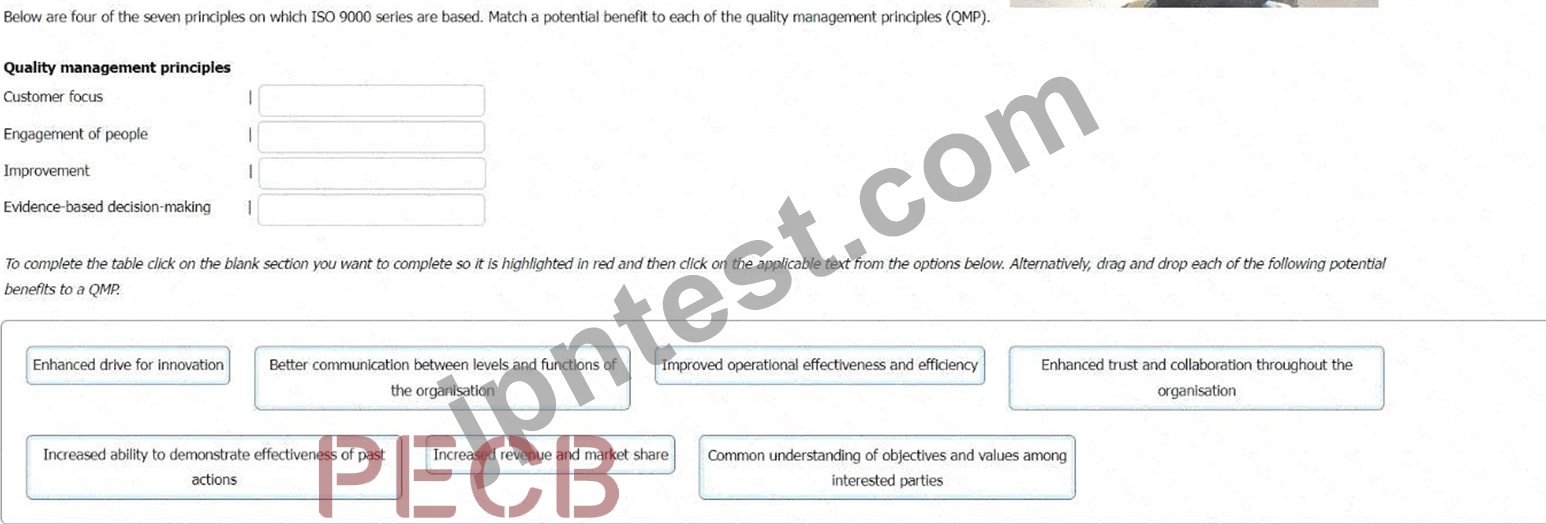
正解:
解説: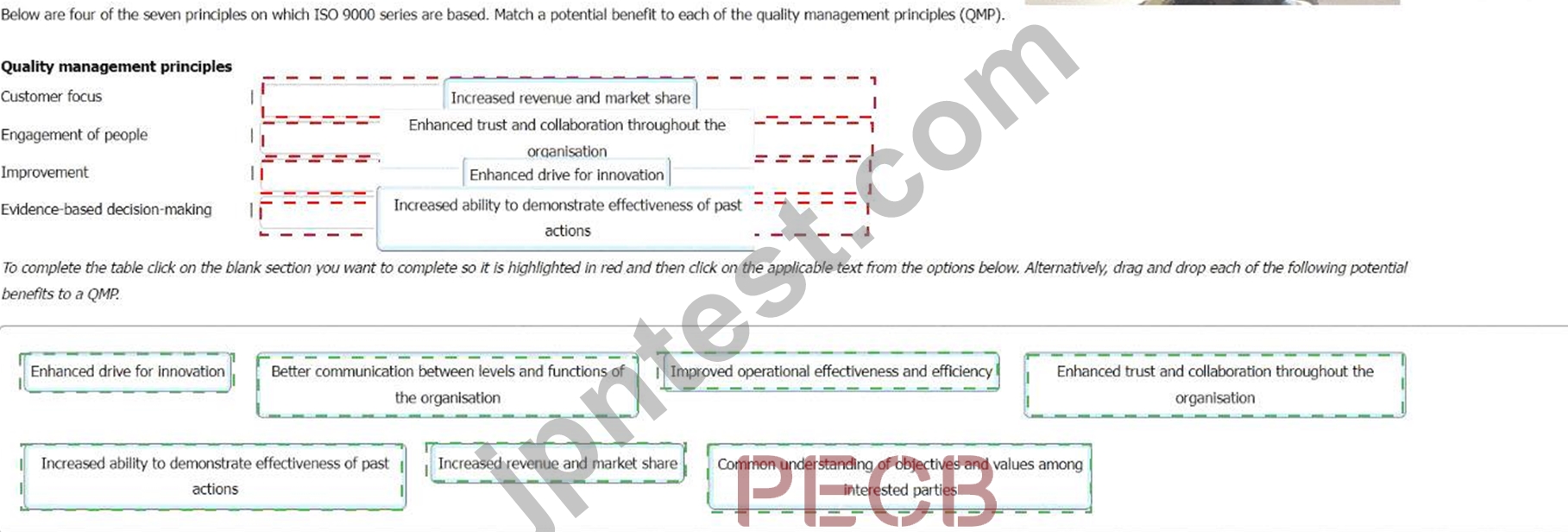
Explanation:
A screenshot of a chat Description automatically generated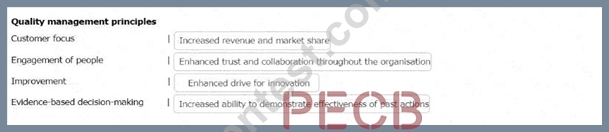
According to the ISO 9000:2015 document, the seven quality management principles are:
Customer focus
Leadership
Engagement of people
Process approach
Improvement
Evidence-based decision making
Relationship management
For each principle, the document provides a statement, a rationale, key benefits, and actions you can take to apply the principle in your organization.
Based on the document, here is a possible way to match a potential benefit to each of the four quality management principles you mentioned:
Table
Quality management principle
Potential benefit
Customer focus
Increased revenue and market share
Engagement of people
Enhanced trust and collaboration throughout the organization
Improvement
Enhanced drive for innovation
Evidence-based decision making
Increased ability to demonstrate effectiveness of past actions
質問 # 148
XYZ 社は 100 人の従業員を抱える組織です。監査チームのリーダーとして、ステージ 1 の認証監査を実施します。品質管理システム (QMS) を確認すると、外部コンサルタントが競合他社の目標を参考にして目標を定義しているものの、何も文書化されていないことがわかりました。
品質管理者は、これが QMS に対する大きな抵抗を生み出していると不満を述べており、最高経営責任者はコストがどれくらいかかるかについて疑問を抱いています。
ISO 9001 の条項 6.2 に対して不適合を指摘できる状況を説明する 2 つのオプションはどれですか。
- A. 品質目標が組織の担当者によって実行されていません。
- B. 品質目標の設定に経営トップが関与していませんでした。
- C. 品質目標は組織の品質方針に沿って設定されていませんでした。
- D. 品質目標は文書化された情報として維持されていません。
- E. コンサルタントは ISO 9001 を正しく解釈していません。
- F. 組織は品質目標を一度にすべて達成する余裕がありません。
正解:C、D
解説:
According to ISO 9001:2015, clause 6.2.1, the organization is required to establish quality objectives at relevant functions, levels, and processes for the quality management system (QMS). The quality objectives must be consistent with the quality policy, measurable, monitored, communicated, and updated as appropriate.
The organization is also required to maintain documented information on the quality objectives, as per clause
7.5.1.
Therefore, in the scenario given, the quality objectives defined by the external consultant are not in alignment with the organization's quality policy, as they are based on those of a competitor, rather than the organization's own purpose, strategic direction, and customer requirements. This creates a mismatch between the organization's vision and goals, and the quality objectives that are supposed to guide and measure the QMS performance. Moreover, the quality objectives are not maintained as documented information, which makes it difficult to communicate, monitor, and update them, as well as to demonstrate evidence of their implementation and achievement.
Hence, the circumstances in which a nonconformity against clause 6.2 of ISO 9001 could be raised are B and C, as they indicate a failure to comply with the requirements of clause 6.2.1. The other options are either irrelevant or not directly related to clause 6.2, as they do not pertain to the establishment and documentation of quality objectives.
References:
ISO 9001:2015(en), Quality management systems - Requirements, clause 6.2.1 and 7.5.1 ISO 19011:2018(en), Guidelines for auditing management systems, clause 6.4.4 and 6.7.2 ISO 9001 Lead Auditor Training Course | IRCA Certified | BSI, section "Learning objectives" ISO 9001 Lead Auditor Course Material | 3FOLD Education Centre, module 5 and 6
質問 # 149
監査におけるガイドの責任は次のどれですか?
- A. 監査人の知識の潜在的なギャップを埋める
- B. 認証機関に代わって監査プロセスに立ち会う
- C. 物流の維持
正解:C
解説:
Comprehensive and Detailed In-Depth Explanation:A guide is assigned by the auditee to assist the audit team by:
* Managing logistics, such as ensuring that relevant documents are available and arranging interviews.
* Assisting in the coordination of meetings and access to facilities.
* Helping the auditors navigate the organization during the audit.
However, the guide does not fill gaps in the auditor's knowledge or witness the audit for the certification body. Their primary function is logistical support, not providing interpretations or assessments.
質問 # 150
サードパーティ認証監査のコンテキストでは、役割を次の責任と一致させます。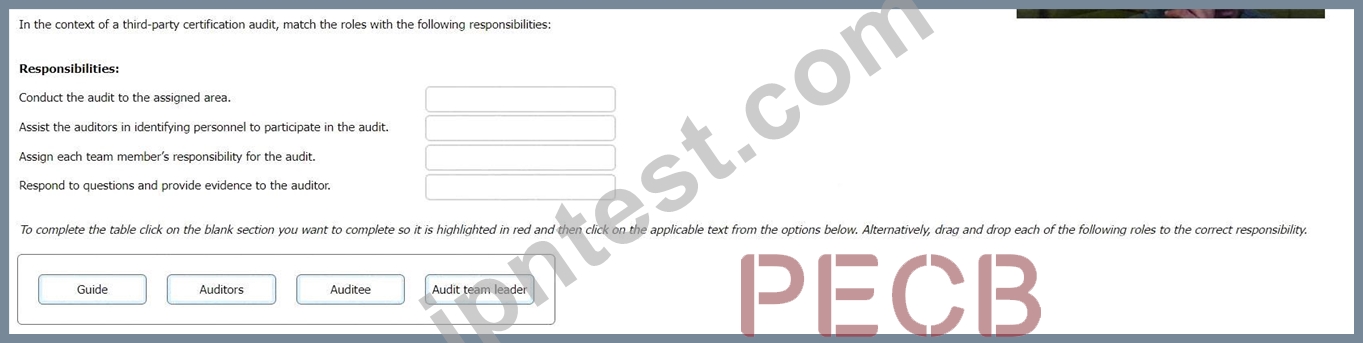
正解:
解説: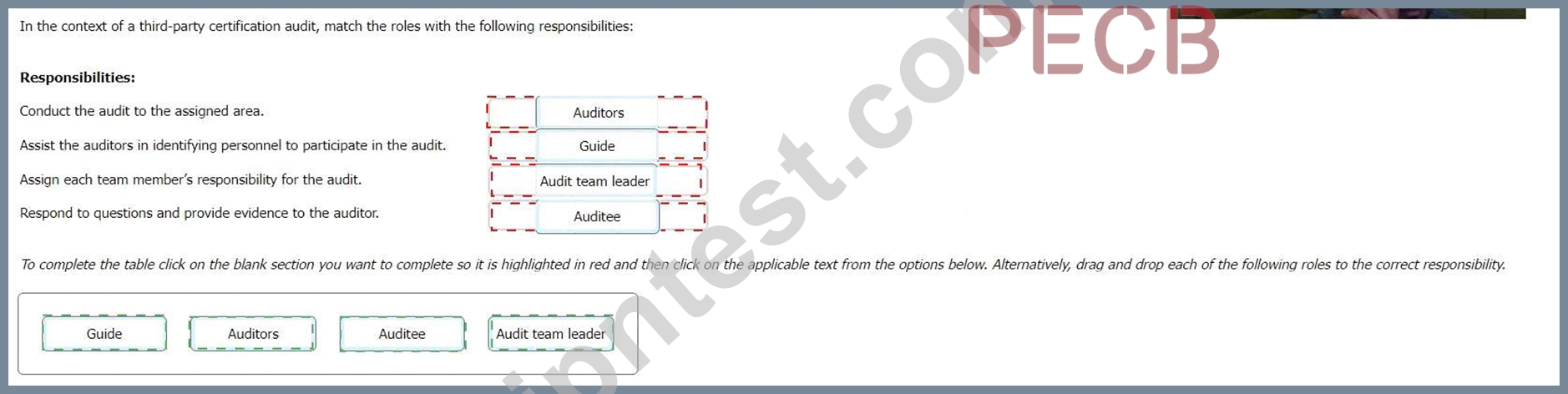
Explanation:
サードパーティ認証監査のコンテキストでは、役割を次の責任と一致させます。
責任:
担当エリアの監査を実施します。=監査員
監査に参加する人員を特定する際に監査人を支援します。= ガイド 各チームメンバーに監査の責任を割り当てます。= 監査チームリーダー 質問に答え、監査人に証拠を提供します。= 監査対象者 ISO 19011:2018 の第 3 項によると、役割の定義は次のとおりです1。
監査人: 監査を実施する能力を有する者
ガイド: 監査対象者によって監査チームを支援するために任命された人物
監査対象: 監査対象となる組織
監査チームリーダー: 監査を管理するために任命された監査チームのメンバー、または監査チーム。したがって、これらの定義と規格 1 の条項 6 の監査プロセスの説明に基づいて、役割を責任と一致させることができます。
参照: ISO 19011:2018(en)、マネジメントシステムの監査に関するガイドライン
質問 # 151
ISO 9001は品質管理原則に基づいています。以下の品質管理原則をそれぞれ、関連する活動に当てはめてください。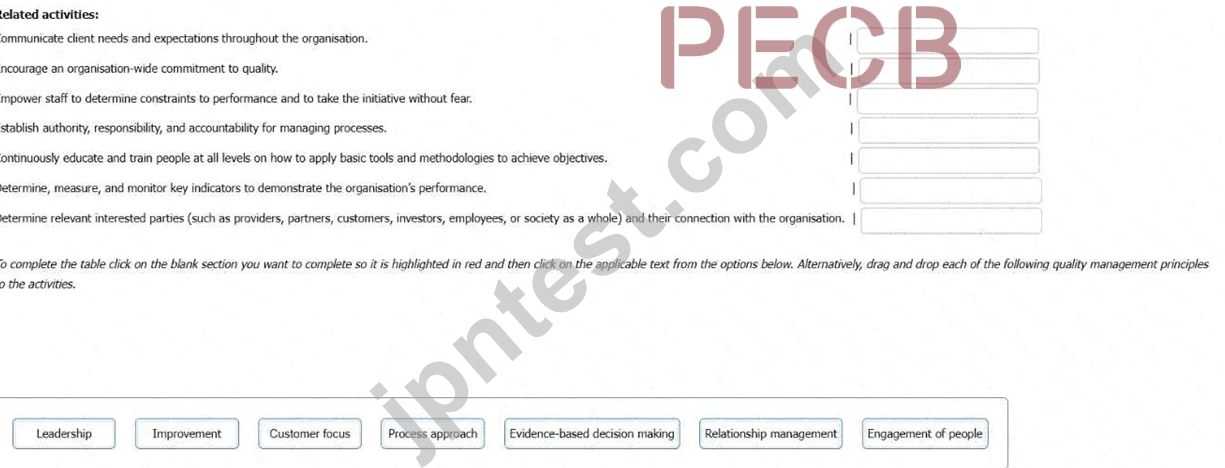
正解:
解説: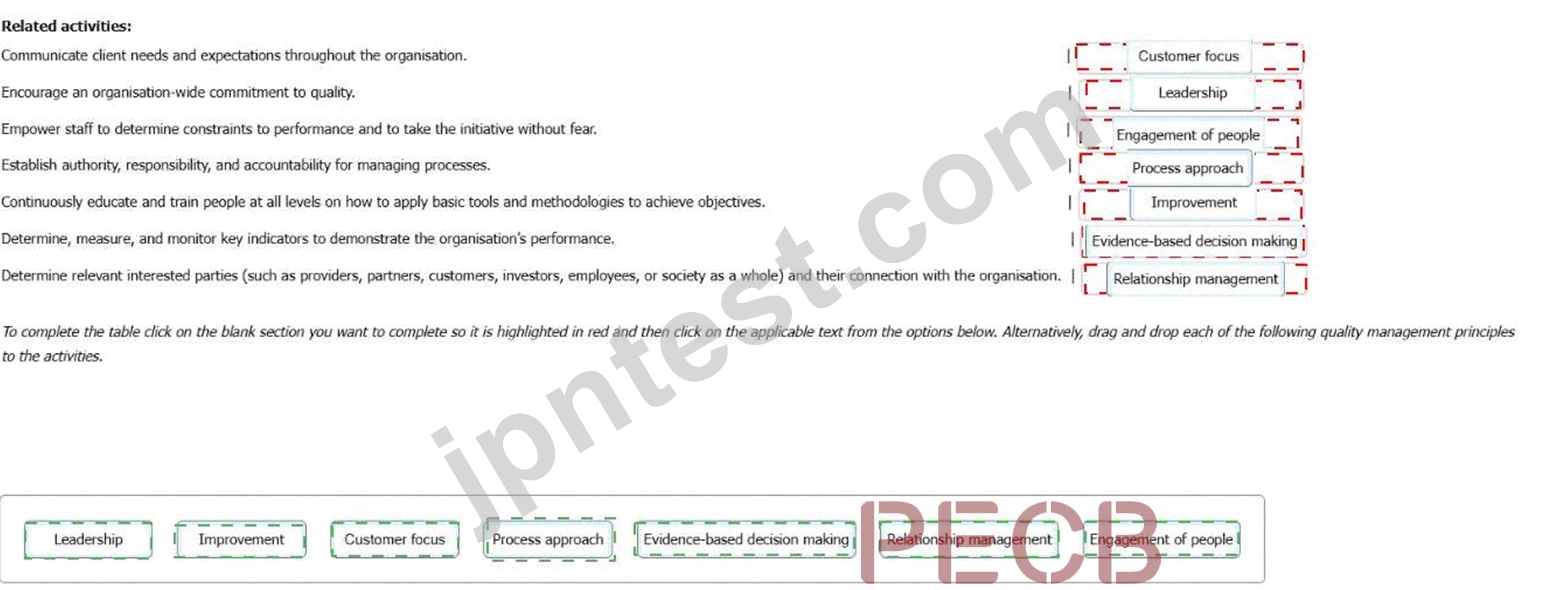
Explanation:
Related Activity
Correct Quality Management Principle
Communicate client needs and expectations throughout the organisation.
Customer focus
Encourage an organisation-wide commitment to quality.
Leadership
Empower staff to determine constraints to performance and to take the initiative without fear.
Engagement of people
Establish authority, responsibility, and accountability for managing processes.
Process approach
Continuously educate and train people at all levels on how to apply basic tools and methodologies to achieve objectives.
Improvement
Determine, measure, and monitor key indicators to demonstrate the organisation's performance.
Evidence-based decision making
Determine relevant interested parties (such as providers, partners, customers, investors, employees, or society as a whole) and their connection with the organisation.
Relationship management
1. Customer focus
ISO 9001 states that organizations must understand and consistently meet customer needs and expectations.
# Communicating client needs throughout the organization ensures alignment and customer satisfaction.
Reference: Clause 0.2; Clause 5.1.2 (Customer focus)
2. Leadership
Leadership establishes unity of purpose and direction and promotes a culture of quality across the organization. # Encouraging organization-wide commitment to quality is a core leadership responsibility.
Reference: Clause 0.2; Clause 5.1 (Leadership and commitment)
3. Engagement of people
ISO emphasizes that competent, empowered, and engaged people at all levels enhance organizational capability. # Empowering staff to identify constraints and act without fear reflects true engagement.
Reference: Clause 0.2; Clause 7.3 (Awareness)
4. Process approach
The process approach requires clear definition of responsibilities, authorities, inputs, outputs, and controls. # Establishing authority, responsibility, and accountability for processes is fundamental to this principle.
Reference: Clause 0.2; Clause 4.4 (QMS and its processes)
5. Improvement
Organizations must continually improve products, services, and system effectiveness. # Ongoing education and training enable improvement through better tools and methods. Reference: Clause 0.2; Clause 10.3 (Continual improvement)
6. Evidence-based decision making
Effective decisions are based on the analysis of data and information. # Measuring and monitoring KPIs directly supports evidence-based decisions. Reference: Clause 0.2; Clause 9.1 (Monitoring, measurement, analysis, and evaluation)
7. Relationship management
Sustained success depends on managing relationships with relevant interested parties. # Identifying interested parties and understanding their connection to the organization reflects this principle. Reference: Clause 0.2; Clause 4.2 (Interested parties)
質問 # 152
シナリオ5: 機械電気(ME)監査段階
ME としてよく知られている Mechanical-Electro は、中国で機械および電気サービスを提供するアメリカの会社です。同社のサービスは、空調システム、換気システム、配管から、自動車工場、電子機器製造施設、食品加工工場の電気機器の設置まで多岐にわたります。
現地の中国企業との激しい競争と顧客の要求を満たせなかったため、MEの収益は大幅に減少しました。さらに、顧客の会社に対する信頼と信用が低下し、会社の評判が損なわれました。
これらの状況を踏まえ、ME の経営陣は ISO 9001 に基づく品質管理システム (QMS) を導入することを決定しました。効果的な QMS を 1 年以上導入した後、経営陣は認証監査を申請しました。
監査には、Li Na 氏を監査チーム リーダーとして含む 4 人の監査員チームが任命されました。最初に、監査チームは、品質方針、運用手順、在庫リスト、QMS 範囲、プロセス文書、トレーニング記録、以前の監査レポートなど、ME の文書の全般的なレビューを実施しました。
Li Na 氏は、これによりチームはすべての監査段階で文書を収集するための体系的かつ構造化されたアプローチを維持できると述べました。文書化された情報を確認している間、チームはいくつかの小さな問題に気付きましたが、大きな不適合は特定しませんでした。そのため、Li Na 氏は、監査のその段階でレポートを作成したり、ME の代表者と会議を行ったりする必要はないと主張しました。彼女は、すべての懸念事項は監査の次の段階で議論されると述べました。
現地での活動と ME の経営陣とのオープニングミーティングに続いて、監査チームは、ME の QMS が ISO 9001 の条項 8.2.1 (顧客とのコミュニケーション) に準拠しているかどうかを確認するための監査テスト計画を作成しました。
そのために、彼らはグループインタビューとサンプリングを通じて情報を収集しました。Li Na は最初のグループで部門マネージャーにインタビューを行い、次に経営陣にインタビューを行いました。さらに、彼女は ME の業務の両分野からの顧客苦情を十分に代表するサンプリング方法を選択しました。
チームメンバーはサンプリング手順を担当し、4つのサンプルサイズを選択しました。
電気サービスについては毎週 45 件の顧客からの苦情が寄せられ、機械サービスについては 10 件中 2 件の苦情が寄せられています。
その後、監査チームは監査基準に照らして証拠を評価し、監査結果を生成しました。
シナリオ 5 によると、Li Na は部門マネージャーと上級管理職とのグループ インタビューを単独で実施しました。これは監査のベスト プラクティスに準拠していますか?
- A. はい、監査対象者のトップマネジメントへのインタビューは、常に監査チームリーダーのみが行います。
- B. はい、監査チームリーダーのみがグループインタビューを実施する必要があります。
- C. いいえ、グループ面接の場合は 2 人の監査人が出席する必要があります。
正解:C
解説:
Comprehensive and Detailed In-Depth Explanation:
According to ISO 19011:2018, Clause 6.4.6 (Conducting Interviews), group interviews should be conducted with at least two auditors to ensure objectivity and accuracy.
* This prevents bias or misinterpretation of responses.
* It allows for cross-validation of information.
* It ensures that the audit results remain objective and impartial.
Since Li Na conducted the group interviews alone, she did not follow audit best practices. The correct approach would have been to have another auditor present during the interviews.
Reference:
ISO 19011:2018, Clause 6.4.6 (Conducting Interviews)
質問 # 153
以下のプロセスの説明をプロセス名と一致させます。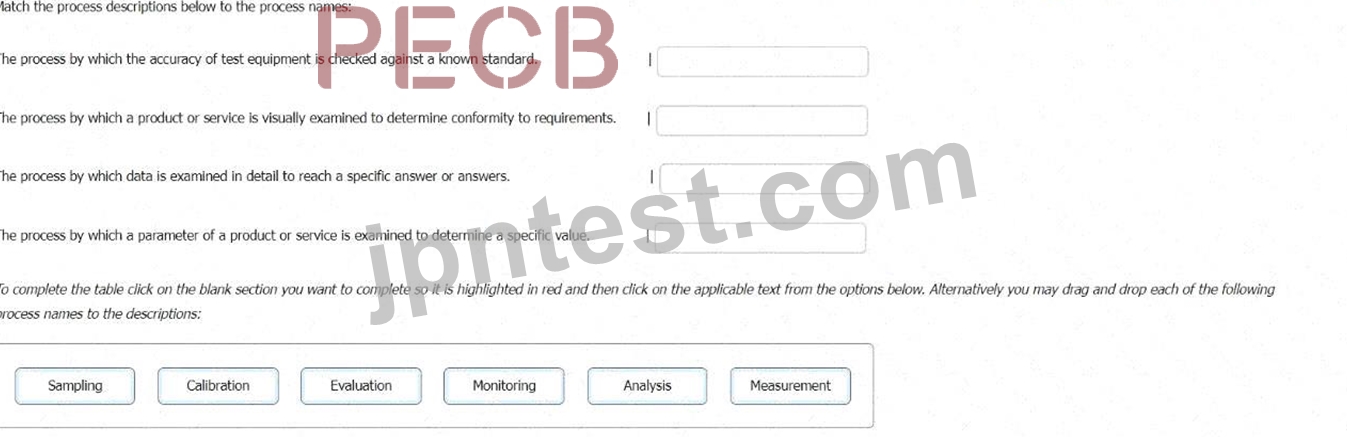
正解:
解説: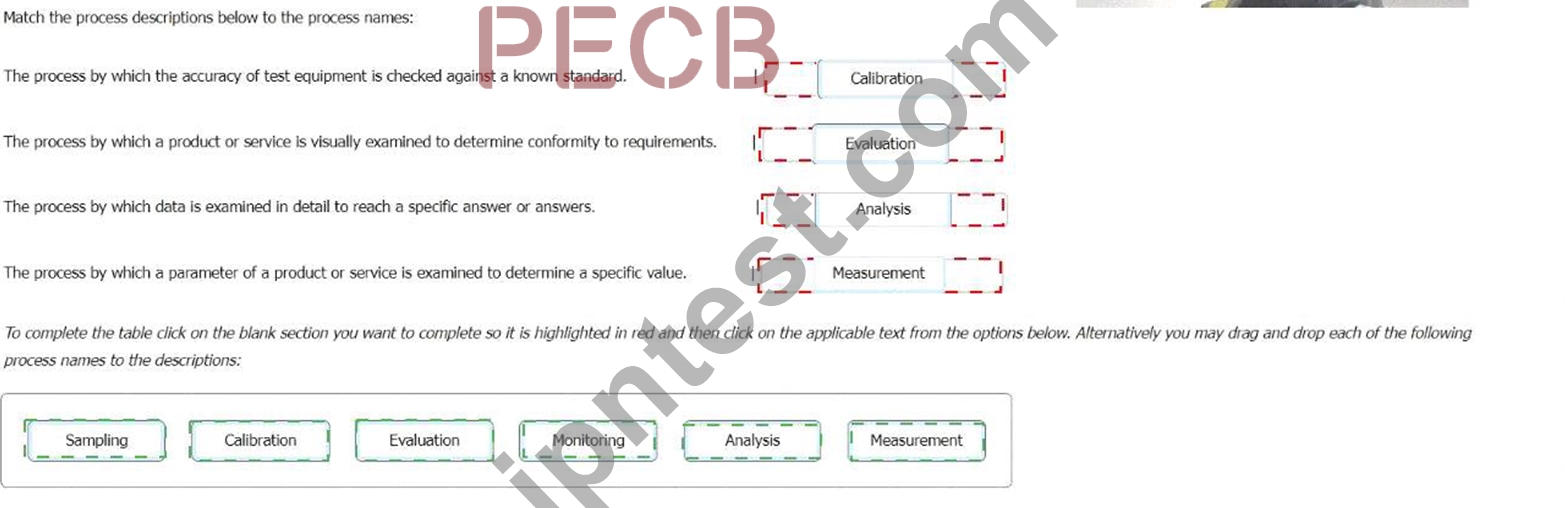
Explanation:
A white background with black text Description automatically generated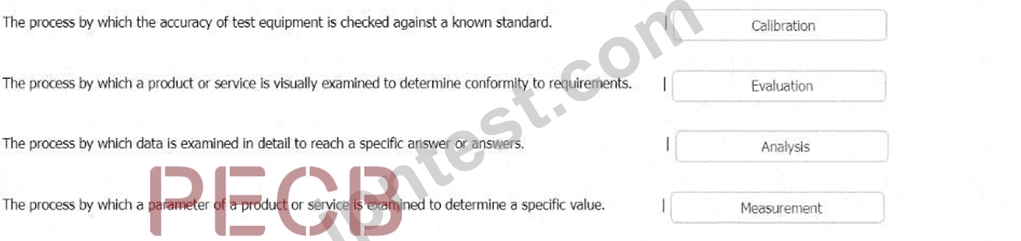
質問 # 154
次の各文を下の表に当てはめて、それがファーストパーティ監査、セカンドパーティ監査、またはサードパーティ監査のいずれに当てはまるかを示してください。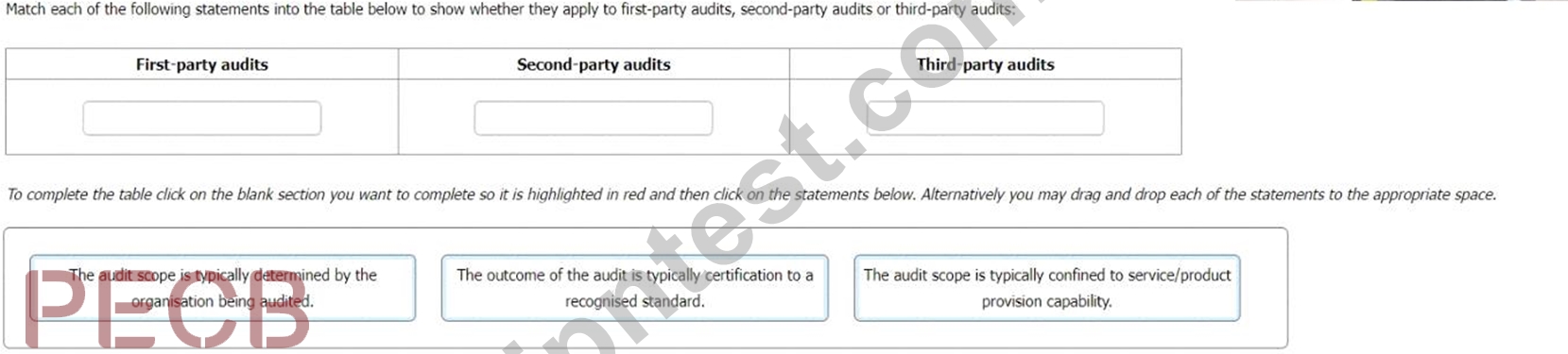
正解:
解説: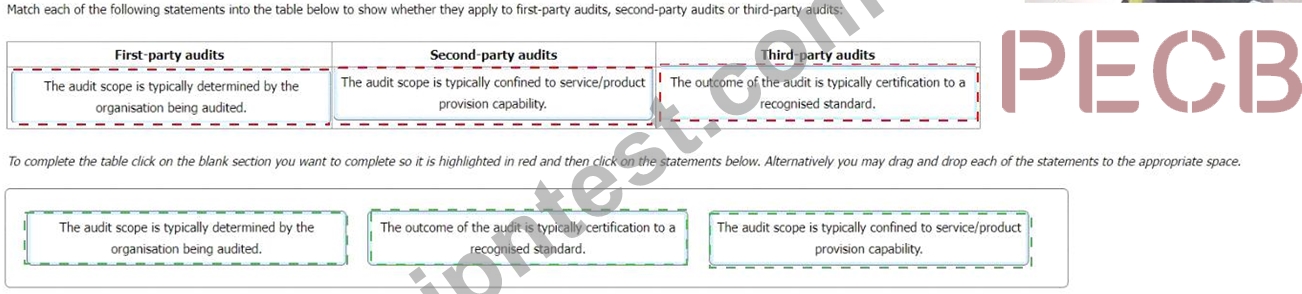
Explanation:
Table
Statement
First-party audits
Second-party audits
Third-party audits
The audit scope is typically determined by the organisation being audited.
Yes
No
No
The outcome of the audit is typically certification to a recognised standard.
No
No
Yes
The audit scope is typically confined to service/product provision capability.
No
Yes
No
Here is a brief explanation of each statement:
The audit scope is typically determined by the organisation being audited: This statement applies to first-party audits, also known as internal audits, where the organisation audits its own processes and activities to ensure conformity and improvement1. The organisation can decide the scope of the audit based on its own needs and objectives2. This statement does not apply to second-party audits, where the customer audits the supplier, or third-party audits, where an independent body audits the organisation. In these cases, the audit scope is determined by the customer or the certification body, respectively34.
The outcome of the audit is typically certification to a recognised standard: This statement applies to third-party audits, where an independent body audits the organisation to verify that it meets the requirements of a specific standard, such as ISO 9001, and issues a certificate of conformity if the audit is successful34. This statement does not apply to first-party audits or second-party audits, where the outcome of the audit is not certification, but rather self-improvement or supplier qualification13.
The audit scope is typically confined to service/product provision capability: This statement applies to second-party audits, where the customer audits the supplier to ensure that they are meeting the requirements specified in the contract, such as service or product quality, delivery, or performance34. The audit scope is usually focused on the specific aspects of the service or product that are of interest to the customer3. This statement does not apply to first-party audits or third-party audits, where the audit scope is broader and covers the entire quality management system or the relevant clauses of the standard14.
質問 # 155
ステージ 1 監査中に監査人は何を文書化する必要がありますか?
- A. 監査対象者の従業員とのインタビュー
- B. 現地監査中に不適合につながる可能性のある観察事項
- C. 監査対象者の主なプロセス
正解:B
解説:
Comprehensive and Detailed In-Depth Explanation:
Stage 1 Audit (ISO 9001:2015, Clause 9.2.2) is a documentation review to assess the readiness for a Stage
2 Audit. The auditor must document:
* Observations that could lead to nonconformities, ensuring they are addressed before Stage 2.
* Areas needing improvement, such as missing documented information or unclear process definitions
.
While understanding the auditee's main processes is important, documenting interviews is not a requirement at Stage 1.
Reference:
ISO 9001:2015, Clause 9.2.2 (Internal Audit Reporting)
質問 # 156
監査チームの各メンバーは、特にどのような能力を備えている必要がありますか?
- A. 監査対象者が活動する業界に関する知識。
- B. 監査対象となる各ドメインにおける専門知識。
- C. 監査に対するリスクベースのアプローチに関する知識。
- D. 品質管理に関する正式な学位。
正解:C
解説:
Comprehensive and Detailed In-Depth Explanation:
Auditors must have competence in risk-based auditing to effectively assess an organization's QMS performance and compliance.
Clause References:
* ISO 19011:2018, Clause 7.2.3 - Determining Auditor Competence:
* Auditors must have knowledge of risk-based thinking to assess risk impact on processes.
* ISO 9001:2015, Clause 0.3.3 - Risk-Based Thinking:
* The standard emphasizes proactive risk management, which auditors must understand.
Why is the Correct Answer B?
* Risk-based auditing ensures audits focus on high-risk areas, improving audit effectiveness.
* Auditors must assess how organizations apply risk-based thinking in decision-making, process control, and improvement.
Why are the Other Options Incorrect?
* A (Industry knowledge) # While helpful, it is not mandatory for all auditors.
* C (Expertise in all domains) # Auditors are not required to be experts in all areas, just in audit methodology.
* D (Formal degree in quality management) # ISO does not require a formal degree, just competence in audit principles and methods.
Reference:
ISO 19011:2018, Clause 7.2.3 - Determining Auditor Competence
ISO 9001:2015, Clause 0.3.3 - Risk-Based Thinking
質問 # 157
監査中に実行する必要があるアクションのリストとそれぞれのタイムラインは何ですか?
- A. 監査オファー。
- B. 監査スケジュール。
- C. 監査基準。
- D. 監査の目的。
正解:B
解説:
Comprehensive and Detailed In-Depth Explanation:
The audit schedule provides a structured timeline of activities to be conducted during the audit.
Clause References:
* ISO 19011:2018, Clause 6.4.2 - Preparing the Audit Plan:
* Requires the development of an audit schedule, including the sequence and timing of activities
.
* ISO/IEC 17021-1:2015, Clause 9.1.3 - Audit Program:
* Certification bodies must establish a schedule for conducting audits.
Why is the Correct Answer C?
* The audit schedule ensures systematic execution of the audit by defining activities, responsible auditors, and timeframes.
* A well-planned schedule improves efficiency and helps auditors cover all necessary areas within the given time.
Why are the Other Options Incorrect?
* A (Audit objectives) # Define why the audit is conducted, not the schedule.
* B (Audit criteria) # Define the standards and requirements to be evaluated, not the timeline.
* D (Audit offer) # Refers to the initial proposal sent to the auditee, not the activity timeline.
質問 # 158
ISO 9001:2015 の要件に準拠した品質管理システムで期待される主な結果は、次の 2 つのうちどれですか。
- A. マネジメントシステムの不適合件数の減少
- B. 製造サイクルのすべての段階で不適合製品の数が減少
- C. 顧客満足度の向上
- D. 利益の増加
- E. 顧客の要求を満たす製品を一貫して提供する
- F. 保証請求件数の減少
正解:C、E
解説:
ISO 9001 の要件に準拠した品質管理システムに期待される主な結果:
2015 の重要な利点は、規格の条項 0.1 に記載されています。「品質管理システムの採用は、組織にとって戦略的な決定であり、全体的なパフォーマンスの向上に役立ち、持続可能な開発イニシアチブの健全な基盤を提供します。この国際規格に基づく品質管理システムを実装することで組織が得る潜在的な利点は次のとおりです。a) 顧客および適用される法定および規制の要件を満たす製品およびサービスを一貫して提供できること。b) 顧客満足度を高める機会の促進。c) 状況および目的に関連するリスクと機会への対応。d) 指定された品質管理システム要件への適合を実証できること。」したがって、これらの利点に最も一致する 2 つのオプションは A と E です。これらは、顧客要件を満たす製品およびサービスの提供と顧客満足度の向上に直接関係しているからです。その他のオプションは、品質管理システムの実装の可能性のある結果ではありますが、主要な期待される結果としては明示的には言及されていません。参考資料: ISO 9001:2015 - 品質管理システム - 要件、ISO 9001:2015 品質管理システムの主要要素、品質管理システムとしての ISO 9001 2015 とは何ですか?
質問 # 159
次のうちどれが「ステージ 1 初期認証監査」の目的に含まれますか?
- A. 監視およびレビュー活動のパフォーマンスを評価します。
- B. 内部監査および管理レビューのプロセスを評価します。
- C. ステージ 2 監査に対する組織の準備状況を評価します。
- D. 品質マニュアルを確認します。
- E. ISO 9001:2015 への認証を決定する。
- F. 組織の運用プロセスを評価します。
正解:C、D
解説:
*ステージ 2 監査に対する組織の準備状況を評価する: この目標には、ステージ 2 監査を受けるための組織の準備状況を評価することが含まれます。ステージ 2 監査では、品質管理システムの適合性と有効性が検証されます123。監査チームは、品質管理システムの実装と理解のレベルを確認し、大きなギャップや不適合を特定し、監査の範囲、基準、および計画を確認します123。
*品質マニュアルを確認する: この目標には、品質ポリシー、品質目標、範囲、プロセス、手順などの品質管理システムの文書化された情報をレビューして、それらが ISO 9001:2015123 の要件を満たしていることを確認することが含まれます。監査チームはまた、組織の標準の理解と適用を評価し、改善または懸念事項を特定します123。
私の内部ツールの Web 検索結果によると、その他のオプションはステージ 1 初期認証監査の目的には含まれていません。これらは他のステージまたは監査の種類に関連している可能性がありますが、ステージ 1 監査の焦点ではありません。
したがって正解はBとDです。
参照: 1: ISO 9001 認証監査 | ステージ 1 およびステージ 2 - 9001。簡略化 2: 監査のステージ 1
| NQA ブログ 3: ISO 9001 認証の取得 - ステージ 1 監査
質問 # 160
XYZ 社は 100 人の従業員を雇用しており、ステージ 1 認証監査中に、品質管理システム (QMS) に特定の問題が特定されました。ISO 9001:2015 の条項 6.2 に対して不適合を指摘できる状況を説明する 2 つのオプションはどれですか。
- A. 品質目標が組織の担当者によって実行されていません。
- B. 品質目標の設定に経営トップが関与していませんでした。
- C. 品質目標は組織の品質方針に沿って設定されていませんでした。
- D. 品質目標は文書化された情報として維持されていません。
- E. コンサルタントは ISO 9001 を正しく解釈していません。
- F. 組織は品質目標を一度にすべて達成する余裕がありません。
正解:C、D
解説:
Understanding Clause 6.2 of ISO 9001:2015:Clause 6.2 (Quality Objectives and Planning to Achieve Them) specifies that organizations must:
Establish measurable and relevant quality objectives consistent with the quality policy (Clause 6.2.1).
Include objectives applicable to product/service conformity and customer satisfaction.
Document these objectives and their planning as documented information (Clause 6.2.1 & 6.2.2).
Plan how to achieve the objectives, including defining actions, resources, responsibilities, timelines, and methods for evaluation.
Analysis of Options:
A). Quality objectives are not being implemented by the organisation ' s personnel:Incorrect. While implementation is critical, this relates more to operational aspects rather than the direct requirements of Clause 6.2. Implementation issues would typically raise concerns under Clause 9.1 (Performance Evaluation).
B). The consultant has not interpreted ISO 9001 correctly:Incorrect. The consultant ' s interpretation of ISO
9001 is irrelevant in terms of Clause 6.2 compliance. The focus is on whether the organization aligns with the requirements, not the consultant ' s role.
C). Establishing quality objectives did not include top management:Incorrect. While top management involvement is vital for QMS effectiveness (Clause 5.1), this is not a direct requirement of Clause 6.2. Top management alignment is implied but not explicitly mandated for establishing quality objectives.
D). Quality objectives were not established in alignment with the organisation ' s quality policy:Correct.
Clause 6.2.1 requires that quality objectives be consistent with the organization's quality policy, ensuring they reflect its purpose, strategic direction, and commitment to continual improvement. Misalignment would constitute a nonconformity.
E). The organisation cannot afford to undertake quality objectives all at once:Incorrect. Financial constraints are not directly addressed in Clause 6.2. The clause focuses on planning to achieve objectives, which includes defining the necessary resources but does not demand achieving all objectives simultaneously.
F). Quality objectives are not maintained as documented information:Correct. Clause 6.2.1 specifically requires that quality objectives be maintained as documented information. Failure to document the objectives is a direct violation of this clause.
Why Options D and F Are Correct:
D: Misalignment between the quality objectives and the quality policy directly violates Clause 6.2.1, which mandates that objectives support the strategic direction of the organization.
F: Lack of documentation for quality objectives breaches the requirement to maintain them as documented information under Clause 6.2.1.
Relevant References:
Clause 6.2.1: Establishing quality objectives aligned with the quality policy.
Clause 6.2.2: Maintaining documented information for quality objectives and planning to achieve them.
Clause 5.1.1: Top management ' s responsibility to ensure alignment between the QMS and strategic direction.
質問 # 161
第三者(認証機関)による監視監査プロセスの一部として ISO 17021-1 で特に要求されているアクティビティを 6 つ選択します。
- A. 前回の訪問以降の QMS の変更を確認します。
- B. 計測機器のキャリブレーション状態を確認します。
- C. 以前に提起された調査結果のステータスを確認し、未解決の調査結果の有効性を監査します。
- D. 財政的責任を果たせていない。
- E. 前回の訪問以降の顧客苦情の処理。
- F. 品質管理システムの完全なドキュメントレビューを完了します。
- G. マーケティング資料における認証マークの使用を監査します。
- H. 法令遵守を確認します。
- I. 認証期間中に最低限の年次監視監査を実施します。
- J. 内部監査と経営レビューの有効性を確認します。
正解:A、C、E、G、H、J
解説:
The activities that are specifically required by ISO 17021-1 as part of third-party (Certification Body) surveillance audit processes are:
*Option A: Audit use of certification marks on marketing materials. This option is correct because ISO
17021-1:2015 clause 9.6.2.2 requires the certification body to audit the client's use of marks and/or any other reference to certification, as applicable, to ensure conformity with the certification requirements.
*Option B: Review changes to the QMS since last visit. This option is correct because ISO 17021-1:2015 clause 9.6.2.2 requires the certification body to review any changes affecting the client's quality management system and its ability to continue to fulfil the requirements of the standard used for certification.
*Option C: Confirm effectiveness of internal audit and management review. This option is correct because ISO
17021-1:2015 clause 9.6.2.2 requires the certification body to confirm the continuing effectiveness of the client's quality management system, including the effectiveness of the internal audit and management review processes.
*Option F: Review the status of previously raised findings and audit effectiveness of any outstanding findings.
This option is correct because ISO 17021-1:2015 clause 9.6.2.2 requires the certification body to review the status of findings and any corrective actions taken by the client in response to previous audits, and to verify the effectiveness of the implemented corrective actions.
*Option H: Verify legal compliance. This option is correct because ISO 17021-1:2015 clause 9.6.2.2 requires the certification body to verify the client's compliance with applicable statutory and regulatory requirements related to the scope of certification.
*Option I: Handling of customer complaints since last visit. This option is correct because ISO 17021-1:2015 clause 9.6.2.2 requires the certification body to review the client's handling of customer complaints related to the certified activities since the last audit.
The following options are not correct:
*Option D: Complete a full document review of the quality management system. This option is not correct because ISO 17021-1:2015 clause 9.6.2.2 does not require the certification body to complete a full document review of the quality management system during surveillance audits. A full document review is only required during the initial certification audit or when there are significant changes to the quality management system or the certification requirements.
*Option E: Failing to meet financial responsibilities. This option is not correct because ISO 17021-1:2015 clause 9.6.2.2 does not require the certification body to audit the client's financial responsibilities during surveillance audits. The certification body may have contractual arrangements with the client regarding the payment of fees, but this is not part of the surveillance audit process.
*Option G: Review the calibration status of the instrumentation. This option is not correct because ISO
17021-1:2015 clause 9.6.2.2 does not require the certification body to review the calibration status of the instrumentation during surveillance audits. The certification body may audit the client's monitoring and measuring resources as part of the quality management system requirements, but this is not a specific activity required by ISO 17021-1.
*Option J: Conduct a minimum number of annual surveillance audits during the certification period. This option is not correct because ISO 17021-1:2015 clause 9.6.2.2 does not require the certification body to conduct a minimum number of annual surveillance audits during the certification period. The certification body may determine the frequency and duration of surveillance audits based on the risk and performance of the client, but this is not a specific activity required by ISO 17021-1.
References:
*ISO 17021-1:2015 Conformity assessment - Requirements for bodies providing audit and certification of management systems - Part 1: Requirements
*ISO 9001 Lead Auditor Course Material, Module 7: Audit Follow-up and Surveillance, Slide 8: Surveillance Audit
*ISO 9001 Lead Auditor Training Course - IRCA Certified, Section 7.2: Audit Follow-up and Surveillance
*Lead Auditor Exam Preparation Guide (EPG) Template - PECB, Section 3.2: Exam Content Outline, Subsection 3.2.1: Section 1 - Audit Fundamentals, Subsection 3.2.2: Section 2 - Audit Principles, Subsection
3.2.3: Section 3 - Audit Process, Subsection 3.2.4: Section 4 - Audit Competencies
質問 # 162
ドキュメントレビューを実施する目的を最もよく表すオプションを 1 つ選択します。
- A. 文書化されたシステムが監査基準に準拠していないかどうかを明らかにし、監査レポートを裏付ける証拠を収集します。
- B. 監査基準に従って文書化されたシステムの不適合を確立し、監査レポートを作成するための情報を収集します。
- C. 文書化されたシステムが監査基準に準拠しているかどうかを決定し、監査プロセスをサポートするための調査結果を収集します。
- D. 文書化されている場合、システムが監査基準に準拠していることを確認し、監査結果を裏付ける情報を収集します。
- E. 監査基準に違反するシステムがあれば、それを文書化して検出し、監査計画をサポートする情報を特定します。
- F. 文書化された範囲でシステムが監査基準に準拠しているかどうかを判断し、監査活動をサポートするための情報を収集します。
正解:F
解説:
文書レビューを実施する目的は、文書化されたシステムが監査基準に準拠しているかどうかを判断し、監査活動をサポートする情報を収集することです。文書レビューは、監査の目的と範囲に関連する文書化された情報を体系的かつ客観的に検査することです。文書化された情報が完全、正確、一貫性があり、最新であるかどうかを監査人が確認するのに役立ちます。また、監査人が、監査結果や結論に影響を与える可能性のある文書化された情報のギャップ、エラー、または不適合を特定するのにも役立ちます。
その他のオプションは、文書レビューの真の目的を反映していないため、正しくありません。オプション A は、監査結果と推奨事項を経営陣やその他の関係者に伝えるという監査レポートの目的について説明しています。オプション B は、監査の範囲、目的、基準、方法、リソース、およびスケジュールを定義するという監査計画の目的について説明しています。オプション C は、監査中に特定された不適合または改善の機会の証拠を提供するという監査証拠レポートの目的について説明しています。オプション D は、監査中に特定の決定が行われた理由を正当化または説明するという監査決定レポートの目的について説明しています。
この回答が、オプション F が正しい理由とオプション ACD が間違っている理由を理解するのに役立つことを願っています。ISO 9001 主任監査員試験の質問と回答について詳しく知りたい場合は、次のリソースを確認してください。
ISO 9001 主任監査員試験のサンプル問題と回答: この記事では、ISO 9001 主任監査員試験の各セクションのサンプル問題と回答をいくつか紹介します。
ISO 9001 (QMS) 主任監査員クイズの質問と回答: この記事では、ISO 9001 QMS に関連するさまざまなトピックに関するクイズの質問と回答をいくつか紹介します。
ISO 9001 主任監査員 - 試験模擬テスト: このコースでは、各質問の説明付きの模擬テストを提供します。
Irca 主任監査人試験の質問と回答 PDF: このドキュメントには、PDF 形式の試験の質問と回答がいくつか含まれています。
質問 # 163
第二者監査のコンテキストでは、アクティビティとそれを実施する責任者を一致させます。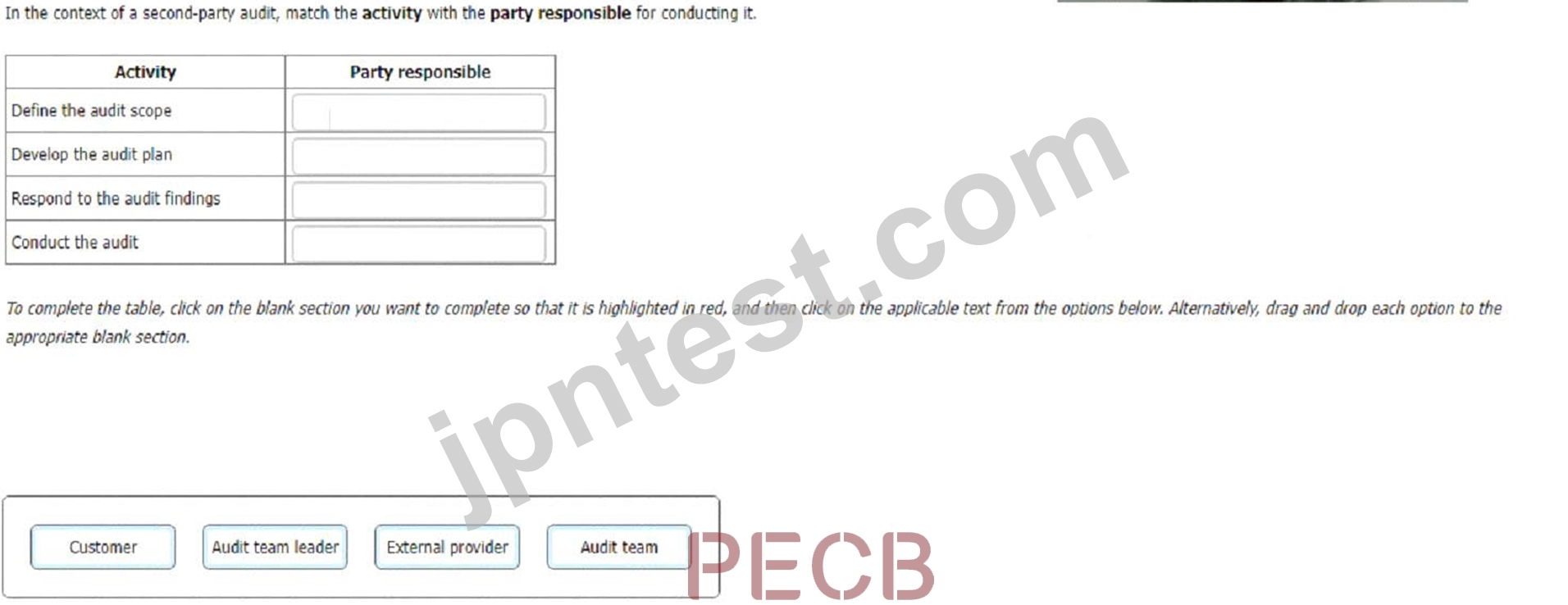
正解:
解説: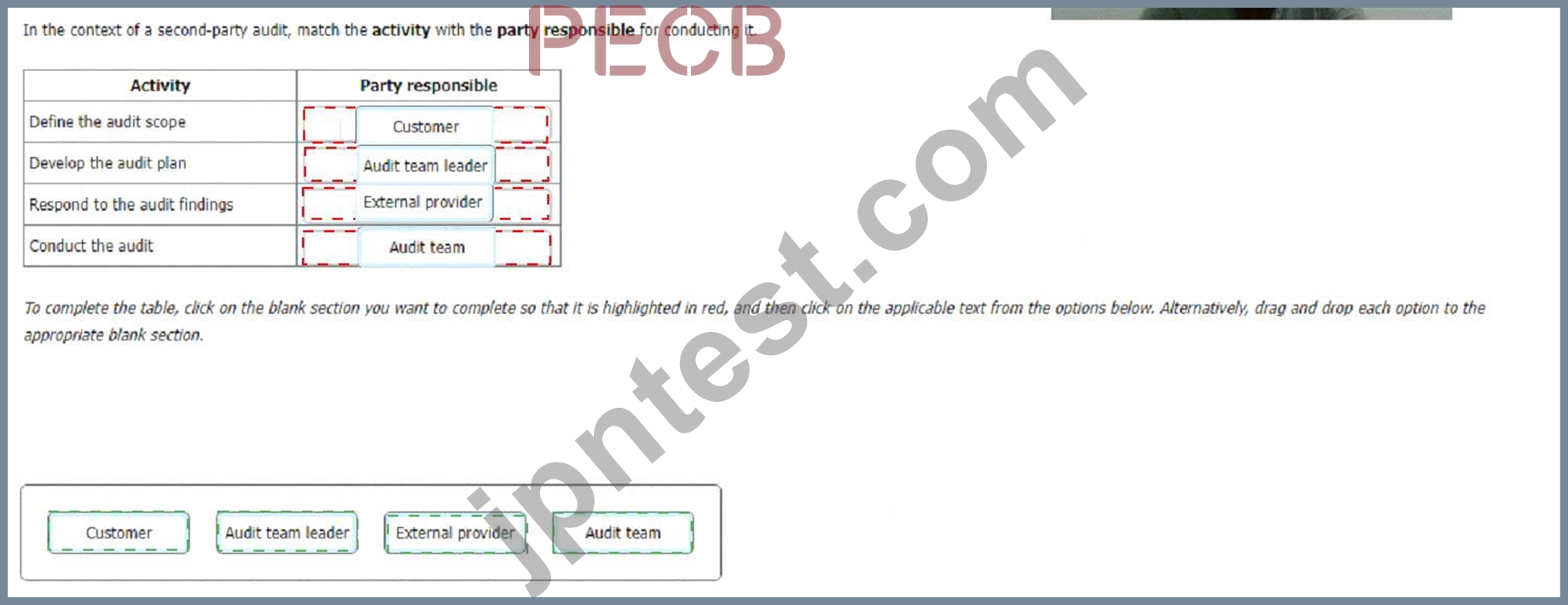
Explanation:
Here is the correct matching of the activities with the responsible parties in the context of a second-party audit:
* Define the audit scope: Customer
* Develop the audit plan: Audit team leader
* Respond to the audit findings: External provider
* Conduct the audit: Audit team
This reflects the typical division of responsibilities in a second-party audit, where the customer (the party commissioning the audit) sets the scope, the audit team leader manages the planning, the external provider responds to findings, and the audit team carries out the audit.
質問 # 164
組織が ISO 9001 の第三者認定認証を取得するための認証プロセスにおけるイベントの正しい順序を述べます。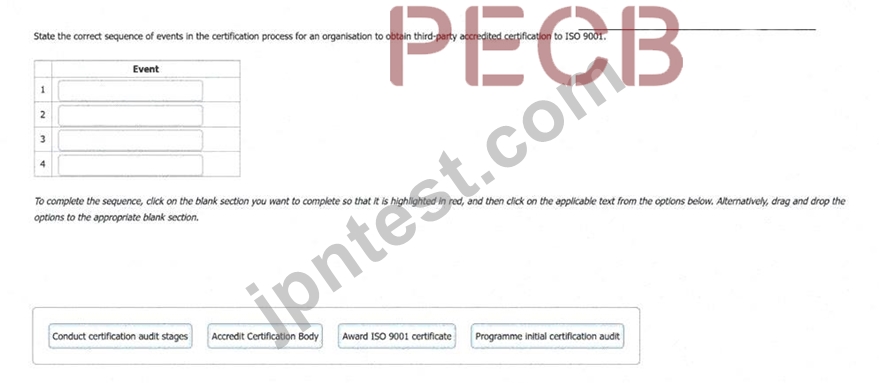
正解:
解説: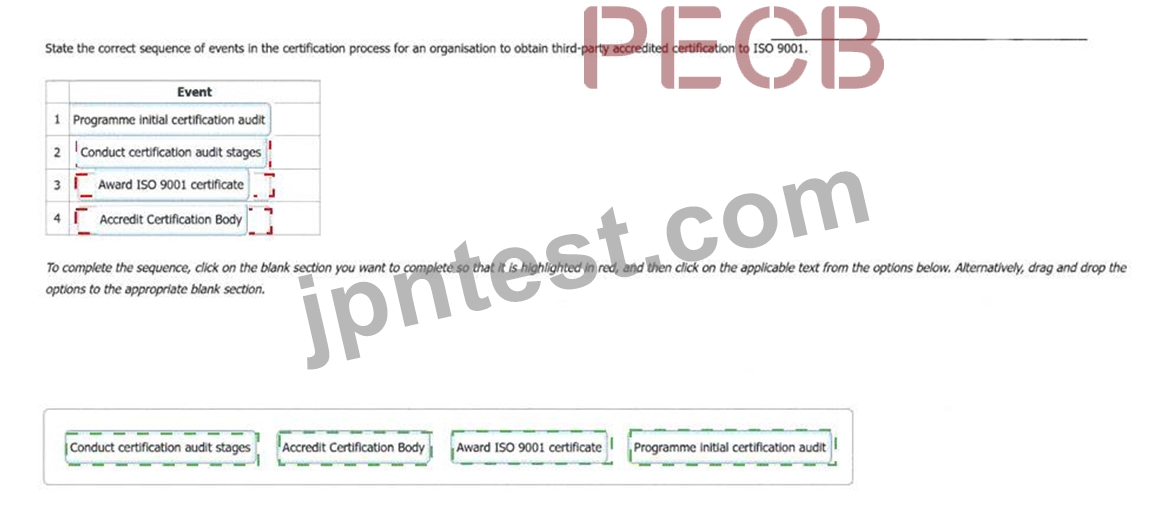
Reference: ISO 9001:2015 Clause 9.2 emphasizes the planning of audits and their scheduling to achieve desired results.
Step 2: Conduct Certification Audit StagesThe certification process includes a two-stage audit.
Stage 1 Audit: Review of documentation to verify readiness and understanding of the Quality Management System (QMS).
Stage 2 Audit: A detailed evaluation of the implementation and effectiveness of the QMS against ISO 9001 requirements.Reference: Clause 8.1 of ISO 9001:2015 discusses operational planning and control, which includes the preparation for audit activities.
Step 3: Award ISO 9001 CertificateAfter successfully completing the certification audits and resolving any identified non-conformities, the certification body awards the ISO 9001 certificate. This certificate demonstrates that the organization's QMS meets the ISO 9001 standard.Reference: Clause 10 of ISO 9001:
2015 focuses on continual improvement and conformity, which leads to the certification issuance.
Step 4: Accredit Certification BodyCertification bodies must be accredited to ensure they meet international standards for certification. Accreditation is conducted by bodies like UKAS (United Kingdom Accreditation Service) or ANAB (ANSI National Accreditation Board), ensuring the credibility and global acceptance of the certification process.Reference: Clause 7.1.5 of ISO 9001 covers resource monitoring, which supports the integrity of the certification process.
By following these steps, organizations can ensure an effective and compliant certification process, achieving ISO 9001 certification.
質問 # 165
紛争解決のテクニックの 1 つはトーンダウンすることです。その場合、紛争はどのように管理されますか?
- A. 交渉の結果、各当事者は共通の合意に達するために譲歩します。
- B. 同意できる点は強調され、同意できない点は適切な視点で捉えられます。
- C. 監査チームのリーダーは、権限を使って対立を解決します。
正解:B
解説:
Comprehensive and Detailed In-Depth Explanation:Toning down (or de-escalation) is a conflict resolution technique where:
* Common agreements are emphasized to reduce tension.
* Disagreements are addressed with a rational and constructive approach.
Option A describes compromise, and Option B describes authoritative resolution, which are different conflict resolution techniques.
質問 # 166
......
正真正銘のベスト材料はISO-9001-Lead-Auditor日本語オンライン練習試験:https://www.jpntest.com/shiken/ISO-9001-Lead-Auditor-JPN-mondaishu