

最新の2025年02月28日試験エンジン練習問題Network-Security-Essentials最新の有効問題集を提供中です
試験解答はNetwork-Security-Essentials最新版テストエンジンをタダで提供します
質問 # 25
What type of NAT enables clients on a private network to connect to servers on the Internet? (Select one.)
- A. Static NAT
- B. Dynamic NAT
- C. NAT loopback
- D. Hairpin NAT
正解:B
解説:
Dynamic NAT enables clients on a private network to connect to servers on the Internet. By translating private IP addresses to a public IP address (or pool of addresses), Dynamic NAT allows multiple devices within a private network to access external resources on the Internet. This form of NAT is essential in conserving IP addresses and maintaining privacy for internal network topologies.
質問 # 26
As you troubleshoot a Branch Office VPN tunnel, you see the log message below. Which settings can you modify in the BOVPN virtual interface configuration to resolve this issue? (Select one.)
- A. Phase 1 Settings
- B. Phase 2 Settings
- C. BOVPN-Allow policies
- D. VPN Routes
- E. Gateway Settings
正解:B
解説:
When troubleshooting a Branch Office VPN (BOVPN) tunnel, issues in thePhase 2 settingscan commonly cause connectivity problems. Adjusting settings such as the encryption and integrity algorithms, or setting correct lifetimes in Phase 2, may resolve compatibility or timeout issues with third-party VPN endpoints. This configuration ensures the two VPN endpoints can securely exchange data in alignment with each other's capabilities and settings.
質問 # 27
When you configure a Branch Office VPN tunnel to a third-party device, AES-GCM encryption is recommended for:
- A. Better uptime because of additional keep-alive options
- B. Better performance and throughput when supported by both VPN endpoints
- C. Troubleshooting purposes
- D. Connections to third-party firewalls only
- E. Routing over a BOVPN
正解:B
解説:
AES-GCM (Galois/Counter Mode)encryption is recommended for VPNs because it provides strong encryption with high performance and low overhead, making it an ideal choice for environments where both endpoints support it. AES-GCM combines encryption and authentication in a single step, resulting in faster processing compared to traditional encryption modes that handle these tasks separately. This mode is advantageous for maintaining high throughput in VPN tunnels, especially beneficial for branch office or inter- site VPNs where performance is critical.
質問 # 28
You routinely ship Fireboxes directly to remote offices without configuring them first. What is the zero-touch deployment method you can use to apply a configuration file after a Firebox arrives at a remote office? (Select one.)
- A. RapidDeploy
- B. Fireware Web UI
- C. WatchGuard System Manager
- D. Firebox Deployment Manager
- E. Dimension Command
正解:A
解説:
When shipping Fireboxes to remote offices without pre-configuration, theRapidDeployfeature is designed to facilitate zero-touch deployment. RapidDeploy enables network administrators to apply a pre-configured setup file after the device arrives at its destination.
* Process of RapidDeploy: Administrators can upload a configuration file to the WatchGuard Cloud or another accessible location, from which the Firebox downloads its initial configuration upon connection. This method ensures that even with remote deployment, the Firebox will automatically configure itself based on predefined settings, eliminating the need for manual on-site setup.
* Advantages: RapidDeploy streamlines setup for large-scale, geographically distributed environments where physical access may be limited. This feature is specifically useful for organizations seeking a scalable, efficient deployment process for devices in remote locations.
質問 # 29
You configured your Firebox interfaces and routes and want to verify the status of the routes and connected hosts. You found this information in Firebox System Manager > Status Report. What is true about the IPv4 routes and ARP table in this deployment? (Select one.)
- A. The Firebox cannot resolve a MAC address for 10.0.1.32
- B. The MAC address for 172.16.1.20 is 00:50:56:b0:22:0f
- C. The Firebox is publicly reachable at 198.51.100.1 through the eth0 interface
- D. The MAC address for the default gateway that currently routes traffic is 00:50:56:b5:e5:42
- E. 10.0.20.53 can be reached through the vlan20 interface
正解:C
解説:
Analyzing the routing table and ARP table in the provided image:
* Routing Table Analysis:
* The route 0.0.0.0 with a gateway of 198.51.100.1 on the eth0 interface suggests this is the default route for outbound traffic, indicating that the Firebox's public interface (eth0) is configured to route traffic through this gateway.
* This confirms that the Firebox is publicly reachable at the IP address 198.51.100.1.
* ARP Table Analysis:
* The ARP entry for the gateway IP 198.51.100.1 is not directly shown in the image but could typically be resolved to verify connectivity.
* Other options provided, such as MAC address validation, do not correspond with the current ARP entries shown in the image.
This setup indicates that the Firebox is accessible publicly on the eth0 interface using the IP 198.51.100.1, makingOption Athe correct answer.
質問 # 30
You configured a Firebox for a school environment. Students must have more restricted access than teachers, and unauthenticated users cannot have any Internet access. You added Student and Teacher groups to your proxy policies that handle web traffic. Based on the image below, this configuration can accomplish your goals.
- A. True
- B. False
正解:A
解説:
The image shows a configuration for a school environment with separateHTTPandHTTPS proxy policiesfor StudentsandTeachers. This separation allows for different levels of access control based on group membership, providing more restrictive access for students compared to teachers.
* Studentsare restricted by specific HTTP and HTTPS proxy policies, limiting their access to designated content and sites.
* Teachershave their own policies, which can be configured with more permissive rules.
* Unauthenticated users are not included in any policy, effectively blocking their internet access, as the firewall denies traffic not explicitly allowed by a policy.
This configuration meets the requirements by:
* Allowing teachers and students access as per their respective policies.
* Blocking unauthenticated users from internet access entirely.
質問 # 31
If you have only one public IP address, can you use Static NAT to enable inbound connections to both an email server and a web server on the private network? (Select one.)
- A. Yes, if both servers are on different private subnets
- B. No, you must assign a public IP address to each server
- C. Yes, if both servers use different ports
- D. No, you must use Dynamic NAT to route inbound connections to more than one server
正解:C
解説:
With only one public IP address, you can still configure Static NAT to route connections to both an email server and a web server, as long as each service is accessed on a different port. For instance, HTTP/HTTPS traffic for the web server can use port 80/443, while the email server can use ports associated with email protocols (e.g., 25 for SMTP). Static NAT can direct incoming requests to different internal servers based on port, making this approach feasible.
質問 # 32
You added a route on the Firebox for the 10.0.20.0/24 network. The server has 10.0.2.1 configured as its default gateway. The clients have 10.0.10.1 configured as their default gateway. The client computers on the
10.0.10.0/24 network cannot route traffic to the server at 10.0.20.100. What could cause this problem? (Select one.)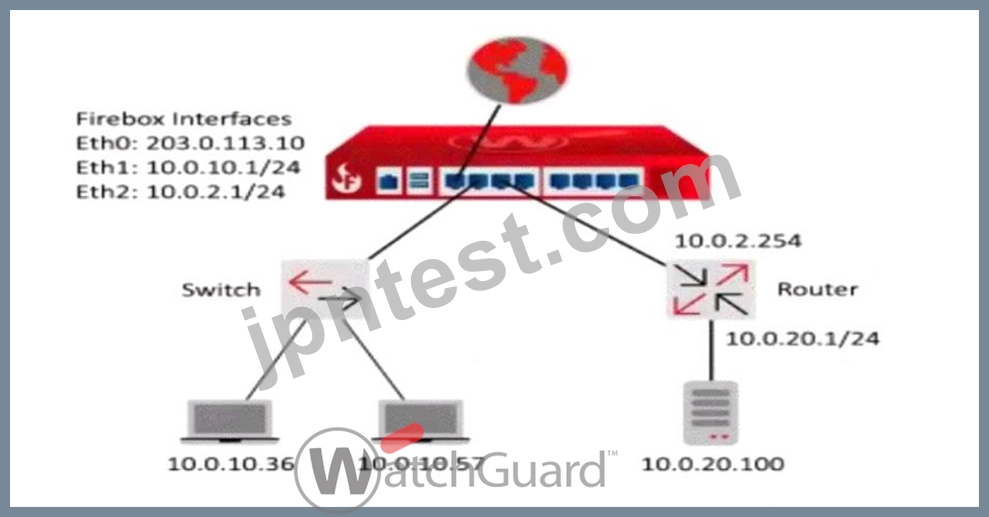
- A. The default gateway of the clients is misconfigured
- B. The default gateway of the server is misconfigured
- C. The router at 10.0.2.254 needs an IP address in the 10.0.10.0/24 network
- D. The server does not have a route for the 10.0.10.0/24 network
- E. The router at 10.0.2.254 does not have a route to reach the server
正解:B
解説:
In this scenario:
* The Firebox has a route to the 10.0.20.0/24 network.
* The server has 10.0.2.1 as its default gateway.
* Clients on the 10.0.10.0/24 network use 10.0.10.1 as their default gateway.
The issue arises because the server is in the 10.0.20.0/24 network and should have a gateway that directs traffic through the appropriate path. However, since 10.0.2.1 is configured as the server's gateway, the server likely doesn't have a correct return path to the clients on 10.0.10.0/24. This misconfiguration prevents the server from properly routing responses back to clients.
* Option Cis correct because the misconfigured default gateway on the server disrupts the routing, preventing communication with clients.
* Option Ais incorrect because the router at 10.0.2.254 is used for routing but doesn't need additional configuration if the server's gateway is corrected.
* Option Bis incorrect because the clients have the correct gateway for reaching the Firebox.
* Option Dis irrelevant since adding an IP in 10.0.10.0/24 on the router won't resolve the routing issue.
* Option Eis incorrect because adding a route on the server wouldn't solve the default gateway misconfiguration.
質問 # 33
You want to create a branch office VPN virtual interface between a remote Firebox and your headquarters Firebox so the remote Firebox can send log data to a server at headquarters. For the log data to be sent from the remote Firebox over the VPN successfully, what BOVPN virtual interface setting must you configure?
(Select one.)
- A. An IPSec certificate, instead of a Pre-shared key
- B. Perfect Forward Secrecy (PFS)
- C. Dead Peer Detection (DPD)
- D. Virtual IP addresses
- E. IKEv2 in the Phase 1 settings
正解:D
解説:
To enable the remote Firebox to send log data to a server at headquarters through a Branch Office VPN (BOVPN) virtual interface, you must configureVirtual IP addresses. Virtual IPs enable devices on either end of the VPN tunnel to communicate as if they are on the same network, facilitating routing of log data from the remote Firebox to the log server located at headquarters.
Other options likeIPSec certificatesandIKEv2are not specifically required for this configuration, though they can enhance security.Dead Peer Detection (DPD)andPerfect Forward Secrecy (PFS)are useful for maintaining VPN stability and security but are not directly necessary for enabling log transmission.
質問 # 34
After you enable content inspection, your users cannot connect to the business-critical website www.example.
com/account.html hosted by a trusted partner. To try to resolve this issue, you added a Domain Name exception of www.example.com/account.html, but users still cannot connect to the website. What is the Domain Name exception format to add to the HTTP proxy to correctly resolve this issue? (Select two.)
- A. www.example.com
- B. /example.com/
- C. example.com/
- D. *.example.com
- E. /account.html
正解:A、D
解説:
When using domain exceptions to bypass content inspection for specific websites on a Firebox, the format is critical. For the domain www.example.com/account.html, two viable exception formats are:
* A. *.example.com: This wildcard format will include all subdomains of example.com, covering www.
example.com as well as any other subdomains like api.example.com. This format is useful when you need to exclude an entire domain and its subdomains from content inspection.
* D. www.example.com: This specifies the exact domain. Adding this as an exception will directly match www.example.com, making it suitable for bypassing content inspection on that specific subdomain.
Other formats, like /example.com/ or /account.html, do not match the required structure for domain name exceptions in the Firebox HTTP proxy settings.
質問 # 35
The Firebox can scan the contents of encrypted zip files with Gateway AntiVirus when HTTPS content inspection is enabled.
- A. True
- B. False
正解:B
解説:
The Firebox cannot scan the contents of encrypted zip files even if HTTPS content inspection is enabled.
HTTPS content inspection allows the Firebox to inspect encrypted HTTPS traffic by decrypting it. However, the content within encrypted zip files remains inaccessible to Gateway AntiVirus scanning because the encryption key for the zip file is not available to the Firebox. This limitation is consistent with standard network security practices, where encrypted files need to be decrypted with a known key before content scanning can occur.
質問 # 36
In a Mobile VPN configuration, why would you choose default-route (full tunnel) VPN instead of split tunnel VPN? (Select one.)
- A. Default-route VPN uses less processing power.
- B. Default-route VPN enables your Firebox to examine all remote user traffic.
- C. Default-route VPN is the only option you can use to apply security services to connections routed to your internal servers.
- D. Default-route VPN automatically allows dynamic NAT.
- E. Default-route VPN uses less bandwidth.
正解:B
解説:
In a Mobile VPN setup, adefault-route (full tunnel)VPN routes all of a remote user's internet traffic through the VPN tunnel to the Firebox. This configuration allows the Firebox to inspect and apply security policies to all traffic, including traffic that is not destined for internal network resources. In contrast, asplit tunnel VPN would route only traffic meant for the internal network through the VPN, while internet-bound traffic would bypass the Firebox, potentially exposing it to threats and limiting the Firebox's ability to inspect all traffic.
質問 # 37
Based on the configuration shown in this image, clients on the network can successfully connect tohttps://www.watchguard.com.
- A. True
- B. False
正解:A
解説:
Based on the configuration shown in the image, the HTTPS-proxy-out policy allows traffic fromAny-Trusted andAny-Optionalnetworks toAny-Externaldestination on port443(which is the standard port for HTTPS).
This rule effectively permits outbound HTTPS connections from clients within the trusted network to external HTTPS websites, such as https://www.watchguard.com.
Since the policy type isHTTPS-proxy, it can inspect and manage HTTPS traffic according to configured policies, but it does not block the connection itself. Therefore, users on the network should be able to successfully connect to external HTTPS sites.
質問 # 38
If policies are automatically ordered, which of these policies has the highest precedence? (Select one.)
- A. Outgoing policy - From: Any-Trusted, Any-Optional To: Any-External
- B. HTTPS policy - From: Any-Trusted, Any-Optional To: Any-External
- C. HTTPS policy - From: Trusted To: Any-External
- D. HTTPS policy - From: User1@Firebox-DB To: Any-External
正解:D
解説:
When policies are automatically ordered, policies with more specific user-based criteria have higher precedence over general policies. In this scenario, an HTTPS policy for a specific user (e.g.,User1@Firebox- DB) would take precedence over policies that apply to broader groups or networks, such asAny-Trustedor Any-Optional. This ordering ensures that individual user rules are evaluated first before generic policies, providing finer access control.
質問 # 39
You have just configured Mobile VPN with IKEv2 for your customer. By default, authenticated Mobile VPN users are allowed to send traffic to all Firebox networks through the VPN.
- A. True
- B. False
正解:B
解説:
In the default configuration ofMobile VPN with IKEv2, authenticated VPN users are only allowed access to specified networks or resources as defined by the VPN policy. They do not automatically have access to all Firebox networks through the VPN. To enable access to specific networks, administrators need to configure access routes explicitly within the Mobile VPN settings.
質問 # 40
You enable a network device monitoring application on a server with IP address 10.0.1.22. After you run the application, it reports that it cannot ping the Firebox at 10.0.1.1, and you see this log message in Traffic Monitor. What is the most likely cause of this issue? (Select one.)
- A. There is no policy that allows Ping traffic from the server to the Firebox alias
- B. The server IP address is on the Blocked Sites list
- C. There is no route on the Firebox for the 10.0.1.0/24 subnet
- D. The default Unhandled Internal Packet policy is at the top of the policy set
- E. The dynamic NAT statement is not configured correctly for the 10.0.1.0/24 subnet
正解:A
解説:
The most likely reason for the network device monitoring application's failure to ping the Firebox is the absence of an explicit policy permitting Ping traffic from the server (IP 10.0.1.22) to the Firebox alias (10.0.1.1). By default, Firebox policies are configured to allow only traffic explicitly permitted by a policy.
Therefore, without a dedicated policy allowing ICMP (Ping) requests from this specific source to the Firebox, the device will drop the traffic, resulting in a connectivity failure for Ping.
This is a common scenario in Firebox configurations, where restrictive policy settings enhance network security by blocking all traffic types unless specifically allowed.
質問 # 41
Before packets are examined by Default Threat Protection, they are processed by firewall policies in top- down order.
- A. True
- B. False
正解:A
解説:
In Firebox configuration, packets are processed by firewall policies in atop-down orderbefore they reach Default Threat Protection. This ordering ensures that the firewall policies defined higher in the policy list take precedence. Packets are evaluated against each rule sequentially from top to bottom until a matching policy is found, which then determines the action taken (allow, deny, or inspect further). Only after this process will any unfiltered traffic be subject to Default Threat Protection for additional security checks.
質問 # 42
Your users have no network connectivity on their computers in the 10.0.40.0/24 network. You investigate and discover the DHCP address pool for this network is exhausted, but there are no available IP addresses in the network to assign. Which of these options can you use to expand the IP address space of this network? (Select two.)
- A. Create a Dynamic NAT rule for traffic from the 10.0.40.1/24 network going to the 10.0.50.1/24 network
- B. Enable a wireless SSID for the 10.0.40.1/24 network
- C. Add 10.0.50.1/24 to the 10.0.40.1/24 network as a secondary network
- D. Bridge the 10.0.40.1/24 network across additional interfaces
- E. Change the IP address of the 10.0.40.1/24 network to 10.0.40.123/24
正解:C、D
解説:
* Adding a Secondary Network (10.0.50.1/24): By adding a secondary subnet (such as10.0.50.1/24) to the existing 10.0.40.1/24 network, you expand the IP address space, effectively increasing the number of available IP addresses for DHCP allocation.
* Bridging Across Additional Interfaces: Bridging the 10.0.40.1/24 network across multiple interfaces can also increase the available address pool by creating a larger logical network. This approach helps manage IP space across a broader range of devices without subnet fragmentation.
These methods provide scalable solutions to expand IP address availability within constrained network spaces.
質問 # 43
......
Network-Security-Essentials試験問題集で無料サンプルは365日更新されます:https://www.jpntest.com/shiken/Network-Security-Essentials-mondaishu
合格させるNetwork-Security-Essentials試験問題と最新のNetwork-Security-Essentialsテスト問題集PDF:https://drive.google.com/open?id=1gRq8YSoxQPckOmYprs7knt6YYvo3nhNp