

最新2024年12月24日リアルなN10-009試験問題集解答で有効なN10-009問題集PDF
CompTIA N10-009試験問題集でPDF問題とテストエンジン
質問 # 62
A network engineer is now in charge of all SNMP management in the organization. The engineer must use a SNMP version that does not utilize plaintext data. Which of the following is the minimum version of SNMP that supports this requirement?
- A. v2u
- B. v3
- C. v2c
- D. v1
正解:B
解説:
SNMPv3 is the version of the Simple Network Management Protocol that introduces security enhancements, including message integrity, authentication, and encryption. Unlike previous versions (v1 and v2c), SNMPv3 supports encrypted communication, ensuring that data is not transmitted in plaintext. This provides confidentiality and protects against eavesdropping and unauthorized access.References:CompTIA Network+ study materials.
質問 # 63
A network administrator wants users to be able to authenticate to the corporate network using a port-based authentication framework when accessing both wired and wireless devices. Which of the following is the best security feature to accomplish this task?
- A. Port security
- B. 802.1X
- C. MAC filtering
- D. Access control list
正解:B
解説:
802.1X is a port-based network access control (PNAC) protocol that provides an authentication mechanism to devices wishing to connect to a LAN or WLAN. It is widely used for secure network access, ensuring that only authenticated devices can access the network, whether they are connecting via wired or wireless means.
802.1X works in conjunction with an authentication server, such as RADIUS, to validate the credentials of devices trying to connect.References:CompTIA Network+ study materials.
質問 # 64
Which of the following fiber connector types is the most likely to be used on a network interface card?
- A. SC
- B. ST
- C. LC
- D. MPO
正解:C
解説:
Definition of Fiber Connector Types:
LC (Lucent Connector): A small form-factor fiber optic connector with a push-pull latching mechanism, commonly used for high-density applications.
SC (Subscriber Connector or Standard Connector): A larger form-factor connector with a push-pull latching mechanism, often used in datacom and telecom applications.
ST (Straight Tip): A bayonet-style connector, typically used in multimode fiber optic networks.
MPO (Multi-fiber Push On): A connector designed to support multiple fibers (typically 12 or 24 fibers), used in high-density cabling environments.
Common Usage:
LC Connectors: Due to their small size, LC connectors are widely used in network interface cards (NICs) and high-density environments such as data centers. They allow for more connections in a smaller space compared to SC and ST connectors.
SC and ST Connectors: These are larger and more commonly used in patch panels and older fiber installations but are less suitable for high-density applications.
MPO Connectors: Primarily used for trunk cables in data centers and high-density applications but not typically on individual network interface cards.
Selection Criteria:
The small form-factor and high-density capabilities of LC connectors make them the preferred choice for network interface cards, where space and connection density are critical considerations.
Reference:
CompTIA Network+ study materials on fiber optics and connector types.
質問 # 65
Which of the following best describes the transmission format that occurs at the transport layer over connectionless communication?
- A. Frames
- B. Segment
- C. Datagram
- D. Packets
正解:C
解説:
At the transport layer, connectionless communication is typically handled using the User Datagram Protocol (UDP), which transmits data in units called datagrams. Unlike TCP, UDP does not establish a connection before sending data and does not guarantee delivery, making datagrams the correct term for the transmission format in this context. References: CompTIA Network+ Exam Objectives and official study guides.
質問 # 66
A network administrator wants to implement security zones in the corporate network to control access to only individuals inside of the corporation. Which of the following security zones is the best solution?
- A. Trusted
- B. Extranet
- C. VPN
- D. Public
正解:A
解説:
* Introduction to Security Zones:
* Security zones are logical segments within a network designed to enforce security policies and control access. They help in segregating and securing different parts of the network.
* Types of Security Zones:
* Trusted Zone:This is the most secure zone, typically used for internal corporate networks where only trusted users have access.
* Extranet:This zone allows controlled access to external partners, vendors, or customers.
* VPN (Virtual Private Network):While VPNs are used to create secure connections over the internet, they are not a security zone themselves.
* Public Zone:This zone is the least secure and is typically used for public-facing services accessible by anyone.
* Trusted Zone Implementation:
* The trusted zone is configured to include internal corporate users and resources. Access controls,
* firewalls, and other security measures ensure that only authorized personnel can access this zone.
* Internal network segments, such as the finance department, HR, and other critical functions, are usually placed in the trusted zone.
* Example Configuration:
* Firewall Rules:Set up rules to allow traffic only from internal IP addresses.
* Access Control Lists (ACLs):Implement ACLs on routers and switches to restrict access based on IP addresses and other criteria.
* Segmentation:Use VLANs and subnetting to segment and isolate the trusted zone from other zones.
* Explanation of the Options:
* A. Extranet:Suitable for external partners, not for internal-only access.
* B. Trusted:The correct answer, as it provides controlled access to internal corporate users.
* C. VPN:A method for secure remote access, not a security zone itself.
* D. Public:Suitable for public access, not for internal corporate users.
* Conclusion:
* Implementing a trusted zone is the best solution for controlling access within a corporate network.
It ensures that only trusted internal users can access sensitive resources, enhancing network security.
References:
* CompTIA Network+ guide detailing security zones and their implementation in a corporate network (see pageRef 9†Basic Configuration Commands).
質問 # 67
Which of the following is a cost-effective advantage of a split-tunnel VPN?
- A. Monitoring detects insecure machines on the company's network.
- B. Web traffic is filtered through a web filter.
- C. Cloud-based traffic flows outside of the company's network.
- D. More bandwidth is required on the company's internet connection.
正解:C
解説:
A split-tunnel VPN allows certain traffic (e.g., cloud-based services) to bypass the VPN and go directly to the Internet. This reduces the amount of traffic that needs to traverse the company's VPN and Internet connection, conserving bandwidth and reducing costs. It also means that not all traffic is subject to the same level of inspection or filtering, which can improve performance for cloud-based services.
Reference: CompTIA Network+ study materials.
質問 # 68
SIMULATION
You have been tasked with setting up a wireless network in an office. The network will consist of 3 Access Points and a single switch. The network must meet the following parameters:
The SSIDs need to be configured as CorpNet with a key of S3cr3t!
The wireless signals should not interfere with each other
The subnet the Access Points and switch are on should only support 30 devices maximum The Access Points should be configured to only support TKIP clients at a maximum speed INSTRUCTONS Click on the wireless devices and review their information and adjust the settings of the access points to meet the given requirements.
If at any time you would like to bring back the initial state of the simulation, please click the Reset All button.


正解:
解説:
See explanation below.
Explanation:
On the first exhibit, the layout should be as follows


Exhibit 2 as follows
Access Point Name AP2

Exhibit 3 as follows
Access Point Name AP3

質問 # 69
Which of the following are environmental factors that should be considered when installing equipment in a building? (Select two).
- A. Power load
- B. Proximity to nearest MDF
- C. Floor construction type
- D. Fire suppression system
- E. UPS location
- F. Humidity control
正解:D
解説:
When installing equipment in a building, environmental factors are critical to ensure the safety and longevity of the equipment. A fire suppression system is essential to protect the equipment from fire hazards. Humidity control is crucial to prevent moisture-related damage, such as corrosion and short circuits, which can adversely affect electronic components. Both factors are vital for maintaining an optimal environment for networking equipment.References:CompTIA Network+ study materials.
質問 # 70
You have been tasked with implementing an ACL on the router that will:
1. Permit the most commonly used secure remote access technologies from the management network to all other local network segments
2. Ensure the user subnet cannot use the most commonly used remote access technologies in the Linux and Windows Server segments.
3. Prohibit any traffic that has not been specifically allowed.
INSTRUCTIONS
Use the drop-downs to complete the ACL
If at any time you would like to bring back the initial state of the simulation, please click the Reset All button.

正解:
解説:
See the answer and solution below.
Explanation:
質問 # 71
A virtual machine has the following configuration:
*IPv4 address: 169.254.10.10
*Subnet mask: 255.255.0.0
The virtual machine can reach colocated systems but cannot reach external addresses on the Internet. Which of the following Is most likely the root cause?
- A. Thesubnet mask is incorrect.
- B. TheDHCP server is offline.
- C. TheIP address is an RFC1918 private address.
- D. TheDNS server is unreachable.
正解:B
解説:
* Understanding the 169.254.x.x Address:
* An IPv4 address in the range of 169.254.x.x is an Automatic Private IP Addressing (APIPA) address, assigned when a DHCP server is unavailable.
* DHCP Server Offline:
* APIPA Assignment:When a device cannot obtain an IP address from a DHCP server, it assigns itself an APIPA address to enable local network communication. This allows communication with other devices on the same local subnet but not with external networks.
* Resolution:Ensure the DHCP server is operational. Check for connectivity issues between the virtual machine and the DHCP server, and verify the DHCP server settings.
* Comparison with Other Options:
* The subnet mask is incorrect:The subnet mask 255.255.0.0 is appropriate for the 169.254.x.x range and does not prevent external access by itself.
* The IP address is an RFC1918 private address:RFC1918 addresses are private IP ranges (10.x.x.x, 172.16.x.x-172.31.x.x, 192.168.x.x) but 169.254.x.x is not one of them.
* The DNS server is unreachable:While this could affect name resolution, it would not prevent the assignment of a non-APIPA address or local network communication.
* Troubleshooting Steps:
* Verify the DHCP server's status and connectivity.
* Restart the DHCP service if necessary.
* Renew the IP lease on the virtual machine using commands such asipconfig /renew(Windows) ordhclient(Linux).
References:
* CompTIA Network+ study materials on IP addressing and DHCP troubleshooting.
質問 # 72
A newtwork administrator needs to create an SVI on a Layer 3-capable device to separate voice and data traffic. Which of the following best explains this use case?
- A. A logical interface used for the routing of VLANs
- B. A physical interface used for trunking logical ports
- C. A physical interface used for management access
- D. A logical interface used when the number of physical ports is insufficent.
正解:A
質問 # 73
Which of the following panels would be best to facilitate a central termination point for all network cables on the floor of a company building?
- A. MDF
- B. Rack
- C. Patch
- D. UPS
正解:C
解説:
A patch panel is the best choice to facilitate a central termination point for all network cables on the floor of a company building. Patch panels are used to manage and organize multiple network cables, providing a central point where all cables converge. This setup allows for easy management, troubleshooting, and reconfiguration of network connections. The other options, such as UPS (Uninterruptible Power Supply), MDF (Main Distribution Frame), and rack, serve different purposes and are not specifically designed for the central termination of network cables.
Reference: CompTIA Network+ Certification Exam Objectives - Network Installation section.
質問 # 74
Which of the following disaster recovery concepts is calculated by dividing the total hours of operation by the total number of units?
- A. MTBF
- B. RPO
- C. MTTR
- D. RTO
正解:A
解説:
Introduction to Disaster Recovery Concepts:
Disaster recovery involves strategies and measures to ensure business continuity and data recovery in the event of a disaster.
Mean Time Between Failures (MTBF):
MTBF is a reliability metric used to predict the time between failures of a system during operation. It is calculated by dividing the total operational time by the number of failures.
Formula: MTBF=Total Operational TimeNumber of Failures\text{MTBF} = \frac{\text{Total Operational Time}}{\text{Number of Failures}}MTBF=Number of FailuresTotal Operational Time This metric helps in understanding the reliability and expected lifespan of systems and components.
Example Calculation:
If a server operates for 1000 hours and experiences 2 failures, the MTBF is: MTBF=1000 hours2=500 hours\text{MTBF} = \frac{1000 \text{ hours}}{2} = 500 \text{ hours}MTBF=21000 hours=500 hours Explanation of the Options:
A . MTTR (Mean Time to Repair): The average time required to repair a system after a failure.
B . MTBF (Mean Time Between Failures): The correct answer, representing the average time between failures.
C . RPO (Recovery Point Objective): The maximum acceptable amount of data loss measured in time.
D . RTO (Recovery Time Objective): The target time set for the recovery of IT and business activities after a disaster.
Conclusion:
MTBF is a crucial metric in disaster recovery and system reliability, helping organizations plan maintenance and predict system performance.
Reference:
CompTIA Network+ guide explaining MTBF, MTTR, RPO, and RTO concepts and their calculations (see page Ref 10fHow to Use Cisco Packet Tracer).
質問 # 75
A network technician is troubleshooting a web application's poor performance. The office has two internet links that share the traffic load. Which of the following tools should the technician use to determine which link is being used for the web application?
- A. nslookup
- B. ping
- C. netstat
- D. tracert
正解:D
解説:
* Understanding Tracert:
* Traceroute Tool:tracert(Windows) ortraceroute(Linux) is a network diagnostic tool used to trace the path that packets take from a source to a destination. It lists all the intermediate routers the packets traverse.
* Determining Traffic Path:
* Path Identification:By runningtracertto the web application's destination IP address, the technician can identify which route the traffic is taking and thereby determine which internet link is being used.
* Load Balancing Insight:If the office uses load balancing for its internet links,tracertcan help verify which link is currently handling the traffic for the web application.
* Comparison with Other Tools:
* netstat:Displays network connections, routing tables, interface statistics, and more, but does not trace the path of packets.
* nslookup:Used for querying DNS to obtain domain name or IP address mapping, not for tracing packet routes.
* ping:Tests connectivity and measures round-trip time but does not provide path information.
* Implementation:
* Open a command prompt or terminal.
* Executetracert [destination IP]to trace the route.
* Analyze the output to determine the path and the link being used.
References:
* CompTIA Network+ study materials on network troubleshooting and diagnostic tools.
質問 # 76
An organization has a security requirement that all network connections can be traced back to a user. A network administrator needs to identify a solution to implement on the wireless network. Which of the following is the best solution?
- A. Enforcing wired equivalent protection
- B. Requiring theuse of PSKs
- C. Implementingenterprise authentication
- D. Configuring acaptive portal for users
正解:C
解説:
Enterprise authentication (such as WPA2-Enterprise) utilizes unique credentials for each user, typically integrating with an authentication server like RADIUS. This allows for tracking and logging user activity, ensuring that all connections can be traced back to individual users. PSKs (Pre-Shared Keys) are shared among users and do not provide individual accountability. Captive portals can identify users but are less secure than enterprise authentication, and Wired Equivalent Privacy (WEP) is outdated and not recommended for security purposes.
質問 # 77
A network administrator is configuring a new switch and wants to ensure that only assigned devices can connect to the switch. Which of the following should the administrator do?
- A. Enable port security.
- B. Implement a captive portal.
- C. Disable unnecessary services.
- D. Configure ACLs.
正解:A
質問 # 78
SIMULATION
You have been tasked with setting up a wireless network in an office. The network will consist of 3 Access Points and a single switch. The network must meet the following parameters:
The SSIDs need to be configured as CorpNet with a key of S3cr3t!
The wireless signals should not interfere with each other
The subnet the Access Points and switch are on should only support 30 devices maximum The Access Points should be configured to only support TKIP clients at a maximum speed INSTRUCTONS Click on the wireless devices and review their information and adjust the settings of the access points to meet the given requirements.
If at any time you would like to bring back the initial state of the simulation, please click the Reset All button.


正解:
解説:
See explanation below
Explanation:
On the first exhibit, the layout should be as follows


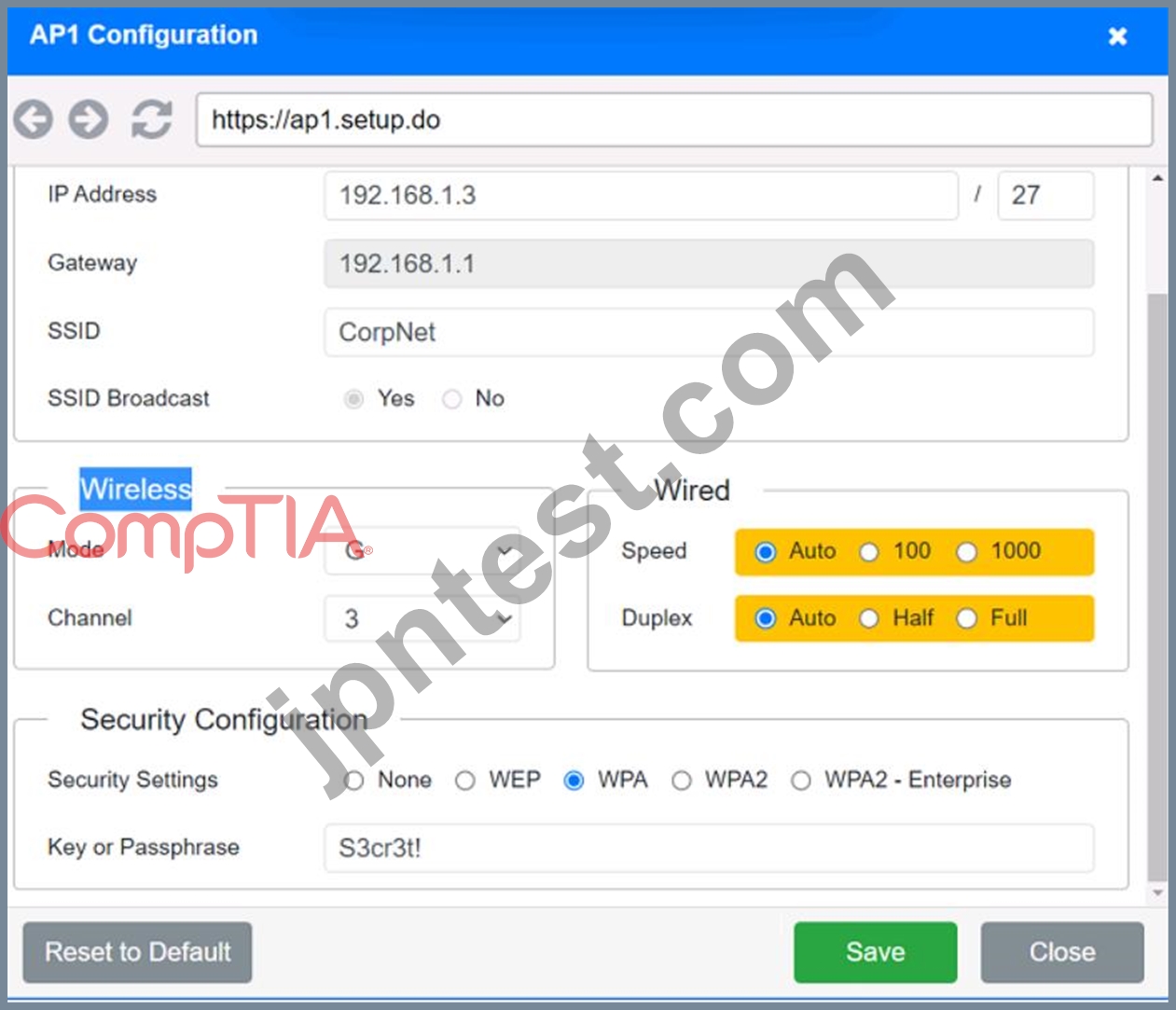
Exhibit 2 as follows
Access Point Name AP2

Exhibit 3 as follows
Access Point Name AP3

質問 # 79
Which of the following protocols has a default administrative distance value of 90?
- A. OSPF
- B. EIGRP
- C. BGP
- D. RIP
正解:B
解説:
EIGRP (Enhanced Interior Gateway Routing Protocol) has a default administrative distance (AD) value of 90 for internal routes. The administrative distance is used to rate the trustworthiness of routing information received from different routing protocols. EIGRP, developed by Cisco, has an AD of 90, which is lower than that of RIP (120) and OSPF (110), making it more preferred if multiple protocols provide a route to the same destination.
Reference: CompTIA Network+ study materials.
質問 # 80
A network architect needs to create a wireless field network to provide reliable service to public safety vehicles. Which of the following types of networks is the best solution?
- A. Point-to-point
- B. Infrastructure
- C. Mesh
- D. Ad hoc
正解:C
解説:
A mesh network is the best solution for providing reliable wireless service to public safety vehicles. In a mesh network, each node (vehicle) can connect to multiple other nodes, providing multiple paths for data to travel. This enhances reliability and redundancy, ensuring continuous connectivity even if one or more nodes fail. Mesh networks are highly resilient and are well-suited for dynamic and mobile environments such as public safety operations.
Reference: CompTIA Network+ study materials.
質問 # 81
......
信頼できるCompTIA Network+ N10-009問題集PDF2024年12月24日最近更新された問題:https://www.jpntest.com/shiken/N10-009-mondaishu
最新N10-009試験問題集には合格保証付きます:https://drive.google.com/open?id=15WwVB5OZ6ufLoacgZ2rQPoA5q-PVoakH