

検証済みNetSec-Analyst問題集と解答で2026年最新のNetSec-Analystをダウンロード
更新された100%カバー率リアルNetSec-Analyst試験問題で100%合格保証付いてます
質問 # 48
A security analyst is investigating a complex NAT issue on a Palo Alto Networks firewall. An internal application server (172.16.10.10) in the 'DMZ' zone needs to establish a connection to an external third-party API (api.example.com, IP: 198.51.100.20) on port 443. The firewall's 'External' interface has multiple public IP addresses (203.0.113.1, 203.0.113.2). The requirement is that all traffic from 172.16.10.10 to 198.51.100.20 must source NAT to 203.0.113.2, while all other outbound traffic from 172.16.10.10 should source NAT to 203.0.113.1. Additionally, the firewall has the following NAT policies configured (listed in order of evaluation):
When 172.16.10.10 attempts to connect to 198.51.100.20, what will be the effective source IP address for this connection, and why? Assume the External interface's primary IP is 203.0.113.1.
- A. The connection will be dropped because of a NAT misconfiguration, preventing any translation.
- B. It depends on the order of security policies, not NAT policies, as NAT is processed after security.
- C. The connection will use a randomly selected IP from the firewall's available public IPs.
- D. 203.0.113.2, because Rule 2 is more specific and therefore evaluated first.
- E. 203.0.113.1, because Rule 1 is evaluated first and matches the traffic.
正解:E
解説:
Palo Alto Networks firewalls process NAT rules in the order they appear in the policy list, from top to bottom, and the first match is applied. Rule 1 is a broader rule matching any traffic from 172.16.10.0/24 to 'Any' destination in the 'External' zone. Rule 2 is more specific for 172.16.10.10 to 198.51.100.20. However, since Rule 1 is listed BEFORE Rule 2, the traffic from 172.16.10.10 to 198.51.100.20 will match Rule 1 first, resulting in the source IP being translated to the 'External' interface's primary IP (203.0.113.1). To achieve the desired outcome, Rule 2 should be moved above Rule 1 in the NAT policy list.
質問 # 49
An organization relies heavily on cloud-based Software as a Service (SaaS) applications. They need to implement a security policy that allows access to approved SaaS applications (e.g., Office 365, Box) but strictly blocks all other SaaS applications, and also prevents any shadow IT usage. Furthermore, for approved SaaS applications, the organization wants to apply specific content inspection profiles for data loss prevention and malware prevention. Which combination of Security Policy rules and features would be the most robust and maintainable?
- A. Rule 1 (Allow): Source: Internal, Destination: Untrust, Application Filter: 'Approved_SaaS_Apps' (custom filter group), Service: application-default, Action: allow, Profiles: Data Filtering, Antivirus, Vulnerability Protection, URL Filtering (block unknown/unrated). Rule 2 (Deny): Source: Internal, Destination: Untrust, Application: any, Service: application-default, Action: deny.
- B. Rule 1 (Allow): Source: Internal, Destination: Untrust, Application: office365-base, box-base, Service: tcp/443, Action: allow, Profiles: URL Filtering (allow approved SaaS URLs). Rule 2 (Deny): Source: Internal, Destination: Untrust, Application: any, Service: tcp/443, Action: deny.
- C. Rule 1 (Allow): Source: Internal, Destination: Untrust, Application Filter: 'SaaS', Action: allow, Profiles: Data Filtering, Antivirus. Rule 2 (Deny): Source: Internal, Destination: Untrust, Application: any, Action: deny.
- D. Rule 1 (Allow): Source: Internal, Destination: Untrust, Application: office365-base, box-base, Service: application-default, Action: allow, Profiles: Data Filtering, Antivirus. Rule 2 (Deny): Source: Internal, Destination: Untrust, Application: any, Service: any, Action: deny.
- E. Rule 1 (Allow): Source: Internal, Destination: Untrust, Application Group: 'Approved_SaaS_Applications' (with App-IDs for Office 365, Box etc.), Service: application-default, Action: allow, Profiles: Data Filtering, Antivirus, WildFire, Spyware. Rule 2 (Deny): Source: Internal, Destination: Untrust, Application Group: 'Unknown_SaaS_Applications' (using App-ID filters), Service: application-default, Action: deny. Rule 3 (Final Deny): Source: Internal, Destination: Untrust, Application: any, Service: any, Action: deny.
正解:A
解説:
Option C is the most robust and maintainable. Creating a custom Application Filter Group ('Approved_SaaS_Apps') allows for easy management of allowed SaaS applications. Applying comprehensive security profiles (Data Filtering, Antivirus, Vulnerability Protection, URL Filtering to block unknown/unrated) to this allowed traffic ensures deep inspection and protection. The subsequent 'deny any' rule acts as a catch- all to block all other unwanted traffic, including unapproved SaaS and shadow IT. Option E is also good but creates unnecessary complexity with an 'Unknown_SaaS_Applications' group when a simple final 'deny any' is sufficient after allowing known good. Option A and D are less granular and might miss some SaaS traffic. Option B's 'SaaS' filter might include unapproved SaaS, defeating the purpose of strict control.
質問 # 50
Files are sent to the WildFire cloud service via the WildFire Analysis Profile. How are these files used?
- A. WildFire signature updates
- B. Spyware analysis
- C. Malware analysis
- D. Domain Generation Algorithm (DGA) learning
正解:C
質問 # 51
A critical infrastructure organization is upgrading its SCADA network and has deployed Palo Alto Networks NGFWs to secure the environment. They need to implement an IoT security profile that strictly adheres to the Purdue Model for segmentation and communication. Specifically, they want to:
1. Allow only specific Modbus/TCP function codes (Read Coils, Read Holding Registers) between Zone 3 (Control Servers) and Zone 2 (PLCs).
2. Block all internet access for devices in Zone 2 and Zone 3.
3. Alert on any new, unclassified device attempting to communicate within Zone 2 or Zone 3.
4. Implement signature-based protection against known ICS exploits.
Which of the following configuration steps, in combination, are necessary to achieve these requirements using a Palo Alto Networks IoT Security Profile and related features? (Multiple Response)
- A. Create an 'IoT Security Profile' for ICS, enabling 'Application Function Filtering' for Modbus/TCP to permit only 'Read Coils' and 'Read Holding Registers'. Apply this profile to an 'IoT Policy Rule' between Zone 3 and Zone 2, with 'Application' set to 'modbus-tcp'.
- B. Configure a 'Vulnerability Protection' profile with a focus on 'Critical' and 'High' severity signatures, especially those related to SCADA/ICS vulnerabilities, and apply it to all relevant security policies.
- C. Create a custom 'Anti-Spyware' profile with specific Modbus/TCP signatures and apply it to all security rules for Zone 2 and Zone 3 traffic.
- D. Utilize 'Device-ID' within the IoT Security Profile to automatically identify and classify devices in Zone 2 and Zone 3. Configure 'IoT Policy Rules' to use 'IoT Device Groups' as source/destination and set 'Action: Alert' for unknown device communication attempts.
- E. Configure 'Security Policies' with 'Source Zone: Zone 2/3', 'Destination Zone: Untrust', 'Application: any', 'Service: any', and 'Action: Deny'. Ensure these rules are placed higher than any default permit rules.
正解:A、B、D、E
解説:
This question requires a comprehensive understanding of Palo Alto Networks' IoT security features.
A: Correct. 'Application Function Filtering' is precisely for granular control over industrial protocols like Modbus/TCP functions.
B: Correct. Explicit deny rules are essential for blocking unwanted internet access, especially for critical infrastructure, and their placement in the rulebase is crucial.
C: Correct. Device-ID and IoT Device Groups are fundamental for dynamic classification and alerting on rogue devices. This fulfills requirement #3.
D: Incorrect. 'Anti-Spyware' is primarily for C2 and malware. 'Vulnerability Protection' (E) is the correct profile for signature-based ICS exploit protection.
E: Correct. 'Vulnerability Protection' profiles are designed for blocking known exploits and vulnerabilities, including those specific to ICS, fulfilling requirement
質問 # 52
The compliance officer requests that all evasive applications need to be blocked on all perimeter firewalls out to the internet The firewall is configured with two zones;
1. trust for internal networks
2. untrust to the internet
Based on the capabilities of the Palo Alto Networks NGFW, what are two ways to configure a security policy using App-ID to comply with this request? (Choose two )
- A. Create a deny rule at the top of the policy from trust to untrust over any service and add an application filter with the evasive characteristic
- B. Create a deny rule at the top of the policy from trust to untrust over any service and select evasive as the application
- C. Create a deny rule at the top of the policy from trust to untrust with service application-default and add an application filter with the evasive characteristic
- D. Create a deny rule at the top of the policy from trust to untrust with service application-default and select evasive as the application
正解:A、C
質問 # 53
When creating a custom URL category object, which is a valid type?
- A. category match
- B. domain match
- C. host names
- D. wildcard
正解:A
解説:
Reference: https://docs.paloaltonetworks.com/pan-os/9-0/pan-os-web-interface-help/objects/objects-custom- objects-url-category.html
質問 # 54
Why does a company need an Antivirus profile?
- A. To prevent access to malicious web content
- B. To prevent command-and-control traffic
- C. To protect against viruses, worms, and trojans
- D. To prevent known exploits
正解:C
質問 # 55
An organization is using a custom External Dynamic List (EDL) for IP addresses, sourced from an internal HTTP server. The firewall's data plane interfaces are in an 'internal' zone, and the EDL source server is in a 'dmz' zone. The security policy allowing EDL updates is as follows: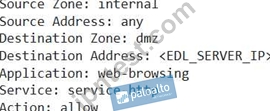
However, the EDL consistently fails to update, and logs show no attempts to reach the EDL server from the 'internal' zone. What is the most likely reason for this failure?
- A. The 'Application' should be 'paloalto-updates' instead of 'web-browsing'.
- B. The 'Source Zone' should be 'management' because EDL fetching is a management plane operation.
- C. A NAT policy is missing to allow the firewall to reach the DMZ.
- D. The firewall requires a security profile attached to this policy.
- E. The 'Service' should be 'application-default' to cover both HTTP and HTTPS.
正解:B
解説:
This is a common misconception. While data traffic flows through data plane interfaces, EDL fetching, like other updates (Antivirus, Threat, WildFire), is a management plane operation. Therefore, the source of the connection originates from the firewall's management plane, which is conceptually in the 'management' zone (or implicitly handled from it). The security policy needs to permit traffic from the management plane to the EDL server. If 'internal' is a data plane zone, the policy will never be hit for EDL updates. The application 'web-browsing' and service 'service-http' are generally correct for basic HTTP EDL fetching, though 'application-default' is safer. NAT is irrelevant for outbound connections initiated by the firewall. Security profiles are for inspecting traffic, not enabling it to flow.
質問 # 56
Which the app-ID application will you need to allow in your security policy to use facebook-chat?
- A. facebook-chat
- B. facebook-base
- C. facebook
- D. facebook-email
正解:A、B
質問 # 57
A sophisticated zero-day attack is suspected to be propagating laterally within your network. You need to quickly identify all active network connections, their associated applications, users, and any related threats, across your distributed environment. Then, you need to rapidly quarantine affected hosts and block the identified malicious application signature. Which set of tools and features provides the most efficient and comprehensive response?
- A. 1. Command Center: 'Network Activity' dashboard filtered for high session count. 2. Activity Insights: Review 'Top Applications' for anomalies. 3. Policy Optimizer: Create a new 'Deny' rule for the suspicious application.
- B. 1. Command Center: Focus on 'Application Usage' dashboard to detect new applications. 2. Manually configure a URL filtering profile to block suspicious websites. 3. Isolate the network segment.
- C. 1. Activity Insights: Generate 'User Activity' reports for suspicious logins. 2. Policy Optimizer: Recommend rules to block specific user activity. 3. Manually block user accounts.
- D. 1. Review firewall logs for 'deny' entries. 2. Use Wireshark on affected hosts for packet capture. 3. Manually update security policies on each firewall.
- E. 1. Command Center: 'Threat Activity' and 'Network Activity' dashboards for real-time anomalous traffic. 2. Use dynamic filters in Command Center to pinpoint source/destination IPs, users, and applications. 3. Implement External Dynamic Lists (EDLs) or a custom Anti-Spyware profile for rapid IPIURL blocking. 4. Create Security Policy rules to quarantine infected hosts (e.g., move to a quarantine zone or block all traffic).
正解:E
解説:
This scenario requires a rapid, comprehensive incident response. Command Center is paramount for real-time visibility into 'Threat Activity' and 'Network Activity' to quickly identify ongoing propagation, including applications and users. Its dynamic filtering capabilities are essential for pinpointing affected entities. For rapid blocking of indicators of compromise (IPs, URLs), EDLs or custom Anti-Spyware profiles are highly effective. Finally, creating Security Policy rules to quarantine or block traffic to/from infected hosts is the direct action needed to contain the lateral movement. Activity Insights is more for trend analysis, and Policy Optimizer is for policy refinement, not immediate incident response to a zero-day.
質問 # 58
View the diagram.
What is the most restrictive yet fully functional rule to allow general Internet and SSH traffic into both the DMZ and Untrust/lnternet zones from each of the lOT/Guest and Trust Zones?
- A.

- B.

- C.

- D.

正解:B
質問 # 59
A security analyst observes unusual outbound DNS queries for newly registered domains (NRDs) originating from several internal workstations, followed by attempts to establish C2 communication on non-standard ports. This behavior is indicative of a sophisticated malware infection. Which combination of Palo Alto Networks profiles and configurations, applied to outbound security policies, would be most effective in detecting and preventing this type of multi-stage attack?
- A. DNS Security Profile (Sinkhole unknown domains, enable DNS signatures), Anti-Spyware Profile (Enable DNS Sinkhole, signatures for C2), WildFire Analysis (all file types), and a Security Policy with application 'ping' and 'web-browsing' explicitly denied on outbound.
- B. Vulnerability Protection Profile (Critical severity, Block), Data Filtering Profile (Predefined PII), and QOS profile for suspicious traffic.
- C. Custom Application Signature for non-standard C2 ports, User-ID for affected users, and a Port-Based Security Policy blocking all non-standard ports.
- D. DNS Security Profile (Sinkhole & Block NRD category), Anti-Spyware Profile (DNS Signatures), and WildFire Analysis Profile for all unknown executables.
- E. URL Filtering Profile (Block 'newly-registered-domain' category), Antivirus Profile (Heuristics), and a custom 'File Blocking' profile for all executables.
正解:D
解説:
Option A directly addresses the described attack stages. 'DNS Security Profile' with 'Sinkhole' and 'Block NRD category' will detect and prevent resolution of newly registered malicious domains. The 'Anti-Spyware Profile' is crucial for detecting C2 traffic based on signatures, including DNS-based C2. 'WildFire Analysis Profile' is essential for identifying and blocking unknown malicious executables that might initiate this behavior. This combination offers a multi-layered defense against both the initial DNS stage and subsequent C2 attempts.
質問 # 60
A financial institution utilizes custom-built applications that transmit highly sensitive data over non-standard ports (e.g., TCP 10000, 10001 They need to apply the full suite of security profiles (Antivirus, Anti-Spyware, Vulnerability Protection, URL Filtering, File Blocking, Data Filtering) to this traffic. However, Palo Alto Networks' App-ID initially classifies this traffic as 'unknown-tcp'. What is the most appropriate and secure method to ensure these security profiles are applied correctly?
- A. Create an 'Application Override' rule for TCP ports 10000 and 10001 , setting the overridden application to 'web-browsing'. Then, apply the security profiles to the policy allowing 'web-browsing'.
- B. Create a 'Service' object for ports 10000 and 10001. In the Security Policy, use this service object, set the application to 'unknown-tcp', and apply the security profiles.
- C. Develop a 'Custom Application' signature for the internal applications based on their unique traffic characteristics (e.g., specific HTTP headers, protocol patterns, or SSL certificate details). Once recognized, use this custom application in the Security Policy and apply the desired security profiles.
- D. Apply the security profiles to the 'Default Security Policy' rule, as it catches all 'unknown-tcp' traffic by default.
- E. Configure a Security Policy rule for the specific source/destination/port, and set the application to 'any'. Apply the profile group to this rule.
正解:C
解説:
Option C is the most appropriate and secure. The core of Palo Alto Networks' Next-Generation Firewall capabilities is App-ID. For custom applications on non-standard ports, creating a 'Custom Application' signature (using known characteristics like HTTP headers if it's web- based, or specific byte patterns if it's a proprietary protocol) allows the firewall to correctly identify and classify the application. Once classified, the firewall can then apply the full suite of security profiles. Option A is incorrect because applying profiles to 'any' or 'unknown-tcp' without proper App- ID means the profiles won't function effectively as they rely on application context. Option B (Application Override) is a workaround but typically used when an application is misidentified, not for applying security profiles based on deep inspection of a truly custom application. Option E is flawed for the same reason as A 'unknown-tcp' doesn't provide the necessary context for effective profile application. Option D is a security risk as the default policy is generally a 'deny' rule and not intended for applying granular profiles to specific allowed traffic.
質問 # 61
Which three types of entries can be excluded from an external dynamic list (EDL)? (Choose three.)
- A. URLs
- B. User-ID
- C. Applications
- D. Domains
- E. IP addresses
正解:A、D、E
解説:
Three types of entries that can be excluded from an external dynamic list (EDL) are IP addresses, domains, and URLs. An EDL is a text file that is hosted on an external web server and contains a list of objects, such as IP addresses, URLs, domains, International Mobile Equipment Identities (IMEIs), or International Mobile Subscriber Identities (IMSIs) that the firewall can import and use in policy rules. You can exclude entries from an EDL to prevent the firewall from enforcing policy on those entries. For example, you can exclude benign domains that applications use for background traffic from Authentication policy1. To exclude entries from an EDL, you need to:
Select the EDL on the firewall and click Manual Exceptions.
Add the entries that you want to exclude in the Manual Exceptions list. The entries must match the type and format of the EDL. For example, if the EDL contains IP addresses, you can only exclude IP addresses.
Click OK to save the changes. The firewall will not enforce policy on the excluded entries.
質問 # 62
Where in the PAN-OS GUI can an administrator monitor the rule usage for a specified period of time?
- A. Objects > Schedules
- B. Policies > Policy Optimizer
- C. Monitor > Packet Capture
- D. Monitor > Reports
正解:B
解説:
The Policy Optimizer is a feature in the PAN-OS GUI that allows an administrator to monitor the rule usage for a specified period of time, as well as optimize the security policies based on the traffic logs and recommendations. The Policy Optimizer can help the administrator to improve the security posture, reduce the attack surface, and simplify the policy management. The Policy Optimizer can be accessed from Policies > Policy Optimizer in the PAN-OS GUI. Reference: Policy Optimizer, View Policy Rule Usage, Updated Certifications for PAN-OS 10.1
質問 # 63
A Palo Alto Networks firewall is configured with a complex data filtering policy to prevent PII exfiltration. A Data Pattern named 'SSN_Pattern' (using a pre-defined regex for Social Security Numbers) is configured with a 'Threshold' of 3 occurrences within a single session to trigger an alert, and an 'Action' of 'Alert'. This 'SSN_Pattern' is part of a Data Filtering Profile named 'PII_Monitoring', which is applied to an 'Allow' security policy rule for all outbound traffic from the 'Internal_Users' zone. During testing, a user from 'Internal_Users' attempts to upload a document containing two valid SSN patterns to an external cloud storage service via HTTPS. Simultaneously, another user from the 'Internal_Users' zone attempts to send an email with four valid SSN patterns through an external SMTP server. Assuming SSL decryption is correctly configured for both traffic flows and working as expected: Which of the following statements accurately describes the expected behavior of the firewall?
- A. Both the cloud storage upload and the email will be blocked due to PII detection.
- B. Both the cloud storage upload and the email will be allowed, and no alerts will be generated.
- C. The cloud storage upload will be allowed with an alert, and the email will be blocked.
- D. The cloud storage upload will be allowed with no alert, and the email will be allowed with an alert.
- E. The cloud storage upload will be blocked, and the email will be allowed with an alert.
正解:D
解説:
This question tests the understanding of Data Pattern thresholds, actions, and the 'per-session' context for Data Filtering. Key Configuration Details: Data Pattern: 'SSN_Pattern' Threshold: 3 occurrences within a single session . Action for 'SSN_Pattern': 'Alert'. This means even if the threshold is met, the traffic itself is allowed , but an alert is generated. Data Filtering Profile: 'PII_Monitoring' contains 'SSN_Pattern'. Security Policy: 'PII_Monitoring' is applied to an 'Allow' rule. Scenario Analysis: 1. Cloud Storage Upload (User 1): Number of SSN patterns: 2 Threshold for alert: 3 Result: Since 2 is less than the threshold of 3, the action (Alert) is not triggered. The traffic is allowed because the security policy is an 'Allow' rule. Outcome: Allowed, No Alert. 2. Email Send (User 2): Number of SSN patterns: 4 Threshold for alert: 3 Result: Since 4 meets or exceeds the threshold of 3, the action (Alert) is triggered. The traffic is still allowed because the action is 'Alert', not 'Block'. An alert log entry will be generated. Outcome: Allowed, With Alert. Combining these, the cloud storage upload is allowed with no alert, and the email is allowed with an alert. Therefore, Option C is the correct answer.
質問 # 64
......
Palo Alto Networks NetSec-Analyst 認定試験の出題範囲:
| トピック | 出題範囲 |
|---|---|
| トピック 1 |
|
| トピック 2 |
|
| トピック 3 |
|
| トピック 4 |
|
リアル問題集で100%無料NetSec-Analyst試験問題集を試そう:https://www.jpntest.com/shiken/NetSec-Analyst-mondaishu
実際のNetSec-Analyst問題集最新練習テスト問題集:https://drive.google.com/open?id=1mIp-I8WptOyApLhau6i1heRBztfqcDJk