

[2025年04月]更新のPECB ISO-9001-Lead-Auditor試験基本問題には解答が付きます
2025年最新の実際に出るPECB ISO-9001-Lead-Auditor試験問題集と解答
質問 # 21
Below are four of the seven principles on which ISO 9000 series are based. Match a potential benefit to each of the quality management principles (QMP).
正解:
解説:
Explanation:
A screenshot of a chat Description automatically generated
According to the ISO 9000:2015 document, the seven quality management principles are:
Customer focus
Leadership
Engagement of people
Process approach
Improvement
Evidence-based decision making
Relationship management
For each principle, the document provides a statement, a rationale, key benefits, and actions you can take to apply the principle in your organization.
Based on the document, here is a possible way to match a potential benefit to each of the four quality management principles you mentioned:
Table
Quality management principle
Potential benefit
Customer focus
Increased revenue and market share
Engagement of people
Enhanced trust and collaboration throughout the organization
Improvement
Enhanced drive for innovation
Evidence-based decision making
Increased ability to demonstrate effectiveness of past actions
質問 # 22
In the context of a management system audit, identify the sequence of a typical process for collecting and verifying information. The first one has been done for you.
To complete the sequence click on the blank section you want to complete so it is highlighted in red and then click on the applicable text from the options below. Alternatively, drag and drop the options to the appropriate blank section.
正解:
解説:
Explanation:
Identifying the source of information
Sampling available data
Gathering audit evidence
Verifying objective evidence
Evaluating evidence against the audit criteria
Making audit conclusions
Evaluating against the audit criteria
According to ISO 19011:2018, clause 6.4, the process of collecting and verifying information during an audit involves the following steps1:
Identifying the source of information: The audit team should identify the sources of information that are relevant to the audit objectives, scope and criteria. These sources may include documents, records, personnel, processes, activities, facilities, equipment, etc. The audit team should also determine the methods and tools for accessing and collecting the information, such as interviews, observations, document review, sampling, etc.
Sampling available data: The audit team should select a representative sample of the available data to verify the conformity and effectiveness of the management system. The sample size and selection method should be based on the audit objectives, scope and criteria, as well as the level of confidence and risk. The audit team should also consider the validity, reliability, relevance and sufficiency of the data.
Gathering audit evidence: The audit team should use the methods and tools identified in the previous step to collect audit evidence, which is the records, statements of fact or other information that are relevant to the audit criteria and verifiable. The audit team should record the audit evidence in a clear, concise and objective manner, using notes, checklists, photographs, audio or video recordings, etc.
Verifying objective evidence: The audit team should verify the accuracy, completeness and authenticity of the audit evidence collected. This may involve cross-checking different sources of information, confirming the identity and authority of the persons providing the information, examining the original documents or records, etc. The audit team should also identify any discrepancies, inconsistencies or gaps in the audit evidence.
Evaluating evidence against the audit criteria: The audit team should compare the audit evidence with the audit criteria to determine the extent of conformity and nonconformity. The audit team should also identify any opportunities for improvement, best practices, positive aspects or potential risks. The audit team should use professional judgement and apply the principles of auditing when evaluating the audit evidence.
Making audit conclusions: The audit team should consolidate the audit findings and evaluate the overall performance and effectiveness of the management system. The audit team should also consider the audit objectives, scope and criteria, as well as the context and expectations of the auditee and other interested parties. The audit team should provide a clear, concise and objective statement of the audit conclusions, which may include the degree of conformity, the achievement of the intended outcomes, the need for corrective actions, the suitability for certification, etc.
Evaluating against the audit criteria: The audit team should review the audit conclusions and ensure that they are consistent with the audit criteria and supported by sufficient and appropriate audit evidence. The audit team should also ensure that the audit conclusions are communicated to the auditee and other relevant parties in a timely and effective manner, using the agreed audit report format and distribution method.
References: ISO 19011:2018(en), Guidelines for auditing management systems
質問 # 23
Select the words that best complete the sentence:
正解:
解説:
Explanation:
According to the ISO 19011:2018 document, the audit plan should provide the basis for agreement regarding the conduct and scheduling of the audit activities. The amount of detail provided in the audit plan should reflect the scope and complexity of the audit, as well as the risk of not achieving the audit objectives1. The scope of the audit refers to the extent and boundaries of the audit, such as the audit criteria, the audit objectives, the organizational and functional units, and the processes to be audited1. The complexity of the audit refers to the degree of difficulty or intricacy of the audit, such as the number and diversity of the auditees, the audit criteria, the audit methods, and the audit team composition2. The risk of not achieving the audit objectives refers to the possibility that the audit may fail to provide reliable and sufficient audit evidence to support the audit conclusions and report1.
Therefore, the complete sentence is:
In the context of a third-party audit, the amount of detail provided in the audit plan should reflect the scope and complexity of the audit, as well as the risk of not achieving the audit objectives.
References: 1: ISO 19011:2018 - Guidelines for auditing management systems 2: Audit Complexity - an overview | ScienceDirect Topics
質問 # 24
An audit team leader arrives at a printing organisation to carry out a Stage 2 audit for a certification body. At a meeting with the Quality Manager, she is told that they have won their biggest contract from a computer manufacturer to print and compile computer documentation packages. They have leased the unit next door for space reasons but have never worked in this sector before. The Quality Manager wants the ISO 9001 certificate to cover the new contract.
During the audit, a team member finds that a number of print jobs have been rejected by several clients over a number of months due to spelling errors in the print run. The Print Manager blames the new employees they had to take on because of a big contract. The auditor raises a nonconformance against clause 10.2.1.b of ISO
9001.
Which one of the evidence statements would support this finding?
- A. The actions taken to deal with customer complaints did not prevent recurrence of the problem.
- B. There was no evidence that a check of spelling took place before the release of printing to the client.
- C. The organisation did not provide the correct resources to prevent nonconformity.
- D. There was no record that the organisation evaluated the effectiveness of the training given to new employees.
正解:A
解説:
According to clause 10.2.1.b of ISO 9001:2015, the organization should evaluate the need for action to eliminate the causes of nonconformities, in order to prevent their recurrence. This means that the organization should identify and address the root causes and contributing factors of the nonconformities, and implement appropriate corrective actions that are effective and proportional to the impact of the nonconformities. In this case, the evidence statement that supports the finding of nonconformance is C, because it shows that the organization did not take effective actions to prevent the recurrence of the spelling errors in the print run, which resulted in repeated customer rejections and dissatisfaction. The other options are not directly related to clause 10.2.1.b, although they may indicate other nonconformities or weaknesses in the organization's QMS.
For example, option A may relate to clause 7.2 on competence, option B may relate to clause 8.6 on release of products and services, and option D may relate to clause 7.1 on resources. References: ISO 9001:2015, [ISO
9001 Auditing Practices Group Guidance on Nonconformity and Corrective Action], ISO 9001 Clause 10.
Improvement - ISO-templates.com
質問 # 25
An audit team of three people is conducting a Stage 2 audit to ISO 9001 of an engineering organisation that manufactures sacrificial anodes for the oll and gas industry in marine environments. These are aluminium products designed to prevent corrosion of submerged steel structures. You, as one of the auditors, find that the organisation has shipped anodes for Project DK in the Gulf of Mexico before the galvanic efficiency test results for the anodes have been fully analysed and reported as required by the customer. The Quality Manager explains that the Managing Director authorised release of the anodes to avoid late delivery as penalties would be imposed. The customer was not informed since the tests very rarely fall below the required efficiency. You raise a nonconformity against clause 8.6 of ISO 9001.
Which of the following options for the best description of the nonconformity?
- A. The untested product was not recalled until the galvanic efficiency of the anodes was verified.
- B. Products for Project DK have been released before product approval through the quality control process.
- C. Release of the product without acceptable test results has been accepted by the customer for Project DK.
- D. A retrospective concession was not sought from the customer once the test results had been approved by the Quality Manager.
正解:B
解説:
Clause Reference - ISO 9001:2015 Clause 8.6 (Release of Products and Services):ISO 9001 requires that products and services are not released to the customer until:
* All planned verification activities have been completed.
* Acceptance criteria have been met.
* Any necessary approvals have been obtained.
In this scenario:
* The sacrificial anodes for Project DK were shipped before the galvanic efficiency test results were analyzed.
* This constitutes a nonconformity against Clause 8.6 because the products were released without completing the required tests.
Option Analysis:
* A. A retrospective concession was not sought from the customer once the test results had been approved by the Quality Manager:Incorrect. While obtaining a concession might mitigate the situation, the nonconformity pertains to the process failure of releasing the products without completing required tests, not the absence of a concession.
* B. Release of the product without acceptable test results has been accepted by the customer for Project DK:Incorrect. The customer was not informed before the release, and there is no indication that this was accepted beforehand. Furthermore, ISO 9001 requires planned processes to be followed, regardless of later acceptance.
* C. Products for Project DK have been released before product approval through the quality control process:Correct. This description accurately reflects the nonconformity. The quality control process required test results to be analyzed and verified before release, which did not happen.
* D. The untested product was not recalled until the galvanic efficiency of the anodes was verified:
Incorrect. The issue is not about recalling the product but about releasing it without completing the required tests. Recalling the product is not mentioned in the scenario.
Why C is Correct:
* The nonconformity is a clear breach of Clause 8.6, where the products were released without meeting the planned verification requirements.
* This demonstrates a failure in adhering to quality control processes, which is a critical aspect of ISO
9001 compliance.
Key ISO 9001 Reference:
* Clause 8.6: Products and services shall not be released to the customer until all planned activities (e.g., testing) have been satisfactorily completed, or the customer has approved the release with knowledge of deviations.
質問 # 26
You are carrying out an annual audit at an organisation that offers home security services. You are interviewing the Quality Manager (QM) You: "Would you tell me about your management review process?" QM: "The senior management team plans to review the management system every six months. The review follows a set agenda and records are maintained." You: "May I see the records from the last two management reviews?" Narrative: The Quality Manager gives you the latest record, which shows the last management review took place nine months ago.
The Quality Manager then gives you the previous management review record, which took place one year before the latest review.
You: "Are there any other review reports in the last two years?
QM: "No, these are the only ones."
正解:
解説:
Explanation:
Nonconformity report
ISO 9001 Clause Number: 9.3.1 Nature of problem: Management review has not been conducted at the defined frequency. ISO 9001 requirement that has not been fulfilled: ISO 9001 - "Top management shall review the organization's quality management system at planned intervals." Evidence: The last management review took place nine months ago, and the previous one took place one year before the latest review. The planned interval is six months.
質問 # 27
Which one of the following is not an ISO 9000:2015 quality management principle?
- A. Leadership
- B. Process approach
- C. Evidence-based decision-making
- D. Risk-based approach
正解:D
解説:
According to the ISO 9000:2015 quality management principles document1, risk-based approach is not one of the seven quality management principles that ISO 9000, ISO 9001 and other related quality management standards are based on. The seven quality management principles are:
* Customer focus
* Leadership
* Engagement of people
* Process approach
* Improvement
* Evidence-based decision making
* Relationship management
Therefore, risk-based approach is not a quality management principle under ISO 9001:2015.
References: ISO - Quality management principles
質問 # 28
An organisation wants to certify their ISO 9001:2015-based QMS for the first time. Arrange the activities in the correct sequence from 2 to 5.
To complete the sequence, click on the blank section you want to complete so it is highlighted in red and then click on the applicable text from the options below. Alternatively, drag and drop the options to the appropriate blank section.
正解:
解説:
Explanation:
To certify an organization's ISO 9001:2015-based Quality Management System (QMS) for the first time, the correct sequence of activities would be:
* Establish the management system (already in place).
* Supplier audit
* Internal audit
* Management review
* Initial certification audit - stage 1
* Initial certification audit - stage 2 (already in place).
This sequence follows the typical path for preparing and ensuring that a QMS is functioning as required, leading up to certification.
質問 # 29
Match the process descriptions below to the process names:
正解:
解説:
Explanation:
Match the process descriptions below to the process names:
The process by which the accuracy of test equipment is checked against a known standard. = Calibration The process by which a product or service is visually examined to determine conformity to requirements. = Evaluation The process by which data is examined in detail to reach a specific answer or answers. = Analysis The process by which a parameter of a product or service is examined to determine a specific value. = Measurement According to the ISO 9000:2015 - Quality management systems - Fundamentals and vocabulary, the definitions of the process names are as follows:
Calibration: operation that, under specified conditions, in a first step, establishes a relation between the quantity values with measurement uncertainties provided by measurement standards and corresponding indications with associated measurement uncertainties and, in a second step, uses this information to establish a relation for obtaining a measurement result from an indication.
Evaluation: determination of the suitability, adequacy or effectiveness of an object to achieve established objectives.
Analysis: detailed examination of the elements or structure of something.
Measurement: process to experimentally obtain one or more quantity values that can reasonably be attributed to a quantity.
Therefore, the process descriptions can be matched to the process names based on these definitions.
References:
ISO 9000:2015 - Quality management systems - Fundamentals and vocabulary
質問 # 30
XYZ Corporation is an organisation that employs 100 people. As audit team leader, you are conducting a certification audit at Stage 1. When reviewing the quality management system (QMS) documentation, you find that quality objectives have been set for every employee in the organisation except top management.
The Quality Manager complains that this has created a lot of resistance to the QMS, and the Chief Executive is asking questions about how much it will cost. He asks for your opinion on whether this is the correct method of setting objectives.
Three months after Stage 1, you return to XYZ Corporation to conduct a Stage 2 certification audit as Audit Team Leader with one other auditor. You find that the Quality Manager has cancelled the previous quality objectives for all employees and replaced them with a single objective for himself. This states that "The Quality Manager will drive multiple improvements in the QMS in the next year". The Quality Manager indicates that this gives him the authority to issue instructions to department managers when quality improvement is needed. He says that this approach has the full backing of senior management. He shows you the latest Quality Improvement Request that was included in the last management review.
After further auditing, the issues below were found. Select three statements that apply to the term 'audit trail'
- A. Decisions on improvement action timescales not involving departmental managers.
- B. Limited knowledge of the content of Quality Improvement Requests by departmental staff.
- C. Quality improvements not aligning with the quality policy.
- D. Evaluation of the results of the improvement action not always documented by the Quality Manager.
- E. The single quality objective set for the organisation by the Quality Manager.
- F. Top management claim not to be aware of the improvement request (QI/12/20/HR-3) initiated by the Quality Manager.
正解:A、B、D
解説:
Based on the scenario and the concept of an 'audit trail' within the context of ISO 9001, the three statements that apply would likely be:
A: Decisions on improvement action timescales not involving departmental managers. This indicates a lack of involvement and communication with those responsible for implementing the improvements, which is a key part of an effective audit trail1.
B: Evaluation of the results of the improvement action not always documented by the Quality Manager.
Proper documentation is essential for an audit trail, as it provides evidence that actions have been evaluated and are effective1.
C: Limited knowledge of the content of Quality Improvement Requests by departmental staff. An audit trail should ensure that all relevant parties are aware of and understand the actions being taken, which is not the case here1.
These points suggest issues with the communication, documentation, and involvement of relevant personnel in the quality management system processes, which are crucial for maintaining an effective audit trail and, by extension, a robust quality management system.
質問 # 31
Select the word that best completes the sentence:
正解:
解説:
Explanation:
According to the ISO - Management system standards page, the key benefits of an effective management system include improved operational effectiveness and efficiency, improved risk management and protection of people and the environment, and enhanced drive for innovation. The Integrated Use of Management System Standards (IUMSS) handbook also states that the purpose and objectives of management system standards are to help organizations improve their performance by specifying repeatable steps that organizations consciously implement to achieve their goals and objectives.
Therefore, the complete sentence is:
"The purpose of a management system standard is to improve the performance of an organisation."
質問 # 32
Noitol is an organisation specialising in the design and production of e-learning training materials for the insurance market. During an ISO 9001 audit of the development department, the auditor asks the Head of Development about the process used for validation of the final course design. She states that they usually ask customers to validate the product with volunteers. She says that the feedback received often leads to key improvements.
The auditor samples the design records for a recently completed course for the 247 Insurance organisation.
Design verification was carried out but there was no validation report. The Head of Development advises that this customer required the product on an urgent basis, so the validation stage was omitted. When asked, the Head estimates that this occurs about 50% of the time. She confirms that they always ask for feedback and often make changes. There is no record of feedback in the design file for the course.
The auditor decides to review the training course design process in more depth.
Select three options that provide a meaningful audit trail for this process.
- A. How is the cost of the course calculated?
- B. How is customer feedback integrated into the course?
- C. What are the qualifications of the administrative staff?
- D. How are students advised about prior learning requirements?
- E. How is technical content of courses verified as correct?
- F. What risks and opportunities have been notified to interested parties?
- G. How is the tutor trained to deliver the completed course?
- H. How is design documentation controlled and managed?
正解:B、E、H
解説:
According to clause 8.3 of ISO 9001:2015, the organization should establish, implement, and maintain a design and development process that is appropriate to ensure the subsequent provision of products and services. The design and development process should include the following activities:
*Determining the requirements for the products and services to be designed and developed, considering the intended use, the statutory and regulatory requirements, the customer and other relevant interested parties' needs and expectations, and the potential risks and opportunities.
*Defining the design and development objectives, stages, responsibilities, and authorities, and ensuring the availability of adequate resources and competence.
*Implementing design and development controls, such as reviews, verification, and validation, to ensure that the design and development outputs meet the design and development inputs, and to identify and resolve any problems or errors.
*Maintaining documented information on the design and development inputs, outputs, reviews, verification, validation, and changes, and ensuring the traceability and conformity of the products and services to the requirements.
*Managing the design and development changes, by identifying, reviewing, and controlling them, and evaluating their effects on the products and services and the QMS.
In this case, the evidence statements that provide a meaningful audit trail for the design and development process are B, E, and F, because they relate to the design and development controls, the documented information, and the verification activities that are required by the standard. These options can help the auditor to assess the effectiveness and conformity of the design and development process, and to identify any nonconformities or opportunities for improvement. The other options are not directly related to clause 8.3, although they may be relevant for other aspects of the QMS, such as clause 7.2 on competence, clause 7.3 on awareness, clause 7.4 on communication, clause 8.2 on requirements for products and services, clause 8.4 on externally provided processes, products, and services, and clause 8.7 on control of nonconforming outputs.
References: ISO 9001:2015, ISO 9001 Auditing Practices Group Guidance on Design and Development, ISO
9001 Clause 8.3 Design and development of products and services
質問 # 33
The Closing meeting of a second-party audit was planned for 6 pm with the general manager and the quality manager.
At 6 pm, when the audit team enters the meeting room, only the Quality Manager is present and walting for them.
The dialogue among them is as follows:
Auditor team leader: "Good evening, could you please inform the general manager that we are ready to start with the closing meeting?" Quality manager: "Good evening. I am sorry to inform you that the general manager will not be able to attend the meeting. He will try to participate virtually to make some closing remarks." Auditor team leader: "OK. We identified seven nonconformities - these are the reports. Could you please review them and sign them?" Quality manager: "OK. As you know, I reviewed them after yesterday's meeting and accept of all them, where shall I sign?" General manager (from speakers in the room and addressing the quality manager): "Hold on! Do not sign the two nonconformities related to ABC Bank! I have just checked, and we did not provide any services to ABC Bank during September! You can sign the remaining five nonconformities." How would you proceed with the audit? Select one.
- A. I will discuss this issue with our corporate quality manager and will let you know what we will do
- B. I withdraw the two nonconformities related to service to ABC and will present the report with the remaining five nonconformities
- C. I will include the seven nonconformities in the report, considering that we identified objective evidence on which all these nonconformities are based
- D. I will review this issue at length with the audit team tonight and will phone you tomorrow to let you know our decision
正解:D
質問 # 34
You are the supervisor in Production of a medium size manufacturing organisation. You are qualified as an internal auditor. The Quality Manager asks you to lead the next internal audit of Production and Logistics Dispatch. The audit team includes two other internal auditors.
正解:
解説:
Explanation:
Here is the correct matching of actions to the statements in the context of leading the internal audit:
* If practicablecarry out a formal opening meeting
* You should notaudit production (as you are a supervisor in that area, and this would compromise audit objectivity)
* You need notchange the audit team (unless there is a specific reason, such as conflict of interest)
* You mustraise audit findings if necessary (this is a key responsibility of an auditor when nonconformities are found)
* You must notsend the audit report to the Quality Manager (the audit report must be reviewed first; it is typically part of the internal audit process to go through necessary channels before final submission)
* You shouldsend the audit report to the Quality Manager (after appropriate reviews and approvals) This reflects key principles of conducting an internal audit according to ISO 9001:2015, ensuring objectivity, proper documentation, and clear reporting procedures.
質問 # 35
Select one of the options that best describes the purpose of conducting a document review:
- A. To determine the conformity of the system, as far as documented, with audit criteria and to gather information to support the audit activities.
- B. To confirm the conformity of the system, where documented, with audit criteria and to gather information to support the audit findings.
- C. To reveal whether the documented system is nonconforming with audit criteria and to gather evidence to support the audit report.
- D. To establish nonconformity in the documented system with audit criteria and to gather information to compile the audit report.
- E. To detect any nonconformity of the system, if documented, with audit criteria and to identify information to support the audit plan.
- F. To decide about the conformity of the documented system with audit standards and to gather findings to support the audit process.
正解:A
解説:
The purpose of conducting a document review is to determine the conformity of the system, as far as documented, with audit criteria and to gather information to support the audit activities. A document review is a systematic and objective examination of the documented information that is relevant to the audit objectives and scope. It can help the auditor to verify if the documented information is complete, accurate, consistent, and up-to-date. It can also help the auditor to identify any gaps, errors, or nonconformities in the documented information that may affect the audit findings or conclusions.
The other options are not correct because they do not reflect the true purpose of a document review. Option A describes the purpose of an audit report, which is to communicate the audit results and recommendations to the management and other interested parties. Option B describes the purpose of an audit plan, which is to define the scope, objectives, criteria, methods, resources, and schedule of an audit. Option C describes the purpose of an audit evidence report, which is to provide evidence of nonconformities or opportunities for improvement identified during an audit. Option D describes the purpose of an audit decision report, which is to justify or explain why certain decisions were made during an audit.
I hope this answer helps you understand why option F is correct and why options A-C-D are incorrect. If you want to learn more about ISO 9001 Lead Auditor exam questions and answers, you can check out some of these resources:
ISO 9001 Lead Auditor Sample Exam Questions and Answers: This article provides some sample questions and answers for each section of the ISO 9001 Lead Auditor exam.
ISO 9001 (QMS) Lead Auditor Quiz Questions and Answers: This article provides some quiz questions and answers on various topics related to ISO 9001 QMS.
ISO 9001 Lead Auditor - Exam Practice Tests: This course offers practice tests with explanations for each question.
Irca Lead Auditor Exam Questions And Answers Pdf: This document contains some exam questions and answers in PDF format.
質問 # 36
Which two of the following are included in the objectives of the 'Stage 1 initial certification audit'?
- A. To evaluate the operational processes of the organisation.
- B. To make a decision on certification to ISO 9001:2015.
- C. To evaluate the performance of monitoring and reviewing activities.
- D. To review the quality manual.
- E. To evaluate the preparedness of the organisation for a Stage 2 audit.
- F. To evaluate the internal audit and management review processes.
正解:D、E
解説:
*To evaluate the preparedness of the organisation for a Stage 2 audit: This objective involves assessing the readiness of the organisation to undergo the Stage 2 audit, where the conformity and effectiveness of the quality management system will be verified123. The audit team will check the level of implementation and understanding of the quality management system, identify any major gaps or nonconformities, and confirm the audit scope, criteria, and plan123.
*To review the quality manual: This objective involves reviewing the documented information of the quality management system, such as the quality policy, the quality objectives, the scope, the processes, and the procedures, to ensure that they meet the requirements of ISO 9001:2015123. The audit team will also evaluate the organisation's understanding and application of the standard, and identify any areas of improvement or concern123.
The other options are not included in the objectives of the Stage 1 initial certification audit, according to the web search results from my internal tool. They may be related to other stages or types of audits, but they are not the focus of the Stage 1 audit.
Therefore, the correct answer is B and D.
References: 1: ISO 9001 Certification Audits | Stage 1 and Stage 2 - 9001. Simplified 2: Stage 1 of your Audit
| NQA Blog 3: Getting Certified to ISO 9001 - the Stage 1 Audit
質問 # 37
Which two of the following aspects of a quality management system must the organisation continually improve?
- A. Responsiveness
- B. Applicability
- C. Efficiency
- D. Adaptability
- E. Suitability
- F. Effectiveness
正解:C、F
解説:
According to the ISO 9001:2015 document, the organisation must continually improve the suitability, adequacy, and effectiveness of the quality management system1. However, among the six options given, only effectiveness is directly mentioned as an aspect of the quality management system that must be continually improved. Therefore, C is one of the correct answers.
Efficiency, on the other hand, is not explicitly stated as an aspect of the quality management system that must be continually improved, but it is implied by the quality management principle of improvement, which states that successful organisations have an ongoing focus on improvement2. One of the key benefits of applying this principle is improving operational effectiveness and efficiency2. Therefore, E is another correct answer.
Suitability, adaptability, responsiveness, and applicability are not aspects of the quality management system that must be continually improved, according to the ISO 9001:2015 document. They may be related to the quality management system, but they are not the focus of continual improvement.
Therefore, the correct answer is C and E.
References: 1: ISO 9001:2015 - Quality management systems - Requirements 2: ISO - Quality management principles
質問 # 38
Match the process descriptions below to the process names:
正解:
解説:
Explanation:
Match the process descriptions below to the process names:
The process by which the accuracy of test equipment is checked against a known standard. = Calibration The process by which a product or service is visually examined to determine conformity to requirements. = Evaluation The process by which data is examined in detail to reach a specific answer or answers. = Analysis The process by which a parameter of a product or service is examined to determine a specific value. = Measurement According to the ISO 9000:2015 - Quality management systems - Fundamentals and vocabulary, the definitions of the process names are as follows:
Calibration: operation that, under specified conditions, in a first step, establishes a relation between the quantity values with measurement uncertainties provided by measurement standards and corresponding indications with associated measurement uncertainties and, in a second step, uses this information to establish a relation for obtaining a measurement result from an indication.
Evaluation: determination of the suitability, adequacy or effectiveness of an object to achieve established objectives.
Analysis: detailed examination of the elements or structure of something.
Measurement: process to experimentally obtain one or more quantity values that can reasonably be attributed to a quantity.
Therefore, the process descriptions can be matched to the process names based on these definitions.
References:
ISO 9000:2015 - Quality management systems - Fundamentals and vocabulary
質問 # 39
XYZ Corporation employs 100 people, and during a Stage 1 certification audit, certain issues are identified with the Quality Management System (QMS). Which two options describe the circumstances in which you could raise a nonconformity against Clause 6.2 of ISO 9001:2015?
- A. The organisation cannot afford to undertake quality objectives all at once.
- B. Quality objectives are not being implemented by the organisation's personnel.
- C. Quality objectives were not established in alignment with the organisation's quality policy.
- D. Establishing quality objectives did not include top management.
- E. The consultant has not interpreted ISO 9001 correctly.
- F. Quality objectives are not maintained as documented information.
正解:C、F
解説:
* Understanding Clause 6.2 of ISO 9001:2015:Clause 6.2 (Quality Objectives and Planning to Achieve Them) specifies that organizations must:
* Establish measurable and relevant quality objectives consistent with the quality policy (Clause
6.2.1).
* Include objectives applicable to product/service conformity and customer satisfaction.
* Document these objectives and their planning as documented information (Clause 6.2.1 &
6.2.2).
* Plan how to achieve the objectives, including defining actions, resources, responsibilities, timelines, and methods for evaluation.
* Analysis of Options:
* A. Quality objectives are not being implemented by the organisation's personnel:Incorrect.
While implementation is critical, this relates more to operational aspects rather than the direct requirements of Clause 6.2. Implementation issues would typically raise concerns under Clause
9.1 (Performance Evaluation).
* B. The consultant has not interpreted ISO 9001 correctly:Incorrect. The consultant's interpretation of ISO 9001 is irrelevant in terms of Clause 6.2 compliance. The focus is on whether the organization aligns with the requirements, not the consultant's role.
* C. Establishing quality objectives did not include top management:Incorrect. While top management involvement is vital for QMS effectiveness (Clause 5.1), this is not a direct requirement of Clause 6.2. Top management alignment is implied but not explicitly mandated for establishing quality objectives.
* D. Quality objectives were not established in alignment with the organisation's quality policy:Correct. Clause 6.2.1 requires that quality objectives be consistent with the organization's quality policy, ensuring they reflect its purpose, strategic direction, and commitment to continual improvement. Misalignment would constitute a nonconformity.
* E. The organisation cannot afford to undertake quality objectives all at once:Incorrect.
Financial constraints are not directly addressed in Clause 6.2. The clause focuses on planning to achieve objectives, which includes defining the necessary resources but does not demand achieving all objectives simultaneously.
* F. Quality objectives are not maintained as documented information:Correct. Clause 6.2.1 specifically requires that quality objectives be maintained as documented information. Failure to document the objectives is a direct violation of this clause.
* Why Options D and F Are Correct:
* D: Misalignment between the quality objectives and the quality policy directly violates Clause
6.2.1, which mandates that objectives support the strategic direction of the organization.
* F: Lack of documentation for quality objectives breaches the requirement to maintain them as documented information under Clause 6.2.1.
* Relevant References:
* Clause 6.2.1: Establishing quality objectives aligned with the quality policy.
* Clause 6.2.2: Maintaining documented information for quality objectives and planning to achieve them.
* Clause 5.1.1: Top management's responsibility to ensure alignment between the QMS and strategic direction.
質問 # 40
In the context of a third-party audit, match the event with the responsibility for conducting it.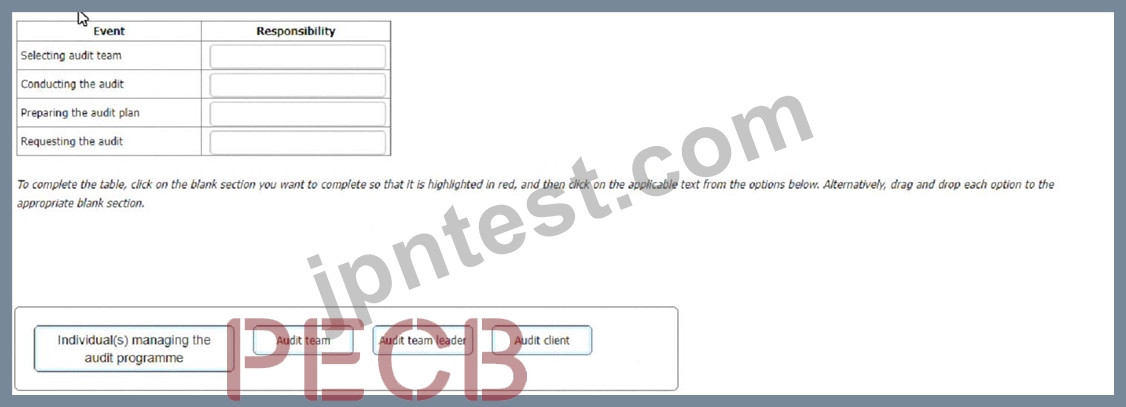
正解:
解説:
Explanation:
The correct answer is:
Event
Selecting audit team = Individual(s) managing the audit programme
Conducting the audit = Audit team
Preparing the audit plan = Audit team leader
Requesting the audit = Audit client
To complete the table, click on the blank section you want to complete so that it is highlighted in red, and then click on the applicable text from the options below. Alternatively, drag and drop each option to the appropriate blank section. Responsibility:- Individual(s) managing the audit programme Audit team Audit team leader Audit client According to ISO 19011:2018, clause 5.3, the individual(s) managing the audit programme are responsible for selecting the audit team, taking into account the competence and availability of the auditors and any experts needed. 1 According to clause 6.2, the audit team is responsible for conducting the audit, which includes collecting and verifying audit evidence, evaluating audit findings, and preparing the audit report. 1 According to clause 6.1, the audit team leader is responsible for preparing the audit plan, which includes defining the audit objectives, scope, criteria, and duration, as well as assigning roles and responsibilities to the audit team members. 1 According to clause 5.2, the audit client is the person or organization that requests the audit, which can be the auditee (the person or organization being audited) or any other person or organization that has an interest in the audit results. 1 References:
* 1: ISO 19011:2018 - Guidelines for auditing management systems
質問 # 41
Match the process descriptions below to the process names:
正解:
解説:
Explanation:
Match the process descriptions below to the process names:
The process by which the accuracy of test equipment is checked against a known standard. = Calibration The process by which a product or service is visually examined to determine conformity to requirements. = Evaluation The process by which data is examined in detail to reach a specific answer or answers. = Analysis The process by which a parameter of a product or service is examined to determine a specific value. = Measurement According to the ISO 9000:2015 - Quality management systems - Fundamentals and vocabulary, the definitions of the process names are as follows:
Calibration: operation that, under specified conditions, in a first step, establishes a relation between the quantity values with measurement uncertainties provided by measurement standards and corresponding indications with associated measurement uncertainties and, in a second step, uses this information to establish a relation for obtaining a measurement result from an indication.
Evaluation: determination of the suitability, adequacy or effectiveness of an object to achieve established objectives.
Analysis: detailed examination of the elements or structure of something.
Measurement: process to experimentally obtain one or more quantity values that can reasonably be attributed to a quantity.
Therefore, the process descriptions can be matched to the process names based on these definitions.
References:
ISO 9000:2015 - Quality management systems - Fundamentals and vocabulary
質問 # 42
ABC is a fast food shop that receives orders by phone or the internet. The normal menu includes 15 different types of hamburgers; however, in the last two days, due to a shortage of a special type of meat, they can only prepare six of the 15 varieties.
You are performing a third-party audit of ABC; you observed that the menu offering food on the website is still the normal one, with 15 different hamburgers. During a 30-minute period, you observed several customers reluctantly accepting other than the hamburger they preferred. You decided to raise the following nonconformity as follows:
"There is evidence that ABC has not reviewed the ability to provide customers the offered products".
The restaurant manager does not accept the nonconformity. She says that ABC had an extensive training programme for all personnel, which you have already seen when auditing Human Resources. This shortage of some hamburgers cannot be considered a management system failure.
Which one would be your answer from the following options?
- A. I will raise it as a minor nonconformity; you have the option to appeal to our Certification Body.
- B. You are right, it is not a system failure. I will change the nonconformity to a recommendation, but it will be audited carefully next time.
- C. I will raise it as a major nonconformity and, therefore, cannot recommend certification of the quality management system.
- D. I will maintain it open, and I will see what the Certification Body thinks about it.
正解:A
解説:
The appropriate response in this situation would be:
C: I will raise it as a minor nonconformity; you have the option to appeal to our Certification Body.
This response acknowledges the restaurant manager's point that the shortage of some hamburgers may not constitute a management system failure. However, the fact remains that the menu was not updated to reflect the current availability of products, which led to customer dissatisfaction. This is a deviation from the ISO
9001 standard, which requires that the organization ensures the availability of resources needed to provide products and services as promised1. Raising it as a minor nonconformity allows the organization to address the issue within a specified timeframe and provides an opportunity for appeal if the organization disagrees with the auditor's decision2.
質問 # 43
You are carrying out an audit at a single-site organisation seeking certification to ISO 9001 for the first time.
The organisation offers warehousing and export services to customers. Customers are invoiced for the time stock items are stored in the warehouse. Transport to and from the warehouse is controlled by the organisation and approved subcontract transport services are used. The organization does not have its own transport vehicles. Stock items are not purchased by the organisation.
You have gathered audit evidence as outlined in the table. Match the ISO 9001 Clause 8 extract to the audit evidence.
正解:
解説:
Explanation:
The table below shows the possible matching of the ISO 9001 Clause 8 extract to the audit evidence.
Table
Audit evidence
ISO 9001 Clause 8 extract
Four of the 10 pallets of stock sampled in the warehouse were not labelled.
"8.5.2 ... shall use suitable means to identify outputs ..."
A damaged pallet of stock seen in the quarantine area was leaking liquid onto the floor.
"8.7.1 ... shall ensure that outputs that do not conform to their requirements are identified and controlled ..." One of the fork-lift truck drivers had no fork-lift truck driving licence.
"8.5.1 e ... shall include, as applicable ... the appointment of competent persons ..." There was no pest control provision in the warehouse.
"8.5.4 ... shall preserve the outputs during production and service provision ..." Two pallets of temperature-sensitive stock items were being stored at ambient as the chilled storage facility was full.
"8.1 ... shall plan, implement and control the processes ..."
質問 # 44
In the context of a third-party certification audit, match the roles with the following responsibilities:
正解:
解説:
Explanation:
In the context of a third-party certification audit, match the roles with the following responsibilities:
Responsibilities:
Conduct the audit to the assigned area.= Auditors
Assist the auditors in identifying personnel to participate in the audit.= Guide Assign each team member's responsibility for the audit.= Audit team leader Respond to questions and provide evidence to the auditor.= Auditee According to ISO 19011:2018, clause 3, the definitions of the roles are as follows1:
Auditors: persons with the competence to conduct an audit
Guide: person appointed by the auditee to assist the audit team
Auditee: organization being audited
Audit team leader: member of an audit team appointed to manage the audit or an audit team Therefore, the roles can be matched to the responsibilities based on these definitions and the description of the audit process in clause 6 of the standard1.
References: ISO 19011:2018(en), Guidelines for auditing management systems
質問 # 45
Which two of the following statements related to Stage 1 of an initial certification audit against ISO 9001:
2015 are true?
- A. Reviews the client's management system documented information
- B. Verifies the compliance with legal requirements
- C. Evaluates the conditions of all sites
- D. Reviews the processes with high level of risk
- E. During the Stage 1 audit, the audit team:
- F. Evaluates the results of the last management review
- G. Verifies the degrees of customer satisfaction
正解:A、D
解説:
* Reviews the client's management system documented information: This activity involves checking the documentation of the quality management system, such as the quality policy, the quality objectives, the scope, the processes, and the procedures, to ensure that they meet the requirements of ISO 9001:2015123. The audit team also evaluates the client's understanding and implementation of the standard, and identifies any gaps or nonconformities that need to be addressed before the Stage 2 audit123.
*Reviews the processes with high level of risk: This activity involves assessing the processes that have a significant impact on the quality of the products or services, or that pose a high risk of nonconformity or customer dissatisfaction123. The audit team also verifies the client's risk management approach, and evaluates the effectiveness of the controls and actions taken to mitigate the risks123.
The other options are not statements that are true for the Stage 1 audit, according to the web search results from my internal tool. They may be related to other stages or types of audits, but they are not the focus of the Stage 1 audit.
Therefore, the correct answer is D and G.
References: 1: ISO 9001 Certification Audits | Stage 1 and Stage 2 - 9001. Simplified 2: Stage 1 of your Audit
| NQA Blog 3: Getting Certified to ISO 9001 - the Stage 1 Audit
質問 # 46
......
PECB ISO-9001-Lead-Auditor 認定試験の出題範囲:
| トピック | 出題範囲 |
|---|---|
| トピック 1 |
|
| トピック 2 |
|
| トピック 3 |
|
| トピック 4 |
|
| トピック 5 |
|
合格保証付きのISO 9001 ISO-9001-Lead-Auditor試験問題集:https://www.jpntest.com/shiken/ISO-9001-Lead-Auditor-mondaishu
ISO-9001-Lead-Auditor練習テストエンジンで今すぐ使おう128試験問題:https://drive.google.com/open?id=1Nt2xjEpud74uUfnBgtQASkVXbmUWPvhb