

[2026年03月]更新のL4M5ブレーン問題集でL4M5問題で最高得点を目指すため今すぐ試そう
L4M5試験問題集でベスト問題集を無料で試そうL4M5試験問題
質問 # 131
According to Fiona Dent and Mike Brent, which of the following are characteristics of Push approach? Select TWO that apply.
- A. Directive
- B. Collaborative
- C. Seeking commitment
- D. Inspirational
- E. Persuasion
正解:A、E
解説:
According to the book 'Influencing: Skills and techniques for business success' by Fiona Dent and Mike Brent, there are two major influencing styles. Push tends to be directive. It tells, and is clear and resolute, but needs to be employed in situations where firmness is required because of difficulties that exist or weakness is evident.
Pull is more participatory and collaborative. It seeks to incorporate everyone's perspective. It can appear wishy-washy if not skilfully employed. That approach should be followed which is most likely to secure commitment and not mere compliance.
The two divisions can be further divided into four style categories: directive; persuasive reasoning; collaborative - team oriented, people oriented to inspire them with a vision. The directive style relies on your expertise and reputation being respected by others, and where there really does seem to be one answer. It is "I" driven whereas persuasive reasoning is more "we" and issue driven. Directive styles can make the user appear as "a bull in a china shop"; persuasive reasoning can be portrayed as tough guy.
Collaborative influencing takes the "we" element further and seeks to mobilise everyone's ideas in a journey of discovery. It may have the flavour of "I'm your best friend", which may not go down too well. Visioning style is concerned to stir people's emotions in support of achieving an objective. This last one has been used by demagogues to stir people's hearts and minds for evil purposes as well as good.
A useful table offers the benefits, problems, words and body language associated with each style along with advice on when to use and when to avoid each. Cases and exercises illustrate these styles.
Empathy comes in for extended treatment with the definition of "standing in the other's shoes". This does not necessarily happen just intuitively, and therefore before a specific influencing effort there should bean intense effort to think about the other person or persons and to sense what it might feel like to be them - their hopes, fears, concerns, what turns them on, what turns them off, where are they coming from.
質問 # 132
Distributive approach in negotiation is typified by which of the following?
- A. Each party attempts to maximise the value obtained at other's expense
- B. Both parties understand each other's goals
- C. Both parties share 50:50 of the 'pie'
- D. Distributive approaches are inherently inferior to integrative approaches in commercial negotiation
正解:A
解説:
:
Distributive approach to negotiation used when the interested parties are attempting to divide something up or distribute something of value, also known as zero-sum approach or win-lose. Commercial situations often demand a distributive bargaining approach, if the 'pie' is inherently of a fixed size. In this case, any conflicts must be resolved by sharing it.
In win-lose approach, a negotiator wants to maximise the value obtained in a single deal, the relationship with the other party is not important. Therefore, a strong party may win more than 50% of the metaphorical 'pie'.
It should not be assumed that win-win can be applied to all commercial negotiations, or that win-lose approaches are inherently inferior.
質問 # 133
A procurement professional is preparing for a negotiation of purchasing non-critical commodity products. He knows that the product can be easily replaced by other substitutes in the market. The negotiation for these products is typified by which of the following?
- A. The buyer should focus on wider costs and risk elements
- B. The approach must be collaborative
- C. There will be only limited negotiation
- D. There will be regular structured negotiations
正解:C
解説:
With non-critical commodity products, the relationship will be transactional. Buyer should not spend too much time and effort into the negotiation.
Table Description automatically generated
LO 1, AC 1.4
質問 # 134
Stalemate is morelikely to happen if both parties trade more variables in a commercial negotiation. Is this assumption true?
- A. No, because the party who offers more variables will have lower bargaining power
- B. Yes, because the negotiation will last endlessly if there aretoo many variables
- C. Yes, because more variables will cause more conflicts of interest
- D. No, because more variables will facilitate more possible negotiated outcomes
正解:D
解説:
Explanation
Negotiation variables such as price or contract length, etc arethat can be traded with TOP in a negotiation. The more variables you can identify, the better. The more variables you can identify and articulate, the lower the chances of the negotiation reaching deadlock as more possibilities are facilitated regarding more creative solutions.
Below are examples of negotiation tradeables in buying professional services:
Table Description automatically generated
Table Description automatically generated
LO 2, AC 2.3
質問 # 135
Which of the following is the true statement?
- A. Commercial negotiation objectives should be driven by just the instincts of procurement
- B. Internal stakeholder support will be important for both negotiation and contract performance
- C. External stakeholders such as suppliers can largely influence an organisation's procurement negotiations
- D. All connected stakeholders have a low level of impact on procurement negotiations
正解:B
解説:
Internal stakeholder support will be important not just at the initial negotiation of the contract, but potentially throughout the life of the contract right through to exit.
As a general rule, connected stakeholders (with the exception of suppliers) have a low level of influence on procurement negotiations.
Suppliers are connected stakeholders who have contractual relationships with the organisation.
Commercial negotiation objective should be driven by thebusiness needs of the organisation, and not just the instinct of procurement.
質問 # 136
An oil refinery plant imports much of its crude oil from overseas. A procurement manager in the refinery suggests that fixing the crude oil contract price for 36 months would be beneficial for the company. Would this be a right thing to do?
- A. No, fixed price should be only applied to contracts that last 60 months or longer
- B. Yes, the supplier would bear the risk when the material price increased
- C. Yes, financial budgeting task would be a lot easier with fixed pricing arrangement
- D. No, the refinery would not be able to reap the benefits from falling commodity price and currency rates
正解:D
解説:
Fixed price contract is the contract in which the price is static throughout the contract period. A fixed-price contract may give certainty to budget and simplify contract management. However, it may lead to other problems since it requires bidders to estimate and bear the financial risks associated with price escalations. If the estimates are too high or events do not materialize, the buyer will pay a steep price that may affect the economy and efficiency of the contract. In the worst case, it may mean that the bid price is then above budget and may lead to a reduction in the requirements or rebidding. If the estimates are too low, it may appear as an abnormally low bid and disrupt contract execution.
On the other hand, price adjustment provisions include formulas designed to address problems, and can protect both the borrower and contractors from price fluctuations. Price adjustment formulas allow contractors to offer more realistic prices at the time of bidding. Despite concerns that they may lead to budget uncertainties, price adjustment formulas will estimate the actual cost implications that will be encountered.
They use indexes that can be used for cost projection.
According to Asia Development Bank (ADB), any contract with a delivery or completion period beyond 18 months should contain an appropriate price adjustment clause.
In the scenario, the crude oil contract is planned to last 36 months. This period is pretty long with a fluctuating commodity. Therefore, the company should use price adjustment agreement.
Reference:
- CIPS study guide page 113-117
- Guidance Note on Procurement: Price Adjustment (adb.org)
LO 2, AC 2.2
質問 # 137
Should a buyer use closed questions in a negotiation?
- A. No, the buyer should maximise the use of open questions
- B. No, supplier will consider closed questions as provocation
- C. Yes, because they urge the supplier to provide more :
- D. Yes, because closed questions help to reconfirm certain facts
正解:D
解説:
:
Asking questions the right way is both an art and a science. Ask the question the wrong way, and the other negotiator might act like a turtle, becoming defensive and withdrawing into their shell. Ask the question the right way, and the other negotiator might "spill the beans.".
Closed Questions: How and when to use them?
Closed questions are those that require a short and focused answer, and are especially helpful in the beginning stages of the negotiation to encourage interaction. They can be used to clarify a point, or to reconfirm certain facts. For example, you can use a closed question to confirm the amount of units the company can produce in a week, or to clarify that what they are really saying is that they don't feel comfortable outsourcing their accounts to India. Most closed questions only require a simple "yes" or "no" response, so there really isn't much room for misinterpretation - great for finding out where both you and they stand.
質問 # 138
Commercial negotiation ends at the award of a contract. Is this statement true?
- A. No, because improvements can be achieved through post-award negotiation
- B. Yes, because the supplier will comply with legally binding obligations
- C. No, because real commercial negotiation begins after the contract is awarded
- D. Yes, because there are no rooms for negotiation after the contract is awarded
正解:A
解説:
Negotiation doesn't end after the contract is awarded. The needs for negotiation can arise in any post-award stages. For example, at supplier development and relationship management stage, improvement in supplier capability, capacity, and product/service range can be negotiated. Negotiations with long-term strategic critical suppliers should be carried out in a partnering style, with a win-win starting point assumed.
In some sectors such as transport, utilities and infrastructure, tenderers may 'bid low' or even make a loss to win major contracts with a view to negotiating lucrative changes, variations and 'add-ons' over the life of the contract when the supplier is bedded in and the buyer is in the weaker position to push back or challenge.
Even in less complex contract, it is very likely that there will be a need to negotiate with that supplier again after the awarding of the contract.
LO 1, AC 1.1
質問 # 139
A senior buyer analyses the supply market and he realises that his organisation is treated as Exploit according to supplier's perspective model. What does he need to do?
- A. Pay the suppliers on time
- B. Increase the spend value
- C. Raise the transactional costs to do business
- D. Adopt opaque processes
正解:A
解説:
The supplier's perspective model has two axes: Spend value and Attractiveness:
Chart, table Description automatically generated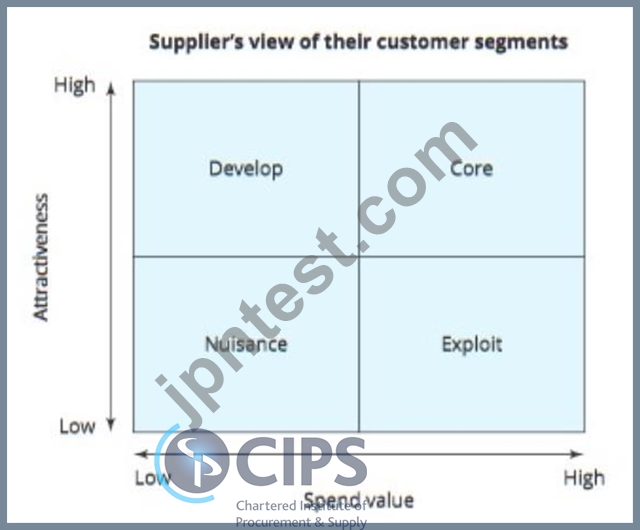
Exploit is the quadrant where the buyer has high spend but low attractiveness. Overarching supplier objective would be: "Milk this customer and charge a high price to compensate for all the pain they put us through".
The buyer should increase its attractiveness to raise the position to Core customer. To do this, a buyer may:
- Simplify procurement processes
- Simplify contracting processes
- Use clear and concise documentation
- Eliminate onerous supplier terms and conditions
- Make the payment on time
- Use transparent processes
- Promote ethical behaviours
LO 1, AC 1.4
質問 # 140
John Browne, a junior buyer for a corporation, is analyzing the global supply market before undertaking negotiations and is wondering whether foreign exchange rates are important to factor into his research. Should John consider the foreign exchange rates?
- A. Yes, only if the organization can handle foreign currencies in their accounts
- B. No, exchange rates only apply to the national economy
- C. No, as they only affect the bank's interest rates for loans
- D. Yes, as they can affect profit and turnover
正解:D
解説:
Foreign exchange rates impact import costs, profit margins, and overall turnover when transactions are conducted in foreign currencies. Understanding these fluctuations allows buyers to anticipate changes in purchasing costs, supporting informed decision-making, as highlighted in CIPS guidance on global procurement considerations.
質問 # 141
Under EU public procurement directives, which of the following are procedures in which there is no commercial negotiation allowed?
- A. Open Procedure
- B. Innovation Partnerships
- C. Restricted Procedure
- D. Competitive Procedure with Negotiation
- E. Competitive Dialogue
正解:A、C
解説:
Explanation
Under the European Union public procurement directives, all public sector bodies must abide by certain rules when they procure goods and services over a threshold value. Theserules are codified under 5 procurement procedures:
1. Open Procedure
2. Restricted Procedure
3. Competitive Dialogue
4. Competitive Procedure with Negotiation
5. Innovation Partnerships.
Under normal circumstances, there is no commercialnegotiation allowed under the two most commonly used procedure, Open and Restricted. Under these procedures, the prices and terms and conditions of contract should be decided via reference only to the tenderers' responses to the buyer's requests for tenders, and not through 'post-tender negotiation'. Under the other procedure, negotiation within the rules is permitted.
Interested learners can read more about these procedures here.
LO 1, AC 1.1
質問 # 142
During a negotiation, Jose Gomez, the salesperson for a strategic supplier, states that his sales director will not approve discounts against initial purchases. However, Jose offers a 5% discount against the aftercare package, which will provide the same monetary saving. Sally Pampas requires both the product and the aftercare package and has an objective to achieve a 5% discount off the purchase price. To achieve a win-win (integrative) negotiation, Sally should:
- A. Ask Jose to apply a discount against the price
- B. Ask Jose to apply the 5% discount against the purchase price
- C. Accept the offer of a discount against the aftercare package
- D. Decline the offer and walk away from the negotiation
正解:C
質問 # 143
Jasmine and the IHL sales team have a negotiation scheduled with one of AB's lead buyers, Samuel, at AB's premises. This is one of the biggest negotiations that Jasmine has been involved in and is eager not to make any mistakes. Jasmine has heard from a colleague that Samuel tends to adopt an integrative negotiation style.
IHL senior management decides to send a team of three members to the negotiation. Jasmine is among the team and she is assigned to check body language, reactions, feeds insight to her leader and to record important comments and information from the meeting for minutes. Which of the following are roles of Jasmine in the forthcoming negotiation? Select TWO that apply.
- A. Technical expert
- B. Commercial expert
- C. Observer
- D. Chief negotiator
- E. Secretary
(Correct)
正解:C、E
解説:
:
A negotiating team can be as few as two people, and one person can play one or more of these roles:
Table Description automatically generated
As from the scenario, Jasmine will act as an observer and a scribe (or secretary).
質問 # 144
Freefields Housing Authority (FHA) is a housing provider that has outsourced a range of management services using fixed-price long-term contracts. FHA's regular supplier credit reviews have identified that some key outsourced service suppliers are at risk of insolvency due to high inflation rates observed in the macroeconomic climate. Which of the following actions would enable FHA to reduce this risk for the lifetime of the affected contracts?
- A. Allow affected suppliers to review and resubmit their fixed costs
- B. Introduce indexation of contracts linked to the Consumer Prices Index
- C. Offer advance payment terms to the affected suppliers
- D. End the contracts and procure the services
正解:B
質問 # 145
In a negotiation for a new contract, the supplier suggests the buyer to shorten payment period from 45 days to
15 days because they are investing in new facilities to expand the supply capacity. The buyer replies that she can only sign off the deal if the payment period is 30 days or more since it often takes at least 30 days for her company to collect the payment from customers. A permission from senior management is required for this suggestion. In order to ensure that supplier understands the matter, she reiterates it throughout the meeting.
Which tactics is she using?
1. Outrageous initial demand
2. Salami slicing
3. Lack of authority
4. Broken record
- A. 2 and 4 only
- B. 1 and 3 only
- C. 3 and 4 only
- D. 1 and 2 only
正解:C
解説:
:
In the scenario, the buyer states that permission from senior management is required to shorten payment period and she only has authority to sign off a deal in which the payment period lasts at least 30 days. The buyer is using lack of authority. The buyer also repeats the matter again throughout the negotiation. This is a common tactic known as broken record.
質問 # 146
Absorption costing is when the total cost per each unit of output:
- A. Includes an allocation of producing an additional unit
- B. Includes an allocation for a proportion of total production costs
- C. Includes an allocation towards indirect costs used in its creation
- D. Includes an allocation towards the activity cost of its creation
正解:C
質問 # 147
Which of the following should be done by the procurement team at the closing stage of a negotiation? Select TWO that apply.
- A. Accept ambiguity or uncertainty
- B. Tell TOP that they could have got a better deal
- C. Seek agreement in principle if TOP does not have the final authority
- D. Leave the meeting as soon as possible
- E. Gloat publicly about the deal
正解:C、D
解説:
The agreement and closing phase is the phase when it is either clear through explicit language, or strongly suggested through non-verbal signals, that TOP is ready to move to agreement. Judging when to close can be difficult and as with phases of the negotiation, experience, observation, practice and reflection will be the best ways to learn here.
In the closing phase, procurement should:
- Watch for closing/buying signals
- Check to ensure all issues have been resolved
- Consider using visual aids to summarise
- Use 'summary close'
- Make a decision to conclude/close
- Seek agreement in principle if TOP does not have the final authority
- Make your own private notes on the final agreement
- Shake hands on the agreement
- Leave the meeting as soon as possible thereafter.
LO 3, AC 3.1
質問 # 148
Which of the following is NOT a barrier to entry in amonopolized market?
- A. A single firm is very large
- B. The government gives a single firm the exclusive right to produce some good
- C. A key resource is owned by a single firm
- D. The costs of production make a single producer more efficient than a large number of producers
正解:A
解説:
Monopolies exist in many markets in real life for very different reasons:
Ownership of a Key Resource: When one company exerts sole control over a resource that is necessary for the production of a specific product,the market may become a monopoly. For example, the only medication deemed acceptable to treat a disease comes from a particular ingredient X, and knowledge of this ingredient X is owned by a single family owned company. The company can, therefore, be saidto have a monopoly over ingredient X that is needed to cure the disease because it is the only company that can produce a product deemed acceptable.
Government Franchise: In certain instances, a monopoly may be explicitly created by the government if it grants a single company, whether private or government-owned, the right to conduct business in a particular market. For example, when a national railways transportation service is created by the government, in most cases they are granted a monopoly on the operation of passenger trains in the country. As a result, other firms are only able to offer passenger train services with the cooperation and/or permission of the government-owned provider.
Intellectual Property Protection: Extending intellectual propertyprotection to a company in the form of patents and copyrights is yet another way in which monopolies are created. When a government does this, it is in fact giving a single company an exclusive right to provide a particular product / service to the market. Patents and copyrights work in providing owners of intellectual property with the right to act as an exclusive provider of a new product for a specific length of time. This creates a temporary monopoly in the market with regards to new products and services.
Natural Monopoly: A market may also become a monopoly simply because it may be more cost-effective for one company to serve the whole market than to have several smaller firms in competition with one another. A company with virtually unlimited economies of scale is referred to as a natural monopoly. Such firms become monopolies due to their position and size, which makes it impossible for new entrants in the market to compete price-wise. Natural monopolies are common in industries with high fixed costsand low marginal costs of operation such as providers of television, telephone, and internet services.
In this question, 'A single firm is very large' is not enough to tell whether this market is monopolistic.
質問 # 149
SBL provides contract bathroom furniture and fittings for a wide variety of domestic and commercial clients.
To some suppliers, SBL spendclaims a large portion of their revenue. But SBL is famous for imposing draconian obligations on these suppliers. Which of the following is most likely to be overarching objective of these suppliers to SBL?
- A. Drop the business with SBL immediately
- B. Win and keep business with SBL at any costs, even without profits
- C. Hold on and keep SBL happy but make sure that the business is profitable
- D. Charge a higher price to compensate for all the pain SBL has put
正解:D
解説:
According to Paul Steele's 'The Seller's Perspective', customer can be classified into 4 categories as below:
Chart, treemap chart Description automatically generated
In this scenario, although SBL's spend claims large portion in suppliers' revenues, their draconian treatment will reduce SBL's attractiveness in supplier's perspective.SBL falls into Exploit quadrant. With exploitable customers, suppliers tend to 'milk' the customer and charge a high price to compensate for all the pain customer put on them.
質問 # 150
......
検証済みのL4M5テスト問題集と解答には的確な373問題と解答があります:https://www.jpntest.com/shiken/L4M5-mondaishu
最新版を今すぐ試そうL4M5認定有効な試験問題集:https://drive.google.com/open?id=1Vu-udaw2Z_7WG-1d_J4q4YAE7vYKfFPr