

L4M5合格させる問題集でCIPS24時間で試験合格できます
最新問題を使おうL4M5試験問題と解答でPDFで一年間無料更新
質問 # 11
What is the most likely outcome when two organisations with adversarial relationship negotiate with each other?
- A. Lose lose
- B. Win win
- C. Deadlocked
- D. Win lose
正解:D
解説:
:
An adversarial relationship in purchasing and supply arises when identical or equivalent good or services are available from competing suppliers and buyers/sellers are trying to gain an advantage over each other. Low levels of trust are characteristic of adversarial relationships. The outcome when two organisations with adversarial negotiate is most likely to be win-lose.
質問 # 12
Jasmine and the IHL sales team have a negotiation scheduled with one of AB's lead buyers, Samuel, at AB's premises. This is one of the biggest negotiations that Jasmine has been involved in and is eager not to make any mistakes. Jasmine has heard from a colleague that Samuel tends to adopt an integrative negotiation style.
IHL senior management decides to send a team of three members to the negotiation. Jasmine is among the team and she is assigned to check body language, reactions, feeds insight to her leader and to record important comments and information from the meeting for minutes. Which of the following are roles of Jasmine in the forthcoming negotiation? Select TWO that apply.
- A. Observer
- B. Chief negotiator
- C. Secretary
(Correct) - D. Technical expert
- E. Commercial expert
正解:A、C
解説:
A negotiating team can be as few as two people, and one person can play one or more of these roles:
Table Description automatically generated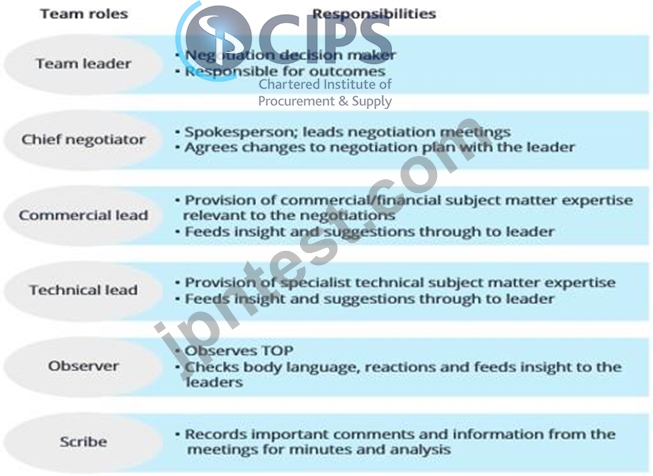
As from the scenario, Jasmine will act as an observer and a scribe (or secretary).
質問 # 13
Which of the following occur within the planning and preparation stage in a negotiation process? Select THREE that apply.
- A. Using questions to elicit information
- B. Defining the constituents
- C. Making as few concessions as possible
- D. Narrowing the range of solutions
- E. Understanding the other party
- F. Analyse the bargaining power
正解:B、E、F
解説:
In the planning and preparation stage of negotiation, it is essential to build a strong foundation by understanding various factors that influence the negotiation outcome. According to CIPS resources, critical aspects of preparation include:
Understanding the other party (A): This helps in anticipating their needs, objectives, and potential negotiation styles, leading to more strategic discussions.
Defining the constituents (B): This involves identifying all stakeholders or parties impacted by the negotiation, ensuring their interests are considered when planning the negotiation strategy.
Analyzing the bargaining power (F): Understanding the relative power each party brings to the negotiation helps in setting realistic goals and predicting possible negotiation dynamics.
These elements are foundational in ensuring a well-rounded approach and enabling both parties to enter negotiations with clarity and strategy, enhancing the potential for a positive outcome.
質問 # 14
If the price of a good is above the equilibrium price, which of the following will happen?
- A. There is a surplus (i.e. an excess supply) and the price will rise
- B. The quantity demanded is equal to the quantity supplied and the price remains unchanged
- C. There is a shortage (i.e. an excess demand) and the price will fall
- D. There is a surplus (i.e. an excess supply) and the price will fall
正解:D
解説:
:
In microeconomics, equilibrium price is determined when the quantity demanded is equal to the quantity supplied at equilibrium price in a market, there will be no shortages and no surpluses. If we combine our supply and demand curves on one graph, the point at which they converge determines the equilibrium price. If the price is set above this price and you read across the graph you will see the supply excess demand and there will be a surplus. In order to reduce this surplus, the price will need to fall. The scenario is illustrated in the graph below:
Chart, line chart Description automatically generated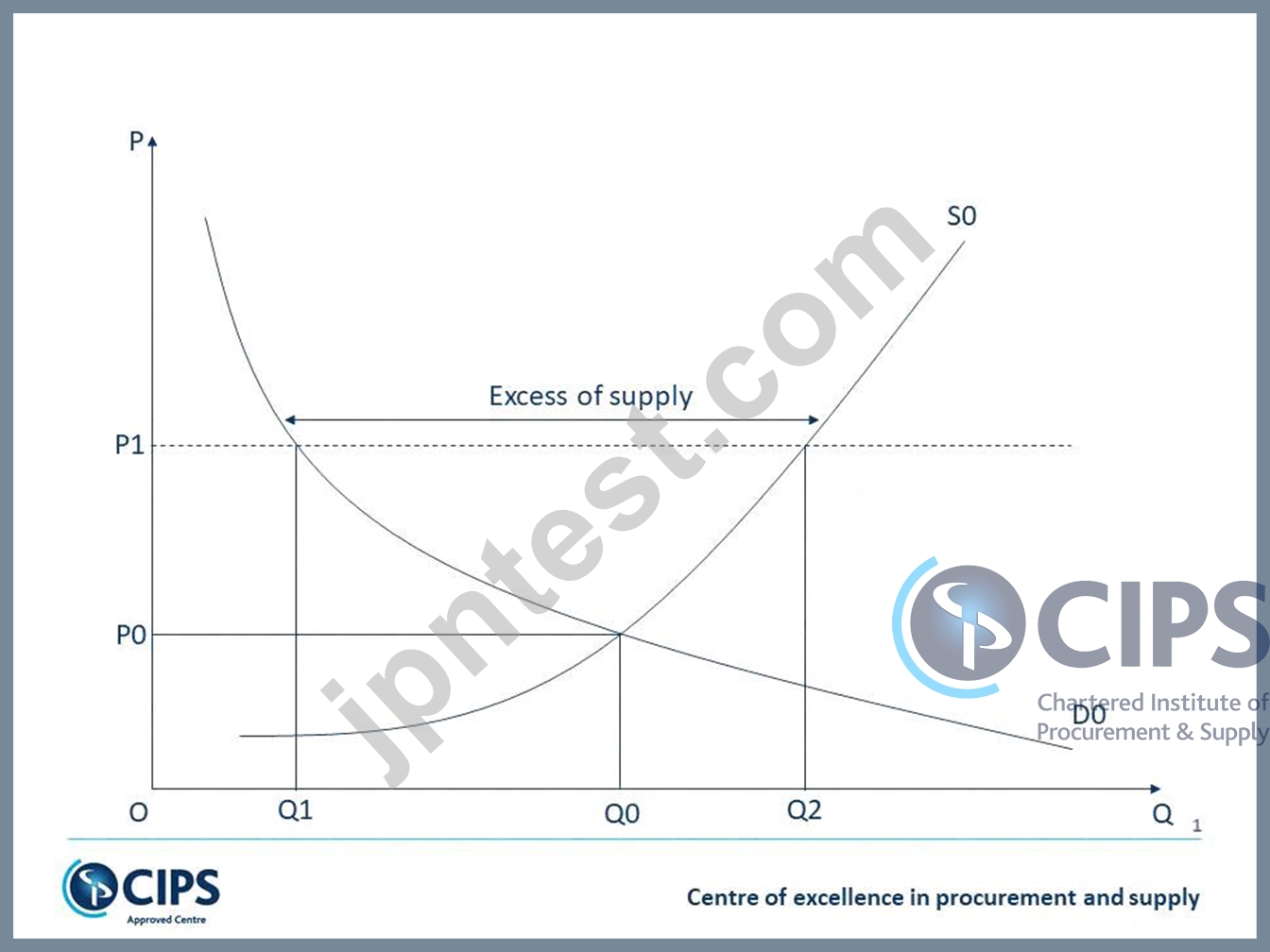
質問 # 15
Representatives from South African Department of Health is negotiating the price of hospital drugs with US pharmaceutical companies. Which of the following are most likely to be macro factors that influence the outcomes of the negotiation? Select TWO that apply.
- A. Order quantity
- B. Regulations on health and safety Switching costs of buyer
- C. Digitalisation of medicine
- D. Forward integration
正解:B、C
解説:
All one-to-one commercial negotiations between a specific purchaser and a specific supplier take place within an industrial market and a larger business environment characterised by multiple forces which both parties typically have little control over. STEEPLE framework highlights the 6 main external influences on a business:
Table Description automatically generated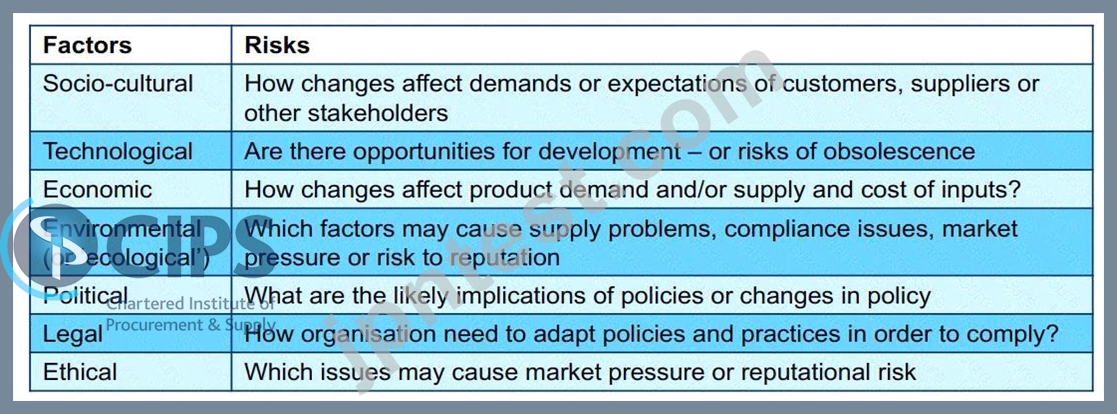
Particularly, pharmaceutical industry is a heavily regulated sector, therefore, legal and regulatory matters in the industry is highly important. Otherwise, technological trends also permeate into pharmaceutical companies, technologies like digitalisation may transform the balance of power in such negotiation.
LO 1, AC 1.3
質問 # 16
Which of the following is the best description of direct cost?
- A. Direct costs include only raw materials and labour of making the final product
- B. Direct costs include raw materials, labour andoverheads
- C. Direct costs include raw materials, labour and other expenses attributable to the final product
- D. Direct costs are only variable raw materials that constitute a product
正解:C
解説:
Direct costs are those costs of a product/service directly attributable/traceable to its production, for example, the costs of labour and materials directly used to produce the goods/services which the organisation sells.
質問 # 17
In a negotiation for a new contract, the supplier suggests the buyer to shorten payment period from 45 days to
15 days because they are investing in new facilitiesto expand the supply capacity. The buyer replies that she can only sign off the deal if the payment period is 30 days or more since it often takes at least 30 days for her company to collect the payment from customers. A permission from senior managementis required for this suggestion. In order to ensure that supplier understands the matter, she reiterates it throughout the meeting.
Which tactics is she using?
1. Outrageous initial demand
2. Salami slicing
3. Lack of authority
4. Broken record
- A. 1 and 2 only
- B. 3 and 4 only
- C. 2 and 4 only
- D. 1 and 3only
正解:B
解説:
In the scenario, the buyer states that permission from senior management is required to shorten payment period and she only has authority to sign off a deal in which thepayment period lasts at least 30 days. The buyer is using lack of authority. The buyer also repeats the matter again throughout the negotiation. This is a common tactic known as broken record.
質問 # 18
A supplier can produce a product for $160. The supplier sells the product to their client for $240, making a profit before tax of $80 on the transaction. What is the mark-up profit percentage earned by the supplier on this transaction?
- A. 50%
- B. 33%
- C. 67%
- D. 159%
正解:A
解説:
The mark-up percentage is calculated as the profit divided by the cost of production, then multiplied by 100 to convert it into a percentage.
Calculation:
(
80
/
160
)
×
100
=
50
%
(80/160)×100=50%
Thus, the supplier's mark-up percentage is 50%, as per standard pricing calculations used in procurement.
質問 # 19
Personal power is only used in distributive approach. Is this statement true?
- A. No, because personal power can be veryhelpful in integrative approach
- B. Yes, because one party will abuse coercive power to maximise the gain
- C. Yes, because only distributive approach to negotiation requires strong personal power
- D. No, because only organisational power will optimise the negotiation outcomes
正解:A
解説:
Explanation
Power, or more precisely perceptions of power,are critically important in understanding the commercial negotiation process. From a commercial negotiation point of view (under any circumstances, either integrative or distributive approach), CIPS is interested in power from both a personal and organisational perspective.
When you are negotiating on behalf of your employer, you bring the power of your organisation (its brand, reputation and purchasing spend) as well your own personal power (6 sources of personal power, based on French and Raven's power base model) to the negotiation.
In both integrative and distributive approaches, personal power plays an important role. It helps both parties push through negotiating barriers and secure commitment and final agreement LO 1, AC 1.3
質問 # 20
Whenimplementing value analysis or value engineering, which of the following acronyms reminds both buyer and supplier of ideas on removal, substitution and design-out of cost elements?
- A. STOPS WASTE
- B. SAMOA
- C. SMART
- D. OWN-IT
正解:A
解説:
Ray Carter coined the mnemonic STOPS WASTE to remind buyers of 10 cost-reduction ideas they can ask for themselves and their suppliers in any situation when considering a key purchase input. Stop Waste by:
Standardisation - is there a standard specification?
Transportation - is the inbound transport classification appropriate
Over-engineered - is the specification too tight?
Packaging - can packaging be reduced or eliminated?
Substitutes - is there a cheaper substitute material
Weight - is there opportunity to reduce weight of the product?
Any unnecessary processing - is there any unnecessary design or feature?
Supplier's input - are suppliers able to assist with the cost reduction To make - is it more economical to make or buy?
Eliminate - if no one uses the feature, can it be eliminated?
SAMOA is a useful acronym for checking and testing the information gathered from the Internet:
Source
Audience
Methodology
Objectivity
Accuracy
OWN-IT is acronym for 5 steps in the process of collecting and analysing the data andinformation needed in any field:
Outline
Wide search
Narrow search
Increase your stockpile of information
Transform your stockpile into new knowledge
A SMART goal is used to help guide goal setting. SMART is an acronym that stands for Specific,Measurable, Achievable, Realistic, and Time-bound.
質問 # 21
A purchasing manager is having a negotiation with a supplier to extend the duration of the contract. In order topersuade the supplier to cut the cost by 10%, she promises to shorten the payment period from
45 days to 30 days for each delivery. The supplier's representative does not agree the offer and clearly states that his proposed price is already lower than the market price. The purchasing manager has used which type of power?
- A. Coercive
- B. Expertise
- C. Informational
- D. Reward
正解:D
解説:
In the scenario, to exchange cost cutting, the purchasing manager promises to 'reward' supplier shorter payment period. This is an example of reward power, which results from one person's ability to compensate or reward another for compliance.
The reward does not need to be money, but could be introduction to other buyers in the group, positive references, agreement to trial new product, quicker payment or indeed any other variable that the buyer knows is attractive and valued by the supplier.
質問 # 22
Which of the following are macroeconomic factors that may have influence to the commercial negotiation?
Select TWO that apply
- A. Rising import tariffs
- B. Equilibrium price
- C. Unemployment rate
- D. Supply curve
- E. Bargaining power of supplier
正解:A、C
解説:
Explanation
There are many macro economic factors that could influence procurement in general andcommercial negotiation in particular. Below are six factors that are agreed to be fairly significant:
* Economy growth rate
* Inflation rates
* Interest rates
* Currency exchange rate
* Unemployment rate
* Protectionism
LO 2, AC 2.2
質問 # 23
During a negotiation, a procurement manager suggests that the two companies should split the difference which would benefit both the supplier and buyer. Which persuasion method is she using?
- A. Good cop/bad cop
- B. Threat
- C. Compromise
- D. Logic
正解:C
解説:
In the scenario, the manager propose to 'split the difference', which means each party will accept some of their demands and concede some. This is known as 'Compromise'.
質問 # 24
Which type of question should be used to receive affirmation on statement?
- A. Narrow
- B. Closed
- C. Leading
- D. Open
正解:B
解説:
:
Different questioning styles can be used to elicit desired responses:
Text Description automatically generated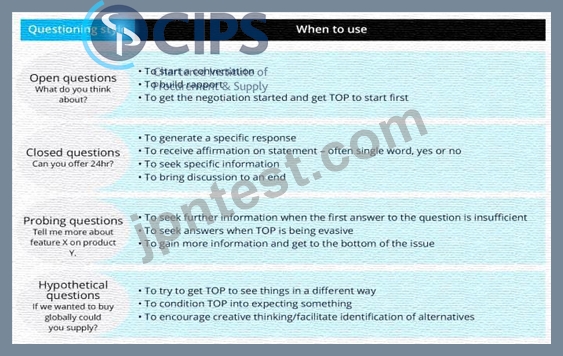
質問 # 25
During a negotiation, Jose Gomez, the salesperson for a strategic supplier, states that his sales director will not approve discounts against initial purchases. However, Jose offers a 5% discount on the aftercare package, which will provide the same monetary saving. Sally Pampas requires both the product and the aftercare package and has an objective to achieve a 5% discount off the purchase price. To achieve a win-win (integrative) negotiation, Sally should...
- A. Ask Jose to apply the 5% discount against the purchase price
- B. Accept the offer of a 5% discount against the aftercare package
- C. Decline the offer and walk away from the negotiation
- D. Ask Jose to apply a 15% discount against the purchase price
正解:B
解説:
To achieve a win-win (integrative) negotiation, Sally should accept the 5% discount on the aftercare package (B), as it meets her objective for a total discount while respecting the supplier's limitations. This approach demonstrates flexibility and is in line with CIPS principles on integrative negotiations, where both parties achieve value in different forms.
質問 # 26
The trust is built based on the other party's professional qualifications or proven or certified technical capability or experience is known as...?
- A. Competence trust
- B. Contractual trust
- C. Goodwill trust
- D. Irrevocable Trust
正解:A
解説:
Trust is the expectation that the other party will behave in a predictable and mutually acceptable way. In inter-firm relationships, the presence and absence of trust can affect the level of cost in a relationship. The existence of trust is taught to lower the transaction cost in a relationship. Dr. Mari Sako identified taxonomy of
3 types of trust in commercial relationship, which is very useful from the perspective of procurement.
Contractual trust: Trust based on the contract with TOP. This is potentially the weakest source of trust if there is nothing else to base the trust on, but it is the quickest to establish.
Competence trust: Trust based on TOP's professional qualifications or proven or certified technical capability or experience.
Goodwilltrust: Trust based on knowing TOP has your interest at heart and will not behave opportunistically.
This is potentially the strongest type of trust, but it takes the longest time to build.
質問 # 27
Which of the following may help the procurement professional increase expert power in commercial negotiation? Select TWO that apply.
- A. Insights
- B. Expertise knowledge
- C. Personality
- D. Ability to compensation
- E. Official positions
正解:A、B
解説:
Expert power is based on a person's high levels of skill and knowledge, formal training, qualifications and experience in aparticular procurement category would give someone expert status and mean that in negotiation their voice is listened to as a more objective, informed knowledge leader. Expert power is based on facts, knowledge, research, insight and study.
Legitimate power comes from rules, formal authority, organisation rank, staff rate or official position held.
Reward power comes from one person's ability to compensate or reward another for compliance.
Referent power stems from their personality, way of engaging with others and habit of acting in a way that is in line with a strong set of values and principles.
質問 # 28
What are the potential sources of conflict between the buyer and supplier? Select TWO that apply.
- A. Requesting early supplier involvement
- B. Unequal sharing of gains, risks, and costs with the supplier
- C. Persistent late payment of the supplier's invoices
- D. Planning scheduled visits to the supplier site
- E. Scheduling agreed supplier delivery dates
正解:B、C
解説:
Persistent late payment of the supplier's invoices (A) and Unequal sharing of gains, risks, and costs with the supplier (B) are potential sources of conflict as they create dissatisfaction and imbalance in the relationship.
According to CIPS materials:
Late payments (A) can strain the supplier's cash flow, affecting their operational stability and leading to mistrust in the buyer.
Unequal sharing of gains, risks, and costs (B) can result in one party feeling exploited or unfairly treated, which undermines the collaborative spirit essential for long-term partnerships.
In contrast, requesting early supplier involvement, planning visits, or setting delivery dates are typically part of constructive relationship management practices and do not inherently lead to conflict.
質問 # 29
Before engaging in a negotiation with a supplier of rechargeable lights, procurement team tries to visualise the breakdown of supplier's costs to calculate its break-even point. They estimate that total fixed expenses related to rechargeableelectric light are $270,000 per month and variable expenses involved in manufacturing this product are $126 per unit. The supplier charges its customer $180 per unit. Within its current capacity, this supplier will make a profit at which of the following?
- A. More than 5,000 units are sold monthly
- B. Exactly 1,500 units are sold monthly
- C. More than 1,500 units are sold monthly
- D. Exactly 5,000 units are sold per month
正解:A
解説:
Explanation
The analysis of cost into fixed and variable enables organisationsto determine their break-even point (BE) - the point where total revenue from sales and total cost exactly balance. All costs need to be covered by sale revenue in order for a company to make a profit. If you know your fixed costs and your variable coststhen you can work out the minimum quantity of goods or services you need to sell to break even. Break even point is measured in volume and can be worked out graphically or via formulae:
Price - Variable costs = Contribution
Break even point (volume) = Fixed expenses/Contribution margin per unit In this scenario, the break even point (Q) is: 270,000/(180-126) = 5,000 To make a profit, the supplier needs to sell more than 5,000units per month.
The BE point is thus an important determinant of flexibility of pricing for suppliers. Before BE is achieved there will be much greater reluctance to offer price concessions to customers than after BE is achieved.
LO 2, AC 2.1
質問 # 30
Which of the following are rules of attentive listening? Select TWO that apply.
- A. Listen deliberately
- B. Only focus on verbal cues
- C. Do not interrupt when the other party is speaking
- D. Prepare for what to say next
- E. React to the person who is speaking
正解:A、C
解説:
Hearing is passive but listening is active, and some people need to learn to be a good, attentive listener. The following rules of attentive listening will help you to become a successful negotiator:
* Be motivated to listen
* Be alert to non-verbal cues
* Do not interrupt the other party when they are speaking
* Fight off distractions
* Write everything down
* Listen with a goal in mind
* Give the other party your undivided attention
* React to the message, not the person
LO 3, AC 3.3
質問 # 31
The stages of commercial negotiation involve which of the following characteristics?
- A. Preparation, proposal, bargain, leave
- B. Opening, debating, promising, testing, disagreeing, closing
- C. Open, testing, bargaining, closing, revisiting
- D. Preparing, opening, bargaining, agreement, closure
正解:D
解説:
The typical stages of commercial negotiation are Preparing, opening, bargaining, agreement, and closure. This sequence facilitates a structured approach where negotiators prepare strategies, initiate discussions, engage in bargaining, reach agreements, and formally close the negotiation. This structure is emphasized in CIPS materials as essential for achieving a balanced negotiation process.
質問 # 32
There are no commitments in hypothetical questions. Is this statement true?
- A. Yes, because hypothetical questions only mention possible situations
- B. No, because hypothetical questions are made explicitly to the other party
- C. Yes, because hypothetical questions generate a specific response
- D. No, because the party who makes hypothetical questions cannot withdraw their proposals
正解:A
解説:
Explanation
There are four types of questions that can be used in a commercial negotiation:
Hypothetical questions, where you ask about a possible situation or abstract concept, are very useful at the testing and proposal phases. Hypothetical question does not state any commitment as it is only about 'if something happens, then ...'. This type of question can be useful at giving suggestion.
Text Description automatically generated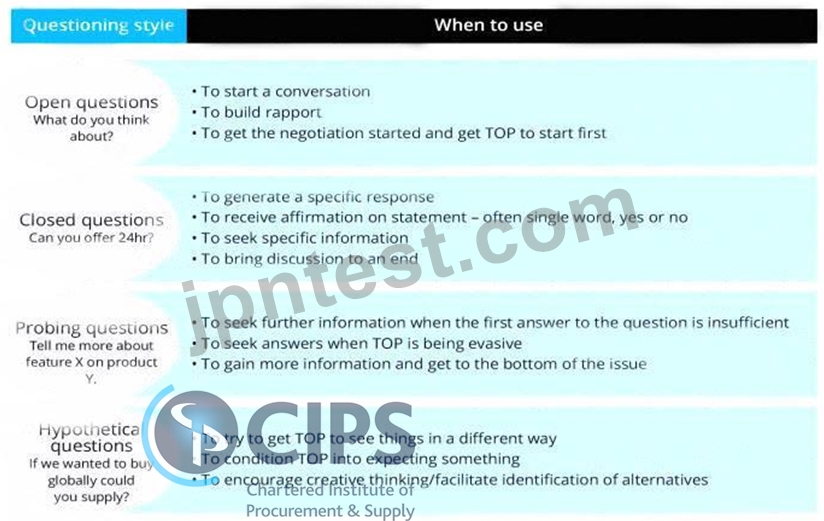
LO 3, AC 3.3
質問 # 33
'What specific tests do you carry out to ensure quality is achieved?' This is an example of which type of negotiation question?
- A. Probing
- B. Closed
- C. Leading
- D. Reflective
正解:A
解説:
The question requires more detailed answer, it is an example of probing question.
Probing questions are typically follow-up questions, and aim to elicit more detailed information on the back of the answer elicited from the open questions. Probing question are also useful to check that the supplier fully understand their offering, as well as your needs, can also be used to communicate to the suppliers that you know this category well.
LO 3, AC 3.3
質問 # 34
The trust is built based on the other party's professional qualifications or proven or certified technical capability or experience is known as...?
- A. Competence trust
- B. Contractual trust
- C. Goodwill trust
- D. Irrevocable Trust
正解:A
解説:
:
Trust is the expectation that the other party will behave in a predictable and mutually acceptable way. In inter- firm relationships, the presence and absence of trust can affect the level of cost in a relationship. The existence of trust is taught to lower the transaction cost in a relationship. Dr. Mari Sako identified taxonomy of 3 types of trust in commercial relationship, which is very useful from the perspective of procurement.
Contractual trust: Trust based on the contract with TOP. This is potentially the weakest source of trust if there is nothing else to base the trust on, but it is the quickest to establish.
Competence trust: Trust based on TOP's professional qualifications or proven or certified technical capability or experience.
Goodwill trust: Trust based on knowing TOP has your interest at heart and will not behave opportunistically.
This is potentially the strongest type of trust, but it takes the longest time to build.
質問 # 35
Which of the following is the area where two or more negotiating parties may find common ground?
- A. Walk away area
- B. Zone of proximal development
- C. Best alternative to a negotiated agreement
- D. Zone of potential agreement
正解:D
解説:
Explanation
The zone of possible agreement (ZOPA) orbargaining range is considered an area where two or more negotiating parties may find common ground. It is this area where parties will often compromise and strike a deal. In order for negotiating parties to find a settlement or reach an agreement, they must work towards a common goal and seek an area that incorporates at least some of each party's ideas.
The zone of proximal development refers to the difference between what a learner can do without help and what he or she can achieve with guidance and encouragement from a skilled partner.
There is no Walk away area. Walk away point is a position from which you cannot concede any more ground and must walk away/decline a deal.
Best alternative to a negotiated agreement is a fallback or backstop position if the negotiation fails to result in an agreement/no deal is agreed.
LO 1, AC 1.2
質問 # 36
......
最新問題をダウンロードL4M5問題集で2025年最新のL4M5試験問題集:https://www.jpntest.com/shiken/L4M5-mondaishu
最新のCIPS L4M5認定練習テスト問題:https://drive.google.com/open?id=1m4Tp-fnboXQ5ETRcJ48YNQJJQY2nz7N3