

Googleは2022年最新のLookML-Developerテスト解説(更新されたのは51問があります)
LookML-Developer試験問題集を提供していますGoogle問題
質問 18
After validating LookML code, a developer receives the following error message:
"Unknown or Inaccessible Field users.name"
What is causing this error?
- A. The field uses incorrect SQL syntax.
- B. The join relationship is incorrect.
- C. There is a missing join.
- D. The field is set to "hidden".
正解: C
質問 19
A developer has created a persistent derived table that tracks new or updated orders and they want to cache the results. The cache should be refreshed whenever some new order is available on the underlying datasource table my tablename or at least every 24 hours.
Which datagroup definition will refresh the cache as expected?
A)
B)
C)
D)
- A. Option D
- B. Option B
- C. Option C
- D. Option A
正解: D
質問 20
A developer needs to implement three persistent derived tables (PDTs) as described below.
The PDTs need to be refreshed after the daily ETL pipeline adds incremental loads to the underlying tables.
Each PDT is built off of one underlying table in the database (one PDT per table).
The underlying tables for each PDT are updated one after the other, and a new row is added to an ETL log table each time a table is updated.
Due to the unpredictable nature of the ETL pipeline, each PDT does not refresh at the same time from day to day.
Each PDT takes over an hour to build, and to save on compute costs each PDT should only be refreshed once per day.
How can the developer set up the PDTs according to these requirements?
- A. Create three separate datagroups tied to three PDTs that run when each corresponding table's row count changes.
- B. Create three separate datagroups tied to three PDTs that run when a new row is added to the ETL log table.
- C. Create one datagroup tied to all three PDTs that runs when the total row count across all three tables changes.
- D. Create one datagroup tied to all three PDTs that parameterizes the view name for each PDT in the SQL trigger condition.
正解: B
質問 21
A developer is defining the users table within a view file in Looker. The users table will be available as an individual Explore and it will also be joined into other Explores, such as the products Explore. The developer needs to limit the fields visible in the products Explore without affecting the visibility of the fields in the users Explore.
How should the developer meet this requirement?
- A. Create duplicate dimensions and measures, one for the users Explore and one for the products Explore, and use the hidden parameter to modify the visibility of the fields.
- B. Create two view files for the users table. One view file will have all possible fields for the users Explore, and the other will have only the fields required for the products Explore.
- C. Use the fields parameter at the join level for the products Explore to specify which fields should be included and leave the users Explore as is.
- D. Use the hidden parameter in the users view file for the fields that should not come over to the products Explore and leave the users Explore as is.
正解: C
質問 22
A LookML developer has a transactions view with several measures that each perform complex calculations involving multiple fields. The LookML developer creates an Explore based on the transactions view. The product team wants to perform further functions on these measures, such as SUM, AVG, MIN, MAX, and RANK. The team wants these further functions to be performed at different levels of detail: weekly, monthly, and yearly.
How can the LookML developer model these requirements and minimize the amount of code rewriting?
- A. Add measures to the transactions view of type: number to apply the required functions.
- B. Create a constant for each measure so it can be reused across other areas of the LookML project.
- C. Create native derived tables using transactions as the explore_source.
- D. Change the existing measures in the transactions view to dimensions, and add measures of the different required types.
正解: C
質問 23
A user reports the following SQL error when selecting the discounted sale price field:
ERROR: column "order_items.sale_price"; must appear in the GROUP BY clause or be used in an aggregate function.
The developer checks the field definition and finds it to be:
measure: discounted_sale_price {
type: number
sql: ${sale_price} * 0.8 ;;
}
The developer also finds the LookML definition of the sale_price field to be:
dimension: sale_price {
type: number
sql: ${TABLE}.sale_price ;;
}
What is the likely cause of the SQL error?
- A. The discounted_sale_price field should be defined as a dimension of type: number, not as a measure.
- B. The underlying database table does not have a field called sale_price.
- C. The sale_price field should be defined as a measure of type: number, not as a dimension.
- D. The discounted_sale_price field should have a group_by: yes parameter.
正解: C
質問 24
A LookML developer has written the following persistent derived table. It references orders_rollup, another persistent derived table that also rebuilds with the same SQL trigger value.
Which change is needed to guarantee that user_facts will always rebuild with the latest data from orders_rollup?
- A. Change the sql_trigger_value parameter of user_facts to select the current date plus one hour, so it triggers an hour after orders_rollup.
- B. Change the orders_rollup view reference to ${orders_rollup.DERVIED_TABLE_NAME}
- C. Change the orders_rollup view reference to the literal table name from the database's scratch schema.
- D. Change the sql_trigger_value parameter for both persistent derived tables to a datagroup_trigger parameter, and set them to use the same datagroup.
正解: D
質問 25
The code below shows a view order_items with its measures total_revenue and user_count
Which code correctly represents a new measure that calculates average revenue per user?
A)
B)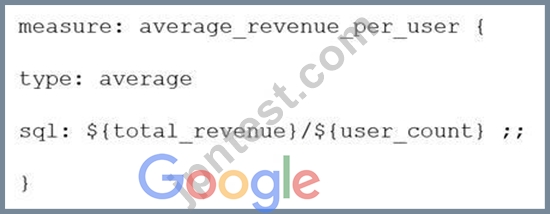
C)
D)
- A. Option D
- B. Option B
- C. Option A
- D. Option C
正解: D
質問 26
A developer needs to model out LookML to convert existing reports into Looker. The existing reports are:
Report 1: A report with order and order_items data, which finds the order with the largest total value of the order_item prices.
Report 2: A report with order and order_items data, which finds the order with the largest total number of products ordered.
Report 3: A report with data on every product, whether or not it has been ordered.
Each database table used is updated in real time as orders are made.
How should the developer construct an Explore using the order_items view as the base view?
- A. Create one ephemeral derived table to calculate Reports 1 and 2, and join in the products view with a full_outer join.
- B. Create one persistent derived table to calculate Reports 1 and 2, and join in the products view with a full_outer join.
- C. Create one persistent derived table to calculate Report 1, create one persistent derived table to calculate Report 2, and join in the products view with a full_outer join.
- D. Create one ephemeral derived table to calculate Report 1, create one ephemeral derived table to calculate Report 2, and join in the products view with a left_outer join.
正解: C
質問 27
A developer has the dimensions enrollment_month and graduation_month already defined in the view. Both were created as part of dimension_groups of type: time. The developer need to use these two dimensions in the sql_start and sql_end parameters of a dimension group of type: duration.
Which LookML should be used to calculate the number of month and years between enrollment month and graduation month?
A)
B)
C)
D)
- A. Option D
- B. Option B
- C. Option C
- D. Option A
正解: D
質問 28
A developer has User Specific Time Zones enabled for a Looker instance, but wants to ensure that queries run in Looker are as performant as they can be. The developer wants to add a datatype: date parameter to all dimension_group definitions without time data in a table-based view, so that time conversions don't occur for these fields.
How can the developer determine to which fields this parameter should be applied through SQL Runner?
- A. Open the Explore query in SQL Runner and validate whether removing the conversion from date fields changes the results.
- B. Open the Explore query in SQL Runner to determine which fields are converted.
- C. Use the CAST function in SQL Runner to ensure that all underlying fields are dates and conversions are not applied.
- D. Use the Describe feature in SQL Runner to determine which fields include time data.
正解: C
質問 29
A LookML developer has created a model with many Explores in it. Business users are having a difficult time locating the Explore they want in the long list displayed.
Which two actions can the LookML developer take to improve the user interface? (Choose two.)
- A. Apply the hidden parameter with a value of yes to Explores that only exist to power specific Looks, dashboards, or suggestion menus.
- B. Apply the fields parameter so that each Explore has fewer fields in it.
- C. Apply the group_label parameter to organize the Explores under different headings.
- D. Modify the business users' roles so they do not have this model in their model set.
- E. Combine the Explores into just a few Explores that each join to many views.
正解: D,E
質問 30
The daily_forecast Explore used by the sales team needs to be cached for 24 hours. All other Explores used by the sales team need to be cached for one hour.
What is a scalable way to configure this caching logic?
- A. Define for the model one datagroup that caches for 1 hour. Create a persistent derived table (PDT) for the daily_forecast Explore, and apply sql_trigger_value to it selecting the current date.
- B. Define two datagroups for the model. Create a persistent derived table (PDT) for the daily_forecast Explore, and apply datagroup_trigger to it using the datagroup for 24-hour caching.
- C. Define two datagroups for the model. Apply persist_with at the model level with the datagroup for 1-hour caching, and apply persist_with to daily_forecast with the datagroup for 24-hour caching.
- D. Define max_cache_age on daily_forecast Explores of 24 hours. Define max_cache_age on all other Explores for one hour.
正解: C
質問 31
Business users report that they are unable to build useful queries because the list of fields in the Explore is too long to find what they need.
Which three LookML options should a developer use to curate the business user's experience? (Choose three.)
- A. Create a separate project for each business unit containing only the fields that the unit needs.
- B. Add a description parameter to each field with context so that users can search key terms.
- C. Use a derived table to show only the relevant fields.
- D. Add a group_label parameter to relevant fields to organize them into logical categories.
- E. Use the hidden parameter to remove irrelevant fields from the Explore.
正解: B,C,D
質問 32
Users report that every time they change the filter on their Explore, the filters take a very long time to populate.
How can the developer improve the filtering experience with this Explore?
- A. Use an access_filter parameter to automatically apply filters.
- B. Limit the filter suggestions using the suggestions parameter.
- C. Add an always_filter parameter to restrict the filter suggestions.
- D. Add persistence to the base view of the Explore.
正解: B
質問 33
A user reports that, when a date dimension is filtered to "before now" results are returned that consistently include tomorrow. Dimension fill has been ruled out as a cause of the issue.
Which LookML parameter should be used to resolve this issue?
- A. Fiscal_month_offset
- B. Datatype
- C. Convert_tz
- D. Week_start_day
正解: A
質問 34
A developer wants to calculate the ratio of total sales from the orders view and total users from the users view.
Which two methods can be used to create a measure that meets these requirements? (Choose two.)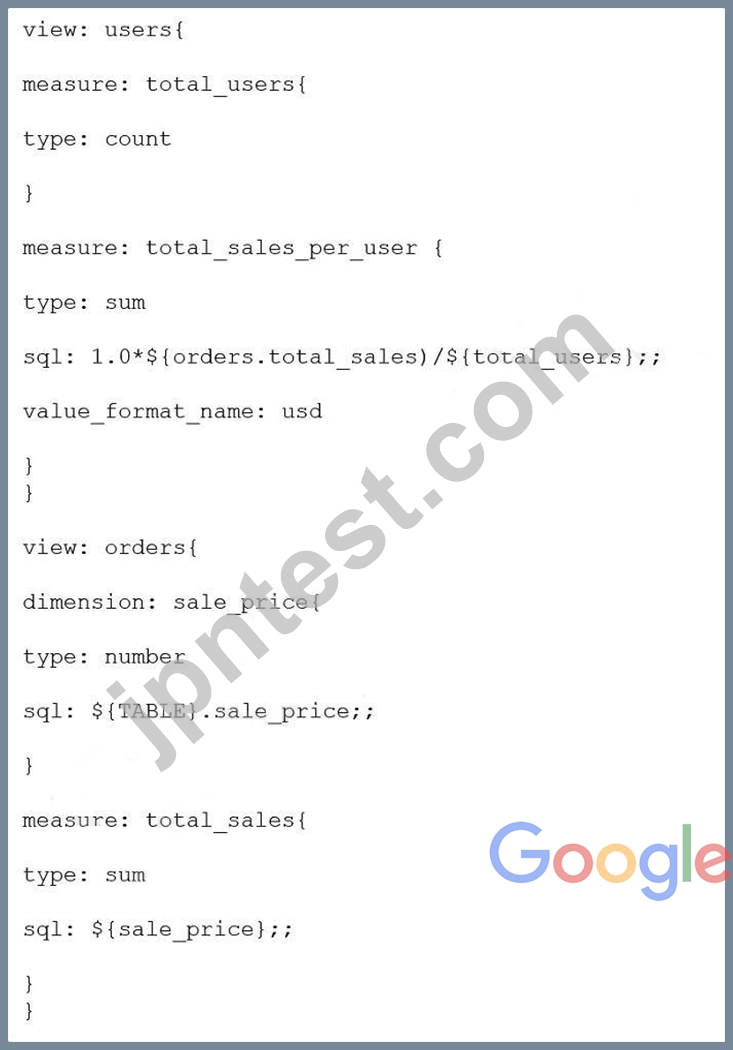
B)
C)
D)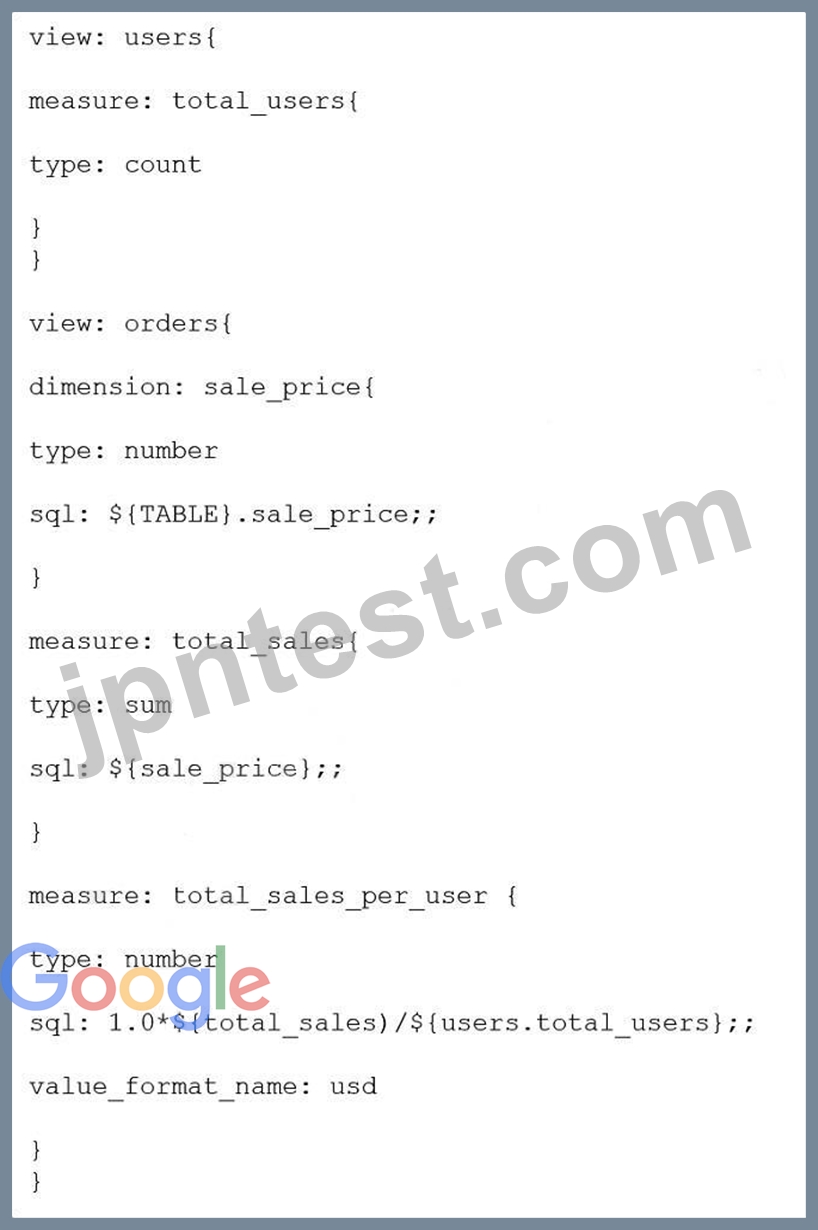
E)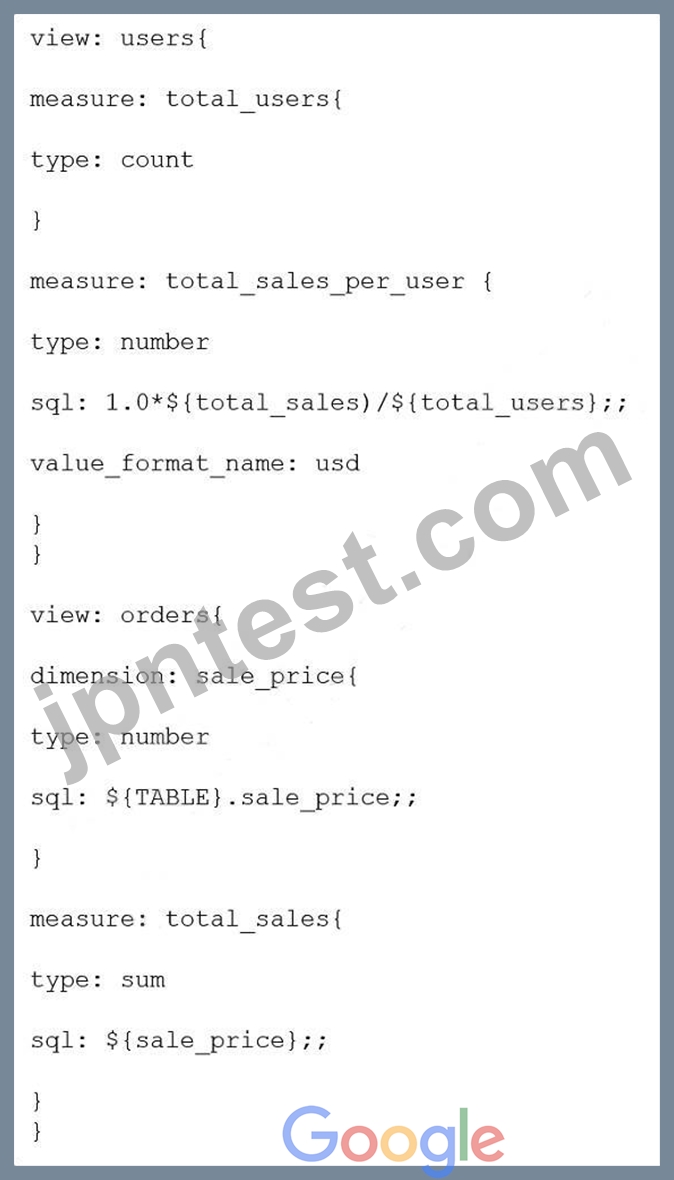
- A. Option D
- B. Option B
- C. Option C
- D. Option A
- E. Option E
正解: C,D
質問 35
A retail company wants to limit who can see the financial information in their reports to executives and store managers. The LookML Developer creates a user attribute called leadership with the value "000" for executives and "999" for store managers. The developer creates three access grant objects and one dimension: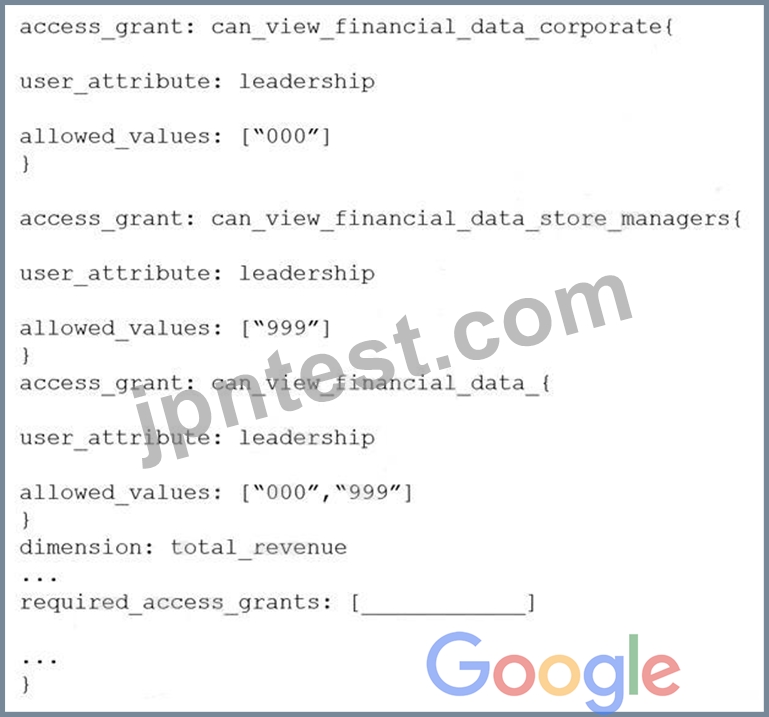
How should the developer ensure that only authorized users see the data in the Total Revenue dimension?
- A. required_access_grants: ["000","999"]
- B. required_access_grants: [can_view_financial_data]
- C. required_access_grants: [total_revenue]
- D. required_access_grants: [leadership]
正解: B
質問 36
After running the Content Validator, a developer can see the error "Unknown field".
Which two changes could cause this issue? (Choose two.)
- A. Field name was changed from id to user_id.
- B. Field type was changed from number to string.
- C. Explore label was changed from users to customers.
- D. View name was changed from users to customers.
- E. Model name was changed from e_commerce to reporting.
正解: A,B
質問 37
Only users with department attributes of Finance and Executive should be able to access the revenue view. Only users with the value of Executive for the department user attribute should be able to view the total_revenue field.
Given the code snippet below:
How should the required access grants be structured to set up this system of access?
- A. required_access_grants: [grant_a] in the revenue view, required_access_grants: [grant_a, grant_b] in the total_revenue field
- B. required_access_grants: [grant_b] in the financial_data Explore, required_access_grants: [grant_a] in the total_revenue field
- C. required_access_grants: [grant_a, grant_b] in the revenue view, required_access_grants: [grant_a] in the total_revenue field
- D. required_access_grants: [grant_b] in the revenue view, required_access_grants: [grant_a] in the total_revenue field
正解: A
質問 38
......
LookML-Developer認定ガイドPDFは100%カバー率でリアル試験問題:https://www.jpntest.com/shiken/LookML-Developer-mondaishu