

ML Data Scientist Databricks-Machine-Learning-Professional最新問題集で2026年09月09日
2026年最新の問題をマスター!ML Data Scientist合格目指そう!Databricks-Machine-Learning-Professionalリアル試験問題集!
Databricks Databricks-Machine-Learning-Professional 認定試験の出題範囲:
| トピック | 出題範囲 |
|---|---|
| トピック 1 |
|
| トピック 2 |
|
| トピック 3 |
|
| トピック 4 |
|
| トピック 5 |
|
| トピック 6 |
|
| トピック 7 |
|
質問 # 101
A Machine Learning Engineer wants to deploy a new change to their existing model training pipeline for a social media app. Currently, they use the Databricks Feature Store to create a training set to train their LightGBM model, which is then used in a Pandas UDF for batch inference to suggest potential friends to users. They have updated the feature engineering pipeline to include an additional feature function, which now computes the number of mutual friends a user has. Which test should they add to quickly inform them if something has broken in the test environment?
- A. Add a unit test that verifies the new mutual friends feature function correctly calculates expected values on live data.
- B. Implement an integration test that runs the entire pipeline from feature engineering to model inference in the production environment.
- C. Implement an integration test that runs the feature engineering pipeline in the production environment.
- D. Add a unit test that verifies the new mutual friends feature function correctly calculates expected values on a fake dataset.
正解:D
解説:
A unit test targeting the new feature function provides the fastest and most reliable signal that the recent change behaves correctly. By validating the mutual friends calculation on a controlled, fake dataset in the test environment, the engineer can quickly detect logic errors without the cost, risk, or latency of running full pipeline or production-based tests.
質問 # 102
A machine learning engineer has created a webhook with the following code block:
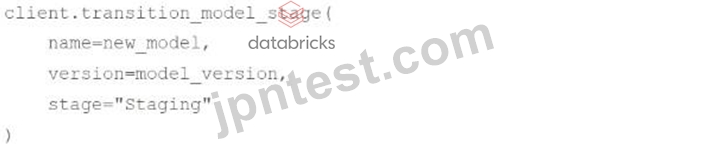
Which of the following code blocks will trigger this webhook to run the associate job?
- A.
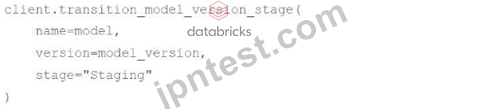
- B.
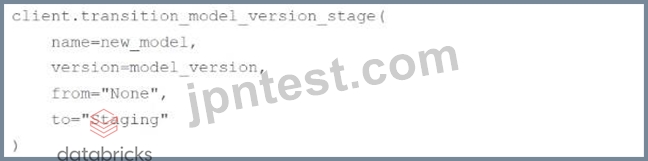
- C.
- D.
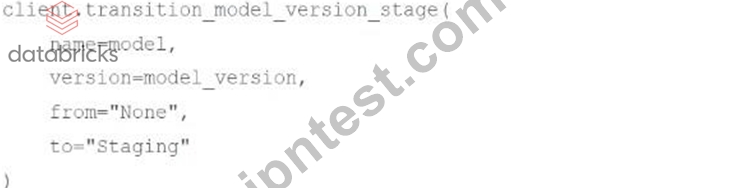
- E.
正解:D
質問 # 103
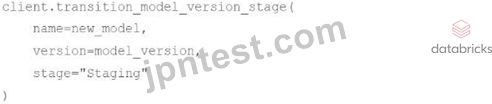
A machine learning engineer wants to move their model version model_version for the MLflow Model Registry model model from the Staging stage to the Production stage using MLflow Client client. Which of the following code blocks can they use to accomplish the task?
- A.
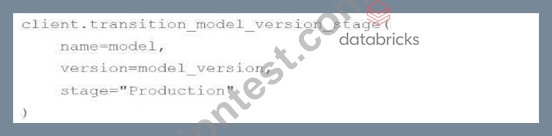
- B.
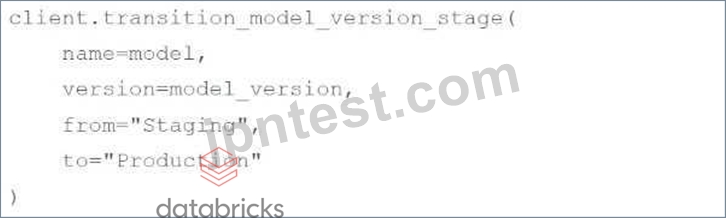
- C.

- D.
- E.
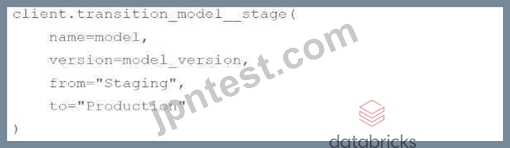
正解:C
質問 # 104
Which MLflow component is used to log parameters, metrics, and artifacts during model training?
- A. MLflow Models
- B. Model Registry
- C. MLflow Tracking
- D. MLflow Projects
正解:C
解説:
MLflow Tracking records experiment runs including:
parameters
metrics
artifacts (models, plots, etc.)
質問 # 105
A Data Scientist at an online gaming company is creating a model to predict player churn. The company currently collects terabytes of player activity logs daily, which are stored in Databricks and processed for daily reporting. The Data Scientist has completed feature engineering and the resulting data is saved as a Delta Table with a size of 500GB. They need to next build the model for the most performant and cost-effective performance for Databricks. Which approach will do this?
- A. Load the feature data as a Spark DataFrame and train the model using Spark's DeepspeedTorchDistributor on a multi-node Databricks cluster.
- B. Load the feature data as a Spark DataFrame and train the model using SparkML's RandomForestClassifier on a multi-node Databricks cluster.
- C. Load the feature data as a pandas DataFrame and train the model using scikit-learn's RandomForestClassifier on a multi-node Databricks cluster.
- D. Load the feature data as a pandas DataFrame and train the model using scikit-learn's RandomForestClassifier on a single-node Databricks cluster.
正解:B
解説:
A 500GB Delta Table is far beyond what is practical to load into a single pandas DataFrame, and scaling pandas-based scikit-learn training across nodes is not the right fit for this workload. Using a Spark DataFrame with Spark ML's RandomForestClassifier leverages distributed data processing and distributed model training on a multi-node cluster, which is the most performant and cost-effective approach for large tabular datasets in Databricks.
質問 # 106
A data scientist would like to switch from manually using MLflow logging to MLflow Autologging for all machine learning libraries used in a notebook.
They begin by adding mlflow.autolog()to the top of the below code block: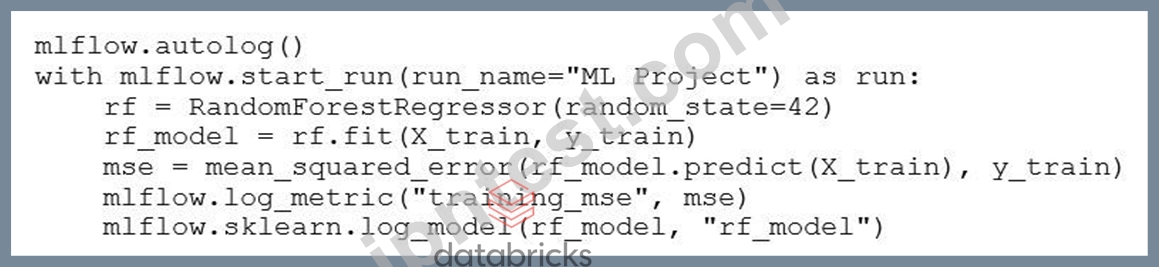
The data scientist is now trying to determine which line of code will kick off the MLflow Autologging process.
Which line of code within the above code block will start the MLflow Autologging process?
- A. mlflow.sklearn.log_model(rf_model, "rf_model")
- B. mlflow.log_metric("training_mse", mse)
- C. with mlflow.start_run(run_name="ML Project") as run:
- D. rf_model = rf.fit(X_train, y_train)
正解:D
解説:
The MLflow Autologging process is triggered when a model's training function is called. In this case, rf.fit(X_train, y_train) starts the autologging process because mlflow.autolog() automatically tracks parameters, metrics, and the model when a supported estimator (like RandomForestRegressor) is fitted. The context manager mlflow.start_run() only initiates an MLflow run, but the actual autologging begins during the .fit() execution.
質問 # 107
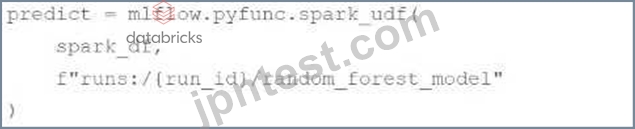
A machine learning engineer has developed a random forest model using scikit-learn, logged the model using MLflow as random_forest_model, and stored its run ID in the run_id Python variable.
They now want to deploy that model by performing batch inference on a Spark DataFrame spark_df. Which of the following code blocks can they use to create a function called predict that they can use to complete the task?
- A.

- B.

- C. It is not possible to deploy a scikit-learn model on a Spark DataFrame.
- D.
- E.

正解:E
質問 # 108
A machine learning engineer wants to programmatically create a new Databricks Job whose schedule depends on the result of some automated tests in a machine learning pipeline. Which Databricks tool can be used to programmatically create the Job?
- A. Jobs cannot be created programmatically
- B. MLflow APIs
- C. Databricks REST APIs
- D. AutoML APIs
- E. MLflow Client
正解:C
質問 # 109
A data scientist set up a machine learning pipeline to automatically log a data visualization with each run. They now want to view the visualizations in Databricks.
Which of the following locations in Databricks will show these data visualizations?
- A. The Artifacts section of the MLflow Run page
- B. Logged data visualizations cannot be viewed in Databricks
- C. The Figures section of the MLflow Run page
- D. The MLflow Model Registry Model paqe
- E. The Artifacts section of the MLflow Experiment page
正解:C
質問 # 110
What tool helps avoid feature mismatch between training and inference?
- A. Feature Store
- B. Model Registry
- C. Spark SQL
- D. MLflow Projects
正解:A
解説:
Feature Store ensures:
same feature computation logic
consistency between training and serving.
質問 # 111
A machine learning engineer wants to view all of the active MLflow Model Registry Webhooks for a specific model.
They are using the following code block: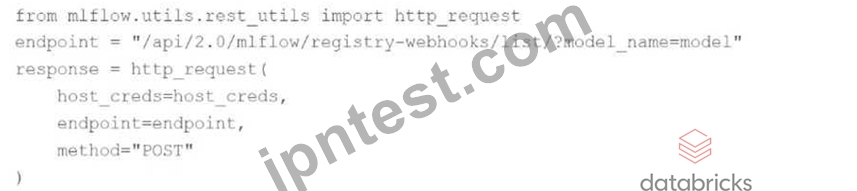
Which of the following changes does the machine learning engineer need to make to this code block so it will successfully accomplish the task?
- A. Replace list with webhooks in the endpoint URL
- B. Replace POST with GET in the call to http request
- C. Replace list with view in the endpoint URL
- D. Replace POST with PUT in the call to http request
- E. There are no necessary changes
正解:B
質問 # 112
A Machine Learning Engineer has a computer vision model in Databricks Model Serving that obscures sensitive data from images. Internal teams use the model throughout the work week when they request access to new files. Recently model users complained that the model takes much longer in the morning. This coincides with when people arrive at work and request files for the day. When the engineer reviews the endpoint health metrics, they see P50 model latency peaks around 9AM at 20 seconds. Request rate also peaks at 9AM at 15 requests/second. The GPU utilization is over 60%, GPU memory usage over 50%, and provisioned concurrency at 4 throughout the day. What can the engineer do to reduce user wait time when request rate peaks at 9AM each morning?
- A. The endpoint is constrained by the GPU. Scale the endpoint vertically by changing the endpoint workload_type from "GPU_SMALL" to "GPU_MEDIUM".
- B. The endpoint is constrained by its ability to handle simultaneous requests. Define a rate_1imit on the endpoint to spread out the requests over the course of the day.
- C. The endpoint is constrained by its ability to handle simultaneous requests. Scale the endpoint horizontally by editing the endpoint workload_size from "Small" to "Medium" to increase the model concurrency.
- D. The endpoint is constrained by its ability to handle simultaneous requests. Enable "scale_to_zero" on the endpoint to spin up additional endpoints quickly to handle the requests.
正解:C
解説:
The symptoms indicate a concurrency bottleneck during the 9AM traffic spike: request rate increases sharply, latency jumps, and the endpoint is already running at a fixed provisioned concurrency of 4. Increasing workload_size scales the endpoint horizontally to handle more concurrent requests, reducing queueing and bringing down user-perceived wait time during peak demand.
質問 # 113
A machine learning engineer has developed a model and registered it using the FeatureStoreClient fs. The model has model URI model_uri. The engineer now needs to perform batch inference on customer-level Spark DataFrame spark_df, but it is missing a few of the static features that were used when training the model. The customer_id column is the primary key of spark_df and the training set used when training and logging the model.
Which of the following code blocks can be used to compute predictions for spark_df when the missing feature values can be found in the Feature Store by searching for features by customer_id?
- A. df = fs.get_missing_features(spark_df, model_uri)
fs.score_batch(model_uri, df)
df = fs.get_missing_features(spark_df) - B. fs.score_batch(model_uri, spark_df)
- C. fs.score_model(model_uri, spark_df)
- D. df = fs.get_missing_features(spark_df, model_uri)
fs.score_model(model_uri, df) - E. fs.score_batch(model_uri, df)
正解:B
質問 # 114
A data scientist wants to track the runs of their random forest model. The data scientist is changing the number of trees and the maximum depth of the trees in the forest across each run.
They write the following code block:
Which Python object type does params need to be an instance of?
- A. dict
- B. array
- C. PySpark DataFrarne
- D. list
正解:A
解説:
The params variable must be a dictionary (dict) because mlflow.log_params() expects a dictionary where each key-value pair represents a parameter name and its corresponding value.
Additionally, the model instantiation RandomForestRegressor(**params) also requires params to be a dictionary to unpack the parameters correctly.
質問 # 115
A machine learning engineering manager has asked all of the engineers on their team to add text descriptions to each of the model projects in the MLflow Model Registry. They are starting with the model project "model" and they'd like to add the text in the model_description variable.
The team is using the following line of code: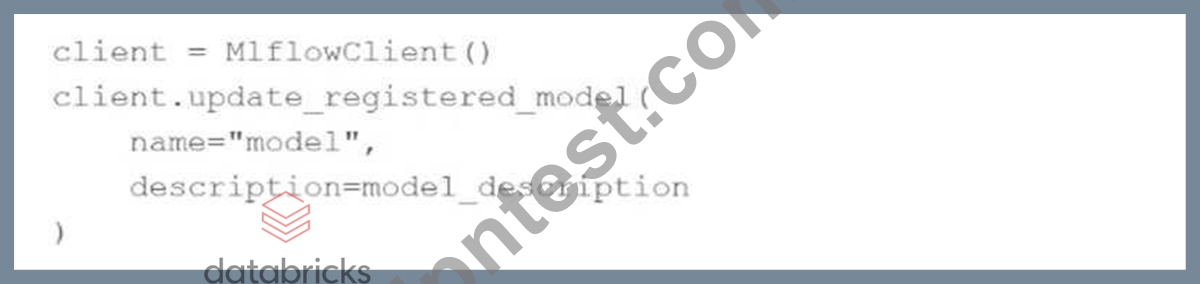
Which change does the team need to make to the above code block to accomplish the task?
- A. Replace client.update_registered_model with mlflow
- B. There no changes necessary
- C. Add a Python model as an argument to update_registered_model
- D. Replace description with artifact
- E. Replace update_registered_model with update_model_version
正解:B
質問 # 116
......
完全版は2026年最新のDatabricks-Machine-Learning-Professional試験問題集テストガイドはトレーニング専門JPNTest:https://www.jpntest.com/shiken/Databricks-Machine-Learning-Professional-mondaishu
合格準備Databricks-Machine-Learning-ProfessionalにはJPNTestが提供するあなたをDatabricks Certified Machine Learning Professional試験合格させます顕著練習問題:https://drive.google.com/open?id=1F7_7yYZvmOrt2wRUOUKLDgYZz4uDuv5P