

無料でゲット!最新の2025年最新の有効な練習ML Data Scientist Databricks-Machine-Learning-Associate問題と解答でテストエンジン
Databricks-Machine-Learning-Associate問題集PDFで100%合格保証付き
質問 # 15
A health organization is developing a classification model to determine whether or not a patient currently has a specific type of infection. The organization's leaders want to maximize the number of positive cases identified by the model.
Which of the following classification metrics should be used to evaluate the model?
- A. RMSE
- B. Recall
- C. Precision
- D. Area under the residual operating curve
- E. Accuracy
正解:B
解説:
When the goal is to maximize the identification of positive cases in a classification task, the metric of interest is Recall. Recall, also known as sensitivity, measures the proportion of actual positives that are correctly identified by the model (i.e., the true positive rate). It is crucial for scenarios where missing a positive case (false negative) has serious implications, such as in medical diagnostics. The other metrics like Precision, RMSE, and Accuracy serve different aspects of performance measurement and are not specifically focused on maximizing the detection of positive cases alone.
Reference:
Classification Metrics in Machine Learning (Understanding Recall).
質問 # 16
A data scientist has produced three new models for a single machine learning problem. In the past, the solution used just one model. All four models have nearly the same prediction latency, but a machine learning engineer suggests that the new solution will be less time efficient during inference.
In which situation will the machine learning engineer be correct?
- A. When the new solution requires that each model computes a prediction for every record
- B. When the new solution requires if-else logic determining which model to use to compute each prediction
- C. When the new solution requires the use of fewer feature variables than the original model
- D. When the new solution's models have an average latency that is larger than the size of the original model
- E. When the new solution's models have an average size that is larger than the size of the original model
正解:A
解説:
If the new solution requires that each of the three models computes a prediction for every record, the time efficiency during inference will be reduced. This is because the inference process now involves running multiple models instead of a single model, thereby increasing the overall computation time for each record.
In scenarios where inference must be done by multiple models for each record, the latency accumulates, making the process less time efficient compared to using a single model.
Reference:
Model Ensemble Techniques
質問 # 17
Which of the following hyperparameter optimization methods automatically makes informed selections of hyperparameter values based on previous trials for each iterative model evaluation?
- A. Halving Random Search
- B. Tree of Parzen Estimators
- C. Grid Search
- D. Random Search
正解:B
解説:
Tree of Parzen Estimators (TPE) is a sequential model-based optimization algorithm that selects hyperparameter values based on the outcomes of previous trials. It models the probability density of good and bad hyperparameter values and makes informed decisions about which hyperparameters to try next.
This approach contrasts with methods like random search and grid search, which do not use information from previous trials to guide the search process.
Reference:
Hyperopt and TPE
質問 # 18
A data scientist learned during their training to always use 5-fold cross-validation in their model development workflow. A colleague suggests that there are cases where a train-validation split could be preferred over k-fold cross-validation when k > 2.
Which of the following describes a potential benefit of using a train-validation split over k-fold cross-validation in this scenario?
- A. Bias is avoidable when using a train-validation split
- B. Reproducibility is achievable when using a train-validation split
- C. Fewer models need to be trained when using a train-validation split
- D. A holdout set is not necessary when using a train-validation split
- E. Fewer hyperparameter values need to be tested when using a train-validation split
正解:C
質問 # 19
Which of the following tools can be used to distribute large-scale feature engineering without the use of a UDF or pandas Function API for machine learning pipelines?
- A. Spark ML
- B. PvTorch
- C. Keras
- D. pandas
- E. Scikit-learn
正解:A
解説:
Spark ML (Machine Learning Library) is designed specifically for handling large-scale data processing and machine learning tasks directly within Apache Spark. It provides tools and APIs for large-scale feature engineering without the need to rely on user-defined functions (UDFs) or pandas Function API, allowing for more scalable and efficient data transformations directly distributed across a Spark cluster. Unlike Keras, pandas, PyTorch, and scikit-learn, Spark ML operates natively in a distributed environment suitable for big data scenarios.
Reference:
Spark MLlib documentation (Feature Engineering with Spark ML).
質問 # 20
A machine learning engineer would like to develop a linear regression model with Spark ML to predict the price of a hotel room. They are using the Spark DataFrame train_df to train the model.
The Spark DataFrame train_df has the following schema:
The machine learning engineer shares the following code block:
Which of the following changes does the machine learning engineer need to make to complete the task?
- A. They need to utilize a Pipeline to fit the model
- B. They need to convert the features column to be a vector
- C. They do not need to make any changes
- D. They need to split the features column out into one column for each feature
- E. They need to call the transform method on train df
正解:B
解説:
In Spark ML, the linear regression model expects the feature column to be a vector type. However, if the features column in the DataFrame train_df is not already in this format (such as being a column of type UDT or a non-vectorized type), the engineer needs to convert it to a vector column using a transformer like VectorAssembler. This is a critical step in preparing the data for modeling as Spark ML models require input features to be combined into a single vector column.
Reference
Spark MLlib documentation for LinearRegression: https://spark.apache.org/docs/latest/ml-classification-regression.html#linear-regression
質問 # 21
A data scientist is using Spark SQL to import their data into a machine learning pipeline. Once the data is imported, the data scientist performs machine learning tasks using Spark ML.
Which of the following compute tools is best suited for this use case?
- A. None of these compute tools support this task
- B. Standard cluster
- C. Single Node cluster
- D. SQL Warehouse
正解:B
解説:
For a data scientist using Spark SQL to import data and then performing machine learning tasks using Spark ML, the best-suited compute tool is a Standard cluster. A Standard cluster in Databricks provides the necessary resources and scalability to handle large datasets and perform distributed computing tasks efficiently, making it ideal for running Spark SQL and Spark ML operations.
Reference:
Databricks documentation on clusters: Clusters in Databricks
質問 # 22
An organization is developing a feature repository and is electing to one-hot encode all categorical feature variables. A data scientist suggests that the categorical feature variables should not be one-hot encoded within the feature repository.
Which of the following explanations justifies this suggestion?
- A. One-hot encoding is dependent on the target variable's values which differ for each apaplication.
- B. One-hot encoding is computationally intensive and should only be performed on small samples of training sets for individual machine learning problems.
- C. One-hot encoding is not a common strategy for representing categorical feature variables numerically.
- D. One-hot encoding is a potentially problematic categorical variable strategy for some machine learning algorithms.
正解:D
解説:
The suggestion not to one-hot encode categorical feature variables within the feature repository is justified because one-hot encoding can be problematic for some machine learning algorithms. Specifically, one-hot encoding increases the dimensionality of the data, which can be computationally expensive and may lead to issues such as multicollinearity and overfitting. Additionally, some algorithms, such as tree-based methods, can handle categorical variables directly without requiring one-hot encoding.
Reference:
Databricks documentation on feature engineering: Feature Engineering
質問 # 23
Which of the following machine learning algorithms typically uses bagging?
- A. Random forest
- B. K-means
- C. Decision tree
- D. IGradient boosted trees
正解:A
解説:
Random Forest is a machine learning algorithm that typically uses bagging (Bootstrap Aggregating). Bagging is a technique that involves training multiple base models (such as decision trees) on different subsets of the data and then combining their predictions to improve overall model performance. Each subset is created by randomly sampling with replacement from the original dataset. The Random Forest algorithm builds multiple decision trees and merges them to get a more accurate and stable prediction.
Reference:
Databricks documentation on Random Forest: Random Forest in Spark ML
質問 # 24
A data scientist has defined a Pandas UDF function predict to parallelize the inference process for a single-node model: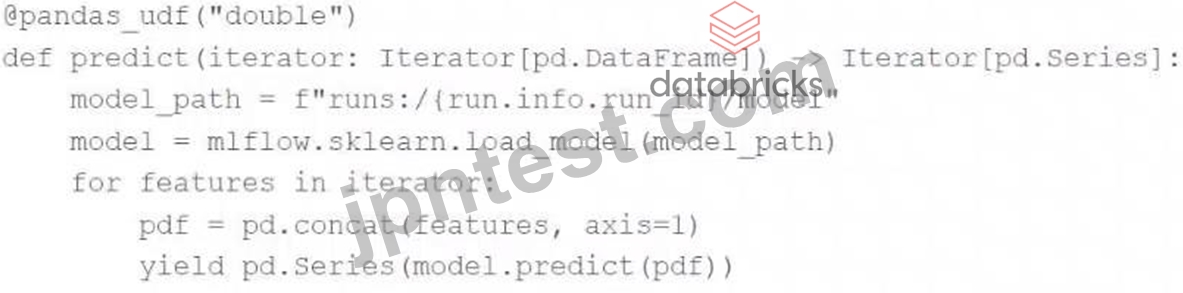
They have written the following incomplete code block to use predict to score each record of Spark DataFrame spark_df: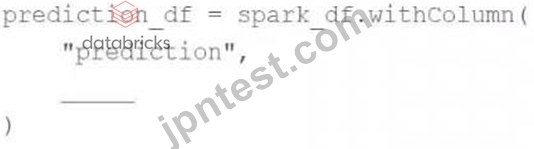
Which of the following lines of code can be used to complete the code block to successfully complete the task?
- A. predict(Iterator(spark_df))
- B. predict(spark_df.columns)
- C. predict(*spark_df.columns)
- D. mapInPandas(predict)
- E. mapInPandas(predict(spark_df.columns))
正解:D
解説:
To apply the Pandas UDF predict to each record of a Spark DataFrame, you use the mapInPandas method. This method allows the Pandas UDF to operate on partitions of the DataFrame as pandas DataFrames, applying the specified function (predict in this case) to each partition. The correct code completion to execute this is simply mapInPandas(predict), which specifies the UDF to use without additional arguments or incorrect function calls.
Reference:
PySpark DataFrame documentation (Using mapInPandas with UDFs).
質問 # 25
A data scientist is wanting to explore the Spark DataFrame spark_df. The data scientist wants visual histograms displaying the distribution of numeric features to be included in the exploration.
Which of the following lines of code can the data scientist run to accomplish the task?
- A. spark_df.describe()
- B. This task cannot be accomplished in a single line of code.
- C. spark_df.summary()
- D. dbutils.data.summarize (spark_df)
- E. dbutils.data(spark_df).summarize()
正解:D
解説:
To display visual histograms and summaries of the numeric features in a Spark DataFrame, the Databricks utility function dbutils.data.summarize can be used. This function provides a comprehensive summary, including visual histograms.
Correct code:
dbutils.data.summarize(spark_df)
Other options like spark_df.describe() and spark_df.summary() provide textual statistical summaries but do not include visual histograms.
Reference:
Databricks Utilities Documentation
質問 # 26
A machine learning engineering team has a Job with three successive tasks. Each task runs a single notebook. The team has been alerted that the Job has failed in its latest run.
Which of the following approaches can the team use to identify which task is the cause of the failure?
- A. Review the matrix view in the Job's runs
- B. Run each notebook interactively
- C. Change each Task's setting to use a dedicated cluster
- D. Migrate the Job to a Delta Live Tables pipeline
正解:A
解説:
To identify which task is causing the failure in the job, the team should review the matrix view in the Job's runs. The matrix view provides a clear and detailed overview of each task's status, allowing the team to quickly identify which task failed. This approach is more efficient than running each notebook interactively, as it provides immediate insights into the job's execution flow and any issues that occurred during the run.
Reference:
Databricks documentation on Jobs: Jobs in Databricks
質問 # 27
Which of the following is a benefit of using vectorized pandas UDFs instead of standard PySpark UDFs?
- A. The vectorized pandas UDFs process data in batches rather than one row at a time
- B. The vectorized pandas UDFs allow for the use of type hints
- C. The vectorized pandas UDFs allow for pandas API use inside of the function
- D. The vectorized pandas UDFs work on distributed DataFrames
- E. The vectorized pandas UDFs process data in memory rather than spilling to disk
正解:A
解説:
Vectorized pandas UDFs, also known as Pandas UDFs, are a powerful feature in PySpark that allows for more efficient operations than standard UDFs. They operate by processing data in batches, utilizing vectorized operations that leverage pandas to perform operations on whole batches of data at once. This approach is much more efficient than processing data row by row as is typical with standard PySpark UDFs, which can significantly speed up the computation.
Reference
PySpark Documentation on UDFs: https://spark.apache.org/docs/latest/api/python/user_guide/sql/arrow_pandas.html#pandas-udfs-a-k-a-vectorized-udfs
質問 # 28
A data scientist learned during their training to always use 5-fold cross-validation in their model development workflow. A colleague suggests that there are cases where a train-validation split could be preferred over k-fold cross-validation when k > 2.
Which of the following describes a potential benefit of using a train-validation split over k-fold cross-validation in this scenario?
- A. Bias is avoidable when using a train-validation split
- B. Reproducibility is achievable when using a train-validation split
- C. Fewer models need to be trained when using a train-validation split
- D. A holdout set is not necessary when using a train-validation split
- E. Fewer hyperparameter values need to be tested when using a train-validation split
正解:C
解説:
A train-validation split is often preferred over k-fold cross-validation (with k > 2) when computational efficiency is a concern. With a train-validation split, only two models (one on the training set and one on the validation set) are trained, whereas k-fold cross-validation requires training k models (one for each fold).
This reduction in the number of models trained can save significant computational resources and time, especially when dealing with large datasets or complex models.
Reference:
Model Evaluation with Train-Test Split
質問 # 29
A data scientist is developing a single-node machine learning model. They have a large number of model configurations to test as a part of their experiment. As a result, the model tuning process takes too long to complete. Which of the following approaches can be used to speed up the model tuning process?
- A. Enable autoscaling clusters
- B. Parallelize with Hyperopt
- C. Scale up with Spark ML
- D. Implement MLflow Experiment Tracking
正解:B
解説:
To speed up the model tuning process when dealing with a large number of model configurations, parallelizing the hyperparameter search using Hyperopt is an effective approach. Hyperopt provides tools like SparkTrials which can run hyperparameter optimization in parallel across a Spark cluster.
Example:
from hyperopt import fmin, tpe, hp, SparkTrials search_space = { 'x': hp.uniform('x', 0, 1), 'y': hp.uniform('y', 0, 1) } def objective(params): return params['x'] ** 2 + params['y'] ** 2 spark_trials = SparkTrials(parallelism=4) best = fmin(fn=objective, space=search_space, algo=tpe.suggest, max_evals=100, trials=spark_trials) Reference:
Hyperopt Documentation
質問 # 30
Which of the following tools can be used to parallelize the hyperparameter tuning process for single-node machine learning models using a Spark cluster?
- A. Autoscaling clusters
- B. Spark ML
- C. MLflow Experiment Tracking
- D. Autoscaling clusters
- E. Delta Lake
正解:B
解説:
Spark ML (part of Apache Spark's MLlib) is designed to handle machine learning tasks across multiple nodes in a cluster, effectively parallelizing tasks like hyperparameter tuning. It supports various machine learning algorithms that can be optimized over a Spark cluster, making it suitable for parallelizing hyperparameter tuning for single-node machine learning models when they are adapted to run on Spark.
Reference
Apache Spark MLlib Guide: https://spark.apache.org/docs/latest/ml-guide.html Spark ML is a library within Apache Spark designed for scalable machine learning. It provides tools to handle large-scale machine learning tasks, including parallelizing the hyperparameter tuning process for single-node machine learning models using a Spark cluster. Here's a detailed explanation of how Spark ML can be used:
Hyperparameter Tuning with CrossValidator: Spark ML includes the CrossValidator and TrainValidationSplit classes, which are used for hyperparameter tuning. These classes can evaluate multiple sets of hyperparameters in parallel using a Spark cluster.
from pyspark.ml.tuning import CrossValidator, ParamGridBuilder
from pyspark.ml.evaluation import BinaryClassificationEvaluator
# Define the model
model = ...
# Create a parameter grid
paramGrid = ParamGridBuilder() \
.addGrid(model.hyperparam1, [value1, value2]) \
.addGrid(model.hyperparam2, [value3, value4]) \
.build()
# Define the evaluator
evaluator = BinaryClassificationEvaluator()
# Define the CrossValidator
crossval = CrossValidator(estimator=model,
estimatorParamMaps=paramGrid,
evaluator=evaluator,
numFolds=3)
Parallel Execution: Spark distributes the tasks of training models with different hyperparameters across the cluster's nodes. Each node processes a subset of the parameter grid, which allows multiple models to be trained simultaneously.
Scalability: Spark ML leverages the distributed computing capabilities of Spark. This allows for efficient processing of large datasets and training of models across many nodes, which speeds up the hyperparameter tuning process significantly compared to single-node computations.
Reference
Apache Spark MLlib Documentation
Hyperparameter Tuning in Spark ML
質問 # 31
A data scientist has been given an incomplete notebook from the data engineering team. The notebook uses a Spark DataFrame spark_df on which the data scientist needs to perform further feature engineering. Unfortunately, the data scientist has not yet learned the PySpark DataFrame API.
Which of the following blocks of code can the data scientist run to be able to use the pandas API on Spark?
- A. spark_df.to_sql()
- B. import pandas as pd
df = pd.DataFrame(spark_df) - C. spark_df.to_pandas()
- D. import pyspark.pandas as ps
df = ps.to_pandas(spark_df) - E. import pyspark.pandas as ps
df = ps.DataFrame(spark_df)
正解:E
解説:
To use the pandas API on Spark, which is designed to bridge the gap between the simplicity of pandas and the scalability of Spark, the correct approach involves importing the pyspark.pandas (recently renamed to pandas_api_on_spark) module and converting a Spark DataFrame to a pandas-on-Spark DataFrame using this API. The provided syntax correctly initializes a pandas-on-Spark DataFrame, allowing the data scientist to work with the familiar pandas-like API on large datasets managed by Spark.
Reference
Pandas API on Spark Documentation: https://spark.apache.org/docs/latest/api/python/user_guide/pandas_on_spark/index.html
質問 # 32
A machine learning engineer is trying to perform batch model inference. They want to get predictions using the linear regression model saved at the path model_uri for the DataFrame batch_df.
batch_df has the following schema:
customer_id STRING
The machine learning engineer runs the following code block to perform inference on batch_df using the linear regression model at model_uri: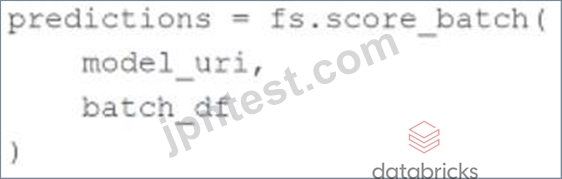
In which situation will the machine learning engineer's code block perform the desired inference?
- A. When all of the features used by the model at model_uri are in a Spark DataFrame in the PySpark
- B. When all of the features used by the model at model_uri are in a single Feature Store table
- C. When the Feature Store feature set was logged with the model at model_uri
- D. This code block will not perform the desired inference in any situation.
- E. When the model at model_uri only uses customer_id as a feature
正解:C
解説:
The code block provided by the machine learning engineer will perform the desired inference when the Feature Store feature set was logged with the model at model_uri. This ensures that all necessary feature transformations and metadata are available for the model to make predictions. The Feature Store in Databricks allows for seamless integration of features and models, ensuring that the required features are correctly used during inference.
Reference:
Databricks documentation on Feature Store: Feature Store in Databricks
質問 # 33
A data scientist is wanting to explore summary statistics for Spark DataFrame spark_df. The data scientist wants to see the count, mean, standard deviation, minimum, maximum, and interquartile range (IQR) for each numerical feature.
Which of the following lines of code can the data scientist run to accomplish the task?
- A. spark_df.describe().head()
- B. spark_df.printSchema()
- C. spark_df.toPandas()
- D. spark_df.summary ()
- E. spark_df.stats()
正解:D
解説:
The summary() function in PySpark's DataFrame API provides descriptive statistics which include count, mean, standard deviation, min, max, and quantiles for numeric columns. Here are the steps on how it can be used:
Import PySpark: Ensure PySpark is installed and correctly configured in the Databricks environment.
Load Data: Load the data into a Spark DataFrame.
Apply Summary: Use spark_df.summary() to generate summary statistics.
View Results: The output from the summary() function includes the statistics specified in the query (count, mean, standard deviation, min, max, and potentially quartiles which approximate the interquartile range).
Reference
PySpark Documentation: https://spark.apache.org/docs/latest/api/python/reference/api/pyspark.sql.DataFrame.summary.html
質問 # 34
A machine learning engineer wants to parallelize the training of group-specific models using the Pandas Function API. They have developed the train_model function, and they want to apply it to each group of DataFrame df.
They have written the following incomplete code block: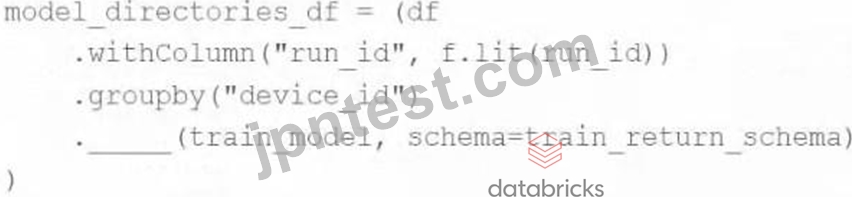
Which of the following pieces of code can be used to fill in the above blank to complete the task?
- A. train_model
- B. groupedApplyIn
- C. mapInPandas
- D. predict
- E. applyInPandas
正解:C
解説:
The function mapInPandas in the PySpark DataFrame API allows for applying a function to each partition of the DataFrame. When working with grouped data, groupby followed by applyInPandas is the correct approach to apply a function to each group as a separate Pandas DataFrame. However, if the function should apply across each partition of the grouped data rather than on each individual group, mapInPandas would be utilized. Since the code snippet indicates the use of groupby, the intent seems to be to apply train_model on each group specifically, which aligns with applyInPandas. Thus, applyInPandas is a better fit to ensure that each group generated by groupby is processed through the train_model function, preserving the partitioning and grouping integrity.
Reference
PySpark Documentation on applying functions to grouped data: https://spark.apache.org/docs/latest/api/python/reference/api/pyspark.sql.GroupedData.applyInPandas.html
質問 # 35
A machine learning engineer wants to parallelize the inference of group-specific models using the Pandas Function API. They have developed the apply_model function that will look up and load the correct model for each group, and they want to apply it to each group of DataFrame df.
They have written the following incomplete code block:
Which piece of code can be used to fill in the above blank to complete the task?
- A. applyInPandas
- B. groupedApplyInPandas
- C. mapInPandas
- D. predict
正解:A
解説:
To parallelize the inference of group-specific models using the Pandas Function API in PySpark, you can use the applyInPandas function. This function allows you to apply a Python function on each group of a DataFrame and return a DataFrame, leveraging the power of pandas UDFs (user-defined functions) for better performance.
prediction_df = ( df.groupby("device_id") .applyInPandas(apply_model, schema=apply_return_schema) ) In this code:
groupby("device_id"): Groups the DataFrame by the "device_id" column.
applyInPandas(apply_model, schema=apply_return_schema): Applies the apply_model function to each group and specifies the schema of the return DataFrame.
Reference:
PySpark Pandas UDFs Documentation
質問 # 36
A data scientist uses 3-fold cross-validation and the following hyperparameter grid when optimizing model hyperparameters via grid search for a classification problem:
* Hyperparameter 1: [2, 5, 10]
* Hyperparameter 2: [50, 100]
Which of the following represents the number of machine learning models that can be trained in parallel during this process?
- A. 0
- B. 1
- C. 2
- D. 3
正解:A
解説:
To determine the number of machine learning models that can be trained in parallel, we need to calculate the total number of combinations of hyperparameters. The given hyperparameter grid includes:
Hyperparameter 1: [2, 5, 10] (3 values)
Hyperparameter 2: [50, 100] (2 values)
The total number of combinations is the product of the number of values for each hyperparameter: 3 (values of Hyperparameter 1)×2 (values of Hyperparameter 2)=63 (values of Hyperparameter 1)×2 (values of Hyperparameter 2)=6 With 3-fold cross-validation, each combination of hyperparameters will be evaluated 3 times. Thus, the total number of models trained will be: 6 (combinations)×3 (folds)=186 (combinations)×3 (folds)=18 However, the number of models that can be trained in parallel is equal to the number of hyperparameter combinations, not the total number of models considering cross-validation. Therefore, 6 models can be trained in parallel.
Reference:
Databricks documentation on hyperparameter tuning: Hyperparameter Tuning
質問 # 37
The implementation of linear regression in Spark ML first attempts to solve the linear regression problem using matrix decomposition, but this method does not scale well to large datasets with a large number of variables.
Which of the following approaches does Spark ML use to distribute the training of a linear regression model for large data?
- A. Logistic regression
- B. Least-squares method
- C. Spark ML cannot distribute linear regression training
- D. Singular value decomposition
- E. Iterative optimization
正解:E
解説:
For large datasets with many variables, Spark ML distributes the training of a linear regression model using iterative optimization methods. Specifically, Spark ML employs algorithms such as Gradient Descent or L-BFGS (Limited-memory Broyden-Fletcher-Goldfarb-Shanno) to iteratively minimize the loss function. These iterative methods are suitable for distributed computing environments and can handle large-scale data efficiently by partitioning the data across nodes in a cluster and performing parallel updates.
Reference:
Spark MLlib Documentation (Linear Regression with Iterative Optimization).
質問 # 38
A team is developing guidelines on when to use various evaluation metrics for classification problems. The team needs to provide input on when to use the F1 score over accuracy.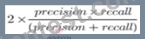
Which of the following suggestions should the team include in their guidelines?
- A. The F1 score should be utilized over accuracy when there are greater than two classes in the target variable.
- B. The F1 score should be utilized over accuracy when there is significant imbalance between positive and negative classes and avoiding false negatives is a priority.
- C. The F1 score should be utilized over accuracy when identifying true positives and true negatives are equally important to the business problem.
- D. The F1 score should be utilized over accuracy when the number of actual positive cases is identical to the number of actual negative cases.
正解:B
解説:
The F1 score is the harmonic mean of precision and recall and is particularly useful in situations where there is a significant imbalance between positive and negative classes. When there is a class imbalance, accuracy can be misleading because a model can achieve high accuracy by simply predicting the majority class. The F1 score, however, provides a better measure of the test's accuracy in terms of both false positives and false negatives.
Specifically, the F1 score should be used over accuracy when:
There is a significant imbalance between positive and negative classes.
Avoiding false negatives is a priority, meaning recall (the ability to detect all positive instances) is crucial.
In this scenario, the F1 score balances both precision (the ability to avoid false positives) and recall, providing a more meaningful measure of a model's performance under these conditions.
Reference:
Databricks documentation on classification metrics: Classification Metrics
質問 # 39
An organization is developing a feature repository and is electing to one-hot encode all categorical feature variables. A data scientist suggests that the categorical feature variables should not be one-hot encoded within the feature repository.
Which of the following explanations justifies this suggestion?
- A. One-hot encoding is not supported by most machine learning libraries.
- B. One-hot encoding is computationally intensive and should only be performed on small samples of training sets for individual machine learning problems.
- C. One-hot encoding is not a common strategy for representing categorical feature variables numerically.
- D. One-hot encoding is a potentially problematic categorical variable strategy for some machine learning algorithms.
- E. One-hot encoding is dependent on the target variable's values which differ for each application.
正解:D
解説:
One-hot encoding transforms categorical variables into a format that can be provided to machine learning algorithms to better predict the output. However, when done prematurely or universally within a feature repository, it can be problematic:
Dimensionality Increase: One-hot encoding significantly increases the feature space, especially with high cardinality features, which can lead to high memory consumption and slower computation.
Model Specificity: Some models handle categorical variables natively (like decision trees and boosting algorithms), and premature one-hot encoding can lead to inefficiency and loss of information (e.g., ordinal relationships).
Sparse Matrix Issue: It often results in a sparse matrix where most values are zero, which can be inefficient in both storage and computation for some algorithms.
Generalization vs. Specificity: Encoding should ideally be tailored to specific models and use cases rather than applied generally in a feature repository.
Reference
"Feature Engineering and Selection: A Practical Approach for Predictive Models" by Max Kuhn and Kjell Johnson (CRC Press, 2019).
質問 # 40
......
Databricks-Machine-Learning-Associateブレーン問題集リアル試験最新問題2025年04月08日には76問題:https://www.jpntest.com/shiken/Databricks-Machine-Learning-Associate-mondaishu
最新Databricks-Machine-Learning-Associate問題集リアル無料テストPDF本日更新です:https://drive.google.com/open?id=1E4-1nNrJt4APvKFQfCxYPeJiCxb93hQa