

Databricks-Machine-Learning-AssociateのPDF試験材料2024年最新の実際に出るDatabricks-Machine-Learning-Associate問題集
更新されたのはDatabricks Databricks-Machine-Learning-Associate問題集PDFオンラインエンジン
質問 # 17
Which of the following describes the relationship between native Spark DataFrames and pandas API on Spark DataFrames?
- A. pandas API on Spark DataFrames are single-node versions of Spark DataFrames with additional metadata
- B. pandas API on Spark DataFrames are unrelated to Spark DataFrames
- C. pandas API on Spark DataFrames are made up of Spark DataFrames and additional metadata
- D. pandas API on Spark DataFrames are more performant than Spark DataFrames
- E. pandas API on Spark DataFrames are less mutable versions of Spark DataFrames
正解:C
解説:
Pandas API on Spark (previously known as Koalas) provides a pandas-like API on top of Apache Spark. It allows users to perform pandas operations on large datasets using Spark's distributed compute capabilities. Internally, it uses Spark DataFrames and adds metadata that facilitates handling operations in a pandas-like manner, ensuring compatibility and leveraging Spark's performance and scalability.
Reference
pandas API on Spark documentation: https://spark.apache.org/docs/latest/api/python/user_guide/pandas_on_spark/index.html
質問 # 18
Which of the following statements describes a Spark ML estimator?
- A. An estimator chains multiple alqorithms toqether to specify an ML workflow
- B. An estimator is an evaluation tool to assess to the quality of a model
- C. An estimator is a trained ML model which turns a DataFrame with features into a DataFrame with predictions
- D. An estimator is an alqorithm which can be fit on a DataFrame to produce a Transformer
- E. An estimator is a hyperparameter arid that can be used to train a model
正解:D
解説:
In the context of Spark MLlib, an estimator refers to an algorithm which can be "fit" on a DataFrame to produce a model (referred to as a Transformer), which can then be used to transform one DataFrame into another, typically adding predictions or model scores. This is a fundamental concept in machine learning pipelines in Spark, where the workflow includes fitting estimators to data to produce transformers.
Reference
Spark MLlib Documentation: https://spark.apache.org/docs/latest/ml-pipeline.html#estimators
質問 # 19
A machine learning engineer is trying to scale a machine learning pipeline by distributing its feature engineering process.
Which of the following feature engineering tasks will be the least efficient to distribute?
- A. One-hot encoding categorical features
- B. Target encoding categorical features
- C. Creating binary indicator features for missing values
- D. Imputing missing feature values with the true median
- E. Imputing missing feature values with the mean
正解:D
解説:
Among the options listed, calculating the true median for imputing missing feature values is the least efficient to distribute. This is because the true median requires knowledge of the entire data distribution, which can be computationally expensive in a distributed environment. Unlike mean or mode, finding the median requires sorting the data or maintaining a full distribution, which is more intensive and often requires shuffling the data across partitions.
Reference
Challenges in parallel processing and distributed computing for data aggregation like median calculation: https://www.apache.org
質問 # 20
Which of the following describes the relationship between native Spark DataFrames and pandas API on Spark DataFrames?
- A. pandas API on Spark DataFrames are single-node versions of Spark DataFrames with additional metadata
- B. pandas API on Spark DataFrames are made up of Spark DataFrames and additional metadata
- C. pandas API on Spark DataFrames are more performant than Spark DataFrames
- D. pandas API on Spark DataFrames are less mutable versions of Spark DataFrames
正解:B
解説:
The pandas API on Spark DataFrames are made up of Spark DataFrames with additional metadata. The pandas API on Spark aims to provide the pandas-like experience with the scalability and distributed nature of Spark. It allows users to work with pandas functions on large datasets by leveraging Spark's underlying capabilities.
Reference:
Databricks documentation on pandas API on Spark: pandas API on Spark
質問 # 21
A machine learning engineer wants to parallelize the inference of group-specific models using the Pandas Function API. They have developed the apply_model function that will look up and load the correct model for each group, and they want to apply it to each group of DataFrame df.
They have written the following incomplete code block:
Which piece of code can be used to fill in the above blank to complete the task?
- A. groupedApplyInPandas
- B. applyInPandas
- C. predict
- D. mapInPandas
正解:B
解説:
To parallelize the inference of group-specific models using the Pandas Function API in PySpark, you can use the applyInPandas function. This function allows you to apply a Python function on each group of a DataFrame and return a DataFrame, leveraging the power of pandas UDFs (user-defined functions) for better performance.
prediction_df = ( df.groupby("device_id") .applyInPandas(apply_model, schema=apply_return_schema) ) In this code:
groupby("device_id"): Groups the DataFrame by the "device_id" column.
applyInPandas(apply_model, schema=apply_return_schema): Applies the apply_model function to each group and specifies the schema of the return DataFrame.
Reference:
PySpark Pandas UDFs Documentation
質問 # 22
Which statement describes a Spark ML transformer?
- A. A transformer chains multiple algorithms together to transform an ML workflow
- B. A transformer is an algorithm which can transform one DataFrame into another DataFrame
- C. A transformer is a learning algorithm that can use a DataFrame to train a model
- D. A transformer is a hyperparameter grid that can be used to train a model
正解:B
解説:
In Spark ML, a transformer is an algorithm that can transform one DataFrame into another DataFrame. It takes a DataFrame as input and produces a new DataFrame as output. This transformation can involve adding new columns, modifying existing ones, or applying feature transformations. Examples of transformers in Spark MLlib include feature transformers like StringIndexer, VectorAssembler, and StandardScaler.
Reference:
Databricks documentation on transformers: Transformers in Spark ML
質問 # 23
A data scientist uses 3-fold cross-validation and the following hyperparameter grid when optimizing model hyperparameters via grid search for a classification problem:
* Hyperparameter 1: [2, 5, 10]
* Hyperparameter 2: [50, 100]
Which of the following represents the number of machine learning models that can be trained in parallel during this process?
- A. 0
- B. 1
- C. 2
- D. 3
正解:A
解説:
To determine the number of machine learning models that can be trained in parallel, we need to calculate the total number of combinations of hyperparameters. The given hyperparameter grid includes:
Hyperparameter 1: [2, 5, 10] (3 values)
Hyperparameter 2: [50, 100] (2 values)
The total number of combinations is the product of the number of values for each hyperparameter: 3 (values of Hyperparameter 1)×2 (values of Hyperparameter 2)=63 (values of Hyperparameter 1)×2 (values of Hyperparameter 2)=6 With 3-fold cross-validation, each combination of hyperparameters will be evaluated 3 times. Thus, the total number of models trained will be: 6 (combinations)×3 (folds)=186 (combinations)×3 (folds)=18 However, the number of models that can be trained in parallel is equal to the number of hyperparameter combinations, not the total number of models considering cross-validation. Therefore, 6 models can be trained in parallel.
Reference:
Databricks documentation on hyperparameter tuning: Hyperparameter Tuning
質問 # 24
A data scientist has developed a linear regression model using Spark ML and computed the predictions in a Spark DataFrame preds_df with the following schema:
prediction DOUBLE
actual DOUBLE
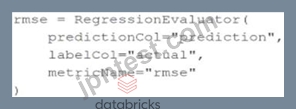
Which of the following code blocks can be used to compute the root mean-squared-error of the model according to the data in preds_df and assign it to the rmse variable?
- A.
- B.
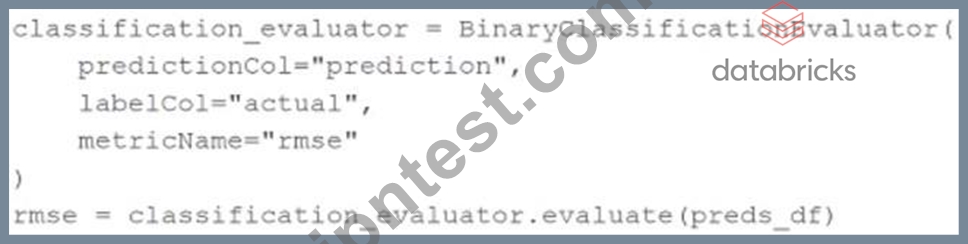
- C.
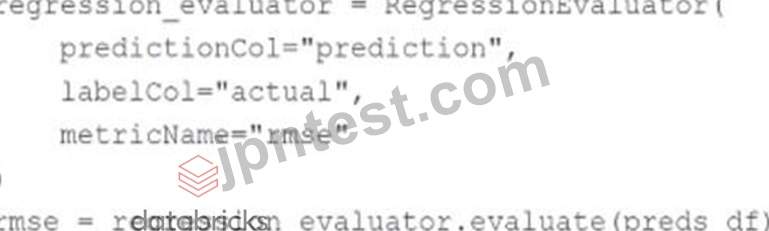
- D.
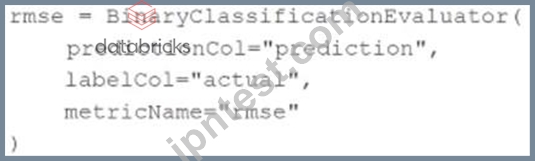
正解:C
解説:
To compute the root mean-squared-error (RMSE) of a linear regression model using Spark ML, the RegressionEvaluator class is used. The RegressionEvaluator is specifically designed for regression tasks and can calculate various metrics, including RMSE, based on the columns containing predictions and actual values.
The correct code block to compute RMSE from the preds_df DataFrame is:
regression_evaluator = RegressionEvaluator( predictionCol="prediction", labelCol="actual", metricName="rmse" ) rmse = regression_evaluator.evaluate(preds_df) This code creates an instance of RegressionEvaluator, specifying the prediction and label columns, as well as the metric to be computed ("rmse"). It then evaluates the predictions in preds_df and assigns the resulting RMSE value to the rmse variable.
Options A and B incorrectly use BinaryClassificationEvaluator, which is not suitable for regression tasks. Option D also incorrectly uses BinaryClassificationEvaluator.
Reference:
PySpark ML Documentation
質問 # 25
A machine learning engineer is using the following code block to scale the inference of a single-node model on a Spark DataFrame with one million records: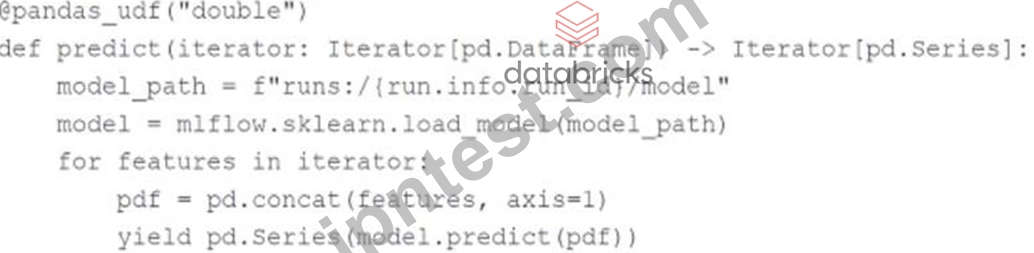
Assuming the default Spark configuration is in place, which of the following is a benefit of using an Iterator?
- A. The model will be limited to a single executor preventing the data from being distributed
- B. The data will be distributed across multiple executors during the inference process
- C. The model only needs to be loaded once per executor rather than once per batch during the inference process
- D. The data will be limited to a single executor preventing the model from being loaded multiple times
正解:C
解説:
Using an iterator in the pandas_udf ensures that the model only needs to be loaded once per executor rather than once per batch. This approach reduces the overhead associated with repeatedly loading the model during the inference process, leading to more efficient and faster predictions. The data will be distributed across multiple executors, but each executor will load the model only once, optimizing the inference process.
Reference:
Databricks documentation on pandas UDFs: Pandas UDFs
質問 # 26
A data scientist has a Spark DataFrame spark_df. They want to create a new Spark DataFrame that contains only the rows from spark_df where the value in column price is greater than 0.
Which of the following code blocks will accomplish this task?
- A. spark_df[spark_df["price"] > 0]
- B. spark_df.filter(col("price") > 0)
- C. SELECT * FROM spark_df WHERE price > 0
- D. spark_df.loc[:,spark_df["price"] > 0]
- E. spark_df.loc[spark_df["price"] > 0,:]
正解:B
解説:
To filter rows in a Spark DataFrame based on a condition, you use the filter method along with a column condition. The correct syntax in PySpark to accomplish this task is spark_df.filter(col("price") > 0), which filters the DataFrame to include only those rows where the value in the "price" column is greater than 0. The col function is used to specify column-based operations. The other options provided either do not use correct Spark DataFrame syntax or are intended for different types of data manipulation frameworks like pandas.
Reference:
PySpark DataFrame API documentation (Filtering DataFrames).
質問 # 27
A data scientist has developed a random forest regressor rfr and included it as the final stage in a Spark MLPipeline pipeline. They then set up a cross-validation process with pipeline as the estimator in the following code block: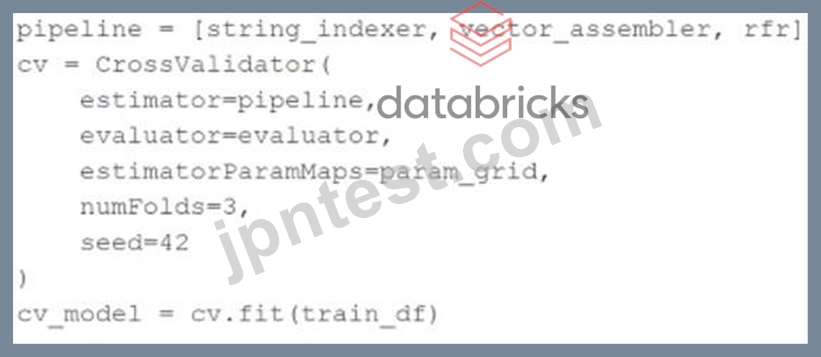
Which of the following is a negative consequence of including pipeline as the estimator in the cross-validation process rather than rfr as the estimator?
- A. The process will leak data prep information from the validation sets to the training sets for each model
- B. The process will leak data from the training set to the test set during the evaluation phase
- C. The process will be unable to parallelize tuning due to the distributed nature of pipeline
- D. The process will have a longer runtime because all stages of pipeline need to be refit or retransformed with each mode
正解:D
解説:
Including the entire pipeline as the estimator in the cross-validation process means that all stages of the pipeline, including data preprocessing steps like string indexing and vector assembling, will be refit or retransformed for each fold of the cross-validation. This results in a longer runtime because each fold requires re-execution of these preprocessing steps, which can be computationally expensive.
If only the random forest regressor (rfr) were included as the estimator, the preprocessing steps would be performed once, and only the model fitting would be repeated for each fold, significantly reducing the computational overhead.
Reference:
Databricks documentation on cross-validation: Cross Validation
質問 # 28
A data scientist learned during their training to always use 5-fold cross-validation in their model development workflow. A colleague suggests that there are cases where a train-validation split could be preferred over k-fold cross-validation when k > 2.
Which of the following describes a potential benefit of using a train-validation split over k-fold cross-validation in this scenario?
- A. A holdout set is not necessary when using a train-validation split
- B. Reproducibility is achievable when using a train-validation split
- C. Fewer models need to be trained when using a train-validation split
- D. Fewer hyperparameter values need to be tested when using a train-validation split
- E. Bias is avoidable when using a train-validation split
正解:C
質問 # 29
A data scientist is using MLflow to track their machine learning experiment. As a part of each of their MLflow runs, they are performing hyperparameter tuning. The data scientist would like to have one parent run for the tuning process with a child run for each unique combination of hyperparameter values. All parent and child runs are being manually started with mlflow.start_run.
Which of the following approaches can the data scientist use to accomplish this MLflow run organization?
- A. They can specify nested=True when starting the child run for each unique combination of hyperparameter values
- B. They can specify nested=True when starting the parent run for the tuning process
- C. They can start each child run with the same experiment ID as the parent run
- D. They can start each child run inside the parent run's indented code block using mlflow.start runO
- E. They can turn on Databricks Autologging
正解:A
解説:
To organize MLflow runs with one parent run for the tuning process and a child run for each unique combination of hyperparameter values, the data scientist can specify nested=True when starting the child run. This approach ensures that each child run is properly nested under the parent run, maintaining a clear hierarchical structure for the experiment. This nesting helps in tracking and comparing different hyperparameter combinations within the same tuning process.
Reference:
MLflow Documentation (Managing Nested Runs).
質問 # 30
A data scientist wants to use Spark ML to one-hot encode the categorical features in their PySpark DataFrame features_df. A list of the names of the string columns is assigned to the input_columns variable.
They have developed this code block to accomplish this task: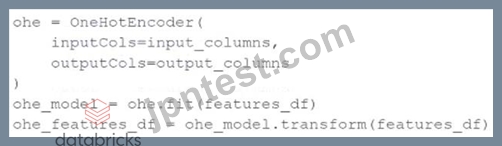
The code block is returning an error.
Which of the following adjustments does the data scientist need to make to accomplish this task?
- A. They need to use Stringlndexer prior to one-hot encodinq the features.
- B. They need to use VectorAssembler prior to one-hot encoding the features.
- C. They need to remove the line with the fit operation.
- D. They need to specify the method parameter to the OneHotEncoder.
正解:A
解説:
The OneHotEncoder in Spark ML requires numerical indices as inputs rather than string labels. Therefore, you need to first convert the string columns to numerical indices using StringIndexer. After that, you can apply OneHotEncoder to these indices.
Corrected code:
from pyspark.ml.feature import StringIndexer, OneHotEncoder # Convert string column to index indexers = [StringIndexer(inputCol=col, outputCol=col+"_index") for col in input_columns] indexer_model = Pipeline(stages=indexers).fit(features_df) indexed_features_df = indexer_model.transform(features_df) # One-hot encode the indexed columns ohe = OneHotEncoder(inputCols=[col+"_index" for col in input_columns], outputCols=output_columns) ohe_model = ohe.fit(indexed_features_df) ohe_features_df = ohe_model.transform(indexed_features_df) Reference:
PySpark ML Documentation
質問 # 31
A data scientist is using Spark ML to engineer features for an exploratory machine learning project.
They decide they want to standardize their features using the following code block: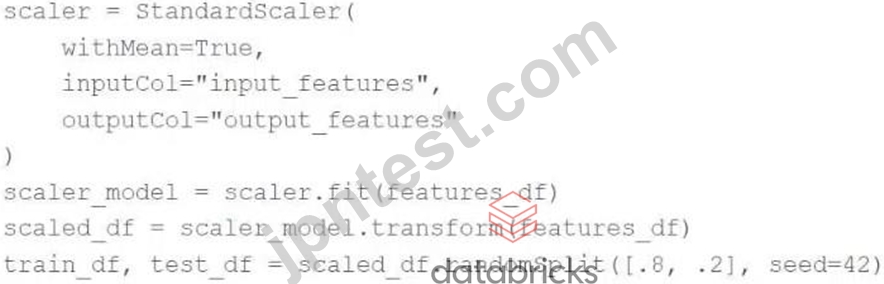
Upon code review, a colleague expressed concern with the features being standardized prior to splitting the data into a training set and a test set.
Which of the following changes can the data scientist make to address the concern?
- A. Utilize the Pipeline API to standardize the training data according to the test data's summary statistics
- B. Utilize the Pipeline API to standardize the test data according to the training data's summary statistics
- C. Utilize the MinMaxScaler object to standardize the test data according to global minimum and maximum values
- D. Utilize a cross-validation process rather than a train-test split process to remove the need for standardizing data
- E. Utilize the MinMaxScaler object to standardize the training data according to global minimum and maximum values
正解:B
解説:
To address the concern about standardizing features prior to splitting the data, the correct approach is to use the Pipeline API to ensure that only the training data's summary statistics are used to standardize the test data. This is achieved by fitting the StandardScaler (or any scaler) on the training data and then transforming both the training and test data using the fitted scaler. This approach prevents information leakage from the test data into the model training process and ensures that the model is evaluated fairly.
Reference:
Best Practices in Preprocessing in Spark ML (Handling Data Splits and Feature Standardization).
質問 # 32
A data scientist has created a linear regression model that uses log(price) as a label variable. Using this model, they have performed inference and the predictions and actual label values are in Spark DataFrame preds_df.
They are using the following code block to evaluate the model:
regression_evaluator.setMetricName("rmse").evaluate(preds_df)
Which of the following changes should the data scientist make to evaluate the RMSE in a way that is comparable with price?
- A. They should exponentiate the predictions before computing the RMSE
- B. They should exponentiate the computed RMSE value
- C. They should evaluate the MSE of the log predictions to compute the RMSE
- D. They should take the log of the predictions before computing the RMSE
正解:A
解説:
When evaluating the RMSE for a model that predicts log-transformed prices, the predictions need to be transformed back to the original scale to obtain an RMSE that is comparable with the actual price values. This is done by exponentiating the predictions before computing the RMSE. The RMSE should be computed on the same scale as the original data to provide a meaningful measure of error.
Reference:
Databricks documentation on regression evaluation: Regression Evaluation
質問 # 33
A data scientist has developed a machine learning pipeline with a static input data set using Spark ML, but the pipeline is taking too long to process. They increase the number of workers in the cluster to get the pipeline to run more efficiently. They notice that the number of rows in the training set after reconfiguring the cluster is different from the number of rows in the training set prior to reconfiguring the cluster.
Which of the following approaches will guarantee a reproducible training and test set for each model?
- A. Set a speed in the data splitting operation
- B. Manually configure the cluster
- C. Write out the split data sets to persistent storage
- D. Manually partition the input data
正解:C
解説:
To ensure reproducible training and test sets, writing the split data sets to persistent storage is a reliable approach. This allows you to consistently load the same training and test data for each model run, regardless of cluster reconfiguration or other changes in the environment.
Correct approach:
Split the data.
Write the split data to persistent storage (e.g., HDFS, S3).
Load the data from storage for each model training session.
train_df, test_df = spark_df.randomSplit([0.8, 0.2], seed=42) train_df.write.parquet("path/to/train_df.parquet") test_df.write.parquet("path/to/test_df.parquet") # Later, load the data train_df = spark.read.parquet("path/to/train_df.parquet") test_df = spark.read.parquet("path/to/test_df.parquet") Reference:
Spark DataFrameWriter Documentation
質問 # 34
A data scientist wants to tune a set of hyperparameters for a machine learning model. They have wrapped a Spark ML model in the objective function objective_function and they have defined the search space search_space.
As a result, they have the following code block: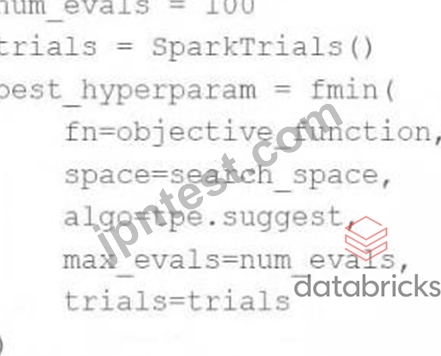
Which of the following changes do they need to make to the above code block in order to accomplish the task?
- A. Remove the trials=trials argument
- B. Reduce num_evals to be less than 10
- C. Remove the algo=tpe.suggest argument
- D. Change fmin() to fmax()
- E. Change SparkTrials() to Trials()
正解:E
解説:
The SparkTrials() is used to distribute trials of hyperparameter tuning across a Spark cluster. If the environment does not support Spark or if the user prefers not to use distributed computing for this purpose, switching to Trials() would be appropriate. Trials() is the standard class for managing search trials in Hyperopt but does not distribute the computation. If the user is encountering issues with SparkTrials() possibly due to an unsupported configuration or an error in the cluster setup, using Trials() can be a suitable change for running the optimization locally or in a non-distributed manner.
Reference
Hyperopt documentation: http://hyperopt.github.io/hyperopt/
質問 # 35
A data scientist wants to parallelize the training of trees in a gradient boosted tree to speed up the training process. A colleague suggests that parallelizing a boosted tree algorithm can be difficult.
Which of the following describes why?
- A. Gradient boosting is an iterative algorithm that requires information from the previous iteration to perform the next step.
- B. Gradient boosting calculates gradients in evaluation metrics using all cores which prevents parallelization.
- C. Gradient boosting requires access to all data at once which cannot happen during parallelization.
- D. Gradient boosting is not a linear algebra-based algorithm which is required for parallelization
正解:A
解説:
Gradient boosting is fundamentally an iterative algorithm where each new tree is built based on the errors of the previous ones. This sequential dependency makes it difficult to parallelize the training of trees in gradient boosting, as each step relies on the results from the preceding step. Parallelization in this context would undermine the core methodology of the algorithm, which depends on sequentially improving the model's performance with each iteration.
Reference:
Machine Learning Algorithms (Challenges with Parallelizing Gradient Boosting).
Gradient boosting is an ensemble learning technique that builds models in a sequential manner. Each new model corrects the errors made by the previous ones. This sequential dependency means that each iteration requires the results of the previous iteration to make corrections. Here is a step-by-step explanation of why this makes parallelization challenging:
Sequential Nature: Gradient boosting builds one tree at a time. Each tree is trained to correct the residual errors of the previous trees. This requires the model to complete one iteration before starting the next.
Dependence on Previous Iterations: The gradient calculation at each step depends on the predictions made by the previous models. Therefore, the model must wait until the previous tree has been fully trained and evaluated before starting to train the next tree.
Difficulty in Parallelization: Because of this dependency, it is challenging to parallelize the training process. Unlike algorithms that process data independently in each step (e.g., random forests), gradient boosting cannot easily distribute the work across multiple processors or cores for simultaneous execution.
This iterative and dependent nature of the gradient boosting process makes it difficult to parallelize effectively.
Reference
Gradient Boosting Machine Learning Algorithm
Understanding Gradient Boosting Machines
質問 # 36
Which of the following approaches can be used to view the notebook that was run to create an MLflow run?
- A. Open the MLmodel artifact in the MLflow run paqe
- B. Click the "Start Time" link in the row corresponding to the run in the MLflow experiment page
- C. Click the "Source" link in the row corresponding to the run in the MLflow experiment page
- D. Click the "Models" link in the row corresponding to the run in the MLflow experiment paqe
正解:C
解説:
To view the notebook that was run to create an MLflow run, you can click the "Source" link in the row corresponding to the run in the MLflow experiment page. The "Source" link provides a direct reference to the source notebook or script that initiated the run, allowing you to review the code and methodology used in the experiment. This feature is particularly useful for reproducibility and for understanding the context of the experiment.
Reference:
MLflow Documentation (Viewing Run Sources and Notebooks).
質問 # 37
A machine learning engineer is trying to perform batch model inference. They want to get predictions using the linear regression model saved at the path model_uri for the DataFrame batch_df.
batch_df has the following schema:
customer_id STRING
The machine learning engineer runs the following code block to perform inference on batch_df using the linear regression model at model_uri: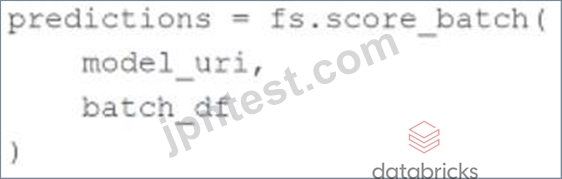
In which situation will the machine learning engineer's code block perform the desired inference?
- A. This code block will not perform the desired inference in any situation.
- B. When the model at model_uri only uses customer_id as a feature
- C. When all of the features used by the model at model_uri are in a single Feature Store table
- D. When all of the features used by the model at model_uri are in a Spark DataFrame in the PySpark
- E. When the Feature Store feature set was logged with the model at model_uri
正解:E
解説:
The code block provided by the machine learning engineer will perform the desired inference when the Feature Store feature set was logged with the model at model_uri. This ensures that all necessary feature transformations and metadata are available for the model to make predictions. The Feature Store in Databricks allows for seamless integration of features and models, ensuring that the required features are correctly used during inference.
Reference:
Databricks documentation on Feature Store: Feature Store in Databricks
質問 # 38
......
Databricks Databricks-Machine-Learning-Associate問題集PDFのベストを目指すなら問題集を使おう!高得点目指すならここ:https://www.jpntest.com/shiken/Databricks-Machine-Learning-Associate-mondaishu
Databricks-Machine-Learning-AssociateのPDFで問題解答!PDFサンプル問題は信頼され続ける:https://drive.google.com/open?id=1E4-1nNrJt4APvKFQfCxYPeJiCxb93hQa