

2025年03月最新のDatabricks Databricks-Machine-Learning-Associate問題集で更新された76問あります
PDF無料ダウンロードにはDatabricks-Machine-Learning-Associate有効な練習テスト問題
質問 # 22
A data scientist is using Spark ML to engineer features for an exploratory machine learning project.
They decide they want to standardize their features using the following code block: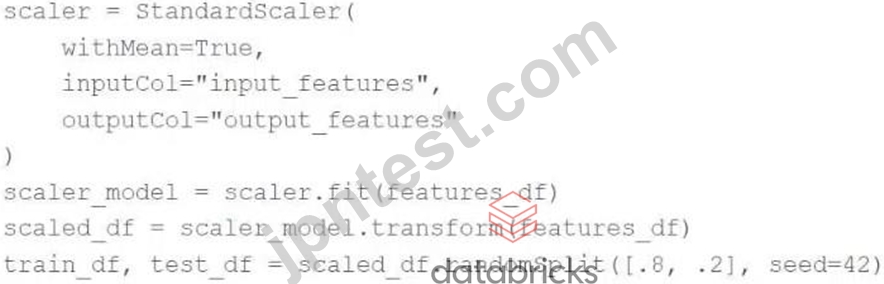
Upon code review, a colleague expressed concern with the features being standardized prior to splitting the data into a training set and a test set.
Which of the following changes can the data scientist make to address the concern?
- A. Utilize the MinMaxScaler object to standardize the training data according to global minimum and maximum values
- B. Utilize the Pipeline API to standardize the test data according to the training data's summary statistics
- C. Utilize a cross-validation process rather than a train-test split process to remove the need for standardizing data
- D. Utilize the MinMaxScaler object to standardize the test data according to global minimum and maximum values
- E. Utilize the Pipeline API to standardize the training data according to the test data's summary statistics
正解:B
解説:
To address the concern about standardizing features prior to splitting the data, the correct approach is to use the Pipeline API to ensure that only the training data's summary statistics are used to standardize the test data. This is achieved by fitting the StandardScaler (or any scaler) on the training data and then transforming both the training and test data using the fitted scaler. This approach prevents information leakage from the test data into the model training process and ensures that the model is evaluated fairly.
Reference:
Best Practices in Preprocessing in Spark ML (Handling Data Splits and Feature Standardization).
質問 # 23
A data scientist is working with a feature set with the following schema: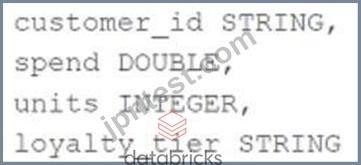
The customer_id column is the primary key in the feature set. Each of the columns in the feature set has missing values. They want to replace the missing values by imputing a common value for each feature.
Which of the following lists all of the columns in the feature set that need to be imputed using the most common value of the column?
- A. customer_id
- B. loyalty_tier
- C. customer_id, loyalty_tier
- D. units
- E. spend
正解:B
解説:
For the feature set schema provided, the columns that need to be imputed using the most common value (mode) are typically the categorical columns. In this case, loyalty_tier is the only categorical column that should be imputed using the most common value. customer_id is a unique identifier and should not be imputed, while spend and units are numerical columns that should typically be imputed using the mean or median values, not the mode.
Reference:
Databricks documentation on missing value imputation: Handling Missing Data If you need any further clarification or additional questions answered, please let me know!
質問 # 24
A data scientist has developed a linear regression model using Spark ML and computed the predictions in a Spark DataFrame preds_df with the following schema:
prediction DOUBLE
actual DOUBLE
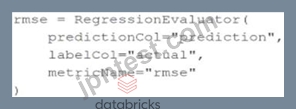
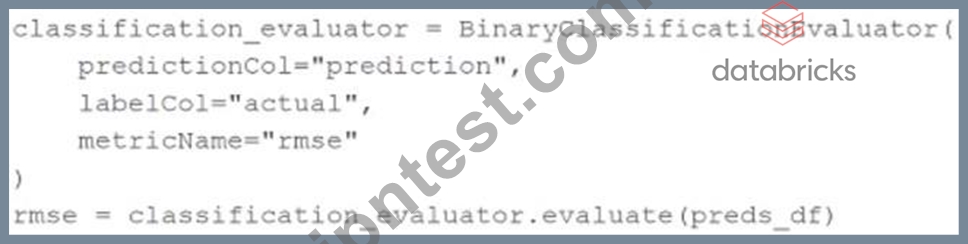
Which of the following code blocks can be used to compute the root mean-squared-error of the model according to the data in preds_df and assign it to the rmse variable?
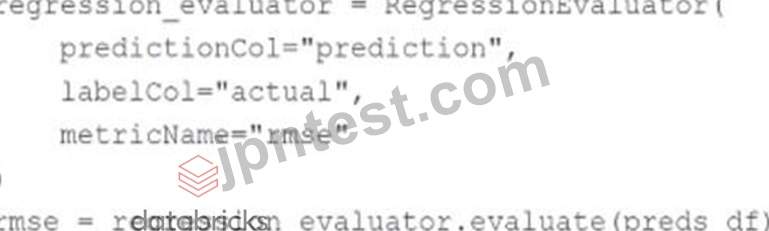
- A.
- B.
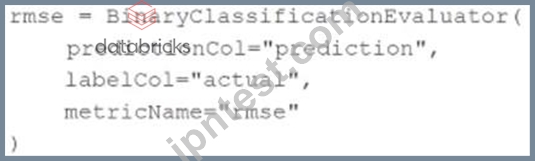
- C.
- D.
正解:A
解説:
To compute the root mean-squared-error (RMSE) of a linear regression model using Spark ML, the RegressionEvaluator class is used. The RegressionEvaluator is specifically designed for regression tasks and can calculate various metrics, including RMSE, based on the columns containing predictions and actual values.
The correct code block to compute RMSE from the preds_df DataFrame is:
regression_evaluator = RegressionEvaluator( predictionCol="prediction", labelCol="actual", metricName="rmse" ) rmse = regression_evaluator.evaluate(preds_df) This code creates an instance of RegressionEvaluator, specifying the prediction and label columns, as well as the metric to be computed ("rmse"). It then evaluates the predictions in preds_df and assigns the resulting RMSE value to the rmse variable.
Options A and B incorrectly use BinaryClassificationEvaluator, which is not suitable for regression tasks. Option D also incorrectly uses BinaryClassificationEvaluator.
Reference:
PySpark ML Documentation
質問 # 25
A data scientist is using MLflow to track their machine learning experiment. As a part of each of their MLflow runs, they are performing hyperparameter tuning. The data scientist would like to have one parent run for the tuning process with a child run for each unique combination of hyperparameter values. All parent and child runs are being manually started with mlflow.start_run.
Which of the following approaches can the data scientist use to accomplish this MLflow run organization?
- A. They can turn on Databricks Autologging
- B. They can start each child run inside the parent run's indented code block using mlflow.start runO
- C. They can start each child run with the same experiment ID as the parent run
- D. They can specify nested=True when starting the child run for each unique combination of hyperparameter values
- E. They can specify nested=True when starting the parent run for the tuning process
正解:D
解説:
To organize MLflow runs with one parent run for the tuning process and a child run for each unique combination of hyperparameter values, the data scientist can specify nested=True when starting the child run. This approach ensures that each child run is properly nested under the parent run, maintaining a clear hierarchical structure for the experiment. This nesting helps in tracking and comparing different hyperparameter combinations within the same tuning process.
Reference:
MLflow Documentation (Managing Nested Runs).
質問 # 26
A health organization is developing a classification model to determine whether or not a patient currently has a specific type of infection. The organization's leaders want to maximize the number of positive cases identified by the model.
Which of the following classification metrics should be used to evaluate the model?
- A. RMSE
- B. Recall
- C. Precision
- D. Accuracy
- E. Area under the residual operating curve
正解:B
解説:
When the goal is to maximize the identification of positive cases in a classification task, the metric of interest is Recall. Recall, also known as sensitivity, measures the proportion of actual positives that are correctly identified by the model (i.e., the true positive rate). It is crucial for scenarios where missing a positive case (false negative) has serious implications, such as in medical diagnostics. The other metrics like Precision, RMSE, and Accuracy serve different aspects of performance measurement and are not specifically focused on maximizing the detection of positive cases alone.
Reference:
Classification Metrics in Machine Learning (Understanding Recall).
質問 # 27
Which of the following statements describes a Spark ML estimator?
- A. An estimator is a trained ML model which turns a DataFrame with features into a DataFrame with predictions
- B. An estimator is an evaluation tool to assess to the quality of a model
- C. An estimator is an alqorithm which can be fit on a DataFrame to produce a Transformer
- D. An estimator is a hyperparameter arid that can be used to train a model
- E. An estimator chains multiple alqorithms toqether to specify an ML workflow
正解:C
解説:
In the context of Spark MLlib, an estimator refers to an algorithm which can be "fit" on a DataFrame to produce a model (referred to as a Transformer), which can then be used to transform one DataFrame into another, typically adding predictions or model scores. This is a fundamental concept in machine learning pipelines in Spark, where the workflow includes fitting estimators to data to produce transformers.
Reference
Spark MLlib Documentation: https://spark.apache.org/docs/latest/ml-pipeline.html#estimators
質問 # 28
A data scientist has written a data cleaning notebook that utilizes the pandas library, but their colleague has suggested that they refactor their notebook to scale with big data.
Which of the following approaches can the data scientist take to spend the least amount of time refactoring their notebook to scale with big data?
- A. They can refactor their notebook to process the data in parallel.
- B. They can refactor their notebook to utilize the pandas API on Spark.
- C. They can refactor their notebook to use the PySpark DataFrame API.
- D. They can refactor their notebook to use the Scala Dataset API.
- E. They can refactor their notebook to use Spark SQL.
正解:B
解説:
The data scientist can refactor their notebook to utilize the pandas API on Spark (now known as pandas on Spark, formerly Koalas). This allows for the least amount of changes to the existing pandas-based code while scaling to handle big data using Spark's distributed computing capabilities. pandas on Spark provides a similar API to pandas, making the transition smoother and faster compared to completely rewriting the code to use PySpark DataFrame API, Scala Dataset API, or Spark SQL.
Reference:
Databricks documentation on pandas API on Spark (formerly Koalas).
質問 # 29
Which of the following tools can be used to distribute large-scale feature engineering without the use of a UDF or pandas Function API for machine learning pipelines?
- A. PyTorch
- B. Keras
- C. Scikit-learn
- D. Spark ML
正解:D
解説:
Spark MLlib is a machine learning library within Apache Spark that provides scalable and distributed machine learning algorithms. It is designed to work with Spark DataFrames and leverages Spark's distributed computing capabilities to perform large-scale feature engineering and model training without the need for user-defined functions (UDFs) or the pandas Function API. Spark MLlib provides built-in transformations and algorithms that can be applied directly to large datasets.
Reference:
Databricks documentation on Spark MLlib: Spark MLlib
質問 # 30
A data scientist is wanting to explore the Spark DataFrame spark_df. The data scientist wants visual histograms displaying the distribution of numeric features to be included in the exploration.
Which of the following lines of code can the data scientist run to accomplish the task?
- A. This task cannot be accomplished in a single line of code.
- B. dbutils.data(spark_df).summarize()
- C. spark_df.summary()
- D. spark_df.describe()
- E. dbutils.data.summarize (spark_df)
正解:E
解説:
To display visual histograms and summaries of the numeric features in a Spark DataFrame, the Databricks utility function dbutils.data.summarize can be used. This function provides a comprehensive summary, including visual histograms.
Correct code:
dbutils.data.summarize(spark_df)
Other options like spark_df.describe() and spark_df.summary() provide textual statistical summaries but do not include visual histograms.
Reference:
Databricks Utilities Documentation
質問 # 31
A data scientist has produced three new models for a single machine learning problem. In the past, the solution used just one model. All four models have nearly the same prediction latency, but a machine learning engineer suggests that the new solution will be less time efficient during inference.
In which situation will the machine learning engineer be correct?
- A. When the new solution requires if-else logic determining which model to use to compute each prediction
- B. When the new solution's models have an average latency that is larger than the size of the original model
- C. When the new solution requires the use of fewer feature variables than the original model
- D. When the new solution's models have an average size that is larger than the size of the original model
- E. When the new solution requires that each model computes a prediction for every record
正解:E
解説:
If the new solution requires that each of the three models computes a prediction for every record, the time efficiency during inference will be reduced. This is because the inference process now involves running multiple models instead of a single model, thereby increasing the overall computation time for each record.
In scenarios where inference must be done by multiple models for each record, the latency accumulates, making the process less time efficient compared to using a single model.
Reference:
Model Ensemble Techniques
質問 # 32
A data scientist is using the following code block to tune hyperparameters for a machine learning model: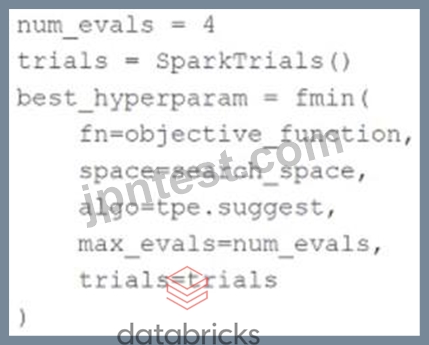
Which change can they make the above code block to improve the likelihood of a more accurate model?
- A. Change sparkTrials() to Trials()
- B. Change fmin() to fmax()
- C. Increase num_evals to 100
- D. Change tpe.suggest to random.suggest
正解:C
解説:
To improve the likelihood of a more accurate model, the data scientist can increase num_evals to 100. Increasing the number of evaluations allows the hyperparameter tuning process to explore a larger search space and evaluate more combinations of hyperparameters, which increases the chance of finding a more optimal set of hyperparameters for the model.
Reference:
Databricks documentation on hyperparameter tuning: Hyperparameter Tuning
質問 # 33
Which of the following machine learning algorithms typically uses bagging?
- A. K-means
- B. Decision tree
- C. Random forest
- D. IGradient boosted trees
正解:C
解説:
Random Forest is a machine learning algorithm that typically uses bagging (Bootstrap Aggregating). Bagging is a technique that involves training multiple base models (such as decision trees) on different subsets of the data and then combining their predictions to improve overall model performance. Each subset is created by randomly sampling with replacement from the original dataset. The Random Forest algorithm builds multiple decision trees and merges them to get a more accurate and stable prediction.
Reference:
Databricks documentation on Random Forest: Random Forest in Spark ML
質問 # 34
A data scientist has a Spark DataFrame spark_df. They want to create a new Spark DataFrame that contains only the rows from spark_df where the value in column price is greater than 0.
Which of the following code blocks will accomplish this task?
- A. spark_df.loc[:,spark_df["price"] > 0]
- B. spark_df.loc[spark_df["price"] > 0,:]
- C. spark_df.filter(col("price") > 0)
- D. spark_df[spark_df["price"] > 0]
- E. SELECT * FROM spark_df WHERE price > 0
正解:C
解説:
To filter rows in a Spark DataFrame based on a condition, you use the filter method along with a column condition. The correct syntax in PySpark to accomplish this task is spark_df.filter(col("price") > 0), which filters the DataFrame to include only those rows where the value in the "price" column is greater than 0. The col function is used to specify column-based operations. The other options provided either do not use correct Spark DataFrame syntax or are intended for different types of data manipulation frameworks like pandas.
Reference:
PySpark DataFrame API documentation (Filtering DataFrames).
質問 # 35
Which of the following tools can be used to parallelize the hyperparameter tuning process for single-node machine learning models using a Spark cluster?
- A. Autoscaling clusters
- B. Autoscaling clusters
- C. MLflow Experiment Tracking
- D. Delta Lake
- E. Spark ML
正解:E
解説:
Spark ML (part of Apache Spark's MLlib) is designed to handle machine learning tasks across multiple nodes in a cluster, effectively parallelizing tasks like hyperparameter tuning. It supports various machine learning algorithms that can be optimized over a Spark cluster, making it suitable for parallelizing hyperparameter tuning for single-node machine learning models when they are adapted to run on Spark.
Reference
Apache Spark MLlib Guide: https://spark.apache.org/docs/latest/ml-guide.html Spark ML is a library within Apache Spark designed for scalable machine learning. It provides tools to handle large-scale machine learning tasks, including parallelizing the hyperparameter tuning process for single-node machine learning models using a Spark cluster. Here's a detailed explanation of how Spark ML can be used:
Hyperparameter Tuning with CrossValidator: Spark ML includes the CrossValidator and TrainValidationSplit classes, which are used for hyperparameter tuning. These classes can evaluate multiple sets of hyperparameters in parallel using a Spark cluster.
from pyspark.ml.tuning import CrossValidator, ParamGridBuilder
from pyspark.ml.evaluation import BinaryClassificationEvaluator
# Define the model
model = ...
# Create a parameter grid
paramGrid = ParamGridBuilder() \
.addGrid(model.hyperparam1, [value1, value2]) \
.addGrid(model.hyperparam2, [value3, value4]) \
.build()
# Define the evaluator
evaluator = BinaryClassificationEvaluator()
# Define the CrossValidator
crossval = CrossValidator(estimator=model,
estimatorParamMaps=paramGrid,
evaluator=evaluator,
numFolds=3)
Parallel Execution: Spark distributes the tasks of training models with different hyperparameters across the cluster's nodes. Each node processes a subset of the parameter grid, which allows multiple models to be trained simultaneously.
Scalability: Spark ML leverages the distributed computing capabilities of Spark. This allows for efficient processing of large datasets and training of models across many nodes, which speeds up the hyperparameter tuning process significantly compared to single-node computations.
Reference
Apache Spark MLlib Documentation
Hyperparameter Tuning in Spark ML
質問 # 36
Which of the following describes the relationship between native Spark DataFrames and pandas API on Spark DataFrames?
- A. pandas API on Spark DataFrames are made up of Spark DataFrames and additional metadata
- B. pandas API on Spark DataFrames are less mutable versions of Spark DataFrames
- C. pandas API on Spark DataFrames are unrelated to Spark DataFrames
- D. pandas API on Spark DataFrames are single-node versions of Spark DataFrames with additional metadata
- E. pandas API on Spark DataFrames are more performant than Spark DataFrames
正解:A
解説:
Pandas API on Spark (previously known as Koalas) provides a pandas-like API on top of Apache Spark. It allows users to perform pandas operations on large datasets using Spark's distributed compute capabilities. Internally, it uses Spark DataFrames and adds metadata that facilitates handling operations in a pandas-like manner, ensuring compatibility and leveraging Spark's performance and scalability.
Reference
pandas API on Spark documentation: https://spark.apache.org/docs/latest/api/python/user_guide/pandas_on_spark/index.html
質問 # 37
......
Databricks Databricks-Machine-Learning-Associate 認定試験の出題範囲:
| トピック | 出題範囲 |
|---|---|
| トピック 1 |
|
| トピック 2 |
|
| トピック 3 |
|
| トピック 4 |
|
Databricks-Machine-Learning-Associateテストエンジンお試しセット、Databricks-Machine-Learning-Associate問題集PDF:https://www.jpntest.com/shiken/Databricks-Machine-Learning-Associate-mondaishu
最新のDatabricks Databricks-Machine-Learning-AssociateのPDFと問題集で(2025)無料試験問題解答はここ:https://drive.google.com/open?id=1cZZIcGBGCoSxl_AvtlD-hg7xB9tBCYIe