

究極のガイド準備で無料Microsoft DP-420試験問題と解答
合格させるMicrosoft DP-420テストエンジンPDFで完全版無料問題集
Microsoft DP-420試験は、Microsoft Azure Cosmos DBを使用してクラウドネイティブアプリケーションを設計および実装する能力と知識をテストするために設計されています。この試験は、Azureを使用してアプリケーションを開発し、クラウドコンピューティングと分散システムの原則を熟知している個人を対象としています。この試験に合格することは、分散環境でスケーラブルで高性能なクラウドネイティブアプリケーションを設計および構築する能力を示すことになります。
Azure Cosmos DBは、Microsoftが提供するグローバルに分散したマルチモデルデータベースサービスです。大量のデータをグローバルスケールで処理するために設計されており、ドキュメント、キー値、グラフ、カラムファミリーなど、複数のデータモデルをサポートしています。Azure Cosmos DBは、スケーラビリティ、高可用性、グローバル分散能力に優れたクラウドネイティブアプリケーションを構築するための人気のある選択肢です。
質問 # 16
You are designing an Azure Cosmos DB Core (SQL) API solution to store data from IoT devices. Writes from the devices will be occur every second.
The following is a sample of the data.
You need to select a partition key that meets the following requirements for writes:
Minimizes the partition skew
Avoids capacity limits
Avoids hot partitions
What should you do?
- A. Create a new synthetic key that contains deviceId and sensor1Value.
- B. Use timestamp as the partition key.
- C. Create a new synthetic key that contains deviceId and deviceManufacturer.
- D. Create a new synthetic key that contains deviceId and a random number.
正解:D
解説:
Use a partition key with a random suffix. Distribute the workload more evenly is to append a random number at the end of the partition key value. When you distribute items in this way, you can perform parallel write operations across partitions.
Incorrect Answers:
A: You will also not like to partition the data on "DateTime", because this will create a hot partition. Imagine you have partitioned the data on time, then for a given minute, all the calls will hit one partition. If you need to retrieve the data for a customer, then it will be a fan-out query because data may be distributed on all the partitions.
B: Senser1Value has only two values.
C: All the devices could have the same manufacturer.
質問 # 17
You have an Azure Cosmos DB Core (SQL) API account named storage1 that uses provisioned throughput capacity mode.
The storage1 account contains the databases shown in the following table.
The databases contain the containers shown in the following table.
For each of the following statements, select Yes if the statement is true. Otherwise, select No.
NOTE: Each correct selection is worth one point.
正解:
解説:
Reference:
https://docs.microsoft.com/en-us/azure/cosmos-db/plan-manage-costs
https://azure.microsoft.com/en-us/pricing/details/cosmos-db/
質問 # 18
You maintain a relational database for a book publisher. The database contains the following tables.
The most common query lists the books for a given authorId.
You need to develop a non-relational data model for Azure Cosmos DB Core (SQL) API that will replace the relational database. The solution must minimize latency and read operation costs.
What should you include in the solution?
- A. Create a container that contains a document for each Author and a document for each Book. In each Book document, embed authorId.
- B. Create a container for Author and a container for Book. In each Author document, embed bookId for each book by the author. In each Book document embed authorId of each author.
- C. Create a container for Author and a container for Book. In each Author document and Book document embed the data from Bookauthorlnk.
- D. Create Author, Book, and Bookauthorlnk documents in the same container.
正解:B
解説:
Explanation
Store multiple entity types in the same container.
質問 # 19
You have an Azure Cosmos DB for NoSQL account named account1 that supports an application named App1. App1 uses the consistent prefix consistency level.
You configure account1 to use a dedicated gateway and integrated cache.
You need to ensure that App1 can use the integrated cache.
Which two actions should you perform for APP1? Each correct answer presents part of the solution.
NOTE: Each correct selection is worth one point.
- A. Change the connection mode to direct
- B. Change the account endpoint to https://account1.documents.azure.com
- C. Change the consistency level of requests to session.
- D. Change the consistency level of requests to strong.
- E. Change the account endpoint to https://account1.sqlx.cosmos.azure.com.
正解:C、E
解説:
Explanation
the Azure Cosmos DB integrated cache is an in-memory cache that is built-in to the Azure Cosmos DB dedicated gateway. The dedicated gateway is a front-end compute that stores cached data and routes requests to the backend database. You can choose from a variety of dedicated gateway sizes based on the number of cores and memory needed for your workload1. The integrated cache can reduce the RU consumption and latency of read operations by serving them from the cache instead of the backend containers2.
For your scenario, to ensure that App1 can use the integrated cache, you should perform these two actions:
* Change the account endpoint to https://account1.sqlx.cosmos.azure.com. This is the dedicated gateway endpoint that you need to use to connect to your Azure Cosmos DB account and leverage the integrated cache. The standard gateway endpoint (https://account1.documents.azure.com) will not use the integrated cache2.
* Change the consistency level of requests to session. This is the highest consistency level that is supported by the integrated cache. If you use a higher consistency level (such as strong or bounded staleness), your requests will bypass the integrated cache and go directly to the backend containers
質問 # 20
You are implementing an Azure Data Factory data flow that will use an Azure Cosmos DB (SQL API) sink to write a dataset. The data flow will use 2,000 Apache Spark partitions.
You need to ensure that the ingestion from each Spark partition is balanced to optimize throughput.
Which sink setting should you configure?
- A. Throughput
- B. Write throughput budget
- C. Collection action
- D. Batch size
正解:D
解説:
Batch size: An integer that represents how many objects are being written to Cosmos DB collection in each batch. Usually, starting with the default batch size is sufficient. To further tune this value, note:
Cosmos DB limits single request's size to 2MB. The formula is "Request Size = Single Document Size * Batch Size". If you hit error saying "Request size is too large", reduce the batch size value.
The larger the batch size, the better throughput the service can achieve, while make sure you allocate enough RUs to empower your workload.
Incorrect Answers:
A: Throughput: Set an optional value for the number of RUs you'd like to apply to your CosmosDB collection for each execution of this data flow. Minimum is 400.
B: Write throughput budget: An integer that represents the RUs you want to allocate for this Data Flow write operation, out of the total throughput allocated to the collection.
D: Collection action: Determines whether to recreate the destination collection prior to writing.
None: No action will be done to the collection.
Recreate: The collection will get dropped and recreated
質問 # 21
You have an Azure Cosmos DB for NoSQL container. The container contains items that have the following properties.
You need to protect the data stored in the container by using Always Encrypted. For each property, you must use the strongest type of encryption and ensure that queries execute properly.
What is the strongest type of encryption that you can apply to each property? To answer, select the appropriate options in the answer area.
NOTE: Each correct selection is worth one point.
正解:
解説:
Explanation
Box 1 = Randomized
Box 2 = Deterministic
Always Encrypted for Azure Cosmos DB supports two types of encryption: deterministic and randomized1.
Deterministic encryption always produces the same encrypted value for any given plain text value.
Randomized encryption produces a different encrypted value for the same plain text value.
For dateOfBirth, randomized encryption is the strongest type of encryption because it provides better protection against statistical analysis and brute-force attacks. Deterministic encryption would not be suitable for dateOfBirth because it could reveal patterns or allow equality comparisons1.
For healthStatus, deterministic encryption is the strongest type of encryption because it allows queries to perform equality comparisons and filters on the encrypted property. Randomized encryption would not be suitable for healthStatus because it would prevent any queries on the encrypted property1.
質問 # 22
You have an application named App1 that reads the data in an Azure Cosmos DB Core (SQL) API account. App1 runs the same read queries every minute. The default consistency level for the account is set to eventual.
You discover that every query consumes request units (RUs) instead of using the cache.
You verify the IntegratedCacheiteItemHitRate metric and the IntegratedCacheQueryHitRate metric. Both metrics have values of 0.
You verify that the dedicated gateway cluster is provisioned and used in the connection string.
You need to ensure that App1 uses the Azure Cosmos DB integrated cache.
What should you configure?
- A. the default consistency level of the Azure Cosmos DB account
- B. the indexing policy of the Azure Cosmos DB container
- C. the consistency level of the requests from App1
- D. the connectivity mode of the App1 CosmosClient
正解:D
解説:
Because the integrated cache is specific to your Azure Cosmos DB account and requires significant CPU and memory, it requires a dedicated gateway node. Connect to Azure Cosmos DB using gateway mode.
質問 # 23
You configure a backup for an Azure Cosmos DB for NoSQL account as shown in the following exhibit.
Use the drop-down menus to select the answer choice that completes each statement based on the information presented in the graphic.
NOTE: Each correct selection is worth one point.
正解:
解説: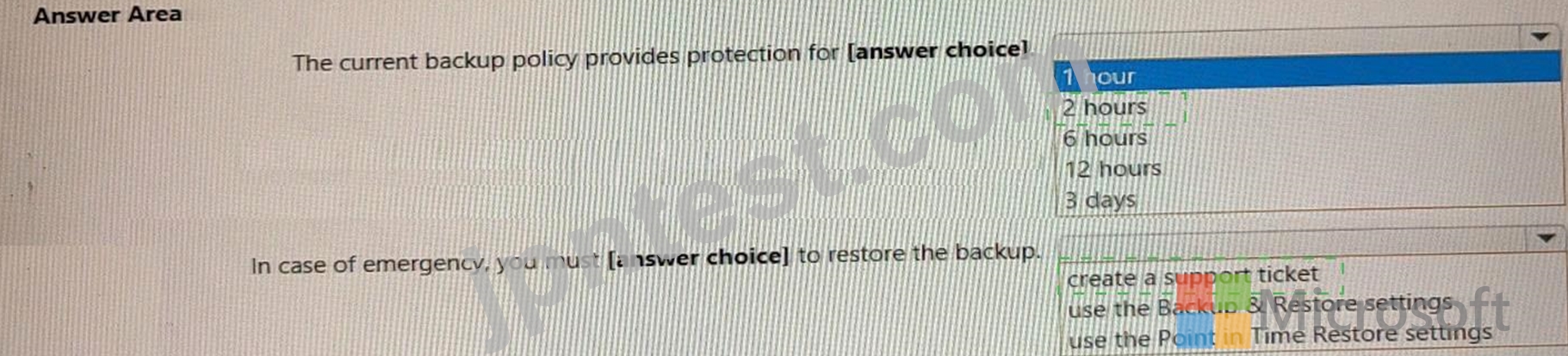
Explanation
Box 1 = The current backup policy provides protection for: 2 Hours Azure Cosmos DB automatically takes backups of your data at regular intervals. The backup interval and the retention period can be configured from the Azure portal. You can also choose between two backup modes: periodic backup mode and continuous backup mode. Periodic backup mode is the default mode for all existing accounts and it takes a full backup of your database every 4 hours by default. Continuous backup mode is a new mode that allows you to restore to any point of time within either 7 or 30 days1.
For your scenario, based on the exhibit, you have configured a backup for an Azure Cosmos DB for NoSQL account using the periodic backup mode with a backup interval of 1 hour and a retention period of 2 hours.
This means that Azure Cosmos DB will take a full backup of your database every hour and keep only the latest two backups. Therefore, the current backup policy provides protection for 2 hours.
Box 2: In case of emergency, you must (answer choice) to restore the backup = create a support ticket Azure Cosmos DB automatically takes backups of your data at regular intervals. You can configure the backup interval and the retention period from the Azure portal. You can also choose between two backup modes:
periodic backup mode and continuous backup mode. Periodic backup mode is the default mode for all existing accounts and it takes a full backup of your database every 4 hours by default. Continuous backup mode is a new mode that allows you to restore to any point of time within either 7 or 30 days1.
For your scenario, based on the exhibit, you have configured a backup for an Azure Cosmos DB for NoSQL account using the periodic backup mode with a backup interval of 1 hour and a retention period of 2 hours.
This means that Azure Cosmos DB will take a full backup of your database every hour and keep only the latest two backups. In case of emergency, you must create a support ticket to restore the backup. This is the answer to your question.
To restore data from a periodic backup, you need to create a support request with Azure Cosmos DB team and provide the following information:
* The name of your Azure Cosmos DB account
* The name of the database or container that you want to restore
* The date and time (in UTC) that you want to restore from
* The name of the target Azure Cosmos DB account where you want to restore the data
* The name of the target resource group where you want to restore the data The Azure Cosmos DB team will then initiate the restore process and notify you when it is completed2.
質問 # 24
You have an Azure Cosmos DB Core (SQL) API account.
You configure the diagnostic settings to send all log information to a Log Analytics workspace.
You need to identify when the provisioned request units per second (RU/s) for resources within the account were modified.
You write the following query.
AzureDiagnostics
| where Category == "ControlPlaneRequests"
What should you include in the query?
- A. | where OperationName startswith "MongoCollectionsThroughputUpdate"
- B. | where OperationName startswith "SqlContainersDelete"
- C. | where OperationName startswith "SqlContainersThroughputUpdate"
- D. | where OperationName startswith "AccountUpdateStart"
正解:D
解説:
The following are the operation names in diagnostic logs for different operations:
RegionAddStart, RegionAddComplete
RegionRemoveStart, RegionRemoveComplete
AccountDeleteStart, AccountDeleteComplete
RegionFailoverStart, RegionFailoverComplete
AccountCreateStart, AccountCreateComplete
*AccountUpdateStart*, AccountUpdateComplete
VirtualNetworkDeleteStart, VirtualNetworkDeleteComplete
DiagnosticLogUpdateStart, DiagnosticLogUpdateComplete
質問 # 25
You have a database in an Azure Cosmos DB Core (SQL) API account. The database is backed up every two hours.
You need to implement a solution that supports point-in-time restore.
What should you do first?
- A. Enable Continuous Backup for the account.
- B. Configure the Point In Time Restore settings for the account.
- C. Create a new account that has a periodic backup policy.
- D. Configure the Backup & Restore settings for the account.
正解:A
解説:
Reference: https://docs.microsoft.com/en-us/azure/cosmos-db/provision-account-continuous-backup
質問 # 26
You have the following query.
SELECT * FROM c
WHERE c.sensor = "TEMP1"
AND c.value < 22
AND c.timestamp >= 1619146031231
You need to recommend a composite index strategy that will minimize the request units (RUs) consumed by the query.
What should you recommend?
- A. a composite index for (value ASC, sensor ASC) and a composite index for (timestamp ASC, sensor ASC)
- B. a composite index for (sensor ASC, value ASC, timestamp ASC) and a composite index for (sensor DESC, value DESC, timestamp DESC)
- C. a composite index for (sensor ASC, value ASC, timestamp ASC)
- D. a composite index for (sensor ASC, value ASC) and a composite index for (sensor ASC, timestamp ASC)
正解:D
解説:
If a query has a filter with two or more properties, adding a composite index will improve performance.
Consider the following query:
SELECT * FROM c WHERE c.name = "Tim" and c.age > 18
In the absence of a composite index on (name ASC, and age ASC), we will utilize a range index for this query. We can improve the efficiency of this query by creating a composite index for name and age.
Queries with multiple equality filters and a maximum of one range filter (such as >,<, <=, >=, !=) will utilize the composite index.
質問 # 27
You have a database named db1 in an Azure Cosmos DB for NoSQL
You are designing an application that will use dbl.
In db1, you are creating a new container named coll1 that will store in coll1.
The following is a sample of a document that will be stored in coll1.
The application will have the following characteristics:
* New orders will be created frequently by different customers.
* Customers will often view their past order history.
You need to select the partition key value for coll1 to support the application. The solution must minimize costs.
To what should you set the partition key?
- A. id
- B. orderDate
- C. orderId
- D. customerId
正解:D
解説:
Explanation
Based on the characteristics of the application and the provided document structure, the most suitable partition key value for coll1 in the given scenario would be the customerId, Option B.
The application frequently creates new orders by different customers and customers often view their past order history. Using customerId as the partition key would ensure that all orders associated with a particular customer are stored in the same partition. This enables efficient querying of past order history for a specific customer and reduces cross-partition queries, resulting in lower costs and improved performance.
a partition key is a JSON property (or path) within your documents that is used by Azure Cosmos DB to distribute data among multiple partitions3. A partition key should have a high cardinality, which means it should have many distinct values, such as hundreds or thousands1. A partition key should also align with the most common query patterns of your application, so that you can efficiently retrieve data by using the partition key value1.
Based on these criteria, one possible partition key that you could use for coll1 is B. customerId.
This partition key has the following advantages:
* It has a high cardinality, as each customer will have a unique ID
* It aligns with the query patterns of the application, as customers will often view their past order history3.
* It minimizes costs, as it reduces the number of cross-partition queries and optimizes the storage and throughput utilization1.
This partition key also has some limitations, such as:
* It may not be optimal for scenarios where orders need to be queried independently from customers or aggregated by date or other criteria
* It may result in hot partitions or throttling if some customers create orders more frequently than others or have more data than others
* It may not support transactions across multiple customers, as transactions are scoped to a single logical partition2.
Depending on your specific use case and requirements, you may need to adjust this partition key or choose a different one. For example, you could use a synthetic partition key that concatenates multiple properties of an item2, or you could use a partition key with a random or pre-calculated suffix to distribute the workload more evenly2.
質問 # 28
You are developing an application that will use an Azure Cosmos DB Core (SQL) API account as a data source.
You need to create a report that displays the top five most ordered fruits as shown in the following table.
A collection that contains aggregated data already exists. The following is a sample document:
{
"name": "apple",
"type": ["fruit", "exotic"],
"orders": 10000
}
Which two queries can you use to retrieve data for the report? Each correct answer presents a complete solution.
NOTE: Each correct selection is worth one point.
A)
B)
C)
D)
- A. Option A
- B. Option D
- C. Option C
- D. Option B
正解:B、D
解説:
Explanation
ARRAY_CONTAINS returns a Boolean indicating whether the array contains the specified value. You can check for a partial or full match of an object by using a boolean expression within the command.
Reference: https://docs.microsoft.com/en-us/azure/cosmos-db/sql/sql-query-array-contains
質問 # 29
You are implementing an Azure Data Factory data flow that will use an Azure Cosmos DB (SQL API) sink to write a dataset. The data flow will use 2,000 Apache Spark partitions.
You need to ensure that the ingestion from each Spark partition is balanced to optimize throughput.
Which sink setting should you configure?
- A. Throughput
- B. Write throughput budget
- C. Collection action
- D. Batch size
正解:D
解説:
Explanation
Batch size: An integer that represents how many objects are being written to Cosmos DB collection in each batch. Usually, starting with the default batch size is sufficient. To further tune this value, note:
Cosmos DB limits single request's size to 2MB. The formula is "Request Size = Single Document Size * Batch Size". If you hit error saying "Request size is too large", reduce the batch size value.
The larger the batch size, the better throughput the service can achieve, while make sure you allocate enough RUs to empower your workload.
Reference: https://docs.microsoft.com/en-us/azure/data-factory/connector-azure-cosmos-db
質問 # 30
You are designing an Azure Cosmos DB Core (SQL) API solution to store data from IoT devices. Writes from the devices will be occur every second.
The following is a sample of the data.
You need to select a partition key that meets the following requirements for writes:
Minimizes the partition skew
Avoids capacity limits
Avoids hot partitions
What should you do?
- A. Create a new synthetic key that contains deviceId and sensor1Value.
- B. Use timestamp as the partition key.
- C. Create a new synthetic key that contains deviceId and deviceManufacturer.
- D. Create a new synthetic key that contains deviceId and a random number.
正解:D
解説:
Explanation
Use a partition key with a random suffix. Distribute the workload more evenly is to append a random number at the end of the partition key value. When you distribute items in this way, you can perform parallel write operations across partitions.
Reference: https://docs.microsoft.com/en-us/azure/cosmos-db/sql/synthetic-partition-keys
質問 # 31
You need to create a data store for a directory of small and medium-sized businesses (SMBs). The data store must meet the following requirements:
* Store companies and the users employed by them. Each company will have less than 1,000 users.
* Some users have data that is greater than 2 KB.
* Associate each user to only one company.
* Provide the ability to browse by company.
* Provide the ability to browse the users by company.
* Whenever a company or user profile is selected, show a details page for the company and all the related users.
* Be optimized for reading data.
Which design should you implement to optimize the data store for reading data?
- A. In a user container, create a document for each user. Embed the company into each user document. Use the user ID as the partition key.
- B. In a directory container, create a document for each company and a document for each user. Use company ID as the partition key.
- C. Create a user container that uses the user ID as the partition key and a company container that container that uses the company ID as the partition key. Add the company ID to each user documents.
- D. In a company container, create a document for each company. Embed the users into company documents. Use the company ID as the partition key.
正解:D
解説:
Explanation
Azure Cosmos DB is a multi-model database that supports various data models, such as documents, key-value, graph, and column-family3. The core content-model of Cosmos DB's database engine is based on atom-record-sequence (ARS), which allows it to store and query different types of data in a flexible and efficient way3.
To optimize the data store for reading data, you should consider the following factors:
* The size and shape of your data
* The frequency and complexity of your queries
* The latency and throughput requirements of your application
* The trade-offs between storage efficiency and query performance
Based on these factors, one possible design that you could implement is B. In a company container, create a document for each company. Embed the users into company documents. Use the company ID as the partition key.
This design has the following advantages:
* It stores companies and users as self-contained documents that can be easily retrieved by company ID1.
* It avoids storing redundant data or creating additional containers for users1.
* It allows you to browse by company and browse the users by company with simple queries1.
* It shows a details page for the company and all the related users by fetching a single document1.
* It leverages the benefits of embedding data, such as reducing the number of requests, improving query performance, and simplifying data consistency2.
This design also has some limitations, such as:
* It may not be suitable for some users who have data that is greater than 2 KB, as it could exceed the
* maximum document size limit of 2 MB2.
* It may not be optimal for scenarios where users need to be associated with more than one company or queried independently from companies2.
* It may not be scalable for companies that have more than 1,000 users, as it could result in hot partitions or throttling2.
Depending on your specific use case and requirements, you may need to adjust this design or choose a different one. For example, you could use a hybrid data model that combines embedding and referencing data2
, or you could use a graph data model that expresses entities and relationships as vertices and edges.
質問 # 32
Note: This question is part of a series of questions that present the same scenario. Each question in the series contains a unique solution that might meet the stated goals. Some question sets might have more than one correct solution, while others might not have a correct solution.
After you answer a question in this section, you will NOT be able to return to it. As a result, these questions will not appear in the review screen.
You have an Azure Cosmos DB Core (SQL) API account named account 1 that uses autoscale throughput.
You need to run an Azure function when the normalized request units per second for a container in account1 exceeds a specific value.
Solution: You configure the function to have an Azure CosmosDB trigger.
Does this meet the goal?
- A. No
- B. Yes
正解:A
解説:
Explanation
Instead configure an Azure Monitor alert to trigger the function.
You can set up alerts from the Azure Cosmos DB pane or the Azure Monitor service in the Azure portal.
Reference: https://docs.microsoft.com/en-us/azure/cosmos-db/create-alerts
Topic 1, Litware, inc
Case Study
This is a case study. Case studies are not timed separately. You can use as much exam time as you would like to complete each case. However, there may be additional case studies and sections on this exam. You must manage your time to ensure that you are able to complete all questions included on this exam in the time provided.
To answer the questions included in a case study, you will need to reference information that is provided in the case study. Case studies might contain exhibits and other resources that provide more information about the scenario that is described in the case study. Each question is independent of the other questions in this case study.
At the end of this case study, a review screen will appear. This screen allows you to review your answers and to make changes before you move to the next section of the exam. After you begin a new section, you cannot return to this section.
To start the case study
To display the first question in this case study, click the Next button. Use the buttons in the left pane to explore the content of the case study before you answer the questions. Clicking these buttons displays information such as business requirements, existing environment, and problem statements. If the case study has an All Information tab, note that the information displayed is identical to the information displayed on the subsequent tabs. When you are ready to answer a question, click the Question button to return to the question.
Overview
Litware, Inc. is a United States-based grocery retailer. Litware has a main office and a primary datacenter in Seattle. The company has 50 retail stores across the United States and an emerging online presence. Each store connects directly to the internet.
Existing environment. Cloud and Data Service Environments.
Litware has an Azure subscription that contains the resources shown in the following table.
Each container in productdb is configured for manual throughput.
The con-product container stores the company's product catalog data. Each document in con-product includes a con-productvendor value. Most queries targeting the data in con-product are in the following format.
SELECT * FROM con-product p WHERE p.con-productVendor - 'name'
Most queries targeting the data in the con-productVendor container are in the following format SELECT * FROM con-productVendor pv ORDER BY pv.creditRating, pv.yearFounded Existing environment. Current Problems.
Litware identifies the following issues:
Updates to product categories in the con-productVendor container do not propagate automatically to documents in the con-product container.
Application updates in con-product frequently cause HTTP status code 429 "Too many requests". You discover that the 429 status code relates to excessive request unit (RU) consumption during the updates.
Requirements. Planned Changes
Litware plans to implement a new Azure Cosmos DB Core (SQL) API account named account2 that will contain a database named iotdb. The iotdb database will contain two containers named con-iot1 and con-iot2.
Litware plans to make the following changes:
Store the telemetry data in account2.
Configure account1 to support multiple read-write regions.
Implement referential integrity for the con-product container.
Use Azure Functions to send notifications about product updates to different recipients.
Develop an app named App1 that will run from all locations and query the data in account1.
Develop an app named App2 that will run from the retail stores and query the data in account2. App2 must be limited to a single DNS endpoint when accessing account2.
Requirements. Business Requirements
Litware identifies the following business requirements:
Whenever there are multiple solutions for a requirement, select the solution that provides the best performance, as long as there are no additional costs associated.
Ensure that Azure Cosmos DB costs for IoT-related processing are predictable.
Minimize the number of firewall changes in the retail stores.
Requirements. Product Catalog Requirements
Litware identifies the following requirements for the product catalog:
Implement a custom conflict resolution policy for the product catalog data.
Minimize the frequency of errors during updates of the con-product container.
Once multi-region writes are configured, maximize the performance of App1 queries against the data in account1.
Trigger the execution of two Azure functions following every update to any document in the con-product container.
質問 # 33
You have a container in an Azure Cosmos DB Core (SQL) API account. The container stores telemetry data from IoT devices. The container uses telemetryId as the partition key and has a throughput of 1,000 request units per second (RU/s). Approximately 5,000 IoT devices submit data every five minutes by using the same telemetryId value.
You have an application that performs analytics on the data and frequently reads telemetry data for a single IoT device to perform trend analysis.
The following is a sample of a document in the container.
You need to reduce the amount of request units (RUs) consumed by the analytics application.
What should you do?
- A. Move the data to a new container that has a partition key of deviceId.
- B. Increase the offerThroughput value for the container.
- C. Decrease the offerThroughput value for the container.
- D. Move the data to a new container that uses a partition key of date.
正解:A
解説:
The partition key is what will determine how data is routed in the various partitions by Cosmos DB and needs to make sense in the context of your specific scenario. The IoT Device ID is generally the "natural" partition key for IoT applications.
質問 # 34
......
Designing and Implementing Cloud-Native Applications Using Microsoft Azure Cosmos DB練習テスト2023年最新のDP-420をストレスなしで合格!:https://drive.google.com/open?id=1kq--cAZfIaLrRot4QkRiHptHuvTv72Ba
オンライン試験練習テストと詳細な解説付き!:https://www.jpntest.com/shiken/DP-420-mondaishu