

100%無料DP-420試験問題集リアルAzure Cosmos DB Developer Specialty問題集52解答を掴み取れ!
あなたを余裕でDP-420試験合格させます!100%試験高合格率保証 [2022]
質問 11
You have an Azure Cosmos DB Core (SQL) API account that is configured for multi-region writes. The account contains a database that has two containers named container1 and container2.
The following is a sample of a document in container1:
{
"customerId": 1234,
"firstName": "John",
"lastName": "Smith",
"policyYear": 2021
}
The following is a sample of a document in container2:
{
"gpsId": 1234,
"latitude": 38.8951,
"longitude": -77.0364
}
You need to configure conflict resolution to meet the following requirements:
For container1 you must resolve conflicts by using the highest value for policyYear.
For container2 you must resolve conflicts by accepting the distance closest to latitude: 40.730610 and longitude: -73.935242.
Administrative effort must be minimized to implement the solution.
What should you configure for each container? To answer, drag the appropriate configurations to the correct containers. Each configuration may be used once, more than once, or not at all. You may need to drag the split bar between panes or scroll to view content.
NOTE: Each correct selection is worth one point.
正解:
解説:
Reference:
https://docs.microsoft.com/en-us/azure/cosmos-db/conflict-resolution-policies
https://docs.microsoft.com/en-us/azure/cosmos-db/sql/how-to-manage-conflicts
質問 12
You configure Azure Cognitive Search to index a container in an Azure Cosmos DB Core (SQL) API account as shown in the following exhibit.
Use the drop-down menus to select the answer choice that completes each statement based on the information presented in the graphic.
NOTE: Each correct selection is worth one point.
正解:
解説:
質問 13
You have an Azure Cosmos DB Core (SQL) API account named account1.
You have the Azure virtual networks and subnets shown in the following table.
The vnet1 and vnet2 networks are connected by using a virtual network peer.
The Firewall and virtual network settings for account1 are configured as shown in the exhibit.
For each of the following statements, select Yes if the statement is true. Otherwise, select No.
NOTE: Each correct selection is worth one point.
正解:
解説:
質問 14
You are developing an application that will use an Azure Cosmos DB Core (SQL) API account as a data source.
You need to create a report that displays the top five most ordered fruits as shown in the following table.
A collection that contains aggregated data already exists. The following is a sample document:
{
"name": "apple",
"type": ["fruit", "exotic"],
"orders": 10000
}
Which two queries can you use to retrieve data for the report? Each correct answer presents a complete solution.
NOTE: Each correct selection is worth one point.
A)
B)
C)
D)
- A. Option D
- B. Option B
- C. Option A
- D. Option C
正解: A,B
解説:
ARRAY_CONTAINS returns a Boolean indicating whether the array contains the specified value. You can check for a partial or full match of an object by using a boolean expression within the command.
Incorrect Answers:
A: Default sorting ordering is Ascending. Must use Descending order.
C: Order on Orders not on Type.
質問 15
You have a database in an Azure Cosmos DB SQL API Core (SQL) account that is used for development.
The database is modified once per day in a batch process.
You need to ensure that you can restore the database if the last batch process fails. The solution must minimize costs.
How should you configure the backup settings? To answer, select the appropriate options in the answer area.
NOTE: Each correct selection is worth one point.
正解:
解説:
質問 16
You have the following query.
SELECT * FROM c
WHERE c.sensor = "TEMP1"
AND c.value < 22
AND c.timestamp >= 1619146031231
You need to recommend a composite index strategy that will minimize the request units (RUs) consumed by the query.
What should you recommend?
- A. a composite index for (sensor ASC, value ASC) and a composite index for (sensor ASC, timestamp ASC)
- B. a composite index for (sensor ASC, value ASC, timestamp ASC) and a composite index for (sensor DESC, value DESC, timestamp DESC)
- C. a composite index for (sensor ASC, value ASC, timestamp ASC)
- D. a composite index for (value ASC, sensor ASC) and a composite index for (timestamp ASC, sensor ASC)
正解: A
解説:
If a query has a filter with two or more properties, adding a composite index will improve performance.
Consider the following query:
SELECT * FROM c WHERE c.name = "Tim" and c.age > 18
In the absence of a composite index on (name ASC, and age ASC), we will utilize a range index for this query. We can improve the efficiency of this query by creating a composite index for name and age.
Queries with multiple equality filters and a maximum of one range filter (such as >,<, <=, >=, !=) will utilize the composite index.
質問 17
You are creating a database in an Azure Cosmos DB Core (SQL) API account. The database will be used by an application that will provide users with the ability to share online posts. Users will also be able to submit comments on other users' posts.
You need to store the data shown in the following table.
The application has the following characteristics:
Users can submit an unlimited number of posts.
The average number of posts submitted by a user will be more than 1,000.
Posts can have an unlimited number of comments from different users.
The average number of comments per post will be 100, but many posts will exceed 1,000 comments.
Users will be limited to having a maximum of 20 interests.
For each of the following statements, select Yes if the statement is true. Otherwise, select No.
NOTE: Each correct selection is worth one point.
正解:
解説:
質問 18
You are designing an Azure Cosmos DB Core (SQL) API solution to store data from IoT devices. Writes from the devices will be occur every second.
The following is a sample of the data.
You need to select a partition key that meets the following requirements for writes:
Minimizes the partition skew
Avoids capacity limits
Avoids hot partitions
What should you do?
- A. Use timestamp as the partition key.
- B. Create a new synthetic key that contains deviceId and sensor1Value.
- C. Create a new synthetic key that contains deviceId and deviceManufacturer.
- D. Create a new synthetic key that contains deviceId and a random number.
正解: D
解説:
Use a partition key with a random suffix. Distribute the workload more evenly is to append a random number at the end of the partition key value. When you distribute items in this way, you can perform parallel write operations across partitions.
Incorrect Answers:
A: You will also not like to partition the data on "DateTime", because this will create a hot partition. Imagine you have partitioned the data on time, then for a given minute, all the calls will hit one partition. If you need to retrieve the data for a customer, then it will be a fan-out query because data may be distributed on all the partitions.
B: Senser1Value has only two values.
C: All the devices could have the same manufacturer.
質問 19
You have a database named telemetry in an Azure Cosmos DB Core (SQL) API account that stores IoT dat a. The database contains two containers named readings and devices.
Documents in readings have the following structure.
id
deviceid
timestamp
ownerid
measures (array)
- type
- value
- metricid
Documents in devices have the following structure.
id
deviceid
owner
- ownerid
- emailaddress
- name
brand
model
For each of the following statements, select Yes if the statement is true. Otherwise, select No.
NOTE: Each correct selection is worth one point.
正解:
解説:
質問 20
You have an Azure Cosmos DB Core (SQL) API account named storage1 that uses provisioned throughput capacity mode.
The storage1 account contains the databases shown in the following table.
The databases contain the containers shown in the following table.
For each of the following statements, select Yes if the statement is true. Otherwise, select No.
NOTE: Each correct selection is worth one point.
正解:
解説:
Reference:
https://docs.microsoft.com/en-us/azure/cosmos-db/plan-manage-costs
https://azure.microsoft.com/en-us/pricing/details/cosmos-db/
質問 21
You have a database in an Azure Cosmos DB Core (SQL) API account. The database is backed up every two hours.
You need to implement a solution that supports point-in-time restore.
What should you do first?
- A. Create a new account that has a periodic backup policy.
- B. Configure the Point In Time Restore settings for the account.
- C. Enable Continuous Backup for the account.
- D. Configure the Backup & Restore settings for the account.
正解: C
質問 22
You have an application named App1 that reads the data in an Azure Cosmos DB Core (SQL) API account. App1 runs the same read queries every minute. The default consistency level for the account is set to eventual.
You discover that every query consumes request units (RUs) instead of using the cache.
You verify the IntegratedCacheiteItemHitRate metric and the IntegratedCacheQueryHitRate metric. Both metrics have values of 0.
You verify that the dedicated gateway cluster is provisioned and used in the connection string.
You need to ensure that App1 uses the Azure Cosmos DB integrated cache.
What should you configure?
- A. the consistency level of the requests from App1
- B. the indexing policy of the Azure Cosmos DB container
- C. the connectivity mode of the App1 CosmosClient
- D. the default consistency level of the Azure Cosmos DB account
正解: C
解説:
Because the integrated cache is specific to your Azure Cosmos DB account and requires significant CPU and memory, it requires a dedicated gateway node. Connect to Azure Cosmos DB using gateway mode.
質問 23
You have an Azure Cosmos DB Core (SQL) API account that uses a custom conflict resolution policy. The account has a registered merge procedure that throws a runtime exception.
The runtime exception prevents conflicts from being resolved.
You need to use an Azure function to resolve the conflicts.
What should you use?
- A. a function that pulls items from the conflicts feed and is triggered by a timer trigger
- B. a function that receives items pushed from the conflicts feed and is triggered by an Azure Cosmos DB trigger
- C. a function that receives items pushed from the change feed and is triggered by an Azure Cosmos DB trigger
- D. a function that pulls items from the change feed and is triggered by a timer trigger
正解: B
解説:
Topic 1, Litware, inc
Requirements
Planned Changes
Litware plans to implement a new Azure Cosmos DB Core (SQL) API account named account2 that will contain a database named iotdb. The iotdb database will contain two containers named con-iot1 and con-iot2.
Litware plans to make the following changes:
Store the telemetry data in account2.
Configure account1 to support multiple read-write regions.
Implement referential integrity for the con-product container.
Use Azure Functions to send notifications about product updates to different recipients.
Develop an app named App1 that will run from all locations and query the data in account1.
Develop an app named App2 that will run from the retail stores and query the data in account2. App2 must be limited to a single DNS endpoint when accessing account2.
Requirements. Business Requirements
Litware identifies the following business requirements:
Whenever there are multiple solutions for a requirement, select the solution that provides the best performance, as long as there are no additional costs associated.
Ensure that Azure Cosmos DB costs for IoT-related processing are predictable.
Minimize the number of firewall changes in the retail stores.
Requirements. Product Catalog Requirements
Litware identifies the following requirements for the product catalog:
Implement a custom conflict resolution policy for the product catalog data.
Minimize the frequency of errors during updates of the con-product container.
Once multi-region writes are configured, maximize the performance of App1 queries against the data in account1.
Trigger the execution of two Azure functions following every update to any document in the con-product container.
質問 24
The settings for a container in an Azure Cosmos DB Core (SQL) API account are configured as shown in the following exhibit.
Which statement describes the configuration of the container?
- A. All items will be deleted after one year.
- B. Items stored in the collection will be retained always, regardless of the items time to live value.
- C. Items stored in the collection will expire only if the item has a time to live value.
- D. All items will be deleted after one hour.
正解: C
解説:
When DefaultTimeToLive is -1 then your Time to Live setting is On (No default) Time to Live on a container, if present and the value is set to "-1", it is equal to infinity, and items don't expire by default.
Time to Live on an item:
This Property is applicable only if DefaultTimeToLive is present and it is not set to null for the parent container.
If present, it overrides the DefaultTimeToLive value of the parent container.
質問 25
You have the indexing policy shown in the following exhibit.
Use the drop-down menus to select the answer choice that answers each question based on the information presented in the graphic.
NOTE: Each correct selection is worth one point.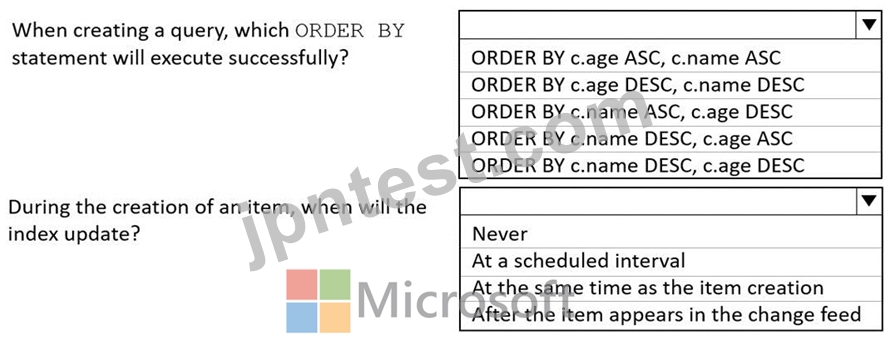
正解:
解説:
質問 26
You have a database in an Azure Cosmos DB Core (SQL) API account.
You plan to create a container that will store employee data for 5,000 small businesses. Each business will have up to 25 employees. Each employee item will have an emailAddress value.
You need to ensure that the emailAddress value for each employee within the same company is unique.
To what should you set the partition key and the unique key? To answer, select the appropriate options in the answer area.
NOTE: Each correct selection is worth one point.
正解:
解説:
質問 27
You have a container in an Azure Cosmos DB Core (SQL) API account. The container stores telemetry data from IoT devices. The container uses telemetryId as the partition key and has a throughput of 1,000 request units per second (RU/s). Approximately 5,000 IoT devices submit data every five minutes by using the same telemetryId value.
You have an application that performs analytics on the data and frequently reads telemetry data for a single IoT device to perform trend analysis.
The following is a sample of a document in the container.
You need to reduce the amount of request units (RUs) consumed by the analytics application.
What should you do?
- A. Move the data to a new container that uses a partition key of date.
- B. Decrease the offerThroughput value for the container.
- C. Move the data to a new container that has a partition key of deviceId.
- D. Increase the offerThroughput value for the container.
正解: C
解説:
The partition key is what will determine how data is routed in the various partitions by Cosmos DB and needs to make sense in the context of your specific scenario. The IoT Device ID is generally the "natural" partition key for IoT applications.
質問 28
You have a container in an Azure Cosmos DB Core (SQL) API account.
You need to use the Azure Cosmos DB SDK to replace a document by using optimistic concurrency.
What should you include in the code? To answer, select the appropriate options in the answer area.
NOTE: Each correct selection is worth one point.
正解:
解説:
Reference:
https://docs.microsoft.com/en-us/dotnet/api/microsoft.azure.cosmos.itemrequestoptions
https://cosmosdb.github.io/labs/dotnet/labs/10-concurrency-control.html
質問 29
Note: This question is part of a series of questions that present the same scenario. Each question in the series contains a unique solution that might meet the stated goals. Some question sets might have more than one correct solution, while others might not have a correct solution.
After you answer a question in this section, you will NOT be able to return to it. As a result, these questions will not appear in the review screen.
You have a container named container1 in an Azure Cosmos DB Core (SQL) API account.
You need to make the contents of container1 available as reference data for an Azure Stream Analytics job.
Solution: You create an Azure Data Factory pipeline that uses Azure Cosmos DB Core (SQL) API as the input and Azure Blob Storage as the output.
Does this meet the goal?
- A. No
- B. Yes
正解: A
解説:
Instead create an Azure function that uses Azure Cosmos DB Core (SQL) API change feed as a trigger and Azure event hub as the output.
The Azure Cosmos DB change feed is a mechanism to get a continuous and incremental feed of records from an Azure Cosmos container as those records are being created or modified. Change feed support works by listening to container for any changes. It then outputs the sorted list of documents that were changed in the order in which they were modified.
The following diagram represents the data flow and components involved in the solution:
質問 30
You have an Azure Cosmos DB Core (SQL) API account named account1 that has the disableKeyBasedMetadataWriteAccess property enabled.
You are developing an app named App1 that will be used by a user named DevUser1 to create containers in account1. DevUser1 has a non-privileged user account in the Azure Active Directory (Azure AD) tenant.
You need to ensure that DevUser1 can use App1 to create containers in account1.
What should you do? To answer, select the appropriate options in the answer area.
NOTE: Each correct selection is worth one point.
正解:
解説:
Reference:
https://docs.microsoft.com/en-us/azure/cosmos-db/secure-access-to-data
https://docs.microsoft.com/en-us/rest/api/resources/
質問 31
You have an Azure Cosmos DB Core (SQL) API account used by an application named App1.
You open the Insights pane for the account and see the following chart.
Use the drop-down menus to select the answer choice that answers each question based on the information presented in the graphic.
NOTE: Each correct selection is worth one point.
正解:
解説: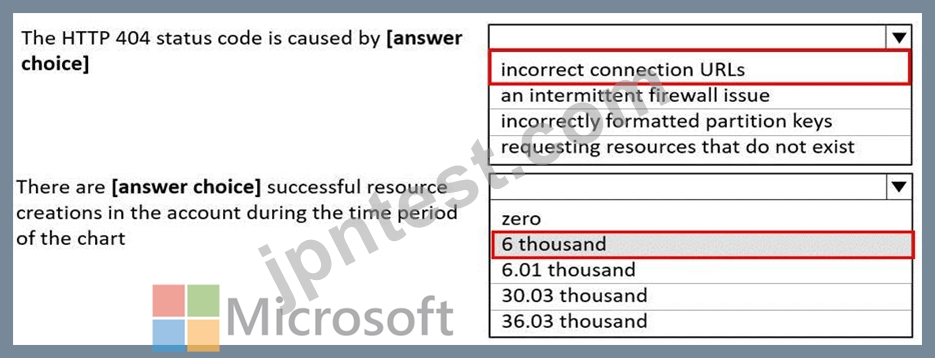
質問 32
......
Microsoft DP-420 認定試験の出題範囲:
| トピック | 出題範囲 |
|---|---|
| トピック 1 |
|
| トピック 2 |
|
| トピック 3 |
|
| トピック 4 |
|
| トピック 5 |
|
| トピック 6 |
|
| トピック 7 |
|
| トピック 8 |
|
学習材料は有効DP-420効率的問題集:https://www.jpntest.com/shiken/DP-420-mondaishu
DP-420問題集本日限定!無料アクセス可能に!:https://drive.google.com/open?id=1wpjI0yNELRlbWrXgijR_xWhtqxBN7ggC