

[2025年02月22日] 完全版最新の問題集でPDFで最新DP-100試験問題と解答
無料で使えるDP-100試験問題集で100%合格できる試験簡単に合格させるJPNTest
質問 # 209
You plan to preprocess text from CSV files. You load the Azure Machine Learning Studio default stop words list.
You need to configure the Preprocess Text module to meet the following requirements:
* Ensure that multiple related words from a single canonical form.
* Remove pipe characters from text.
* Remove words to optimize information retrieval.
Which three options should you select? To answer, select the appropriate options in the answer area.
NOTE: Each correct selection is worth one point.
正解:
解説: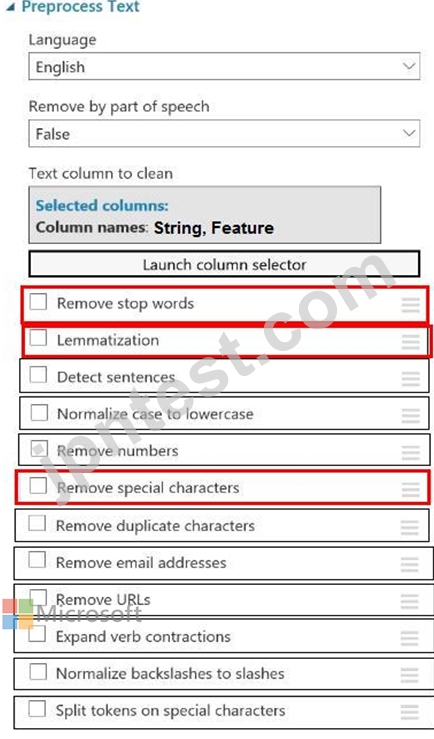
Explanation:
Box 1: Remove stop words
Remove words to optimize information retrieval.
Remove stop words: Select this option if you want to apply a predefined stopword list to the text column. Stop word removal is performed before any other processes.
Box 2: Lemmatization
Ensure that multiple related words from a single canonical form.
Lemmatization converts multiple related words to a single canonical form Box 3: Remove special characters Remove special characters: Use this option to replace any non-alphanumeric special characters with the pipe | character.
References:
https://docs.microsoft.com/en-us/azure/machine-learning/studio-module-reference/preprocess-text
質問 # 210
You are a lead data scientist for a project that tracks the health and migration of birds. You create a multi-image classification deep learning model that uses a set of labeled bird photos collected by experts. You plan to use the model to develop a cross-platform mobile app that predicts the species of bird captured by app users.
You must test and deploy the trained model as a web service. The deployed model must meet the following requirements:
An authenticated connection must not be required for testing.
The deployed model must perform with low latency during inferencing.
The REST endpoints must be scalable and should have a capacity to handle large number of requests when multiple end users are using the mobile application.
You need to verify that the web service returns predictions in the expected JSON format when a valid REST request is submitted.
Which compute resources should you use? To answer, select the appropriate options in the answer area.
NOTE: Each correct selection is worth one point.
正解:
解説:
Reference:
https://docs.microsoft.com/en-us/azure/machine-learning/data-science-virtual-machine/dsvm-common-identity
https://docs.microsoft.com/en-us/azure/architecture/reference-architectures/ai/training-deep-learning
質問 # 211
You collect data from a nearby weather station. You have a pandas dataframe named weather_df that includes the following data:
The data is collected every 12 hours: noon and midnight.
You plan to use automated machine learning to create a time-series model that predicts temperature over the next seven days. For the initial round of training, you want to train a maximum of 50 different models.
You must use the Azure Machine Learning SDK to run an automated machine learning experiment to train these models.
You need to configure the automated machine learning run.
How should you complete the AutoMLConfig definition? To answer, select the appropriate options in the answer area.
NOTE: Each correct selection is worth one point.
正解:
解説:
Explanation:

Box 1: forcasting
Task: The type of task to run. Values can be 'classification', 'regression', or 'forecasting' depending on the type of automated ML problem to solve.
Box 2: temperature
The training data to be used within the experiment. It should contain both training features and a label column (optionally a sample weights column).
Box 3: observation_time
time_column_name: The name of the time column. This parameter is required when forecasting to specify the datetime column in the input data used for building the time series and inferring its frequency. This setting is being deprecated. Please use forecasting_parameters instead.
Box 4: 7
"predicts temperature over the next seven days"
max_horizon: The desired maximum forecast horizon in units of time-series frequency. The default value is 1.
Units are based on the time interval of your training data, e.g., monthly, weekly that the forecaster should predict out. When task type is forecasting, this parameter is required.
Box 5: 50
"For the initial round of training, you want to train a maximum of 50 different models." Iterations: The total number of different algorithm and parameter combinations to test during an automated ML experiment.
Reference:
https://docs.microsoft.com/en-us/python/api/azureml-train-automl-client/azureml.train.automl.automlconfig.
automlconfig
質問 # 212
You have an Azure Machine Learning workspace
You plan to use the Azure Machine Learning SDK for Python v1 to submit a job to run a training script.
You need to complete the script to ensure that it will execute the training script.
How should you complete the script? To answer, select the appropriate options in the answer area.
NOTE: Each correct selection is worth one point
正解:
解説:
質問 # 213
You have a binary classifier that predicts positive cases of diabetes within two separate age groups.
The classifier exhibits a high degree of disparity between the age groups.
You need to modify the output of the classifier to maximize its degree of fairness across the age groups and meet the following requirements:
* Eliminate the need to retrain the model on which the classifier is based.
* Minimize the disparity between true positive rates and false positive rates across age groups.
Which algorithm and panty constraint should you use? To answer, select the appropriate options in the answer are a. NOTE: Each correct selection is worth one point.
正解:
解説:
質問 # 214
You have a dataset that contains over 150 features. You use the dataset to train a Support Vector Machine (SVM) binary classifier.
You need to use the Permutation Feature Importance module in Azure Machine Learning Studio to compute a set of feature importance scores for the dataset.
In which order should you perform the actions? To answer, move all actions from the list of actions to the answer area and arrange them in the correct order.
正解:
解説:
Explanation
Step 1: Add a Two-Class Support Vector Machine module to initialize the SVM classifier.
Step 2: Add a dataset to the experiment
Step 3: Add a Split Data module to create training and test dataset.
To generate a set of feature scores requires that you have an already trained model, as well as a test dataset.
Step 4: Add a Permutation Feature Importance module and connect to the trained model and test dataset.
Step 5: Set the Metric for measuring performance property to Classification - Accuracy and then run the experiment.
Reference:
https://docs.microsoft.com/en-us/azure/machine-learning/studio-module-reference/two-class-support-vector-mac
https://docs.microsoft.com/en-us/azure/machine-learning/studio-module-reference/permutation-feature-importan
質問 # 215
The finance team asks you to train a model using data in an Azure Storage blob container named finance-data.
You need to register the container as a datastore in an Azure Machine Learning workspace and ensure that an error will be raised if the container does not exist.
How should you complete the code? To answer, select the appropriate options in the answer area.
NOTE: Each correct selection is worth one point.
正解:
解説:
Explanation:
Box 1: register_azure_blob_container
Register an Azure Blob Container to the datastore.
Box 2: create_if_not_exists = False
Create the file share if it does not exists, defaults to False.
Reference:
https://docs.microsoft.com/en-us/python/api/azureml-core/azureml.core.datastore.datastore
質問 # 216
You need to modify the inputs for the global penalty event model to address the bias and variance issue.
Which three actions should you perform in sequence? To answer, move the appropriate actions from the list of actions to the answer area and arrange them in the correct order.
正解:
解説: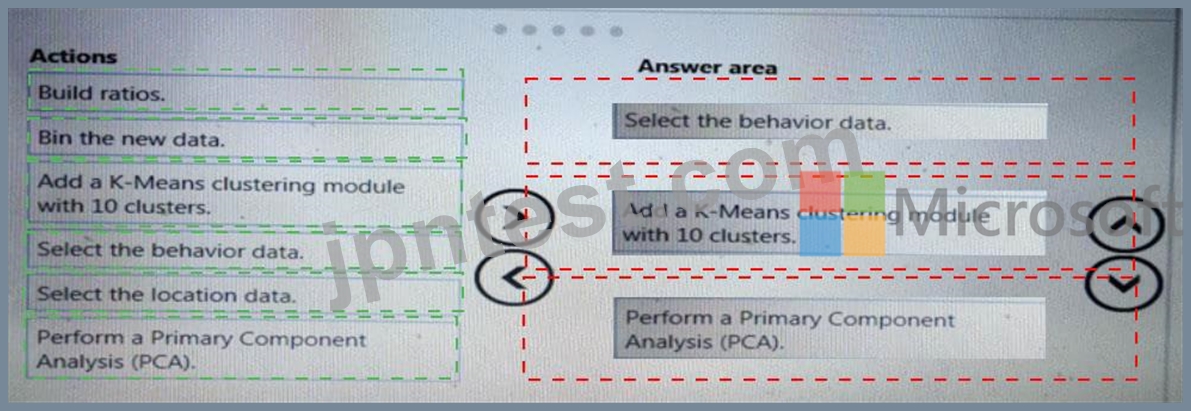
質問 # 217
You are preparing to use the Azure ML SDK to run an experiment and need to create compute. You run the following code:
For each of the following statements, select Yes if the statement is true. Otherwise, select No.
NOTE: Each correct selection is worth one point.
正解:
解説:
Reference:
https://notebooks.azure.com/azureml/projects/azureml-getting-started/html/how-to-use-azureml/training/train-on-amlcompute/train-on-amlcompute.ipynb
https://docs.microsoft.com/en-us/python/api/azureml-core/azureml.core.compute.computetarget
質問 # 218
You create an Azure Machine learning workspace. The workspace contains a folder named src. The folder contains a Python script named script 1 .py.
You use the Azure Machine Learning Python SDK v2 to create a control script. You must use the control script to run script l.py as part of a training job.
You need to complete the section of script that defines the job parameters.
How should you complete the script? To answer, select the appropriate options in the answer area.
NOTE: Each correct selection is worth one point.
正解:
解説:
Explanation
質問 # 219
You need to visually identify whether outliers exist in the Age column and quantify the outliers before the outliers are removed.
Which three Azure Machine Learning Studio modules should you use in sequence? To answer, move the appropriate modules from the list of modules to the answer area and arrange them in the correct order.
正解:
解説:
Explanation
Create Scatterplot
Summarize Data
Clip Values
You can use the Clip Values module in Azure Machine Learning Studio, to identify and optionally replace data values that are above or below a specified threshold. This is useful when you want to remove outliers or replace them with a mean, a constant, or other substitute value.
References:
https://blogs.msdn.microsoft.com/azuredev/2017/05/27/data-cleansing-tools-in-azure-machine-learning/
https://docs.microsoft.com/en-us/azure/machine-learning/studio-module-reference/clip-values
質問 # 220
You are developing deep learning models to analyze semi-structured, unstructured, and structured data types.
You have the following data available for model building:
* Video recordings of sporting events
* Transcripts of radio commentary about events
* Logs from related social media feeds captured during sporting events
You need to select an environment for creating the model.
Which environment should you use?
- A. Azure Cognitive Services
- B. Azure Machine Learning Studio
- C. Azure Data Lake Analytics
- D. Azure HDInsight with Spark MLib
正解:A
解説:
Azure Cognitive Services expand on Microsoft's evolving portfolio of machine learning APIs and enable developers to easily add cognitive features - such as emotion and video detection; facial, speech, and vision recognition; and speech and language understanding - into their applications. The goal of Azure Cognitive Services is to help developers create applications that can see, hear, speak, understand, and even begin to reason. The catalog of services within Azure Cognitive Services can be categorized into five main pillars - Vision, Speech, Language, Search, and Knowledge.
Reference:
https://docs.microsoft.com/en-us/azure/cognitive-services/welcome
質問 # 221
You are building a recurrent neural network to perform a binary classification.
You review the training loss, validation loss, training accuracy, and validation accuracy for each training epoch.
You need to analyze model performance.
You need to identify whether the classification model is overfitted.
Which of the following is correct?
- A. The training loss stays constant and the validation loss decreases when training the model.
- B. The training loss decreases while the validation loss increases when training the model.
- C. The training loss stays constant and the validation loss stays on a constant value and close to the training loss value when training the model.
- D. The training loss increases while the validation loss decreases when training the model.
正解:B
解説:
An overfit model is one where performance on the train set is good and continues to improve, whereas performance on the validation set improves to a point and then begins to degrade.
Reference:
https://machinelearningmastery.com/diagnose-overfitting-underfitting-lstm-models/
質問 # 222
An organization uses Azure Machine Learning service and wants to expand their use of machine learning.
You have the following compute environments. The organization does not want to create another compute environment.
You need to determine which compute environment to use for the following scenarios.
Which compute types should you use? To answer, drag the appropriate compute environments to the correct scenarios. Each compute environment may be used once, more than once, or not at all. You may need to drag the split bar between panes or scroll to view content.
NOTE: Each correct selection is worth one point.
正解:
解説:
Explanation
Box 1: nb_server
Box 2: mlc_cluster
With Azure Machine Learning, you can train your model on a variety of resources or environments, collectively referred to as compute targets. A compute target can be a local machine or a cloud resource, such as an Azure Machine Learning Compute, Azure HDInsight or a remote virtual machine.
Reference:
https://docs.microsoft.com/en-us/azure/machine-learning/concept-compute-target
https://docs.microsoft.com/en-us/azure/machine-learning/how-to-set-up-training-targets
質問 # 223
You are building a binary classification model by using a supplied training set.
The training set is imbalanced between two classes.
You need to resolve the data imbalance.
What are three possible ways to achieve this goal? Each correct answer presents a complete solution NOTE: Each correct selection is worth one point.
- A. Use accuracy as the evaluation metric of the model.
- B. Penalize the classification
- C. Normalize the training feature set.
- D. Resample the data set using under sampling or oversampling
- E. Generate synthetic samples in the minority class.
正解:A、D、E
質問 # 224
You manage an Azure Machine Learning workspace named workspace1.
You must register an Azure Blob storage datastore in workspace1 by using an access key. You develop Python SDK v2 code to import all modules required to register the datastore.
You need to complete the Python SDK v2 code to define the datastore.
How should you complete the code? To answer, select the appropriate options in the answer area.
NOTE: Each correct selection is worth one point.
正解:
解説:
Explanation:
質問 # 225
You need to implement a new cost factor scenario for the ad response models as illustrated in the performance curve exhibit.
Which technique should you use?
- A. Set the threshold to 0.5 and retrain if weighted Kappa deviates +/- 5% from 0.45.
- B. Set the threshold to 0.2 and retrain if weighted Kappa deviates +/- 5% from 0.6.
- C. Set the threshold to 0.75 and retrain if weighted Kappa deviates +/- 5% from 0.15.
- D. Set the threshold to 0.05 and retrain if weighted Kappa deviates +/- 5% from 0.5.
正解:A
解説:
Scenario:
Performance curves of current and proposed cost factor scenarios are shown in the following diagram: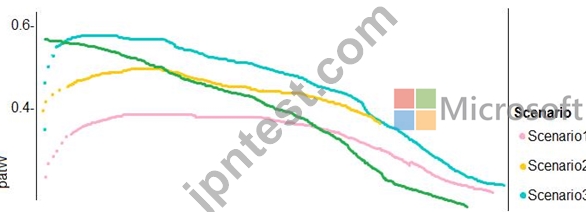
The ad propensity model uses a cut threshold is 0.45 and retrains occur if weighted Kappa deviated from 0.1 +/- 5%.
You are a data scientist for Fabrikam Residences, a company specializing in quality private and commercial property in the United States. Fabrikam Residences is considering expanding into Europe and has asked you to investigate prices for private residences in major European cities. You use Azure Machine Learning Studio to measure the median value of properties. You produce a regression model to predict property prices by using the Linear Regression and Bayesian Linear Regression modules.
Datasets
There are two datasets in CSV format that contain property details for two cities, London and Paris, with the following columns:
The two datasets have been added to Azure Machine Learning Studio as separate datasets and included as the starting point of the experiment.
質問 # 226
You create a binary classification model using Azure Machine Learning Studio.
You must use a Receiver Operating Characteristic (RO C) curve and an F1 score to evaluate the model.
You need to create the required business metrics.
How should you complete the experiment? To answer, select the appropriate options in the dialog box in the answer area.
NOTE: Each correct selection is worth one point.
正解:
解説: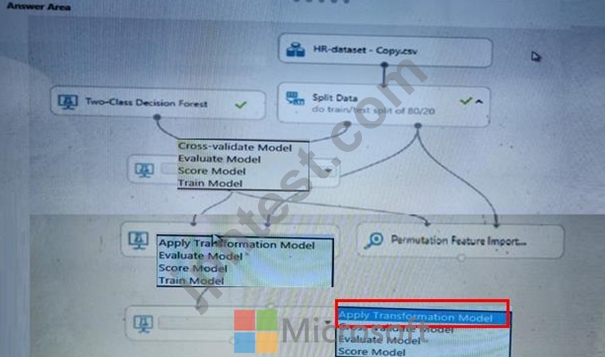
質問 # 227
You manage an Azure Machine Learning workspace named workspace1 by using the Python SDK v2.
The default datastore of workspace1 contains a folder named sample_dat
a. The folder structure contains the following content:
You write Python SDK v2 code to materialize the data from the files in the sample.data folder into a Pandas data frame. You need to complete the Python SDK v2 code to use the MLTaWe folder as the materialization blueprint. How should you complete the code? To answer, select the appropriate options in the answer area.
NOTE: Each correct selection is worth one point.
正解:
解説:
質問 # 228
You need to define a process for penalty event detection.
Which three actions should you perform in sequence? To answer, move the appropriate actions from the list of actions to the answer area and arrange them in the correct order.
正解:
解説:
1 - Vary the length of frequency bands between modeling epochs.
2 - Standardize to mono audio clips.
3 - Use an inverse Fourier transform on frequency changes over time.
質問 # 229
You train and register a model in your Azure Machine Learning workspace.
You must publish a pipeline that enables client applications to use the model for batch inferencing. You must use a pipeline with a single ParallelRunStep step that runs a Python inferencing script to get predictions from the input data.
You need to create the inferencing script for the ParallelRunStep pipeline step.
Which two functions should you include? Each correct answer presents part of the solution.
NOTE: Each correct selection is worth one point.
- A. main()
- B. score(mini_batch)
- C. init()
- D. batch()
- E. run(mini_batch)
D
正解:C、E
解説:
Reference:
https://github.com/Azure/MachineLearningNotebooks/tree/master/how-to-use-azureml/machine-learningpipeline
質問 # 230
You create an Azure Machine Learning model to include model files and a scorning script. You must deploy the model. The deployment solution must meet the following requirements:
* Provide near real-time inferencing.
* Enable endpoint and deployment level cost estimates.
* Support logging to Azure Log Analytics.
You need to configure the deployment solution.
What should you configure? To answer, select the appropriate options in the answer area.
NOTE: Each correct selection is worth one point.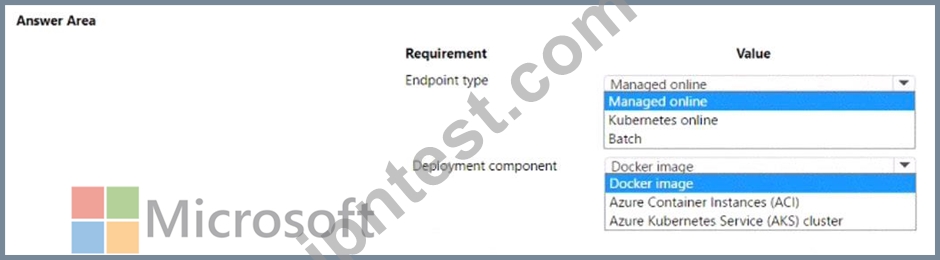
正解:
解説:
Explanation:
質問 # 231
You must store data in Azure Blob Storage to support Azure Machine Learning.
You need to transfer the data into Azure Blob Storage.
What are three possible ways to achieve the goal? Each correct answer presents a complete solution.
NOTE: Each correct selection is worth one point.
- A. Bulk Copy Program (BCP)
- B. AzCopy
- C. Python script
- D. Azure Storage Explorer
- E. Bulk Insert SQL Query
正解:B、C、D
解説:
You can move data to and from Azure Blob storage using different technologies:
Azure Storage-Explorer
AzCopy
Python
SSIS
References:
https://docs.microsoft.com/en-us/azure/machine-learning/team-data-science-process/move-azure-blob
質問 # 232
......
無料で試せるDP-100試験問題DP-100実際の無料試験問題:https://www.jpntest.com/shiken/DP-100-mondaishu
検証済みのDP-100問題集と445格別な問題:https://drive.google.com/open?id=12g8YLSlwI05XpCht4RETQ_19wmzYIyal