

[2025年04月12日] 365日無料更新DP-100知能問題集をゲット
ベスト品質のMicrosoft DP-100試験問題
DP-100認定試験は、Microsoft Azureを使用してデータソリューションを設計および実装するためのスキルを開発したいデータプロフェッショナルにとって必須の認定試験です。この認定試験は、データ探索、データ準備、データモデリング、機械学習、データ可視化などのデータサイエンスのさまざまな側面における候補者の熟練度を示します。この認定試験は、世界的に認められており、候補者がより良い就職機会やキャリアの成長を得るのに役立ちます。
Microsoft DP-100認定試験は、Azureプラットフォームでデータサイエンスソリューションの設計と実装のスキルを検証したいデータサイエンティスト向けに設計されています。この試験は、PythonやRなどの言語をプログラミングした経験があり、Azure Machine Learning、Azure Databricks、およびその他のAzureサービスに精通している専門家に最適です。 DP-100試験は、データサイエンスの分野でお客様の専門知識を紹介し、認定データサイエンティストとして認識を獲得するための優れた方法です。
質問 # 205
You are solving a classification task.
The dataset is imbalanced.
You need to select an Azure Machine Learning Studio module to improve the classification accuracy.
Which module should you use?
- A. Synthetic Minority Oversampling Technique (SMOTE)
- B. Filter Based Feature Selection
- C. Permutation Feature Importance
- D. Fisher Linear Discriminant Analysis
正解:A
解説:
Explanation
Explanation:
Use the SMOTE module in Azure Machine Learning Studio (classic) to increase the number of underepresented cases in a dataset used for machine learning. SMOTE is a better way of increasing the number of rare cases than simply duplicating existing cases.
You connect the SMOTE module to a dataset that is imbalanced. There are many reasons why a dataset might be imbalanced: the category you are targeting might be very rare in the population, or the data might simply be difficult to collect. Typically, you use SMOTE when the class you want to analyze is under-represented.
Reference:
https://docs.microsoft.com/en-us/azure/machine-learning/studio-module-reference/smote Prepare data for modeling Testlet 1 Case study Overview You are a data scientist in a company that provides data science for professional sporting events. Models will use global and local market data to meet the following business goals:
* Understand sentiment of mobile device users at sporting events based on audio from crowd reactions.
* Assess a user's tendency to respond to an advertisement.
* Customize styles of ads served on mobile devices.
* Use video to detect penalty events
Current environment
* Media used for penalty event detection will be provided by consumer devices. Media may include images and videos captured during the sporting event and shared using social media. The images and videos will have varying sizes and formats.
* The data available for model building comprises of seven years of sporting event media. The sporting event media includes; recorded video transcripts or radio commentary, and logs from related social media feeds captured during the sporting events.
* Crowd sentiment will include audio recordings submitted by event attendees in both mono and stereo formats.
Penalty detection and sentiment
* Data scientists must build an intelligent solution by using multiple machine learning models for penalty event detection.
* Data scientists must build notebooks in a local environment using automatic feature engineering and model building in machine learning pipelines.
* Notebooks must be deployed to retrain by using Spark instances with dynamic worker allocation.
* Notebooks must execute with the same code on new Spark instances to recode only the source of the data.
* Global penalty detection models must be trained by using dynamic runtime graph computation during training.
* Local penalty detection models must be written by using BrainScript.
* Experiments for local crowd sentiment models must combine local penalty detection data.
* Crowd sentiment models must identify known sounds such as cheers and known catch phrases. Individual crowd sentiment models will detect similar sounds.
* All shared features for local models are continuous variables.
* Shared features must use double precision. Subsequent layers must have aggregate running mean and standard deviation metrics available.
Advertisements
During the initial weeks in production, the following was observed:
* Ad response rated declined.
* Drops were not consistent across ad styles.
* The distribution of features across training and production data are not consistent Analysis shows that, of the 100 numeric features on user location and behavior, the 47 features that come from location sources are being used as raw features. A suggested experiment to remedy the bias and variance issue is to engineer 10 linearly uncorrelated features.
* Initial data discovery shows a wide range of densities of target states in training data used for crowd sentiment models.
* All penalty detection models show inference phases using a Stochastic Gradient Descent (SGD) are running too slow.
* Audio samples show that the length of a catch phrase varies between 25%-47% depending on region
* The performance of the global penalty detection models shows lower variance but higher bias when comparing training and validation sets. Before implementing any feature changes, you must confirm the bias and variance using all training and validation cases.
* Ad response models must be trained at the beginning of each event and applied during the sporting event.
* Market segmentation models must optimize for similar ad response history.
* Sampling must guarantee mutual and collective exclusively between local and global segmentation models that share the same features.
* Local market segmentation models will be applied before determining a user's propensity to respond to an advertisement.
* Ad response models must support non-linear boundaries of features.
* The ad propensity model uses a cut threshold is 0.45 and retrains occur if weighted Kappa deviated from
0.1 +/- 5%.
* The ad propensity model uses cost factors shown in the following diagram: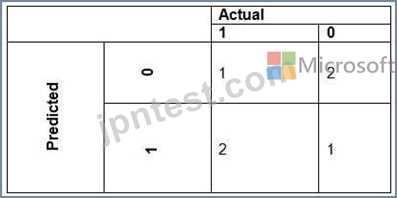
* The ad propensity model uses proposed cost factors shown in the following diagram:
* Performance curves of current and proposed cost factor scenarios are shown in the following diagram:
質問 # 206
You create an Azure Machine Learning workspace and an Azure Synapse Analytics workspace with a Spark pool. The workspaces are contained within the same Azure subscription.
You must manage the Synapse Spark pool from the Azure Machine Learning workspace.
You need to attach the Synapse Spark pool in Azure Machine Learning by usinq the Python SDK v2.
Which three actions should you perform in sequence? To answer move the appropriate actions from the list of actions to the answer area and arrange them in the correct order.
正解:
解説:
Explanation
質問 # 207
Note: This question is part of a series of questions that present the same scenario. Each question in the series contains a unique solution that might meet the stated goals. Some question sets might have more than one correct solution, while others might not have a correct solution.
After you answer a question in this section, you will NOT be able to return to it. As a result, these questions will not appear in the review screen.
You are using Azure Machine learning Studio to perform feature engineering on a dataset. You need to normalize values to produce a feature column grouped into bins.
Solution: Apply an Entropy Minimum Description Length (MDI) binning mode.
Does the solution meet the goal?
- A. Yes
- B. No
正解:A
解説:
Explanation
Entropy MDL binning mode: This method requires that you select the column you want to predict and the column or columns that you want to group into bins. It then makes a pass over the data and attempts to determine the number of bins that minimizes the entropy. In other words, it chooses a number of bins that allows the data column to best predict the target column. It then returns the bin number associated with each row of your data in a column named <colname>quantized.
References:
https://docs.microsoft.com/en-us/azure/machine-learning/studio-module-reference/group-data-into-bins
質問 # 208
You need to implement early stopping criteria as suited in the model training requirements.
Which three code segments should you use to develop the solution? To answer, move the appropriate code segments from the list of code segments to the answer area and arrange them in the correct order.
NOTE: More than one order of answer choices is correct. You will receive credit for any of the correct orders you select.
正解:
解説: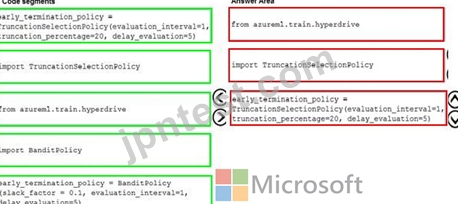
Explanation:
You need to implement an early stopping criterion on models that provides savings without terminating promising jobs.
Truncation selection cancels a given percentage of lowest performing runs at each evaluation interval. Runs are compared based on their performance on the primary metric and the lowest X% are terminated.
Example:
from azureml.train.hyperdrive import TruncationSelectionPolicy
early_termination_policy = TruncationSelectionPolicy(evaluation_interval=1, truncation_percentage=20, delay_evaluation=5) Incorrect Answers:
Bandit is a termination policy based on slack factor/slack amount and evaluation interval. The policy early terminates any runs where the primary metric is not within the specified slack factor / slack amount with respect to the best performing training run.
Example:
from azureml.train.hyperdrive import BanditPolicy
early_termination_policy = BanditPolicy(slack_factor = 0.1, evaluation_interval=1, delay_evaluation=5 References:
https://docs.microsoft.com/en-us/azure/machine-learning/service/how-to-tune-hyperparameters
質問 # 209
You have a dataset contains 2,000 rows. You arc building a machine learning classification model by using Azure Machine Learning Studio. You add a Partition and Sample module to the experiment.
You need to configure the module. You must meet the following requirements:
* Divide the data into subsets.
* Assign the rows into folds using a round-robin method.
* Allow rows in the dataset to be reused.
How should you configure the module? To answer select the appropriate Options m the dialog box in the answer area.
NOTE: Each correct selection is worth one point.

正解:
解説:
Explanation
質問 # 210
You create a script for training a machine learning model in Azure Machine Learning service.
You create an estimator by running the following code:
For each of the following statements, select Yes if the statement is true. Otherwise, select No.
NOTE: Each correct selection is worth one point.
正解:
解説:
Explanation:
Box 1: Yes
Parameter source_directory is a local directory containing experiment configuration and code files needed for a training job.
Box 2: Yes
script_params is a dictionary of command-line arguments to pass to the training script specified in entry_script.
Box 3: No
Box 4: Yes
The conda_packages parameter is a list of strings representing conda packages to be added to the Python environment for the experiment.
質問 # 211
You plan to implement an Azure Machine Learning solution. You have the following requirements:
* Run a Jupyter notebook to interactively tram a machine learning model.
* Deploy assets and workflows for machine learning proof of concept by using scripting rather than custom programming.
You need to select a development technique for each requirement
Which development technique should you use? To answer, select the appropriate options in the answer area.
NOTE: Each correct selection is worth one point.
正解:
解説:
Explanation:
質問 # 212
You plan to use Hyperdrive to optimize the hyperparameters selected when training a model. You create the following code to define options for the hyperparameter experiment

For each of the following statements, select Yes if the statement is true. Otherwise, select No. NOTE: Each correct selection is worth one point.
正解:
解説:
Reference:
https://docs.microsoft.com/en-us/python/api/azureml-train-core/azureml.train.hyperdrive.hyperdriveconfig
https://docs.microsoft.com/en-us/azure/machine-learning/how-to-tune-hyperparameters
質問 # 213
You need to identify the methods for dividing the data according, to the testing requirements.
Which properties should you select? To answer, select the appropriate option-, m the answer are a. NOTE: Each correct selection is worth one point.
正解:
解説:
質問 # 214
You create a training pipeline using the Azure Machine Learning designer. You upload a CSV file that contains the data from which you want to train your model.
You need to use the designer to create a pipeline that includes steps to perform the following tasks:
Select the training features using the pandas filter method.
Train a model based on the naive_bayes.GaussianNB algorithm.
Return only the Scored Labels column by using the query SELECT [Scored Labels] FROM t1; Which modules should you use? To answer, drag the appropriate modules to the appropriate locations. Each module name may be used once, more than once, or not at all. You may need to drag the split bar between panes or scroll to view content.
NOTE: Each correct selection is worth one point.
正解:
解説:

質問 # 215
The finance team asks you to train a model using data in an Azure Storage blob container named finance-data.
You need to register the container as a datastore in an Azure Machine Learning workspace and ensure that an error will be raised if the container does not exist.
How should you complete the code? To answer, select the appropriate options in the answer area.
NOTE: Each correct selection is worth one point.
正解:
解説:
.
Reference:
https://docs.microsoft.com/en-us/python/api/azureml-core/azureml.core.datastore.datastore
質問 # 216
You are a lead data scientist for a project that tracks the health and migration of birds. You create a multi-image classification deep learning model that uses a set of labeled bird photos collected by experts. You plan to use the model to develop a cross-platform mobile app that predicts the species of bird captured by app users.
You must test and deploy the trained model as a web service. The deployed model must meet the following requirements:
An authenticated connection must not be required for testing.
The deployed model must perform with low latency during inferencing.
The REST endpoints must be scalable and should have a capacity to handle large number of requests when multiple end users are using the mobile application.
You need to verify that the web service returns predictions in the expected JSON format when a valid REST request is submitted.
Which compute resources should you use? To answer, select the appropriate options in the answer area.
NOTE: Each correct selection is worth one point.
正解:
解説:
Explanation
Box 1: ds-workstation notebook VM
An authenticated connection must not be required for testing.
On a Microsoft Azure virtual machine (VM), including a Data Science Virtual Machine (DSVM), you create local user accounts while provisioning the VM. Users then authenticate to the VM by using these credentials.
Box 2: gpu-compute cluster
Image classification is well suited for GPU compute clusters
Reference:
https://docs.microsoft.com/en-us/azure/machine-learning/data-science-virtual-machine/dsvm-common-identity
https://docs.microsoft.com/en-us/azure/architecture/reference-architectures/ai/training-deep-learning
質問 # 217
You have a Python data frame named salesData in the following format:
The data frame must be unpivoted to a long data format as follows:
You need to use the pandas.melt() function in Python to perform the transformation.
How should you complete the code segment? To answer, select the appropriate options in the answer area.
NOTE: Each correct selection is worth one point.
正解:
解説:
Explanation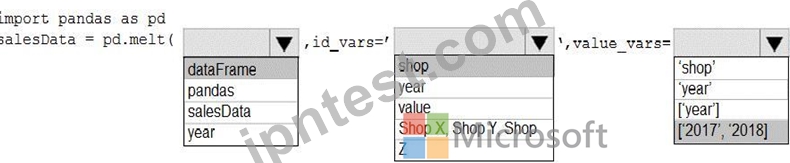
Box 1: dataFrame
Syntax: pandas.melt(frame, id_vars=None, value_vars=None, var_name=None, value_name='value', col_level=None)[source] Where frame is a DataFrame Box 2: shop Paramter id_vars id_vars : tuple, list, or ndarray, optional Column(s) to use as identifier variables.
Box 3: ['2017','2018']
value_vars : tuple, list, or ndarray, optional
Column(s) to unpivot. If not specified, uses all columns that are not set as id_vars.
Example:
df = pd.DataFrame({'A': {0: 'a', 1: 'b', 2: 'c'},
'B': {0: 1, 1: 3, 2: 5},
'C': {0: 2, 1: 4, 2: 6}})
pd.melt(df, id_vars=['A'], value_vars=['B', 'C'])
A variable value
0 a B 1
1 b B 3
2 c B 5
3 a C 2
4 b C 4
5 c C 6
References:
https://pandas.pydata.org/pandas-docs/stable/reference/api/pandas.melt.html
質問 # 218
A biomedical research company plans to enroll people in an experimental medical treatment trial.
You create and train a binary classification model to support selection and admission of patients to the trial. The model includes the following features: Age, Gender, and Ethnicity.
The model returns different performance metrics for people from different ethnic groups.
You need to use Fairlearn to mitigate and minimize disparities for each category in the Ethnicity feature.
Which technique and constraint should you use? To answer, select the appropriate options in the answer area.
NOTE: Each correct selection is worth one point.
正解:
解説:
.
Reference:
https://docs.microsoft.com/en-us/azure/machine-learning/concept-fairness-ml
質問 # 219
You create a binary classification model to predict whether a person has a disease.
You need to detect possible classification errors.
Which error type should you choose for each description? To answer, select the appropriate options in the answer area.
NOTE: Each correct selection is worth one point.
正解:
解説:
Explanation

Box 1: True Positive
A true positive is an outcome where the model correctly predicts the positive class Box 2: True Negative A true negative is an outcome where the model correctly predicts the negative class.
Box 3: False Positive
A false positive is an outcome where the model incorrectly predicts the positive class.
Box 4: False Negative
A false negative is an outcome where the model incorrectly predicts the negative class.
Note: Let's make the following definitions:
"Wolf" is a positive class.
"No wolf" is a negative class.
We can summarize our "wolf-prediction" model using a 2x2 confusion matrix that depicts all four possible outcomes:
Reference:
https://developers.google.com/machine-learning/crash-course/classification/true-false-positive-negative
質問 # 220
You need to define an evaluation strategy for the crowd sentiment models.
Which three actions should you perform in sequence? To answer, move the appropriate actions from the list of actions to the answer area and arrange them in the correct order.
正解:
解説:
1 - Add new features for retraining supervised models.
2 - Evaluate the changes in correlation between model error rate and centriod distance
3 - Filter labeled cases for retraining using the shortest distance from centroids.
Reference:
https://en.wikipedia.org/wiki/Nearest_centroid_classifier
https://docs.microsoft.com/en-us/azure/machine-learning/studio-module-reference/sweep-clustering
質問 # 221
......
Microsoft DP-100認定試験は、Azureプラットフォームでデータサイエンスソリューションを設計および実装したいデータ専門家のスキルをテストするように設計されています。この試験は、Azure Data Servicesの経験があり、データサイエンスの概念と技術に精通している個人を対象としています。この試験では、データの調査と準備、モデリング、展開、監視など、幅広いトピックをカバーしています。
Microsoft試験練習テスト問題で高得点を目指そう:https://www.jpntest.com/shiken/DP-100-mondaishu
検証された材料は決まってこれ!DP-100:https://drive.google.com/open?id=1htAmL4ct8wDbNFoOEm7LiBLCtfoReKl0