

DP-100トレーニング最新認定問題をゲットMicrosoft Azure合格目指せ2024年11月28日
認定トレーニングDP-100試験問題集テストエンジン
質問 # 190
You manage an Azure Machine Learning workspace.
You must log multiple metrics by using MLflow.
You need to maximize logging performance.
What are two possible ways to achieve this goal? Each correct answer presents a complete solution.
NOTE: Each correct selection is worth one point.
- A. mlflow.log_param
- B. MLflowClient.log_batch
- C. mlflow.log. metric
- D. mlflowlog_metrics
正解:B、D
質問 # 191
You train a machine learning model by using Aunt Machine Learning.
You use the following training script m Python to log an accuracy value.
You must use a Python script to define a sweep job.
You need to provide the primary metric and goal you want hyper parameter tuning to optimize.
How should you complete the Python script? To answer select the appropriate options in the answer area NOTE: Each correct selection is worth one point.
正解:
解説:
質問 # 192
You are using the Azure Machine Learning Service to automate hyperparameter exploration of your neural network classification model.
You must define the hyperparameter space to automatically tune hyperparameters using random sampling according to following requirements:
The learning rate must be selected from a normal distribution with a mean value of 10 and a standard deviation of 3.
Batch size must be 16, 32 and 64.
Keep probability must be a value selected from a uniform distribution between the range of 0.05 and
0.1.
You need to use the param_sampling method of the Python API for the Azure Machine Learning Service.
How should you complete the code segment? To answer, select the appropriate options in the answer area.
NOTE: Each correct selection is worth one point.
正解:
解説:
Explanation
In random sampling, hyperparameter values are randomly selected from the defined search space. Random sampling allows the search space to include both discrete and continuous hyperparameters.
Example:
from azureml.train.hyperdrive import RandomParameterSampling
param_sampling = RandomParameterSampling( {
"learning_rate": normal(10, 3),
"keep_probability": uniform(0.05, 0.1),
"batch_size": choice(16, 32, 64)
}
Reference:
https://docs.microsoft.com/en-us/azure/machine-learning/service/how-to-tune-hyperparameters
質問 # 193
You need to produce a visualization for the diagnostic test evaluation according to the data visualization requirements.
Which three modules should you recommend be used in sequence? To answer, move the appropriate modules from the list of modules to the answer area and arrange them in the correct order.
正解:
解説:
Explanation
Step 1: Sweep Clustering
Start by using the "Tune Model Hyperparameters" module to select the best sets of parameters for each of the models we're considering.
One of the interesting things about the "Tune Model Hyperparameters" module is that it not only outputs the results from the Tuning, it also outputs the Trained Model.
Step 2: Train Model
Step 3: Evaluate Model
Scenario: You need to provide the test results to the Fabrikam Residences team. You create data visualizations to aid in presenting the results.
You must produce a Receiver Operating Characteristic (ROC) curve to conduct a diagnostic test evaluation of the model. You need to select appropriate methods for producing the ROC curve in Azure Machine Learning Studio to compare the Two-Class Decision Forest and the Two-Class Decision Jungle modules with one another.
References:
http://breaking-bi.blogspot.com/2017/01/azure-machine-learning-model-evaluation.html
質問 # 194
You register a file dataset named csvjolder that references a folder. The folder includes multiple com ma-separated values (CSV) files in an Azure storage blob container. You plan to use the following code to run a script that loads data from the file dataset. You create and instantiate the following variables:
You have the following code:

You need to pass the dataset to ensure that the script can read the files it references. Which code segment should you insert to replace the code comment?
A)
B)
C)
D)
- A. Option A
- B. Option C
- C. Option D
- D. Option B
正解:C
解説:
Example:
from azureml.train.estimator import Estimator
script_params = {
# to mount files referenced by mnist dataset
'--data-folder': mnist_file_dataset.as_named_input('mnist_opendataset').as_mount(),
'--regularization': 0.5
}
est = Estimator(source_directory=script_folder,
script_params=script_params,
compute_target=compute_target,
environment_definition=env,
entry_script='train.py')
Reference:
https://docs.microsoft.com/en-us/azure/machine-learning/tutorial-train-models-with-aml
質問 # 195
You are designing an Azure Machine Leaning solution by using the Python SDK v2.
You must train and deploy the solution by using a compute target. The compute target must meet the following requirements:
* Enable the use of on-premises compute resources.
* Support autoscalling.
You need to configure a compute target for training and inference.
Which compute target t should you configure?
To answer select the appropriate options in the answer area.
NOTE: Each correct selection is worth one point.
正解:
解説:
質問 # 196
You need to select an environment that will meet the business and data requirements.
Which environment should you use?
- A. Azure Machine Learning Studio
- B. Microsoft Machine Learning Server
- C. Azure Cognitive Services
- D. Azure HDInsight with Spark MLlib
正解:B
質問 # 197
You create an experiment in Azure Machine Learning Studio- You add a training dataset that contains 10.000 rows. The first 9.000 rows represent class 0 (90 percent). The first 1.000 rows represent class 1 (10 percent).
The training set is unbalanced between two Classes. You must increase the number of training examples for class 1 to 4,000 by using data rows. You add the Synthetic Minority Oversampling Technique (SMOTE) module to the experiment.
You need to configure the module.
Which values should you use? To answer, select the appropriate options in the dialog box in the answer area.
NOTE: Each correct selection is worth one point.
正解:
解説:
質問 # 198 
You must use the Azure Machine Learning SDK to interact with data and experiments in the workspace.
You need to configure the config.json file to connect to the workspace from the Python environment.
Which two additional parameters must you add to the config.json file in order to connect to the workspace?
Each correct answer presents part of the solution.
NOTE: Each correct selection is worth one point.
- A. Key
- B. subscription_Id
- C. resource_group
- D. region
- E. Login
正解:B、C
解説:
To use the same workspace in multiple environments, create a JSON configuration file. The configuration file saves your subscription (subscription_id), resource (resource_group), and workspace name so that it can be easily loaded.
The following sample shows how to create a workspace.
from azureml.core import Workspace
ws = Workspace.create(name='myworkspace',
subscription_id='<azure-subscription-id>',
resource_group='myresourcegroup',
create_resource_group=True,
location='eastus2'
)
Reference:
https://docs.microsoft.com/en-us/python/api/azureml-core/azureml.core.workspace.workspace
質問 # 199
You are performing a classification task in Azure Machine Learning Studio.
You must prepare balanced testing and training samples based on a provided data set.
You need to split the data with a 0.75:0.25 ratio.
Which value should you use for each parameter? To answer, select the appropriate options in the answer area.
NOTE: Each correct selection is worth one point.
正解:
解説:
Reference:
https://docs.microsoft.com/en-us/azure/machine-learning/studio-module-reference/split-data
質問 # 200
You are preparing to build a deep learning convolutional neural network model for image classification. You create a script to train the model using CUDA devices.
You must submit an experiment that runs this script in the Azure Machine Learning workspace.
The following compute resources are available:
a Microsoft Surface device on which Microsoft Office has been installed. Corporate IT policies prevent the installation of additional software a Compute Instance named ds-workstation in the workspace with 2 CPUs and 8 GB of memory an Azure Machine Learning compute target named cpu-cluster with eight CPU-based nodes an Azure Machine Learning compute target named gpu-cluster with four CPU and GPU-based nodes You need to specify the compute resources to be used for running the code to submit the experiment, and for running the script in order to minimize model training time.
Which resources should the data scientist use? To answer, select the appropriate options in the answer area.
NOTE: Each correct selection is worth one point.
正解:
解説:
質問 # 201
You are training machine learning models in Azure Machine Learning. You use Hyperdrive to tune the hyperparameters. In previous model training and tuning runs, many models showed similar performance. You need to select an early termination policy that meets the following requirements:
* accounts for the performance of all previous runs when evaluating the current run
* avoids comparing the current run with only the best performing run to date Which two early termination policies should you use? Each correct answer presents part of the solution. NOTE: Each correct selection is worth one point.
- A. Median stopping
- B. Truncation selection
- C. Bandit
- D. Default
正解:A、B
解説:
The Median Stopping policy computes running averages across all runs and cancels runs whose best performance is worse than the median of the running averages.
If no policy is specified, the hyperparameter tuning service will let all training runs execute to completion.
Reference:
https://docs.microsoft.com/en-us/python/api/azureml-train-core/azureml.train.hyperdrive.medianstoppingpolicy
https://docs.microsoft.com/en-us/python/api/azureml-train-core/azureml.train.hyperdrive.truncationselectionpolicy
https://docs.microsoft.com/en-us/python/api/azureml-train-core/azureml.train.hyperdrive.banditpolicy
質問 # 202
You train a model and register it in your Azure Machine Learning workspace. You are ready to deploy the model as a real-time web service.
You deploy the model to an Azure Kubernetes Service (AKS) inference cluster, but the deployment fails because an error occurs when the service runs the entry script that is associated with the model deployment.
You need to debug the error by iteratively modifying the code and reloading the service, without requiring a re-deployment of the service for each code update.
What should you do?
- A. Create a local web service deployment configuration and deploy the model to a local Docker container.
- B. Modify the AKS service deployment configuration to enable application insights and re-deploy to AKS.
- C. Add a breakpoint to the first line of the entry script and redeploy the service to AKS.
- D. Create an Azure Container Instances (ACI) web service deployment configuration and deploy the model on ACI.
- E. Register a new version of the model and update the entry script to load the new version of the model from its registered path.
正解:D
解説:
How to work around or solve common Docker deployment errors with Azure Container Instances (ACI) and Azure Kubernetes Service (AKS) using Azure Machine Learning.
The recommended and the most up to date approach for model deployment is via the Model.deploy() API using an Environment object as an input parameter. In this case our service will create a base docker image for you during deployment stage and mount the required models all in one call. The basic deployment tasks are:
1. Register the model in the workspace model registry.
2. Define Inference Configuration:
a. Create an Environment object based on the dependencies you specify in the environment yaml file or use one of our procured environments.
b. Create an inference configuration (InferenceConfig object) based on the environment and the scoring script.
3. Deploy the model to Azure Container Instance (ACI) service or to Azure Kubernetes Service (AKS).
質問 # 203
You are using a Git repository to track work in an Azure Machine Learning workspace.
You need to authenticate a Git account by using SSH.
Which three actions should you perform in sequence? To answer, move the appropriate actions from the list of actions to the answer area and arrange them in the correct order.
正解:
解説:
Explanation
Graphical user interface, text, application, chat or text message Description automatically generated
Authenticate your Git Account with SSH:
Step 1: Generating a public/private key pair
Generate a new SSH key
1. Open the terminal window in the Azure Machine Learning Notebook Tab.
2. Paste the text below, substituting in your email address.
ssh-keygen -t rsa -b 4096 -C "[email protected]"
This creates a new ssh key, using the provided email as a label.
> Generating public/private rsa key pair.
Step 2: Add the public key to the Git Account
In your terminal window, copy the contents of your public key file.
Step 3: Clone the Git repository by using an SSH repository URL
1. Copy the SSH Git clone URL from the Git repo.
2. Paste the url into the git clone command below, to use your SSH Git repo URL. This will look something like:
git clone [email protected]:GitUser/azureml-example.git
Cloning into 'azureml-example'.
Reference:
https://docs.microsoft.com/en-us/azure/machine-learning/concept-train-model-git-integration
質問 # 204
You need to define a process for penalty event detection.
Which three actions should you perform in sequence? To answer, move the appropriate actions from the list of actions to the answer area and arrange them in the correct order.
正解:
解説:
質問 # 205
You create an Azure Machine Learning workspace and an Azure Synapse Analytics workspace with a Spark pool. The workspaces are contained within the same Azure subscription.
You must manage the Synapse Spark pool from the Azure Machine Learning workspace.
You need to attach the Synapse Spark pool in Azure Machine Learning by usinq the Python SDK v2.
Which three actions should you perform in sequence? To answer move the appropriate actions from the list of actions to the answer area and arrange them in the correct order.
正解:
解説:
1 - Create an instance of the azure...
2 - Define Spark pool configuration..
3 - Attach the Synapase Spark pool with the...
質問 # 206
You are creating a machine learning model that can predict the species of a penguin from its measurements.
You have a file that contains measurements for free species of penguin in comma delimited format.
The model must be optimized for area under the received operating characteristic curve performance metric averaged for each class.
You need to use the Automated Machine Learning user interface in Azure Machine Learning studio to run an experiment and find the best performing model.
Which five actions should you perform in sequence? To answer, move the appropriate actions from the list of actions to the answer area and arrange them in the collect order.
正解:
解説:
Explanation
質問 # 207
You create an Azure Machine Learning workspace. You use the Azure Machine Learning SDK for Python.
You must create a dataset from remote paths. The dataset must be reusable within the workspace.
You need to create the dataset.
How should you complete the following code segment? To answer, select the appropriate options in the answer area.
NOTE: Each correct selection is worth one point.
正解:
解説:
質問 # 208
Note: This question is part of a series of questions that present the same scenario. Each question in the series contains a unique solution that might meet the stated goals. Some question sets might have more than one correct solution, while others might not have a correct solution.
After you answer a question in this section, you will NOT be able to return to it. As a result, these questions will not appear in the review screen.
You have an Azure Machine Learning workspace. You connect to a terminal session from the Notebooks page in Azure Machine Learning studio.
You plan to add a new Jupyter kernel that will be accessible from the same terminal session.
You need to perform the task that must be completed before you can add the new kernel.
Solution: Delete the Python 3.6 - AzureML kernel.
Does the solution meet the goal?
- A. No
- B. Yes
正解:A
質問 # 209
You are implementing hyperparameter tuning for a model training from a notebook. The notebook is in an Azure Machine Learning workspace. You add code that imports all relevant Python libraries.
You must configure Bayesian sampling over the search space for the num_hidden_layers and batch_size hyperparameters.
You need to complete the following Python code to configure Bayesian sampling.
Which code segments should you use? To answer, select the appropriate options in the answer area NOTE: Each correct selection is worth one point.
正解:
解説: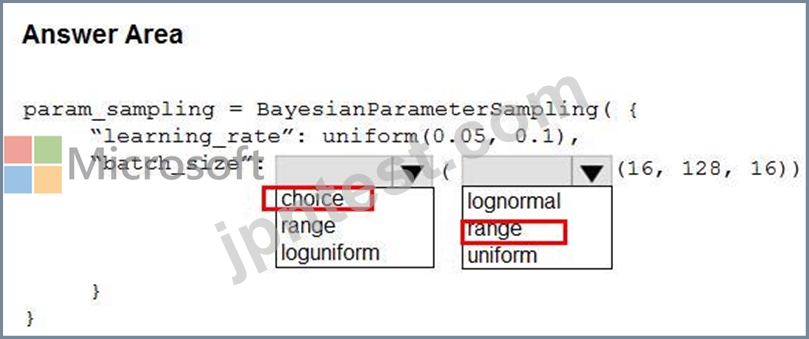
質問 # 210
......
合格確定、ガイドで準備DP-100試験:https://www.jpntest.com/shiken/DP-100-mondaishu
Microsoft Azure DP-100無料最新のリアル試験問題と回答:https://drive.google.com/open?id=1iWjGxzTOUDE6jctPfizgrtd2L93CFN0L