

オンラインISO-9001-Lead-Auditor日本語テストブレーン問題集とテストエンジン
リアルPECB ISO-9001-Lead-Auditor日本語試験問題集には正解128問題と解答があります
質問 # 19
ISO 9001 の第三者監査を実施しており、監査計画の次の項目は「内部監査」です。
過去 5 年間までの監査記録のサンプルを確認すると、多くの記録に不適合レポートが含まれており、何の対策も講じられていないことがわかりました。品質管理者にインタビューします。
あなた: 「古いファイルの多くに、是正措置が取られていない不適合が含まれていることに気付きました。」 品質管理者: 「ビジネスは常に変化しているため、部門管理者から、不適合はもはや適用されないと伝えられています。3 年以上前の不適合は自動的にクローズすると決定しました。」 あなた: 「不適合がもはや適用されないことを、関係部門から事前に確認していますか。」 品質管理者: 「いいえ、非常に古いため、もはや適切ではないと考えています。当社はリスクベースのアプローチを採用しており、監査を行う必要がある場所と時期を定めていることに留意してください。」
オプションから、今実行するアクションを 1 つ選択します。
- A. 関連する部門管理者にインタビューして、古い不適合がまだ有効かどうかを評価します。
- B. 経営陣にインタビューして、品質管理責任者の行動を認識し、同意していたかどうかを判断する。
- C. ISO 9001の条項9.2.2.eに対する不適合報告書を提出する
- D. ISO 9001の条項9.2に関連するすべての不適合レポートを確認する
正解:C
解説:
According to ISO 9001:2015, clause 9.2.2.e, the organization is required to retain documented information as evidence of the implementation of the audit programme and the audit results. This includes the records of the nonconformities identified during the internal audits and the corrective actions taken to address them. The organization is also required to verify the effectiveness of the corrective actions, as per clause 10.2.2.
Therefore, in the scenario given, the Quality Manager's decision to automatically close any nonconformance over 3 years old without obtaining any confirmation from the relevant departments or verifying the effectiveness of the corrective actions is a clear violation of the requirements of clause 9.2.2.e. This indicates a lack of control and follow-up of the internal audit process, as well as a potential risk of recurrence or occurrence of the nonconformities in other areas. This also undermines the credibility and value of the internal audit programme, as well as the risk-based approach claimed by the Quality Manager.
Hence, the best course of action to take is D, to raise a nonconformance report against clause 9.2.2.e of ISO
9001, and to communicate the audit findings to the relevant management. The other options are either insufficient or irrelevant to address the issue, as they do not directly relate to the noncompliance with clause
9.2.2.e.
References:
ISO 9001:2015(en), Quality management systems - Requirements, clause 9.2.2 and 10.2.2 ISO 19011:2018(en), Guidelines for auditing management systems, clause 6.4.4 and 6.7.2 ISO 9001 Lead Auditor Training Course | IRCA Certified | BSI, section "Learning objectives" ISO 9001 Lead Auditor Course Material | 3FOLD Education Centre, module 5 and 6
質問 # 20
次のリストは、組織が ISO 9001 の条項 8.4 の要件をどのように満たしたかの証拠となる可能性がある記録の例を示しています。記録を条項 8.4 の適切な要件と一致させてください。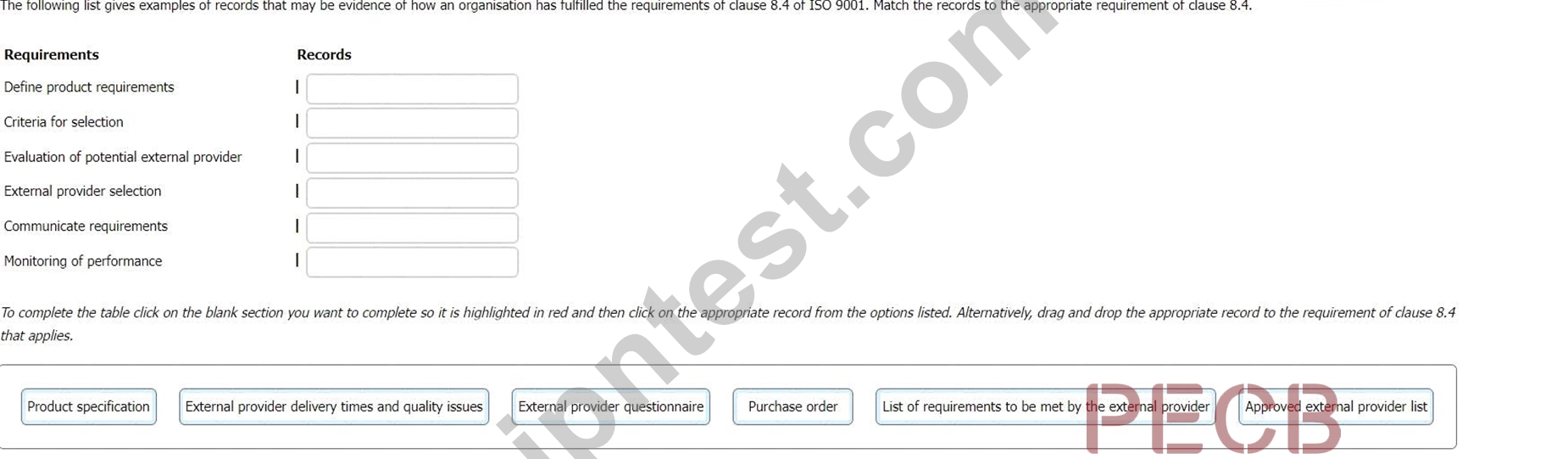
正解:
解説: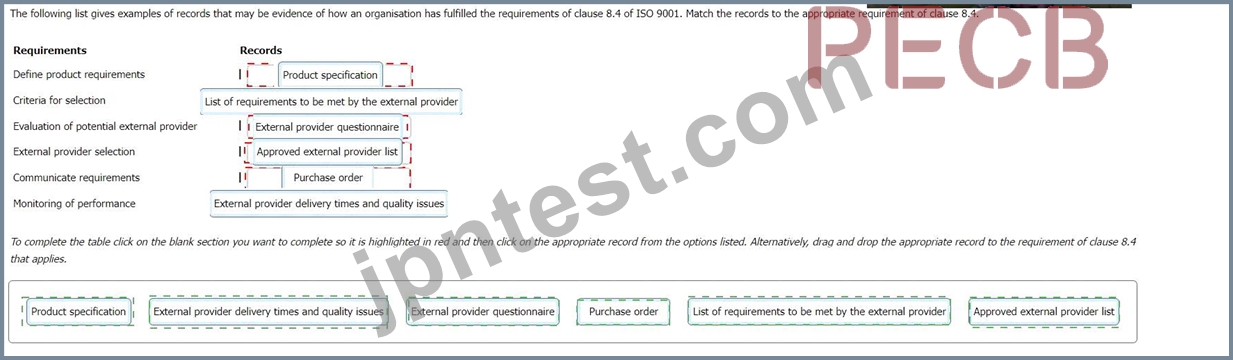
Explanation: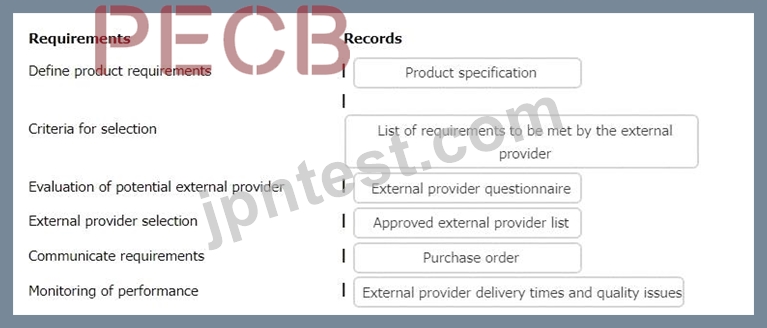
The following table shows the possible matching of the records to the requirements of clause 8.4:
Table
Requirements
Records
Define product requirements
Product specification
Criteria for selection
List of requirements to be met by the external provider
Evaluation of potential external provider
External provider questionnaire
External provider selection
Approved external provider list
Communicate requirements
Purchase order
Monitoring of performance
External provider delivery times and quality issues
Comprehensive and Detailed Explanation: = According to clause 8.4 of ISO 9001:2015, the organization should ensure that externally provided processes, products, and services conform to the specified requirements. To do so, the organization should:
Define the product requirements that are relevant for the external provision, such as specifications, drawings, standards, codes, etc. These should be documented and communicated to the external provider. A record of the product specification can be used as evidence of this requirement.
Establish the criteria for the selection, evaluation, and re-evaluation of external providers, based on their ability to provide processes, products, and services in accordance with the requirements. The criteria should be documented and applied consistently. A record of the list of requirements to be met by the external provider can be used as evidence of this requirement.
Evaluate the potential external providers before selecting them, using the established criteria. The evaluation methods may include questionnaires, audits, references, samples, etc. The results of the evaluation should be documented and reviewed. A record of the external provider questionnaire can be used as evidence of this requirement.
Select the external providers that have demonstrated their competence and conformity to the requirements. The selection should be based on the evaluation results and the organization's needs. The selection should be documented and approved. A record of the approved external provider list can be used as evidence of this requirement.
Communicate the requirements for the processes, products, and services to be provided by the external provider, including the verification and validation activities, the acceptance criteria, the documentation requirements, the changes control, etc. The communication methods may include purchase orders, contracts, agreements, etc. The communication should be clear, complete, and timely. A record of the purchase order can be used as evidence of this requirement.
Monitor the performance and conformity of the external provider, using the established criteria and methods. The monitoring methods may include inspections, tests, audits, feedback, complaints, etc. The monitoring results should be documented and analyzed. A record of the external provider delivery times and quality issues can be used as evidence of this requirement.
References: ISO 9001:2015, [ISO 9001 Auditing Practices Group Guidance on Scope], Mastering the Scope of ISO 9001 Quality Management Systems
質問 # 21
小規模な清掃サービス組織が、地元の医療信託の病院清掃契約の作業を開始しようとしています。あなたは監査人として、ISO 9001 のステージ 2 監査を実施し、サービス マネージャーとの契約を確認します。契約では、清掃計画を作成することが義務付けられています。
あなた:「契約の清掃計画はどのように策定されましたか?」
サービス マネージャー: 「当社には、使用する材料、労働力、清掃方法を網羅した基本テンプレートがあります。その一部は、顧客によって指定されます。」 あなた: 「契約に含まれている集中治療室や手術室などの場所については、計画ではどのように扱われますか?」 サービス マネージャー: 「基本計画では一般病棟をカバーしていますが、病院から要求があれば、それらのエリアの清掃をより頻繁に行います。」 あなた: 「病院の清掃基準に関する規制要件をご存知ですか?」 サービス マネージャー: 「いいえ。契約では、その側面については病院に任せています。」 あなたは、ISO 9001 のセクション 8.2.2.a.1 に対して不適合を申し立てることにしました。
清掃計画がHealth Trustの同意なしに修正されたことが判明し、ISO 9001のセクション8.2.4に違反する別の不適合を指摘することにしました。契約で指定されたものとは異なる洗浄剤が使用されました。フォローアップ監査で提案された是正措置は次のとおりでした。
「新しい化学物質の使用について、保健信託から許可を得る。」この措置を受け入れなかった理由は、次の選択肢のうちどれですか。
- A. このアクションは、Health Trust が変更に同意することを前提としています。
- B. 代替化学物質は元の化学物質ほど効果的でない可能性があります。
- C. 契約を変更するプロセスが対処されていません。
- D. スタッフは新しい化学物質の使用方法について訓練を受けていません。
- E. 代替化学物質は、Health Trust ではこれまで使用されたことがありません。
正解:C
質問 # 22
以下は、ISO 9000 シリーズの基盤となる 7 つの原則のうち 4 つです。それぞれの品質管理原則 (QMP) の潜在的な利点を一致させてください。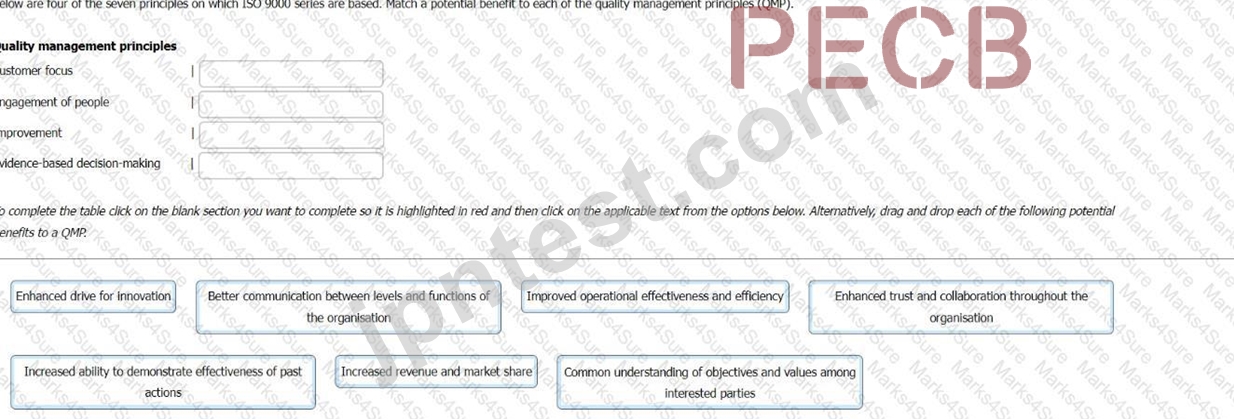
正解:
解説: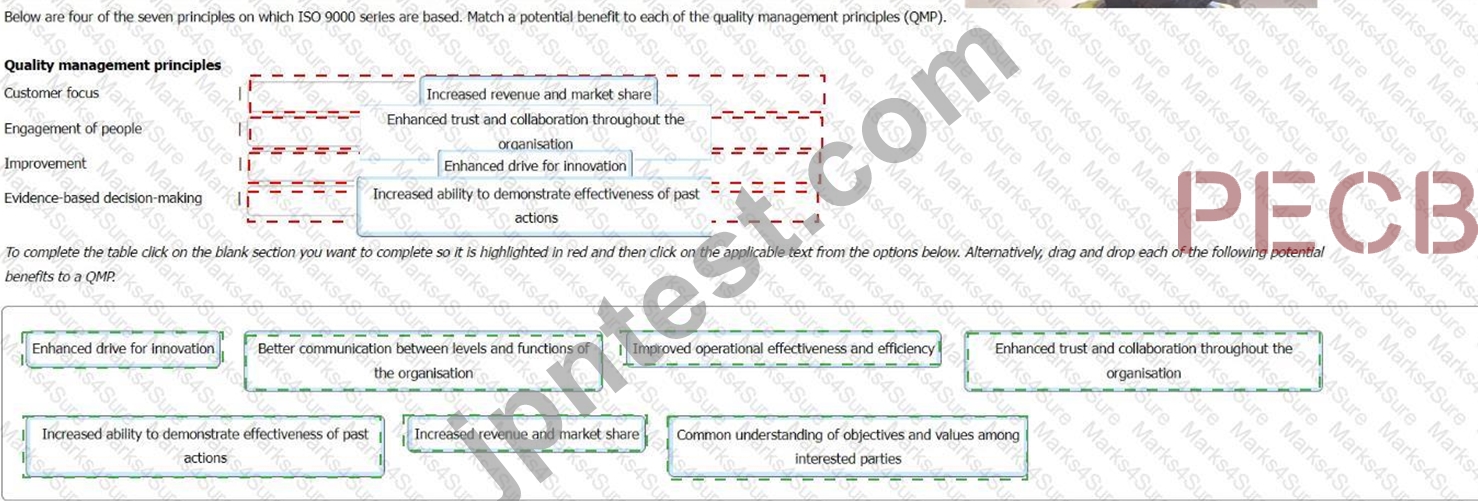
Explanation:
チャットのスクリーンショット 説明は自動的に生成されます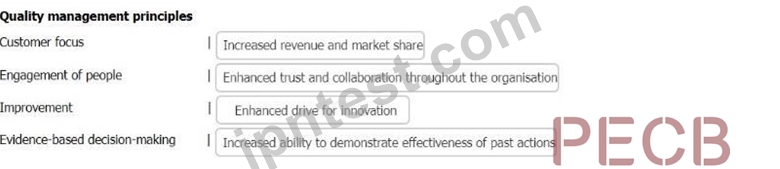
ISO 9000:2015 文書によると、品質管理の 7 つの原則は次のとおりです。
顧客重視
リーダーシップ
人々の関与
プロセスアプローチ
改善
証拠に基づく意思決定
関係管理
このドキュメントでは、各原則について、その説明、根拠、主な利点、組織で原則を適用するために実行できるアクションについて説明します。
文書に基づいて、あなたが言及した 4 つの品質管理原則のそれぞれに潜在的な利点を一致させる方法は次のとおりです。
テーブル
品質管理原則
潜在的なメリット
顧客重視
収益と市場シェアの拡大
人々の関与
組織全体で信頼と協力を強化
改善
イノベーションへの意欲の強化
証拠に基づく意思決定
過去の行動の有効性を示す能力の向上
質問 # 23
TIX は、大規模組織の情報機器にサービスを提供しています。同社は ISO 9001:2015 QMS を運用しており、重要な顧客による監査を受けています (第 2 者監査)。監査中、監査チームは 2 つの不適合を特定しました。最終会議の準備中に、監査チームは TIX の品質管理者と両方の不適合について話し合い、合意しました。最終会議は、ゼネラル マネージャー、品質管理者、サービス管理者が会議室に集まり、午後 6 時に予定されていました。
午後 6 時に監査チームが会議室に入ると、健康安全管理者と倉庫管理者の 2 人だけが待機していました。どちらも監査には参加していませんでした。
彼らの間の対話は次の通りです。
監査チームリーダー: 「こんばんは。3 人のマネージャーに、閉会会議を始める準備ができたことを伝えていただけますか?」 安全衛生監督者: 「こんばんは。残念ながら、ゼネラルマネージャーが重大な交通事故に巻き込まれ、他の 2 人のマネージャーは緊急事態に対応するために急遽退席しなければなりませんでした。」 倉庫監督者: 「彼らは、あなたが言うべきことを聞き、署名する必要があるものには署名するように私たちに依頼しています。また、2 つの不適合に関する彼らからのメッセージも受け取っています。彼らは、今後どうするかを決めるために、数日以内に連絡してもらえるようにお願いしたいと言っています。」 倉庫マネージャーの最後のコメントに対する、次のオプションのうち、あなたが望む対応はどれですか?
- A. 申し訳ありませんが、閉会会議を進めることができません。そのため、私たちは今から出発します。品質管理マネージャーには、明日の早朝に電話することを伝えてください。
- B. ご要望を伺ってから退席します。緊急事態が収束したらすぐにマネージャーに連絡してもらい、閉会会議の新たな日程を決めてください。
- C. ご要望をお聞きし、不適合報告書を受諾した証拠として署名していただきます。緊急事態が終わったらすぐにマネージャーに連絡していただき、最終会議を完了するための新しい日付について合意していただくようお願いいたします。
- D. ご要望を伺い、品質管理者と合意した不適合レポートのコピーをお渡しします。これを最終会議とみなし、監査プログラムを管理している個人が 5 日以内に完全なレポートを送信することを管理者に伝えてください。
正解:B
質問 # 24
次の監査人のうち、第一者監査に参加しない監査人は 2 名ですか?
- A. IRCA認定の監査人
- B. IRCAスキームの訓練を受けた監査人
- C. 社内で訓練を受けた監査人
- D. 顧客からの監査人
- E. 外部のコンサルティング組織に雇用されている監査人
- F. 利害関係者の監査人
正解:D、E
解説:
A first-party audit is an internal audit conducted by auditors who are employed by the organization being audited but who have no vested interest in the audit results of the area being audited1. The purpose of a first-party audit is to assess the conformity of the organization's quality management system to the requirements of ISO 9001 and to identify opportunities for improvement2. Therefore, the two auditors who would not participate in a first-party audit are:
*A. An auditor employed by an external consultancy organization: This auditor is not employed by the organization being audited, and therefore does not qualify as a first-party auditor. This auditor may be hired to conduct a second-party audit (if the external consultancy organization is a customer or supplier of the organization being audited) or a third-party audit (if the external consultancy organization is a certification body or registrar).
*F. An auditor from a customer: This auditor is not employed by the organization being audited, and therefore does not qualify as a first-party auditor. This auditor may be hired to conduct a second-party audit, as a customer is an interested party that has specific requirements for the organization being audited.
The other options are not correct, as they could participate in a first-party audit, as long as they are employed by the organization being audited and have no vested interest in the audit results of the area being audited:
*B. An auditor from an interested party: This auditor could be a first-party auditor, as long as the interested party is within the organization being audited. For example, an auditor from the finance department could audit the production department, as long as they are not involved in the production process or affected by its outcomes.
*C. An auditor trained in-house: This auditor could be a first-party auditor, as long as they are employed by the organization being audited and have no vested interest in the audit results of the area being audited. The source of the auditor's training is not relevant for determining the type of audit, as long as the auditor is competent and qualified to perform the audit.
*D. An auditor trained in the IRCA scheme: This auditor could be a first-party auditor, as long as they are employed by the organization being audited and have no vested interest in the audit results of the area being audited. The IRCA scheme is a professional certification scheme for auditors of management systems, which provides recognition of the auditor's competence and credibility3. However, being trained in the IRCA scheme does not determine the type of audit, as long as the auditor is competent and qualified to perform the audit.
*E. An auditor certified by IRCA: This auditor could be a first-party auditor, as long as they are employed by the organization being audited and have no vested interest in the audit results of the area being audited. Being certified by IRCA means that the auditor has met the requirements of the IRCA scheme and has demonstrated their competence and credibility as an auditor of management systems3. However, being certified by IRCA does not determine the type of audit, as long as the auditor is competent and qualified to perform the audit.
References: First Party Audits: The 5 Steps to Success - Sync Resource Inc, ISO 9001 Auditing Practices Group, IRCA - International Register of Certificated Auditors
質問 # 25
組織が継続的に改善しなければならない品質管理システムの側面は次のうちどれですか?
- A. 適応力
- B. 効率
- C. 応答性
- D. 有効性
- E. 適用範囲
- F. 適合性
正解:B、D
解説:
According to the ISO 9001:2015 document, the organisation must continually improve the suitability, adequacy, and effectiveness of the quality management system1. However, among the six options given, only effectiveness is directly mentioned as an aspect of the quality management system that must be continually improved. Therefore, C is one of the correct answers.
Efficiency, on the other hand, is not explicitly stated as an aspect of the quality management system that must be continually improved, but it is implied by the quality management principle of improvement, which states that successful organisations have an ongoing focus on improvement2. One of the key benefits of applying this principle is improving operational effectiveness and efficiency2. Therefore, E is another correct answer.
Suitability, adaptability, responsiveness, and applicability are not aspects of the quality management system that must be continually improved, according to the ISO 9001:2015 document. They may be related to the quality management system, but they are not the focus of continual improvement.
Therefore, the correct answer is C and E.
References: 1: ISO 9001:2015 - Quality management systems - Requirements 2: ISO - Quality management principles
質問 # 26
あなたは、初めて ISO 9001 認証を取得しようとしている組織で監査を実施しています。この組織は、化粧品メーカーに規制コンサルティング サービスを提供しています。このビジネスは 10 の地域オフィスで運営されています。
監査の終わりが近づいており、品質管理システムに関するトップマネジメントのリーダーシップとコミットメントの十分な証拠が収集されたかどうかを判断する必要があります。
次の 4 つのうち、品質管理システムに関してトップマネジメントのリーダーシップとコミットメントを示すものはどれですか。
- A. 監査終了会議に出席しない
- B. 経営レビュー会議の議長を務める
- C. 不適合に起因する是正措置に時間と費用を投資する
- D. 会計年度の社用車予算の承認
- E. 職員懲戒会議の開催
- F. 手順に従うことの重要性の促進
- G. 改善文化の発展についてスタッフに説明する
正解:B、C、F、G
解説:
品質管理システムに関するトップマネジメントのリーダーシップとコミットメントを示すには、次の 4 つのアクションが参考になります。
B: 改善文化の発展についてスタッフに説明する: これは、品質管理システム1の重要な側面である継続的改善の文化の促進にトップマネジメントが積極的に関与していることを示しています。
C: 経営レビュー会議の議長を務める: これらの会議を主導することで、経営トップは品質管理システムの継続的なパフォーマンスへの関与と継続的改善への取り組みを示します1。
E: 不適合に起因する是正措置に時間と資金を投資する: これは、トップマネジメントが問題に対処し、品質管理システムが有効で継続的に改善されることを保証することに尽力していることを示します1。
G: 手順に従うことの重要性の促進: 経営陣が手順の遵守の重要性を強調すると、品質管理システムとそのプロセスの重要性が強化されます1。
これらの行動は、ISO 9001:2015 の要件と一致しており、最高経営責任者が品質管理システムの有効性について責任を負い、継続的な改善と顧客満足に重点を置くことの重要性を強調しています123。社用車の予算を承認したり、懲戒会議を開催したり、監査の最終会議に出席しなかったりすることは、品質管理システムに対するリーダーシップとコミットメントを直接示すものではありません1。
質問 # 27
3 人の監査チームが、海洋環境で石油およびガス産業向けの犠牲陽極を製造しているエンジニアリング組織に対して、ISO 9001 のステージ 2 監査を実施しています。これらは、水中の鋼構造物の腐食を防ぐために設計されたアルミニウム製品です。監査員の 1 人であるあなたは、陽極のガルバニック効率テストの結果が完全に分析され、顧客の要求どおりに報告される前に、組織がメキシコ湾の Project DK 用の陽極を出荷したことを発見しました。品質管理者は、罰金が課せられる遅延配送を回避するために、マネージング ディレクターが陽極のリリースを承認したと説明します。テストで要求された効率を下回ることはほとんどないため、顧客には通知されませんでした。あなたは、ISO 9001 の条項 8.6 に対して不適合を報告します。
不適合の最も適切な説明として、次のオプションのうちどれが適切でしょうか?
- A. プロジェクト DK では、許容できるテスト結果がない製品のリリースが顧客によって承認されました。
- B. Project DK の製品は、品質管理プロセスによる製品承認前にリリースされています。
- C. 未テスト製品は、アノードのガルバニック効率が検証されるまでリコールされませんでした。
- D. テスト結果が品質マネージャーによって承認された後、顧客から遡及的な譲歩は求められませんでした。
正解:B
解説:
Clause Reference - ISO 9001:2015 Clause 8.6 (Release of Products and Services):ISO 9001 requires that products and services are not released to the customer until:
* All planned verification activities have been completed.
* Acceptance criteria have been met.
* Any necessary approvals have been obtained.
In this scenario:
* The sacrificial anodes for Project DK were shipped before the galvanic efficiency test results were analyzed.
* This constitutes a nonconformity against Clause 8.6 because the products were released without completing the required tests.
Option Analysis:
* A. A retrospective concession was not sought from the customer once the test results had been approved by the Quality Manager:Incorrect. While obtaining a concession might mitigate the situation, the nonconformity pertains to the process failure of releasing the products without completing required tests, not the absence of a concession.
* B. Release of the product without acceptable test results has been accepted by the customer for Project DK:Incorrect. The customer was not informed before the release, and there is no indication that this was accepted beforehand. Furthermore, ISO 9001 requires planned processes to be followed, regardless of later acceptance.
* C. Products for Project DK have been released before product approval through the quality control process:Correct. This description accurately reflects the nonconformity. The quality control process required test results to be analyzed and verified before release, which did not happen.
* D. The untested product was not recalled until the galvanic efficiency of the anodes was verified:
Incorrect. The issue is not about recalling the product but about releasing it without completing the required tests. Recalling the product is not mentioned in the scenario.
Why C is Correct:
* The nonconformity is a clear breach of Clause 8.6, where the products were released without meeting the planned verification requirements.
* This demonstrates a failure in adhering to quality control processes, which is a critical aspect of ISO
9001 compliance.
Key ISO 9001 Reference:
* Clause 8.6: Products and services shall not be released to the customer until all planned activities (e.g., testing) have been satisfactorily completed, or the customer has approved the release with knowledge of deviations.
質問 # 28
あなたは、10 年間 ISO 9001 の認証を受けている組織を監査しています。この組織は、複数の拠点を持つ民間所有の自動車タイヤ取り付け組織です。あなたは、拠点の 1 つを監査しています。自動車タイヤ取り付けサービスを監査しています。あなたは、拠点マネージャー (SM) にインタビューしています。
あなた:「車のタイヤ取り付けサービスについて説明していただけますか?」
SM: 「もちろんです。通常、お客様は電話で要件を伝えてきます。私たちはお客様が何を望んでいるのかを尋ねます。
タイヤがあるかどうかを確認します
顧客が在庫を必要とするタイヤを在庫しています。在庫がない場合は、サプライヤーに連絡して、いつタイヤを供給できるかを確認します。その後、コストを決定します。次に、忙しいスケジュールの中で新しいタイヤを取り付ける空き時間を確認します。次に、コストの詳細とタイヤを取り付け可能な時期を顧客に通知します。顧客が予約を進めることに満足した場合は、作業スケジュールを更新します。同じプロセスが、オフィスに立ち寄った顧客とオンラインリクエストに適用されます。」 あなた:「取り付けたタイヤの製造元から欠陥が報告された場合、どのような情報を保持しますか?」 SM:「顧客の名前、住所、連絡先電話番号の記録を保持しています。取り付けたタイヤの種類とタイヤ製造元のバッチ情報の記録を保持しています。また、タイヤを取り付けた車両の登録番号の記録も保持しています。すべての記録は作業スケジュールにあります。」 サイトマネージャーからの説明を検証するための追加の監査証拠を収集できるようにするには、次のオプションのどれを実行しますか?
- A. タイヤ取り付け工にインタビューして、組織でどのくらいの期間働いているかを確認します。
- B. 3年前の作業スケジュールを確認し、どのような情報が記録されているかを確認します。
- C. 過去 3 週間の作業スケジュールを確認し、記録されている情報を確認します。
- D. サイト管理者のトレーニング記録を確認します。
- E. 顧客にインタビューして、サービスに対する満足度を判断します。
- F. タイヤ取り付け担当者にインタビューして、車に取り付けられている各タイヤの種類とロットを特定します。
正解:C、F
質問 # 29
監査計画に含めるべき項目は次のうちどれですか?
- A. 前回の監査の調査結果のリスト
- B. 認証機関の技術レビュー担当者の署名
- C. 監査対象の総支配人の氏名
- D. 監査活動の順序とタイミング
- E. 監査対象者と監査人の名前
- F. 次回監査日
正解:D、E
解説:
ISO 19011:2018 の 6.3.2 項によれば、監査計画には次の情報が含まれている必要があります。
監査の目的、範囲、基準
監査チームのメンバーとその役割と責任
監査スケジュールには、開始会議、文書レビュー、インタビュー、観察、終了会議などの監査活動の順序とタイミングが含まれます。
各監査活動と場所の予想時間と期間
監査対象者の代表者およびその他の関係者の名前と連絡先の詳細、監査活動をサポートするための適切なリソースの割り当て、インタビュー、観察、サンプリングなどの使用する監査方法と技法。
作成および保管される監査文書および記録
監査言語とコミュニケーション方法
監査のリスクと機会、そしてそれらに対処する方法
該当する場合、監査フォローアップの手配
したがって、正解は D と F です。これらは監査計画の必須要素です。その他の選択肢は、監査計画には無関係かオプションです。参考文献:
ISO 19011:2018(en)、マネジメントシステムの監査に関するガイドライン、6.3.2 項 ISO 19011: マネジメントシステムの監査に関するガイドライン | ASQ、「監査の手配」セクション ISO 19011 マネジメントシステム監査チェックリスト | Process Street、タスク 6.3.2
質問 # 30
組織が継続的に改善しなければならない品質管理システムの側面は次のうちどれですか?
- A. 適応力
- B. 効率
- C. 応答性
- D. 有効性
- E. 適用範囲
- F. 適合性
正解:B、D
解説:
ISO 9001:2015 文書によれば、組織は品質管理システムの適合性、妥当性、有効性を継続的に改善する必要があります1。ただし、6 つの選択肢のうち、継続的に改善する必要がある品質管理システムの側面として直接言及されているのは有効性だけです。したがって、C は正解の 1 つです。
一方、効率性は、継続的に改善しなければならない品質管理システムの側面として明示的には述べられていませんが、品質管理の改善の原則によって暗示されています。この原則では、成功している組織は継続的に改善に重点を置いていると述べられています2。この原則を適用する主な利点の 1 つは、運用の有効性と効率性が向上することです2。したがって、E も正解です。
ISO 9001:2015 文書によれば、適合性、適応性、応答性、適用性は、継続的に改善しなければならない品質管理システムの側面ではありません。これらは品質管理システムに関連しているかもしれませんが、継続的な改善の焦点ではありません。
したがって正解はCとEです。
参照: 1: ISO 9001:2015 - 品質管理システム - 要件 2: ISO - 品質管理の原則
質問 # 31
ISO 9001 の品質管理システムで文書化された情報を保持する目的を最もよく表す用語を選択してください。
- A. 品質管理システムのプロセスの運用をサポートします。
- B. 標準への適合を証明するための監査を容易にします。
- C. 品質管理システムの有効性に対する信頼を提供する。
- D. 品質管理システムの完全性を保護する。
正解:A
解説:
Documented information is a means by which an organization demonstrates compliance. It communicates what we do and how we do things, it communicates what happened and what results were achieved. It is, essentially, a tool for communication. ISO 9001:2015 allows an organization flexibility in the way it chooses to document its quality management system (QMS). This enables each individual organization to determine the correct amount of documented information needed in order to demonstrate the effective planning, operation and control of its processes and the implementation and continual improvement of the effectiveness of its QMS. The standard states that the organization shall maintain documented information to the extent necessary to support the operation of processes and retain documented information to the extent necessary to have confidence that the processes are being carried out as planned. Therefore, the purpose of retaining documented information is to support the operation of the processes of the QMS, not to facilitate auditing, provide confidence or safeguard integrity, which are secondary benefits of documented information.
References: Guidance on the requirements for Documented Information of ISO 9001:2015, ISO 9001:2015 documented information | CQI | IRCA, Documented Information Required by ISO 9001:2015 - 9000 Store
質問 # 32
組織が ISO 9001 の第三者認定認証を取得するための認証プロセスにおけるイベントの正しい順序を述べます。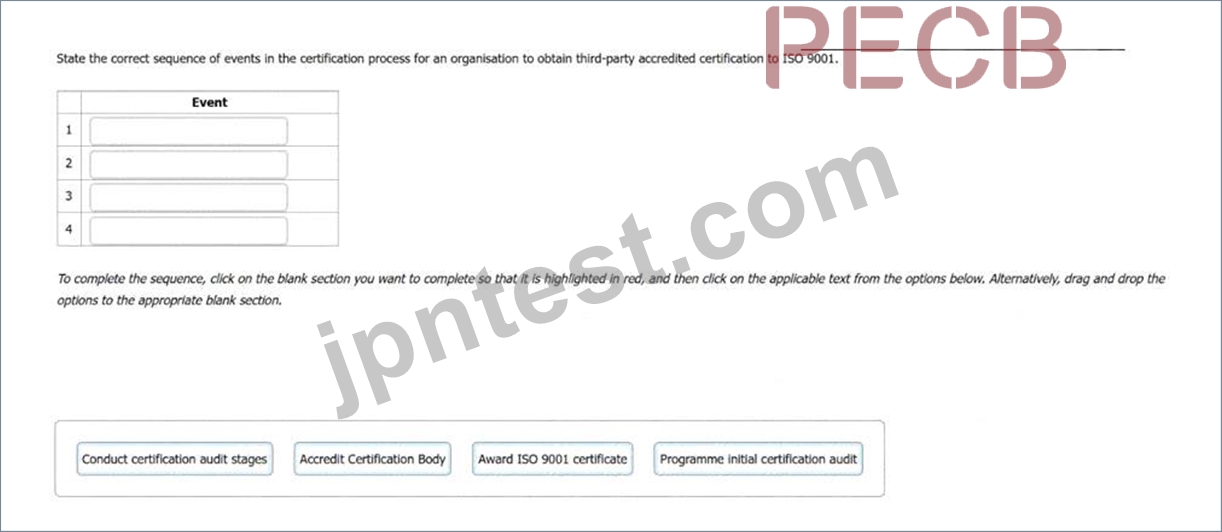
正解:
解説: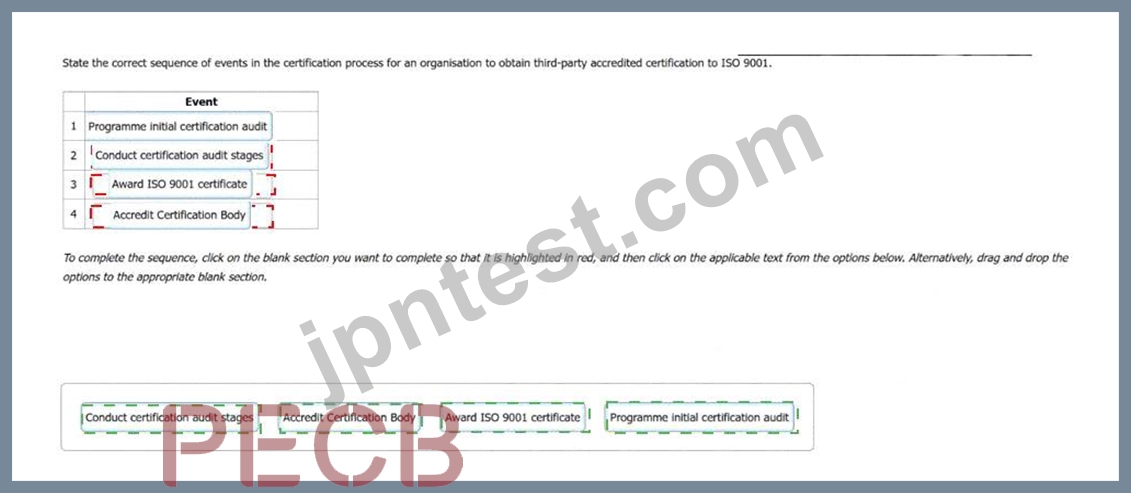
質問 # 33
ヘルストラストは、ISO認証を受けたケータリングサービス組織であるServitupと契約を結んだ。
9001を1年間利用しています。10の小規模な農村地域にサービスを提供しています。
遠隔地にある病院では、乾物や生鮮食品の購入と保管、食事の準備、病院スタッフによる病棟サービス用の暖房付きカートへの積み込みなどを行っています。監査人は、副ケータリング マネージャー (DCM) とともに、1 つのサイトで初めての単独監視監査を実施しています。
DCM のみが出席した最終会議で、監査人は QMS プロセスに多数の欠陥が見つかったため、組織の認証の一時停止を勧告することを検討していると DCM に伝えました。監査人は特に、安全な消費期限を過ぎて保管された農産物、厨房の衛生状態の悪さ、調理不足の食事によって患者の健康が悪影響を受けているという証拠を懸念しています。DCM は、ケータリング マネージャーが病気のため不在のため、これらの問題について決定を下すことはできないが、すべてを書き留めてケータリング マネージャーに報告すると述べています。
監査の文脈で実行する必要がある 2 つのアクションはどれですか?
- A. DCM の回答後すぐに会議を終了し、次回の監視訪問時に問題に対処することを通知します。
- B. 会議を続行し、監査の結論を提示し、組織が適時に監査レポートを受け取ることを DCM に通知します。
- C. すべての担当者に、QMS に関する緊急の徹底的なトレーニングを実施することを推奨します。
- D. 監査プログラムを管理している個人に電話して状況を説明し、認証機関の完全性を保護するために認証の即時停止を推奨します。
- E. 会議を早めに終了し、ケータリング マネージャーが仕事に戻ったら再スケジュールすることを通知します。
- F. DCM に時間を割いてくれたことに感謝し、QMS が改善されることを期待していることを表明します。
正解:B、D
解説:
監査の文脈で実行する必要があるアクションは次のとおりです。
*オプション B: 監査プログラムを管理する担当者に連絡して状況を説明し、認証機関の完全性を保護するために認証の即時停止を勧告します。このオプションは正解です。なぜなら、監査人は QMS プロセスに患者の健康と安全に影響を与える重大かつ重大なギャップを発見したからです。これは認証の停止に値する重大な不適合です。監査人は監査プログラムを管理する担当者に状況と監査結果を報告し、認証機関の完全性と認証制度の信頼性を保護するために認証の即時停止を勧告する必要があります。また、監査人は認証機関の認証停止の手順と規則に従い、決定と結果を被監査者に伝える必要があります。
*オプション C: 会議を続行し、監査の結論を提示し、組織が監査レポートを適時に受け取ることを DCM に通知します。このオプションは正解です。なぜなら、DCM は監査対象者の監査の指名代表者であるため、ケータリング マネージャーの不在を理由に監査人が最終会議を終了または延期すべきではないからです。監査人は会議を続行し、監査の結論と監査結果を提示し、組織が監査レポートを適時に受け取ることを DCM に通知する必要があります。監査人は、監査結果の推奨事項と認証の一時停止についても説明し、DCM に監査結果の受け取りと理解を確認するよう依頼する必要があります。
次のオプションは正しくありません。
*オプション A: DCM の回答後すぐに会議を終了し、次回の監査訪問で問題に対処することを通知します。このオプションは正しくありません。監査人は、監査結論と監査所見を提示せずに会議を終了するべきではありません。これは、監査の原則である公平性と透明性に違反するからです。また、監査人は、次回の監査訪問で問題に対処することを通知すべきではありません。これは、監査人が被監査者の遅延と不作為を受け入れ、重大な不適合を真剣に受け止めていないことを意味するからです。
*オプション D: 会議を早めに終了し、ケータリング マネージャーが仕事に戻ったら再スケジュールすることを通知します。このオプションは正しくありません。ケータリング マネージャーの不在を理由に、監査人が会議を早めに終了したり再スケジュールしたりすると、監査プロセスと監査スケジュールが中断されるためです。また、監査人はケータリング マネージャーが仕事に戻るのを待つべきではありません。そうすると、重大な不適合の伝達と解決が遅れ、患者の健康と安全が損なわれる可能性があります。
*オプション E: すべての担当者に QMS の詳細なトレーニングを緊急に実施することを推奨します。このオプションは正しくありません。監査人は、監査対象者に特定の是正措置を推奨または指示すべきではありません。これは、独立性と客観性の監査原則に違反するからです。監査人は、監査の所見と監査結果の推奨事項のみを報告し、是正措置の決定と実施の責任と権限を監査対象者に委ねる必要があります。
*オプション F: DCM に時間を割いてくれたことへの感謝と、QMS の改善への期待を表明する。このオプションは正しくありません。なぜなら、監査人は DCM に時間を割いてくれたことへの感謝と、QMS の改善への期待を表明すべきではないからです。そうすると、監査人が被監査者のパフォーマンスと対応に満足し、楽観的であり、重大な不適合を真剣に受け止めていないと解釈されるからです。監査人は代わりに、被監査者の QMS プロセスと患者の健康と安全への影響に対する懸念と不満を表明し、認証の一時停止と緊急かつ効果的な是正措置の必要性を伝える必要があります。
参考文献:
*ISO 19011:2018 マネジメントシステムの監査に関するガイドライン、6.4.2項:監査活動の実施、k)およびl)項
*ISO 9001 主任監査員コース教材、モジュール 5: 監査の実施、スライド 20: 閉会会議
*ISO 9001 主任審査員トレーニングコース - IRCA 認定、セクション 5.5: 閉会会議
*主任監査人試験準備ガイド(EPG)テンプレート - PECB、セクション3.2:試験内容の概要、サブセクション3.2.1:セクション1 - 監査の基礎、サブセクション3.2.2:セクション2 - 監査の原則、サブセクション
3.2.3: セクション 3 - 監査プロセス、サブセクション 3.2.4: セクション 4 - 監査能力
質問 # 34
ドキュメントレビューを実施する目的を最もよく表すオプションを 1 つ選択します。
- A. 監査基準に従って文書化されたシステムの不適合を確立し、監査レポートを作成するための情報を収集します。
- B. 文書化されたシステムが監査基準に準拠しているかどうかを決定し、監査プロセスをサポートするための調査結果を収集します。
- C. 文書化されたシステムが監査基準に準拠していないかどうかを明らかにし、監査レポートを裏付ける証拠を収集します。
- D. 文書化されている場合、システムが監査基準に準拠していることを確認し、監査結果を裏付ける情報を収集します。
- E. 文書化された範囲でシステムが監査基準に準拠しているかどうかを判断し、監査活動をサポートするための情報を収集します。
- F. 監査基準に違反するシステムがあれば、それを文書化して検出し、監査計画をサポートする情報を特定します。
正解:E
解説:
文書レビューを実施する目的は、文書化されたシステムが監査基準に準拠しているかどうかを判断し、監査活動をサポートする情報を収集することです。文書レビューは、監査の目的と範囲に関連する文書化された情報を体系的かつ客観的に検査することです。文書化された情報が完全、正確、一貫性があり、最新であるかどうかを監査人が確認するのに役立ちます。また、監査人が、監査結果や結論に影響を与える可能性のある文書化された情報のギャップ、エラー、または不適合を特定するのにも役立ちます。
その他のオプションは、文書レビューの真の目的を反映していないため、正しくありません。オプション A は、監査結果と推奨事項を経営陣やその他の関係者に伝えるという監査レポートの目的について説明しています。オプション B は、監査の範囲、目的、基準、方法、リソース、およびスケジュールを定義するという監査計画の目的について説明しています。オプション C は、監査中に特定された不適合または改善の機会の証拠を提供するという監査証拠レポートの目的について説明しています。オプション D は、監査中に特定の決定が行われた理由を正当化または説明するという監査決定レポートの目的について説明しています。
この回答が、オプション F が正しい理由とオプション ACD が間違っている理由を理解するのに役立つことを願っています。ISO 9001 主任監査員試験の質問と回答について詳しく知りたい場合は、次のリソースを確認してください。
ISO 9001 主任監査員試験のサンプル問題と回答: この記事では、ISO 9001 主任監査員試験の各セクションのサンプル問題と回答をいくつか紹介します。
ISO 9001 (QMS) 主任監査員クイズの質問と回答: この記事では、ISO 9001 QMS に関連するさまざまなトピックに関するクイズの質問と回答をいくつか紹介します。
ISO 9001 主任監査員 - 試験模擬テスト: このコースでは、各質問の説明付きの模擬テストを提供します。
Irca 主任監査人試験の質問と回答 PDF: このドキュメントには、PDF 形式の試験の質問と回答がいくつか含まれています。
質問 # 35
以下のプロセスの説明をプロセス名と一致させます。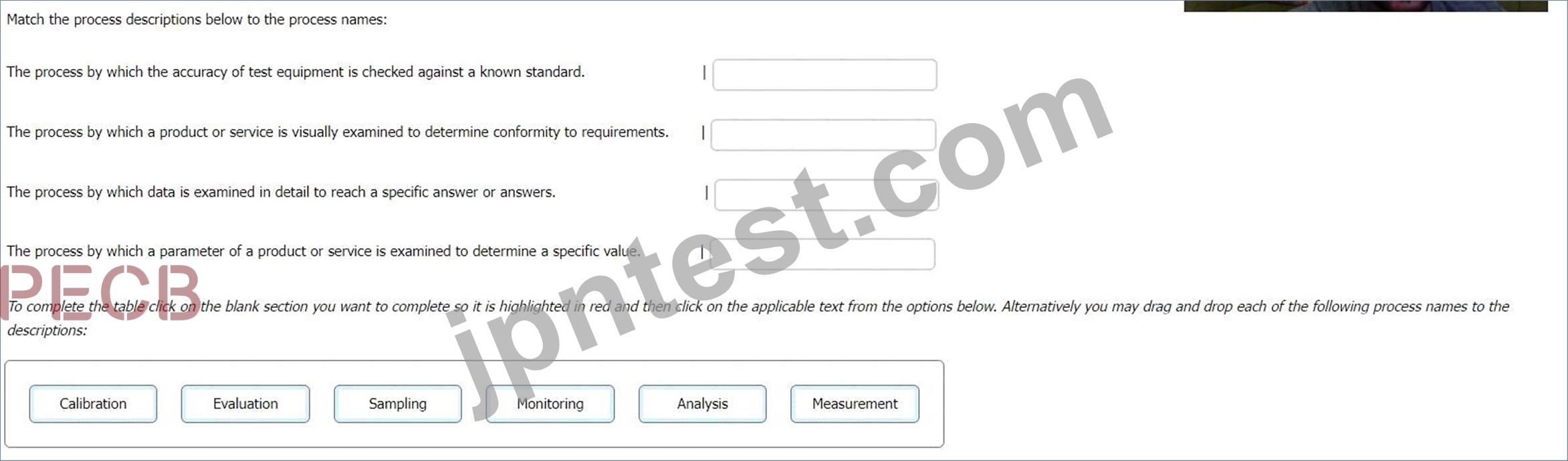
正解:
解説: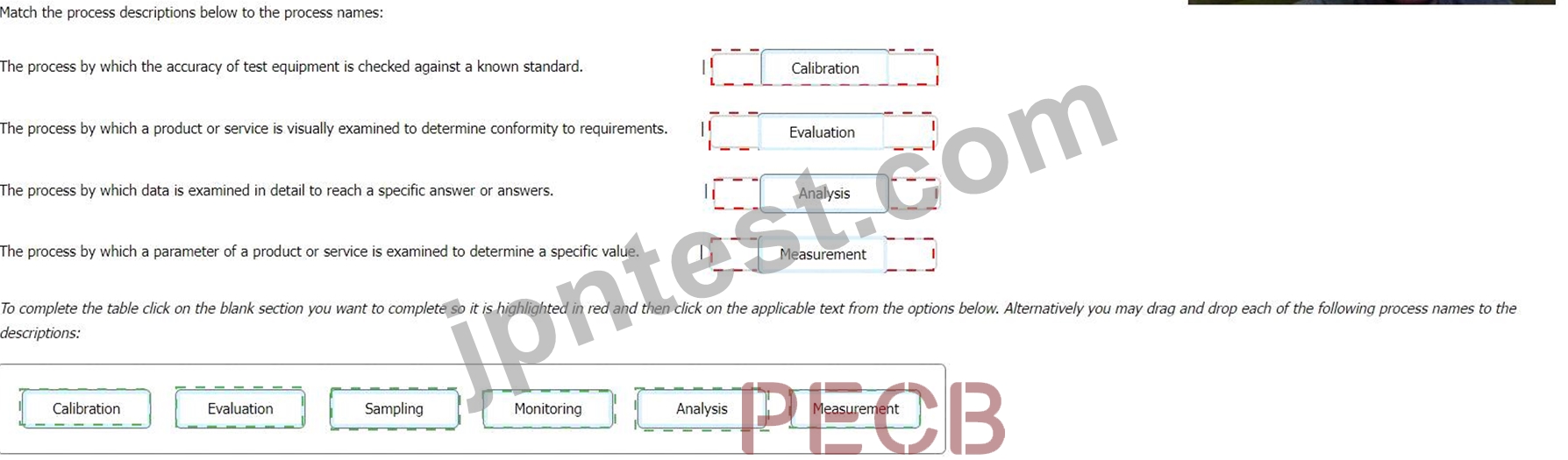
Explanation:
Match the process descriptions below to the process names:
The process by which the accuracy of test equipment is checked against a known standard. = Calibration The process by which a product or service is visually examined to determine conformity to requirements. = Evaluation The process by which data is examined in detail to reach a specific answer or answers. = Analysis The process by which a parameter of a product or service is examined to determine a specific value. = Measurement According to the ISO 9000:2015 - Quality management systems - Fundamentals and vocabulary, the definitions of the process names are as follows:
Calibration: operation that, under specified conditions, in a first step, establishes a relation between the quantity values with measurement uncertainties provided by measurement standards and corresponding indications with associated measurement uncertainties and, in a second step, uses this information to establish a relation for obtaining a measurement result from an indication.
Evaluation: determination of the suitability, adequacy or effectiveness of an object to achieve established objectives.
Analysis: detailed examination of the elements or structure of something.
Measurement: process to experimentally obtain one or more quantity values that can reasonably be attributed to a quantity.
Therefore, the process descriptions can be matched to the process names based on these definitions.
References:
ISO 9000:2015 - Quality management systems - Fundamentals and vocabulary
質問 # 36
サードパーティ認証監査のコンテキストでは、役割を次の責任と一致させます。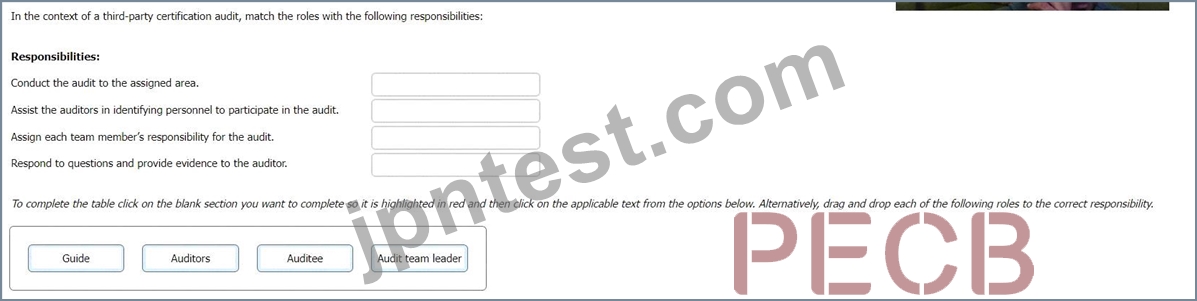
正解:
解説: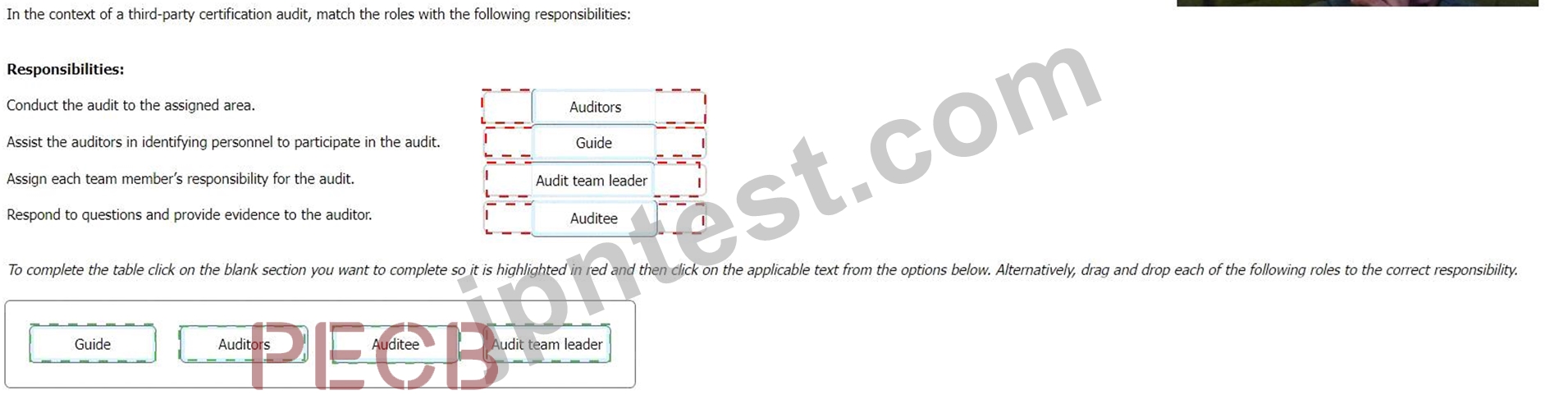
Explanation:
In the context of a third-party certification audit, match the roles with the following responsibilities:
Responsibilities:
Conduct the audit to the assigned area.= Auditors
Assist the auditors in identifying personnel to participate in the audit.= Guide Assign each team member's responsibility for the audit.= Audit team leader Respond to questions and provide evidence to the auditor.= Auditee According to ISO 19011:2018, clause 3, the definitions of the roles are as follows1:
Auditors: persons with the competence to conduct an audit
Guide: person appointed by the auditee to assist the audit team
Auditee: organization being audited
Audit team leader: member of an audit team appointed to manage the audit or an audit team Therefore, the roles can be matched to the responsibilities based on these definitions and the description of the audit process in clause 6 of the standard1.
References: ISO 19011:2018(en), Guidelines for auditing management systems
質問 # 37
......
有効なISO-9001-Lead-Auditor日本語テスト解答とPECB ISO-9001-Lead-Auditor日本語試験PDF:https://www.jpntest.com/shiken/ISO-9001-Lead-Auditor-JPN-mondaishu