

[2024年06月12日] Databricks-Certified-Data-Analyst-Associateテストエンジンお試しセット、Databricks-Certified-Data-Analyst-Associate問題集PDF
最新のDatabricks Databricks-Certified-Data-Analyst-AssociateのPDFと問題集で(2024)無料試験問題解答
Databricks Databricks-Certified-Data-Analyst-Associate 認定試験の出題範囲:
| トピック | 出題範囲 |
|---|---|
| トピック 1 |
|
| トピック 2 |
|
| トピック 3 |
|
| トピック 4 |
|
| トピック 5 |
|
質問 # 10
Delta Lake stores table data as a series of data files, but it also stores a lot of other information.
Which of the following is stored alongside data files when using Delta Lake?
- A. Data summary visualizations
- B. Table metadata, data summary visualizations, and owner account information
- C. Owner account information
- D. None of these
- E. Table metadata
正解:E
解説:
Delta Lake stores table data as a series of data files in a specified location, but it also stores table metadata in a transaction log. The table metadata includes the schema, partitioning information, table properties, and other configuration details. The table metadata is stored alongside the data files and is updated atomically with every write operation. The table metadata can be accessed using the DESCRIBE DETAIL command or the DeltaTable class in Scala, Python, or Java. The table metadata can also be enriched with custom tags or user-defined commit messages using the TBLPROPERTIES or userMetadata options. Reference:
Enrich Delta Lake tables with custom metadata
Delta Lake Table metadata - Stack Overflow
Metadata - The Internals of Delta Lake
質問 # 11
Which of the following benefits of using Databricks SQL is provided by Data Explorer?
- A. It can be used to view metadata and data, as well as view/change permissions.
- B. It can be used to connect to third party Bl cools.
- C. It can be used to produce dashboards that allow data exploration.
- D. It can be used to run UPDATE queries to update any tables in a database.
- E. It can be used to make visualizations that can be shared with stakeholders.
正解:A
解説:
Data Explorer is a user interface that allows you to discover and manage data, schemas, tables, models, and permissions in Databricks SQL. You can use Data Explorer to view schema details, preview sample data, and see table and model details and properties. Administrators can view and change owners, and admins and data object owners can grant and revoke permissions1. Reference: Discover and manage data using Data Explorer
質問 # 12
A data analyst has created a user-defined function using the following line of code:
CREATE FUNCTION price(spend DOUBLE, units DOUBLE)
RETURNS DOUBLE
RETURN spend / units;
Which of the following code blocks can be used to apply this function to the customer_spend and customer_units columns of the table customer_summary to create column customer_price?
- A. SELECT price(customer_spend, customer_units) AS customer_price FROM customer_summary
- B. SELECT double(price(customer_spend, customer_units)) AS customer_price FROM customer_summary
- C. SELECT function(price(customer_spend, customer_units)) AS customer_price FROM customer_summary
- D. SELECT price FROM customer_summary
- E. SELECT PRICE customer_spend, customer_units AS customer_price FROM customer_summary
正解:A
解説:
A user-defined function (UDF) is a function defined by a user, allowing custom logic to be reused in the user environment1. To apply a UDF to a table, the syntax is SELECT udf_name(column_name) AS alias FROM table_name2. Therefore, option E is the correct way to use the UDF price to create a new column customer_price based on the existing columns customer_spend and customer_units from the table customer_summary. Reference:
What are user-defined functions (UDFs)?
User-defined scalar functions - SQL
V
質問 # 13
Data professionals with varying titles use the Databricks SQL service as the primary touchpoint with the Databricks Lakehouse Platform. However, some users will use other services like Databricks Machine Learning or Databricks Data Science and Engineering.
Which of the following roles uses Databricks SQL as a secondary service while primarily using one of the other services?
- A. Data engineer
- B. Business analyst
- C. Data analyst
- D. SQL analyst
- E. Business intelligence analyst
正解:A
解説:
Data engineers are primarily responsible for building, managing, and optimizing data pipelines and architectures. They use Databricks Data Science and Engineering service to perform tasks such as data ingestion, transformation, quality, and governance. Data engineers may use Databricks SQL as a secondary service to query, analyze, and visualize data from the lakehouse, but this is not their main focus. Reference: Databricks SQL overview, Databricks Data Science and Engineering overview, Data engineering with Databricks
質問 # 14
A data analyst has a managed table table_name in database database_name. They would now like to remove the table from the database and all of the data files associated with the table. The rest of the tables in the database must continue to exist.
Which of the following commands can the analyst use to complete the task without producing an error?
- A. DROP TABLE table_name FROM database_name;
- B. DROP TABLE database_name.table_name;
- C. DELETE TABLE table_name FROM database_name;
- D. DELETE TABLE database_name.table_name;
- E. DROP DATABASE database_name;
正解:B
解説:
The DROP TABLE command removes a table from the metastore and deletes the associated data files. The syntax for this command is DROP TABLE [IF EXISTS] [database_name.]table_name;. The optional IF EXISTS clause prevents an error if the table does not exist. The optional database_name. prefix specifies the database where the table resides. If not specified, the current database is used. Therefore, the correct command to remove the table table_name from the database database_name and all of the data files associated with it is DROP TABLE database_name.table_name;. The other commands are either invalid syntax or would produce undesired results. Reference: Databricks - DROP TABLE
質問 # 15
In which of the following situations should a data analyst use higher-order functions?
- A. When custom logic needs to be applied at scale to array data objects
- B. When custom logic needs to be converted to Python-native code
- C. When built-in functions need to run through the Catalyst Optimizer
- D. When built-in functions are taking too long to perform tasks
- E. When custom logic needs to be applied to simple, unnested data
正解:A
解説:
Higher-order functions are a simple extension to SQL to manipulate nested data such as arrays. A higher-order function takes an array, implements how the array is processed, and what the result of the computation will be. It delegates to a lambda function how to process each item in the array. This allows you to define functions that manipulate arrays in SQL, without having to unpack and repack them, use UDFs, or rely on limited built-in functions. Higher-order functions provide a performance benefit over user defined functions. Reference: Higher-order functions | Databricks on AWS, Working with Nested Data Using Higher Order Functions in SQL on Databricks | Databricks Blog, Higher-order functions - Azure Databricks | Microsoft Learn, Optimization recommendations on Databricks | Databricks on AWS
質問 # 16
A data analysis team is working with the table_bronze SQL table as a source for one of its most complex projects. A stakeholder of the project notices that some of the downstream data is duplicative. The analysis team identifies table_bronze as the source of the duplication.
Which of the following queries can be used to deduplicate the data from table_bronze and write it to a new table table_silver?
A)
CREATE TABLE table_silver AS
SELECT DISTINCT *
FROM table_bronze;
B)
CREATE TABLE table_silver AS
INSERT *
FROM table_bronze;
C)
CREATE TABLE table_silver AS
MERGE DEDUPLICATE *
FROM table_bronze;
D)
INSERT INTO TABLE table_silver
SELECT * FROM table_bronze;
E)
INSERT OVERWRITE TABLE table_silver
SELECT * FROM table_bronze;
- A. Option D
- B. Option A
- C. Option E
- D. Option C
- E. Option B
正解:B
解説:
Option A uses the SELECT DISTINCT statement to remove duplicate rows from the table_bronze and create a new table table_silver with the deduplicated data. This is the correct way to deduplicate data using Spark SQL12. Option B simply inserts all the rows from table_bronze into table_silver, without removing any duplicates. Option C is not a valid syntax for Spark SQL, as there is no MERGE DEDUPLICATE statement. Option D appends all the rows from table_bronze into table_silver, without removing any duplicates. Option E overwrites the existing data in table_silver with the data from table_bronze, without removing any duplicates. Reference: Delete Duplicate using SPARK SQL, Spark SQL - How to Remove Duplicate Rows
質問 # 17
How can a data analyst determine if query results were pulled from the cache?
- A. Go to the Alerts tab and check the Cache Status alert.
- B. Go to the Query History tab and click on the text of the query. The slideout shows if the results came from the cache.
- C. Go to the Queries tab and click on Cache Status. The status will be green if the results from the last run came from the cache.
- D. Go to the Data tab and click Last Query. The details of the query will show if the results came from the cache.
- E. Go to the SQL Warehouse (formerly SQL Endpoints) tab and click on Cache. The Cache file will show the contents of the cache.
正解:B
解説:
Databricks SQL uses a query cache to store the results of queries that have been executed previously. This improves the performance and efficiency of repeated queries. To determine if a query result was pulled from the cache, you can go to the Query History tab in the Databricks SQL UI and click on the text of the query. A slideout will appear on the right side of the screen, showing the query details, including the cache status. If the result came from the cache, the cache status will show "Cached". If the result did not come from the cache, the cache status will show "Not cached". You can also see the cache hit ratio, which is the percentage of queries that were served from the cache. Reference: The answer can be verified from Databricks SQL documentation which provides information on how to use the query cache and how to check the cache status. Reference link: Databricks SQL - Query Cache
質問 # 18
A data analyst has created a Query in Databricks SQL, and now they want to create two data visualizations from that Query and add both of those data visualizations to the same Databricks SQL Dashboard.
Which of the following steps will they need to take when creating and adding both data visualizations to the Databricks SQL Dashboard?
- A. They will need to decide on a single data visualization to add to the dashboard.
- B. They will need to create two separate dashboards.
- C. They will need to add two separate visualizations to the dashboard based on the same Query.
- D. They will need to alter the Query to return two separate sets of results.
- E. They will need to copy the Query and create one data visualization per query.
正解:C
解説:
A data analyst can create multiple visualizations from the same query in Databricks SQL by clicking the + button next to the Results tab and selecting Visualization. Each visualization can have a different type, name, and configuration. To add a visualization to a dashboard, the data analyst can click the vertical ellipsis button beneath the visualization, select + Add to Dashboard, and choose an existing or new dashboard. The data analyst can repeat this process for each visualization they want to add to the same dashboard. Reference: Visualization in Databricks SQL, Visualize queries and create a dashboard in Databricks SQL
質問 # 19
A data analyst has recently joined a new team that uses Databricks SQL, but the analyst has never used Databricks before. The analyst wants to know where in Databricks SQL they can write and execute SQL queries.
On which of the following pages can the analyst write and execute SQL queries?
- A. Dashboards page
- B. Alerts page
- C. Data page
- D. SQL Editor page
- E. Queries page
正解:D
解説:
The SQL Editor page is where the analyst can write and execute SQL queries in Databricks SQL. The SQL Editor page has a query pane where the analyst can type or paste SQL statements, and a results pane where the analyst can view the query results in a table or a chart. The analyst can also browse data objects, edit multiple queries, execute a single query or multiple queries, terminate a query, save a query, download a query result, and more from the SQL Editor page. Reference: Create a query in SQL editor
質問 # 20
Which of the following approaches can be used to connect Databricks to Fivetran for data ingestion?
- A. Use Delta Live Tables to establish a cluster for Fivetran to interact with
- B. Use Partner Connect's automated workflow to establish a SQL warehouse (formerly known as a SQL endpoint) for Fivetran to interact with
- C. Use Workflows to establish a SQL warehouse (formerly known as a SQL endpoint) for Fivetran to interact with
- D. Use Workflows to establish a cluster for Fivetran to interact with
- E. Use Partner Connect's automated workflow to establish a cluster for Fivetran to interact with
正解:E
解説:
Partner Connect is a feature that allows you to easily connect your Databricks workspace to Fivetran and other ingestion partners using an automated workflow. You can select a SQL warehouse or a cluster as the destination for your data replication, and the connection details are sent to Fivetran. You can then choose from over 200 data sources that Fivetran supports and start ingesting data into Delta Lake. Reference: Connect to Fivetran using Partner Connect, Use Databricks with Fivetran
質問 # 21
Which of the following is a benefit of Databricks SQL using ANSI SQL as its standard SQL dialect?
- A. It is more performant than other SQL dialects
- B. It allows for the use of Photon's computation optimizations
- C. It is easy to migrate existing SQL queries to Databricks SQL
- D. It has increased customization capabilities
- E. It is more compatible with Spark's interpreters
正解:C
解説:
Databricks SQL uses ANSI SQL as its standard SQL dialect, which means it follows the SQL specifications defined by the American National Standards Institute (ANSI). This makes it easier to migrate existing SQL queries from other data warehouses or platforms that also use ANSI SQL or a similar dialect, such as PostgreSQL, Oracle, or Teradata. By using ANSI SQL, Databricks SQL avoids surprises in behavior or unfamiliar syntax that may arise from using a non-standard SQL dialect, such as Spark SQL or Hive SQL12. Moreover, Databricks SQL also adds compatibility features to support common SQL constructs that are widely used in other data warehouses, such as QUALIFY, FILTER, and user-defined functions2. Reference: ANSI compliance in Databricks Runtime, Evolution of the SQL language at Databricks: ANSI standard by default and easier migrations from data warehouses
質問 # 22
A data analyst has a managed table table_name in database database_name. They would now like to remove the table from the database and all of the data files associated with the table. The rest of the tables in the database must continue to exist.
Which of the following commands can the analyst use to complete the task without producing an error?
- A. DROP TABLE table_name FROM database_name;
- B. DROP TABLE database_name.table_name;
- C. DELETE TABLE table_name FROM database_name;
- D. DELETE TABLE database_name.table_name;
- E. DROP DATABASE database_name;
正解:B
質問 # 23
A data analyst has been asked to use the below table sales_table to get the percentage rank of products within region by the sales: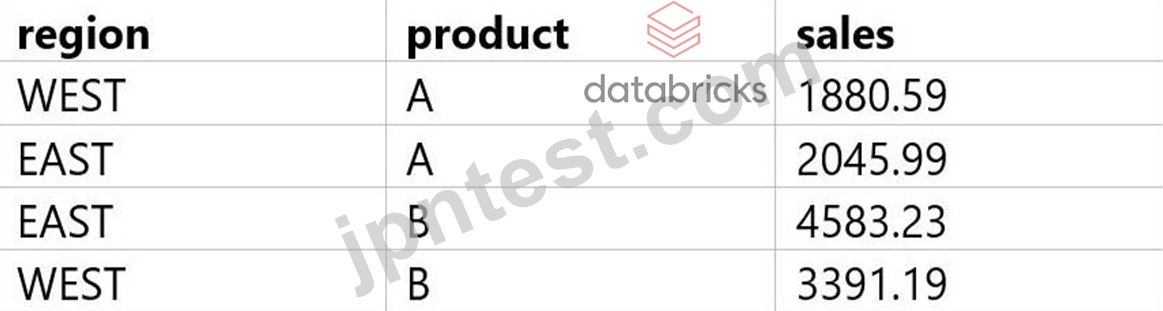
The result of the query should look like this: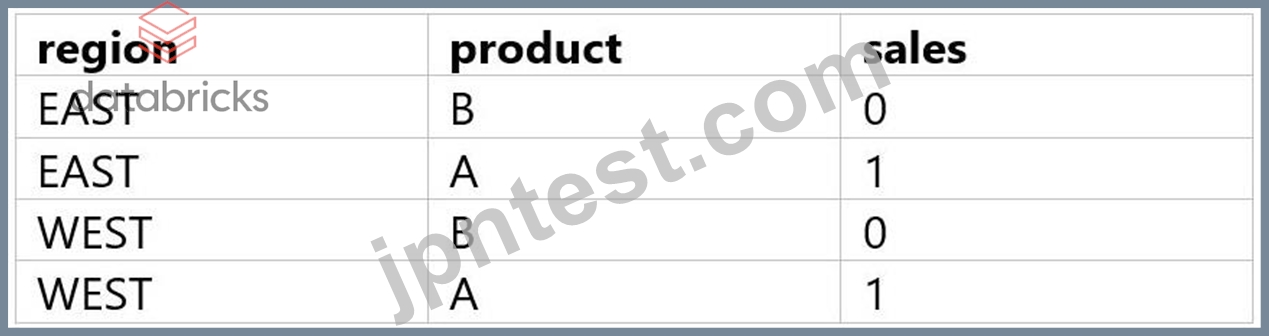
Which of the following queries will accomplish this task?
A)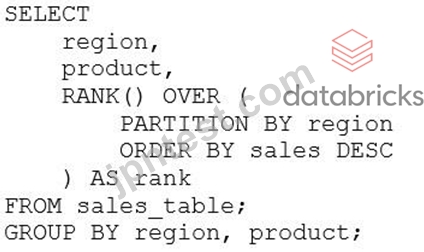
B)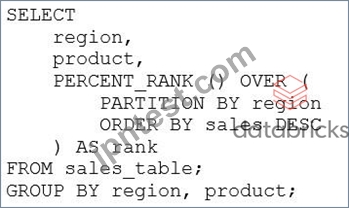
C)

- A. Option D
- B. Option A
- C. Option B
- D. Option C
正解:C
解説:
The correct query to get the percentage rank of products within region by the sales is option B. This query uses the PERCENT_RANK() window function to calculate the relative rank of each product within each region based on the sales amount. The window function is partitioned by region and ordered by sales in descending order. The result is aliased as rank and displayed along with the region and product columns. The other options are incorrect because:
A) Option A uses the RANK() window function instead of the PERCENT_RANK() function. The RANK() function returns the rank of each row within the partition, but not the percentage rank. Also, the query does not have a GROUP BY clause, which is required for aggregate functions like SUM().
C) Option C uses the DENSE_RANK() window function instead of the PERCENT_RANK() function. The DENSE_RANK() function returns the rank of each row within the partition, but not the percentage rank. Also, the query does not have a GROUP BY clause, which is required for aggregate functions like SUM().
D) Option D uses the ROW_NUMBER() window function instead of the PERCENT_RANK() function. The ROW_NUMBER() function returns the sequential number of each row within the partition, but not the percentage rank. Also, the query does not have a GROUP BY clause, which is required for aggregate functions like SUM(). Reference:
1: PERCENT_RANK (Transact-SQL)
2: Window functions in Databricks SQL
3: Databricks Certified Data Analyst Associate Exam Guide
質問 # 24
A data analyst is attempting to drop a table my_table. The analyst wants to delete all table metadata and data.
They run the following command:
DROP TABLE IF EXISTS my_table;
While the object no longer appears when they run SHOW TABLES, the data files still exist.
Which of the following describes why the data files still exist and the metadata files were deleted?
- A. The table did not have a location
- B. The table's data was smaller than 10 GB
- C. The table was managed
- D. The table was external
- E. The table's data was larger than 10 GB
正解:D
解説:
An external table is a table that is defined in the metastore, but its data is stored outside of the Databricks environment, such as in S3, ADLS, or GCS. When an external table is dropped, only the metadata is deleted from the metastore, but the data files are not affected. This is different from a managed table, which is a table whose data is stored in the Databricks environment, and whose data files are deleted when the table is dropped. To delete the data files of an external table, the analyst needs to specify the PURGE option in the DROP TABLE command, or manually delete the files from the storage system. Reference: DROP TABLE, Drop Delta table features, Best practices for dropping a managed Delta Lake table
質問 # 25
......
あなたを合格させるData Analyst Databricks-Certified-Data-Analyst-Associate試験問題集で2024年06月12日には47問あります:https://www.jpntest.com/shiken/Databricks-Certified-Data-Analyst-Associate-mondaishu
Databricks-Certified-Data-Analyst-Associate無料試験学習ガイド!(更新された47問あります):https://drive.google.com/open?id=10xbdxrExnMfYsogUSk7UCpAKqeF2F-lV